
If you’re weighing Crawford & Company’s PEO services against Vensure Employer Solutions, you’re comparing two structurally different approaches to co-employment. Crawford operates as a smaller, relationship-driven provider with regional roots and a hands-on service model. Vensure has grown into one of the largest PEOs in the country through aggressive acquisitions, which brings scale but also introduces real questions about service consistency.
That structural difference matters more than most comparison articles let on. It affects pricing flexibility, how support actually gets delivered, and what your day-to-day experience looks like once you’re past the sales process. This breakdown covers both providers honestly, flags the operational tradeoffs, and includes several alternatives worth evaluating if neither fits your situation cleanly.
1. Clicks Geek PEO Comparison Platform
Best for: Business owners who want independent, unbiased PEO comparisons before signing or renewing.
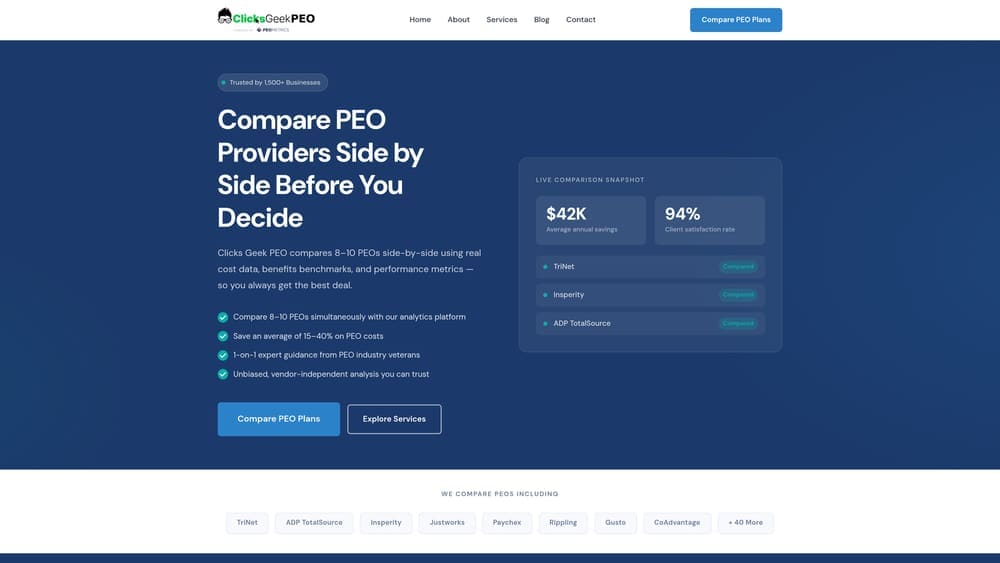
Clicks Geek PEO is an independent comparison and advisory platform that helps businesses evaluate PEO providers without the sales pressure of going directly to each vendor.
Where This Tool Shines
Most business owners evaluate PEOs by talking to the PEOs themselves. That’s a bit like asking a car dealership which car you should buy. Clicks Geek sits outside that dynamic entirely. The platform doesn’t act as a PEO, doesn’t earn commissions tied to which provider you choose, and doesn’t have a financial incentive to steer you toward any particular option.
This matters most when you’re renegotiating a contract or switching providers. Bundled fees and administrative markups are notoriously difficult to decode from a vendor’s own materials. Having a third-party resource that breaks down cost structures, contract terms, and service tiers in plain language changes the conversation significantly.
Key Features
Side-by-Side Provider Comparisons: Transparent breakdowns of pricing models, service inclusions, and contract structures across major PEO providers.
Independent Advisory: No financial incentive tied to any single provider recommendation, which keeps the analysis objective.
Contract Term Analysis: Tools and resources designed to help you understand what you’re actually agreeing to before you sign.
Cost Clarity Resources: Breaks down per-employee-per-month vs. percentage-of-payroll pricing so you can compare apples to apples.
Educational Content for First-Time Buyers: Particularly useful for businesses evaluating a PEO for the first time or those that have never formally reviewed their current agreement.
Best For
Any business owner who’s about to sign a new PEO agreement, renew an existing one, or switch providers. Especially useful for companies that suspect they’re overpaying but don’t have a clear benchmark to work from. Also a strong starting point if you’re comparing two specific providers like Crawford and Vensure and want a neutral frame of reference.
Pricing
Free comparison resources are available on the platform. Advisory services are available for businesses that need more hands-on support through the evaluation process.
2. Crawford & Company PEO
Best for: Smaller employers who prioritize direct account relationships and personalized service over platform sophistication.
Crawford PEO is a regionally focused PEO that emphasizes high-touch account management and personalized service delivery for smaller employer groups.
Where This Tool Shines
Crawford’s core differentiator is relationship density. Smaller client-to-rep ratios mean you’re more likely to reach an actual named contact who knows your account rather than cycling through a general support queue. For employers under 100 employees who want that kind of continuity, Crawford is worth a serious look.
Their insurance heritage also shows up in how they handle workers’ compensation and risk management. If your workforce carries meaningful occupational risk, this background can be a genuine advantage. It’s not just a checkbox service — it reflects actual depth in that area.
Key Features
Dedicated Account Representatives: Lower client-to-rep ratios compared to large national PEOs, which translates to more responsive, personalized service.
Workers’ Compensation and Risk Management: Risk services grounded in insurance expertise rather than bolted on as an afterthought.
Payroll Processing and Benefits Administration: Core PEO services with a focus on reliability over platform sophistication.
Compliance Support: Practical compliance guidance sized appropriately for smaller employer needs rather than enterprise-level complexity.
Best For
Small employers, typically under 100 employees, who want a named contact and consistent service relationship. Industries with meaningful workers’ comp exposure may also find Crawford’s risk management background particularly relevant. Less suited for fast-growing companies that need a highly scalable technology platform.
Pricing
Custom-quoted with no published rate cards. Direct consultation required. Expect pricing to reflect the premium placed on personalized service rather than volume-driven cost efficiency.
3. Vensure Employer Solutions
Best for: Mid-sized businesses that need broad geographic coverage and a wide service menu across multiple states.
Vensure Employer Solutions is one of the largest PEOs in the U.S., built through a significant acquisition strategy that has expanded its footprint across most states.
Where This Tool Shines
Vensure’s scale is genuinely useful if you’re operating across multiple states or need a provider with geographic depth. They offer a broad service menu covering payroll, benefits, workers’ comp, compliance, and HR support — which is appealing if you want a single vendor handling everything.
The honest caveat here is that Vensure’s growth-by-acquisition model creates real variability in client experience. Depending on which legacy platform you were onboarded through, the technology and service delivery can feel inconsistent. This isn’t unusual for large acquisition-driven organizations, but it’s worth asking directly during the sales process which platform and support structure you’d actually be placed on.
Key Features
Extensive Geographic Coverage: Broad multi-state capability, useful for distributed workforces or businesses expanding into new markets.
Full-Service HR Administration: Payroll, benefits, workers’ comp, and compliance support under one contract.
Scalable Platform Options: Multiple service tiers designed to accommodate growing mid-sized businesses.
Flexible Pricing Models: Both per-employee-per-month and percentage-of-payroll structures available depending on your situation.
Best For
Mid-sized businesses with multi-state operations that need broad coverage and a full-service HR model. Less ideal for employers who prioritize service consistency and want a predictable, high-touch account relationship. Ask pointed questions about which legacy platform you’ll be on before signing.
Pricing
Custom-quoted. Both PEPM and percentage-of-payroll models are available. Pricing transparency varies, so request itemized breakdowns during the evaluation process.
4. ADP TotalSource
Best for: Businesses that need enterprise-grade compliance infrastructure and want the credibility of a certified PEO.
ADP TotalSource is ADP’s certified PEO offering, combining their established payroll and HR technology with full co-employment services.
Where This Tool Shines
ADP TotalSource carries IRS CPEO certification, which matters for specific tax treatment and liability protections that non-certified PEOs can’t offer. For businesses where compliance credibility is a priority — heavily regulated industries, companies with investor scrutiny, or those expanding across state lines quickly — that certification is meaningful.
The technology platform is also genuinely strong. ADP has invested heavily in their HR infrastructure, and TotalSource clients benefit from that foundation. The tradeoff is cost: this is a premium-priced option, and smaller businesses may find the price-to-value ratio harder to justify.
Key Features
IRS CPEO Certification: Provides specific tax advantages and liability protections not available through non-certified PEOs.
Enterprise HR Technology: Robust platform covering payroll, benefits, time tracking, and compliance in an integrated system.
Fortune 500-Level Benefits Access: Purchasing power that gives smaller employers access to benefit plan options typically reserved for large organizations.
Dedicated HR Business Partner: Assigned HR support rather than general call center access.
Best For
Mid-sized businesses with complex compliance needs, multi-state payroll, or industries where certified PEO status carries operational or legal weight. Also a strong fit for companies already embedded in the ADP ecosystem.
Pricing
Custom-quoted. Generally positioned at the premium end of the market. Expect pricing to reflect enterprise infrastructure and the CPEO certification overhead.
5. Justworks
Best for: Startups and small teams that want transparent pricing and a clean, modern platform without complex contract negotiations.
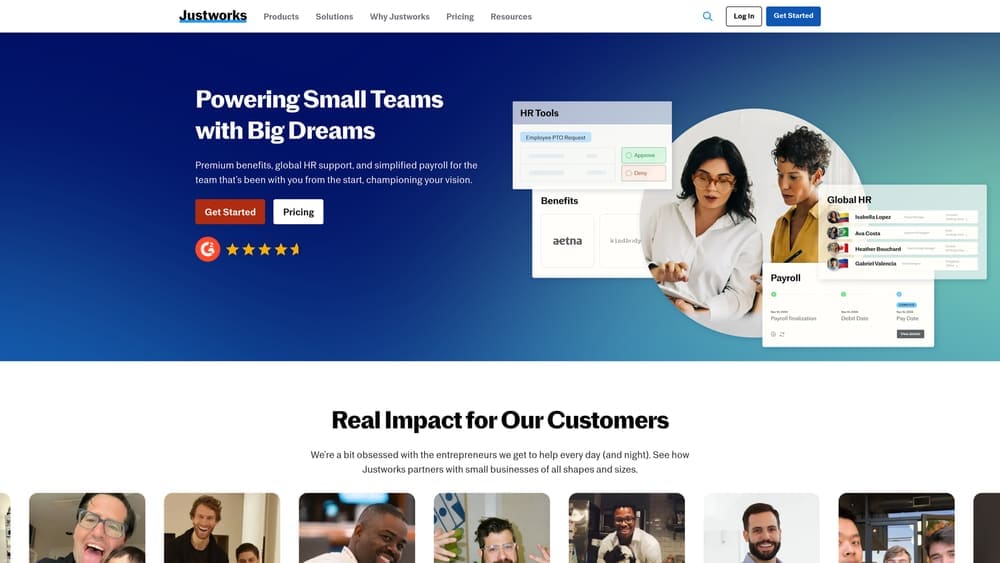
Justworks is a modern PEO built specifically for smaller companies, with published pricing tiers and a self-service platform that’s genuinely easy to use.
Where This Tool Shines
Justworks is one of the few PEOs that publishes its pricing. That alone sets it apart from almost every other provider on this list. For business owners who are tired of going through lengthy sales processes just to get a number, that transparency is a real differentiator.
The platform is clean and intuitive. Onboarding is faster than most enterprise PEOs, and the benefits access — particularly health insurance through large-group plans — is genuinely competitive for small teams. The tradeoff is that Justworks is built for companies under 100 employees, and its feature depth doesn’t match what larger, more complex businesses might need.
Key Features
Published Per-Employee Pricing: No opaque quotes or bundled fee structures — you can see what you’re paying before you call anyone.
Clean Self-Service Platform: Intuitive interface for both employers and employees to manage HR tasks without heavy IT support.
Competitive Health Benefits: Access to large-group health plans that give small teams meaningful coverage options.
Straightforward Onboarding: Faster implementation timeline compared to enterprise PEOs, which matters for small teams moving quickly.
Best For
Startups and companies under 100 employees that want predictable costs and a low-friction HR platform. Especially useful for founders who want to offer strong benefits without building an HR department. Less suitable for businesses with complex workers’ comp needs or multi-state compliance complexity.
Pricing
Starts at $59 per employee per month for the Basic tier, with published pricing across service levels. One of the most cost-transparent options in the market.
6. TriNet
Best for: Companies in specific industries like tech, professional services, life sciences, or financial services that need vertical-specific HR expertise.
TriNet is a PEO that has built its model around industry-specific service delivery, with dedicated teams and compliance guidance tailored to particular verticals.
Where This Tool Shines
Most PEOs offer broadly similar services regardless of what your business actually does. TriNet’s differentiation is that they’ve built genuine depth in specific industries. If you’re running a Series A tech company or a professional services firm with specialized employment compliance considerations, TriNet’s vertical expertise is more than a marketing claim.
Their benefits packages are also competitive, with multiple plan options that tend to resonate with the talent expectations of knowledge-worker industries. The platform is cloud-based with mobile access, which fits the distributed workforce patterns common in their target verticals.
Key Features
Vertical-Specific HR Expertise: Industry-aligned compliance guidance and HR support rather than a generic one-size-fits-all approach.
Comprehensive Benefits Packages: Multiple plan options designed to compete for talent in industries where benefits are a meaningful recruiting lever.
Risk Mitigation and Workers’ Comp: Compliance and risk management calibrated to industry-specific exposure profiles.
Cloud-Based HR Platform: Mobile-accessible system suitable for distributed and remote teams.
Best For
Companies in tech, professional services, financial services, or life sciences where industry-specific compliance and benefits competitiveness are genuine priorities. Less compelling for businesses in industries TriNet doesn’t specialize in, where the vertical advantage disappears.
Pricing
Custom-quoted. Pricing varies by industry vertical and headcount. Request itemized breakdowns and ask specifically how your industry tier affects cost.
7. Insperity
Best for: Mid-market businesses between 50 and 500 employees that need a certified PEO with deep operational experience and strong HR consulting support.
Insperity is one of the most established certified PEOs in the market, with decades of operational history and a clear focus on mid-market employers.
Where This Tool Shines
Insperity’s longevity in the market is actually meaningful here. They’ve navigated multiple economic cycles, regulatory shifts, and ACA changes without the service disruptions that have affected some acquisition-heavy competitors. For businesses that want a PEO they can count on to still be operating the same way in five years, that track record matters.
Their HR consulting depth is also notable. Insperity offers dedicated HR specialists and performance management tools that go beyond basic compliance and payroll. For mid-market companies building out HR infrastructure without hiring a full internal team, that consulting layer adds real value.
Key Features
IRS CPEO Certification: Decades of certified status with the tax treatment and liability benefits that come with it.
Dedicated HR Specialists: Assigned HR professionals who work with your team on both day-to-day needs and longer-term people strategy.
Performance Management Tools: Beyond basic PEO services, Insperity includes tools for employee development and performance tracking.
Comprehensive Compliance and Risk Management: Robust infrastructure for multi-state compliance, benefits administration, and workers’ comp.
Best For
Mid-market companies, typically 50 to 500 employees, that want a certified PEO with genuine HR consulting depth. Strong fit for businesses in growth mode that need HR infrastructure but aren’t ready to build a full internal team. Generally a better fit for established businesses than early-stage startups watching every dollar.
Pricing
Custom-quoted. Positioned at the mid-to-premium tier. Pricing reflects the depth of HR consulting services and CPEO certification overhead.
8. Paychex PEO
Best for: Businesses already using Paychex for payroll that want to expand into full PEO services without switching platforms.
Paychex PEO extends Paychex’s established payroll infrastructure into a full co-employment model, covering HR, benefits, compliance, and workers’ comp.
Where This Tool Shines
The most obvious advantage here is continuity. If your team already knows the Paychex platform, transitioning to their PEO service means less disruption and no data migration headache. For businesses that have built workflows around Paychex payroll, that familiarity has genuine operational value.
Paychex also has strong retirement plan administration, particularly 401(k) services. If retirement benefits are a priority for your workforce, this is worth noting. Their service tiers are scalable, which gives growing businesses room to expand their HR services without switching providers.
Key Features
Seamless Payroll Integration: Direct continuity with existing Paychex payroll infrastructure, eliminating migration friction for current users.
Scalable Service Tiers: Options ranging from basic PEO to full HR outsourcing, allowing businesses to expand services as they grow.
Dedicated HR Professional: Assigned HR support for each client account rather than general queue-based assistance.
Strong Retirement Plan Administration: Particularly capable 401(k) and retirement benefit management.
Best For
Mid-market businesses already using Paychex payroll that want to add co-employment benefits without a platform switch. Also a solid option for businesses where retirement plan administration is a key benefit priority. Less compelling for businesses starting fresh with no existing Paychex relationship.
Pricing
Custom-quoted. Generally competitive, particularly for existing Paychex clients who may benefit from bundled pricing arrangements.
Making the Final Call
The Crawford vs. Vensure decision comes down to what you actually value in a PEO relationship. Crawford gives you proximity and relationship continuity. You’ll likely talk to the same person, they’ll know your account, and service won’t feel like it’s running through a national call center. That matters if you’re a smaller employer and want a PEO that functions more like an extension of your team.
Vensure gives you scale and geographic reach. If you’re operating across multiple states or need a broad service menu, Vensure can accommodate that. Just go in with eyes open about the acquisition-driven model. Ask specifically which platform you’ll be onboarded onto, what your support structure looks like, and whether there are any pending migrations or platform consolidations that might affect your experience after signing.
If neither feels like a clean fit, the alternatives here cover a meaningful range. Justworks is the right call for smaller teams that want pricing clarity and a modern platform. Insperity and ADP TotalSource are strong for mid-market companies with complex compliance needs. TriNet earns its place if you’re in a specific industry where their vertical expertise is genuinely relevant. Paychex PEO makes the most sense if you’re already in their ecosystem.
The one thing most businesses skip is getting an independent read before committing. Most PEO agreements run one to three years, and the bundled fee structures make it genuinely difficult to know whether you’re getting a fair price. Before you renew your PEO agreement, compare your options. Most businesses overpay due to bundled fees and unclear administrative markups. A clear breakdown of pricing, services, and contract structures before you sign is worth the time it takes.