
If you’re comparing Crawford & Company PEO services against Genesis HR Solutions, you’re probably not browsing for fun. You’re a business owner or HR decision-maker in active evaluation mode, trying to figure out which provider actually fits your operation before signing a multi-year agreement.
Both Crawford and Genesis serve overlapping markets but take meaningfully different approaches to pricing, service delivery, and client support. Crawford leans into risk management and claims expertise. Genesis brings a hands-on, relationship-driven model built for small businesses in the Northeast. Neither is a perfect fit for every company.
This comparison expands beyond just those two names. We’ve included five additional PEO providers that regularly appear in competitive evaluations alongside Crawford and Genesis. Every provider here is evaluated on cost transparency, service scope, ideal company size, and operational tradeoffs.
1. Clicks Geek PEO
Best for: Business owners who want independent, objective comparisons before committing to any PEO provider.
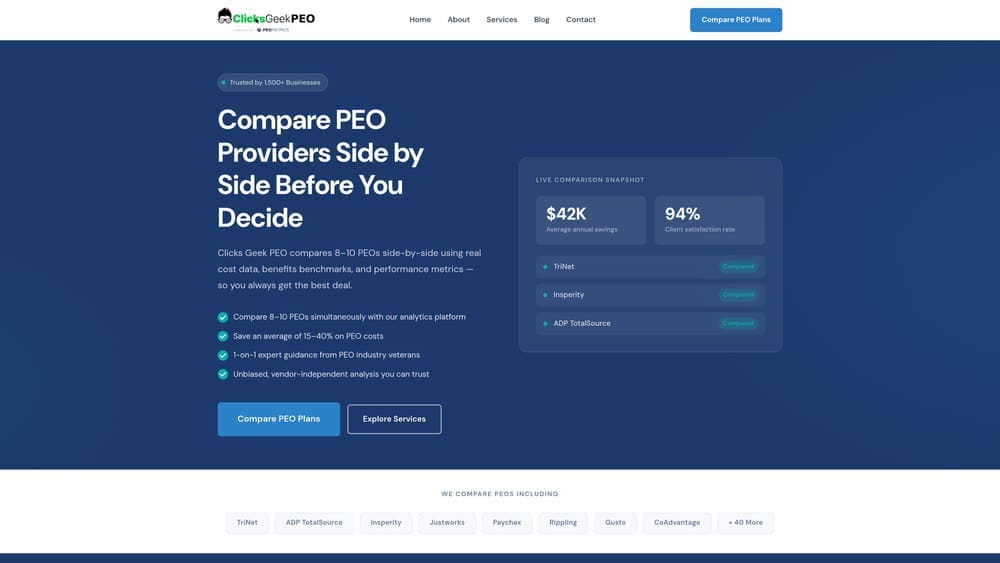
Clicks Geek PEO is an independent PEO comparison and advisory platform built to help businesses evaluate providers like Crawford and Genesis side by side, without the sales spin.
Where This Tool Shines
Most business owners enter a PEO evaluation without a reliable benchmark. Sales reps control the narrative, pricing is bundled in ways that are hard to decode, and contract terms aren’t always explained clearly upfront. Clicks Geek PEO exists specifically to fix that information gap.
In partnership with PEO Metrics, the platform provides structured, data-driven comparisons that break down what you’re actually paying for. It’s not a PEO itself, which matters: there’s no conflict of interest, no commission tied to which provider you choose, and no pressure to close.
Key Features
Side-by-Side Provider Comparisons: Evaluate multiple PEO providers across consistent criteria so you’re comparing apples to apples, not marketing decks to marketing decks.
Transparent Pricing Breakdowns: Administrative fees, benefits markups, and workers’ comp costs are surfaced clearly so you understand the full cost picture before negotiating.
Independent Evaluations: No provider relationships that could bias recommendations. Analysis is based on service structure, pricing data, and contract terms.
PEO Metrics Partnership: Access to structured data and provider benchmarks that most business owners can’t easily gather on their own.
Contract and Service Scope Analysis: Understand what’s actually included in a PEO agreement before you sign, including what happens if you need to exit.
Best For
Business owners who are evaluating PEOs for the first time, companies approaching a contract renewal and wondering if they’re getting fair value, and CFOs who want to stress-test a proposal before approving it. Particularly useful if you’re comparing regional providers like Genesis against national options.
Pricing
Core comparison resources are free. Advisory services are available for businesses that want more hands-on support through the evaluation process.
2. Crawford & Company PEO
Best for: Businesses with significant workers’ compensation exposure who want risk management expertise bundled into their employer services.
Crawford & Company is primarily a global risk management and claims services firm with PEO-adjacent employer services that emphasize workers’ compensation administration and risk mitigation.
Where This Tool Shines
Crawford’s core competency isn’t traditional PEO services. It’s claims management and risk services, and that distinction matters. If your business operates in industries with meaningful workers’ comp exposure (construction, logistics, manufacturing), Crawford’s risk infrastructure is genuinely differentiated from what a standard PEO offers.
Their geographic footprint is broader than most regional PEOs, which can be useful for businesses operating across multiple states. That said, if you’re primarily looking for HR support, benefits access, and payroll processing, Crawford’s offering may feel narrower than dedicated PEO competitors.
Key Features
Risk Management and Claims Administration: Deep expertise in managing workers’ compensation claims, which is a core differentiator for risk-heavy industries.
Workers’ Compensation Program Management: Structured programs designed to reduce claims costs and manage employer liability more proactively than most PEOs.
Broader Geographic Presence: Operations across multiple states and internationally, which can support employers with distributed workforces.
Bundled Employer Services: Risk-focused employer services packaged alongside traditional HR administration functions.
Best For
Mid-sized businesses in risk-heavy industries where workers’ compensation costs are a significant line item. Less ideal for service-based businesses primarily seeking HR support, benefits access, or a modern self-service HR platform.
Pricing
Custom-quoted based on headcount, industry, and risk profile. Expect the conversation to center on claims history and workers’ comp exposure more than a standard PEO sales process would.
3. Genesis HR Solutions
Best for: Small businesses in the Northeast (5-150 employees) that want dedicated account management and a hands-on service relationship.
Genesis HR Solutions is a New England-based, IRS-certified PEO focused on small and mid-sized businesses that want genuine human support alongside their HR infrastructure.
Where This Tool Shines
Genesis’s reputation in Massachusetts and the broader Northeast is built on relationship-driven service. You get a dedicated account manager who knows your business, not a rotating support queue. For small employers who find large national PEOs impersonal or difficult to navigate, that model is genuinely valuable.
Their IRS CPEO certification is a meaningful trust signal. It means they’ve met the IRS’s financial and compliance standards for certified professional employer organizations, which reduces liability risk for clients compared to non-certified providers.
Key Features
IRS CPEO Certification: Certified Professional Employer Organization status, which carries specific legal protections and compliance assurances for clients.
Dedicated Account Management: Named account managers rather than general support lines, which matters for small businesses with limited internal HR capacity.
Northeast Compliance Expertise: Deep familiarity with Massachusetts employment law, state-specific regulations, and Northeast market dynamics.
Competitive Benefits Access: Group health insurance and benefits packages sized for small employers who can’t access Fortune 500-level plans independently.
Modernized HR Technology: An updated HR platform for payroll, onboarding, and employee management that’s evolved beyond legacy systems.
Best For
Small businesses in Massachusetts and surrounding states that want a PEO relationship that feels more like a trusted partner than a vendor. If you’re outside the Northeast or need multi-state compliance support across a wide geography, Genesis may be too regionally focused.
Pricing
Custom-quoted; typically structured as a percentage of payroll. No publicly listed rates, so budget time for a discovery conversation before getting a real number.
4. Justworks
Best for: Tech-forward small businesses and startups that want transparent, predictable per-employee pricing and a clean self-service platform.
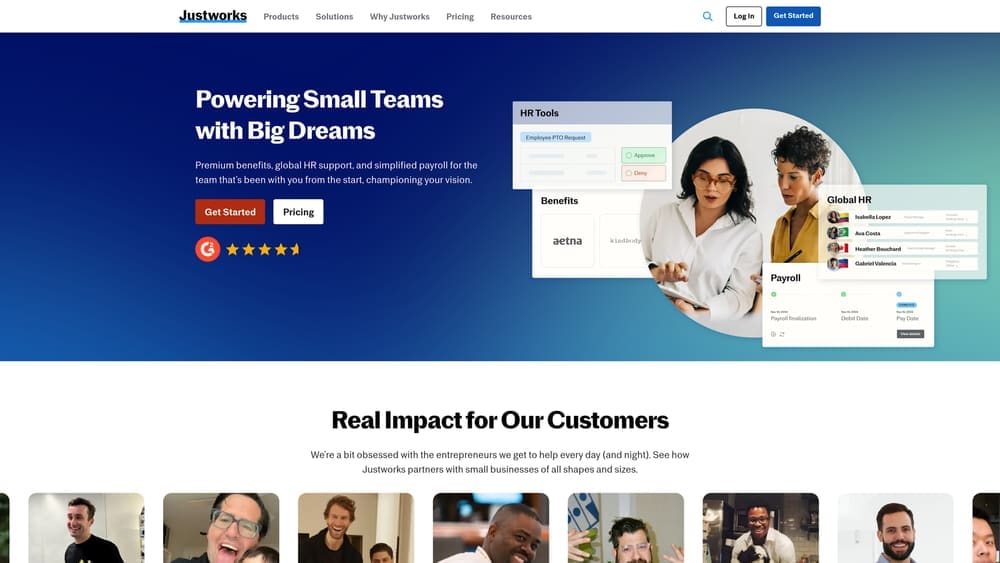
Justworks is a modern PEO platform built around pricing clarity and a strong user experience, with publicly listed rates that make budget planning straightforward.
Where This Tool Shines
Justworks does something most PEOs won’t: they publish their pricing. That alone makes the evaluation process significantly easier. If you’ve spent time trying to extract a real number from traditional PEO sales processes, Justworks’s flat per-employee model is refreshing.
The platform is well-designed and genuinely easy to use. Onboarding, payroll, and benefits administration are handled through a clean interface that doesn’t require an HR background to navigate. For companies without a dedicated HR team, that matters.
Key Features
Transparent Per-Employee Pricing: Flat monthly rates published publicly, making cost modeling and comparison straightforward before you ever talk to sales.
Self-Service HR Platform: Payroll, benefits enrollment, compliance, and onboarding in one clean interface built for non-HR users.
No Long-Term Contracts: Month-to-month flexibility that reduces commitment risk, particularly useful for fast-growing or uncertain-stage businesses.
Strong Onboarding Experience: Employee onboarding flows that reduce administrative burden and improve the new hire experience.
Best For
Startups and small businesses under 100 employees that value pricing transparency and platform quality over deep customization or high-touch account management. Less suited for businesses with complex workers’ comp needs or those wanting a highly personalized service relationship.
Pricing
Starts at $59 per employee per month for the Basic plan. The Plus plan, which includes benefits administration, starts at $109 per employee per month. Pricing is publicly listed and scales with headcount.
5. Paychex PEO
Best for: Growing businesses that need a nationally recognized PEO with scalable services across all 50 states.
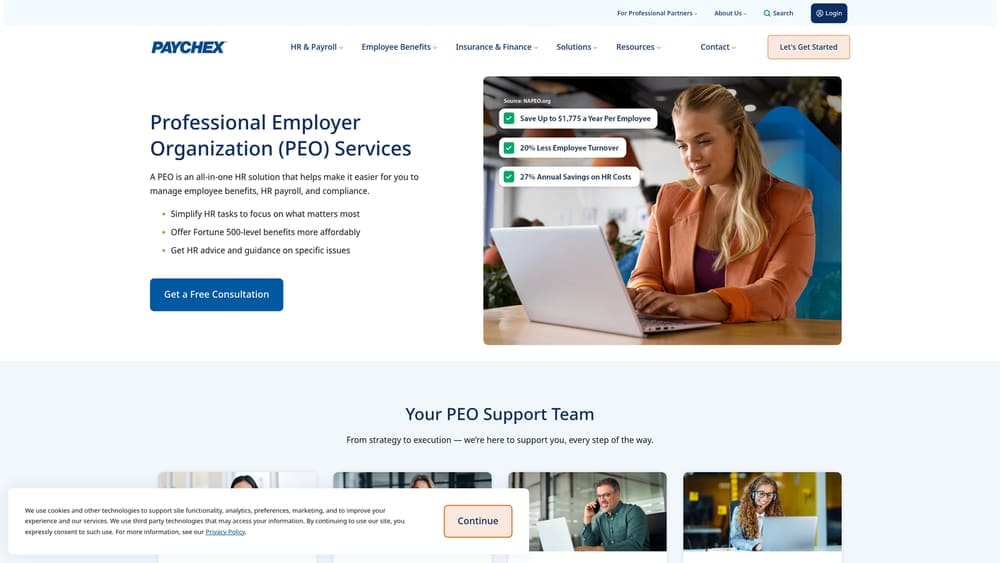
Paychex PEO is a national provider offering a broad service menu that scales from small business through mid-market, backed by one of the most recognized names in payroll and HR services.
Where This Tool Shines
Paychex’s core advantage is breadth. They operate nationally, offer a wide range of bundled services, and have the infrastructure to support businesses as they grow past the size where boutique PEOs start to strain. If you’re planning to expand into multiple states, Paychex can scale with you without requiring a provider switch.
The brand recognition also carries weight in certain contexts. Paychex has a long track record, established compliance infrastructure, and local support options in many markets, which can be useful if you prefer face-to-face service relationships.
Key Features
National Reach with Local Options: Coverage across all 50 states with local representatives available in many markets.
Scalable Service Tiers: Service packages that grow with your headcount, reducing the need to switch providers as you scale.
Flexible Bundling: Payroll, HR, benefits, and compliance services can be configured based on what your business actually needs.
Established Compliance Infrastructure: Long-standing regulatory expertise and a dedicated compliance team supporting multi-state employers.
Best For
Businesses in the 20-300 employee range that are growing, operating across multiple states, or want the stability of a nationally recognized provider. May feel over-engineered for very small businesses that don’t need national scale.
Pricing
Custom-quoted. Pricing varies significantly based on headcount, services selected, and geography. Expect a structured sales process before receiving a real proposal.
6. ADP TotalSource
Best for: Mid-sized businesses (50-500+ employees) that want enterprise-grade benefits access and deep compliance infrastructure.
ADP TotalSource is ADP’s full-service PEO offering, designed for businesses that have outgrown small-business PEOs and need the benefits purchasing power and compliance depth that comes with enterprise scale.
Where This Tool Shines
ADP TotalSource’s most compelling advantage is benefits access. As one of the largest PEOs in the country, they can negotiate Fortune 500-caliber health insurance and benefits packages for clients that would otherwise be priced out of those tiers. For businesses competing for talent against larger employers, that’s a real competitive lever.
Their compliance infrastructure is similarly robust. Multi-state regulatory complexity, ACA compliance, and HR risk management are areas where ADP’s scale and institutional knowledge are genuinely hard to match.
Key Features
Fortune 500-Caliber Benefits Access: Group health, dental, vision, and ancillary benefits at pricing tiers typically reserved for much larger employers.
IRS CPEO Certification: Certified status providing clients with specific legal protections and tax treatment advantages.
Comprehensive Compliance Support: Multi-state employment law compliance, ACA reporting, and regulatory risk management at institutional scale.
HR Analytics Platform: Data and reporting tools that give HR and finance teams visibility into workforce costs and trends.
Best For
Businesses with 50 or more employees, particularly those with multi-state operations or aggressive benefits strategies. The cost structure reflects enterprise service levels, so smaller businesses often find better value elsewhere.
Pricing
Custom-quoted. Generally priced at the higher end of the market, reflecting the depth of services and benefits access. Budget accordingly if you’re in the evaluation process.
7. Amplify PEO
Best for: Small businesses under 50 employees that want personalized service and competitive benefits without the overhead of a large national provider.
Amplify PEO is a boutique PEO built specifically for small employers, offering a high-touch service model and competitive group benefits access at a scale most national PEOs don’t prioritize.
Where This Tool Shines
Amplify occupies a similar market position to Genesis HR Solutions: small business-focused, relationship-driven, and built around the idea that a 15-person company deserves the same quality of service as a 150-person company. If Genesis is the right profile but you’re outside the Northeast, Amplify is worth a direct comparison.
Their onboarding process is structured to minimize disruption, which matters for small businesses where the owner is often personally managing the PEO transition. The workers’ compensation and risk management components are also included, which rounds out the core employer services package.
Key Features
High-Touch Service Model: Personalized support designed specifically for small employers who need more than a support ticket queue.
Competitive Group Health Access: Benefits packages designed to give small employers access to group rates they couldn’t access independently.
Workers’ Compensation Management: Risk management and workers’ comp administration bundled into the service offering.
Personalized Onboarding: Structured transition support to reduce disruption when switching from another provider or setting up PEO services for the first time.
Best For
Small businesses under 50 employees that want a boutique PEO experience with genuine account relationship management. A strong alternative to Genesis for businesses outside the Northeast with similar service expectations.
Pricing
Custom-quoted. Positioned as cost-competitive for small headcounts, though you’ll need a direct conversation to get a real number tied to your specific situation.
Picking the Right PEO When the Decision Isn’t Obvious
If you came here specifically to decide between Crawford and Genesis, here’s the honest summary: they’re not really competing for the same client. Crawford’s strength is risk management and workers’ compensation infrastructure. Genesis’s strength is hands-on HR support for small businesses in the Northeast. If your primary concern is workers’ comp exposure and claims management, Crawford deserves serious consideration. If you want a dedicated account manager who knows Massachusetts employment law and your business by name, Genesis is the more natural fit.
But neither may be the right answer for your situation.
Justworks is the clear choice if pricing transparency and a modern platform matter more than deep customization. Paychex and ADP TotalSource serve businesses that have scaled past the boutique PEO range and need national infrastructure. Amplify is worth a look if you like the Genesis model but operate outside New England.
The harder truth is that most businesses evaluate PEOs without a reliable way to benchmark what they’re actually paying versus what the market rate is. PEO pricing is almost always custom-quoted, fees get bundled in ways that obscure true costs, and multi-year contracts are the norm. That’s where an independent comparison matters.
Before you renew your PEO agreement or sign with a new provider, compare your options. Most businesses overpay due to bundled fees and unclear administrative markups. Understanding the full cost picture, what’s included, and what the exit terms look like before you commit is the kind of due diligence that pays for itself.