
When comparing TriNet to Total HR Management, most comparison articles give you feature checklists that don’t answer the real question: which one fits your specific business situation?
These two PEOs serve fundamentally different market segments with different pricing philosophies, service models, and operational approaches. TriNet operates as a national PEO with industry-vertical specialization and bundled pricing. Total HR Management positions itself as a regional provider with more flexible, customizable arrangements.
This comparison breaks down the actual decision factors that determine which provider makes sense—not based on who has more features, but based on how each provider’s model aligns with your headcount, growth trajectory, geographic footprint, and operational priorities.
We’ll cover the specific scenarios where each provider excels and where each falls short.
1. Understand the Fundamental Business Model Difference First
Before you compare pricing or features, you need to understand how TriNet and Total HR Management approach the PEO business differently. This structural difference affects everything from how they price services to how they handle client relationships.
The Challenge It Solves
Most businesses start comparing PEOs by looking at feature lists or per-employee pricing. That approach misses the fundamental question: does this provider’s business model match how your company operates?
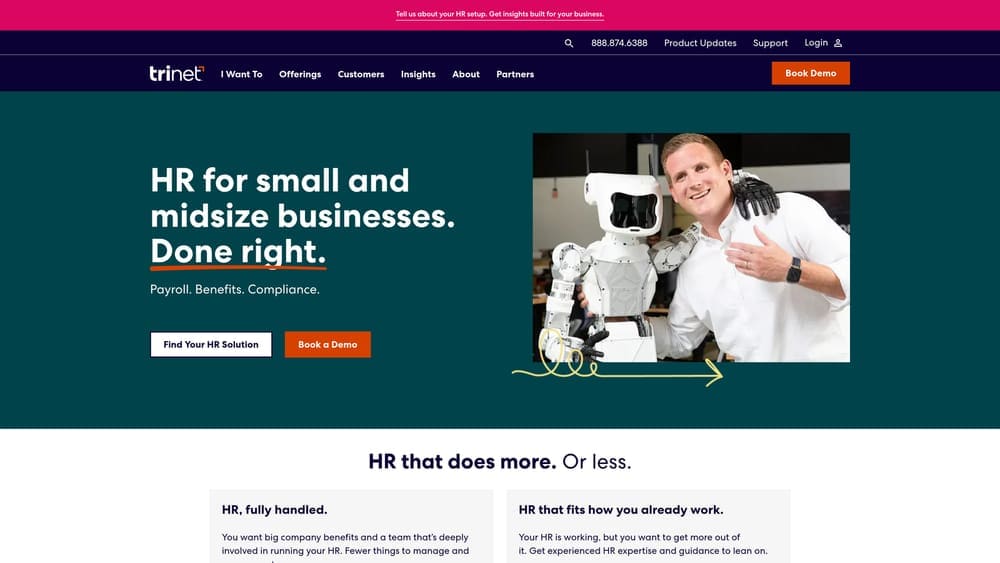
TriNet built their platform around industry verticals. They specialize in technology, life sciences, financial services, and professional services sectors. Their model bundles services into comprehensive packages designed for specific industries.
Total HR Management operates as a regional provider with a more generalist approach. They customize arrangements based on what each client actually needs rather than offering pre-packaged industry solutions. This mirrors how ADP TotalSource compares to Total HR Management in terms of service flexibility.
The Strategy Explained
Start by asking which model aligns with your business reality. If you operate in one of TriNet’s target industries and need specialized compliance support, benefits packages, and risk management tailored to that sector, their vertical approach makes sense.
If your business doesn’t fit neatly into an industry vertical, or if you operate in a sector where general HR and payroll support is sufficient, Total HR Management’s flexibility may serve you better.
The bundled model means you get everything TriNet offers for your industry. You can’t strip out services you don’t need to reduce cost. The customizable model means you build your PEO arrangement around what you actually use, but you’re responsible for identifying what you need.
Implementation Steps
1. Identify whether your business operates in one of TriNet’s specialized verticals and whether industry-specific expertise would materially affect your compliance or benefits strategy.
2. List the specific PEO services you actually need versus services that would be nice to have but aren’t essential to your operations.
3. Determine whether you prefer a comprehensive bundled solution where everything is included, or whether you want the ability to negotiate and customize your service package.
Pro Tips
The bundled model works best when you need most of what’s included. If you only use 60% of the services in a comprehensive package, you’re subsidizing features you don’t need. The customizable model requires more upfront work to define your requirements, but it can eliminate paying for unused services.
2. Evaluate Based on Your Geographic Footprint
Where your employees work matters more than most businesses realize when choosing between a national and regional PEO.
The Challenge It Solves
Multi-state employment creates compliance complexity. Each state has different workers’ compensation requirements, unemployment insurance rules, wage and hour laws, and tax withholding obligations.
TriNet operates nationally with infrastructure designed to handle employees across all 50 states. Their systems, compliance teams, and carrier relationships are built for geographic complexity.
Total HR Management focuses on regional markets. They may handle multi-state situations, but their core strength is deep expertise in their primary service areas. Understanding franchise compliance management becomes critical when operating across multiple jurisdictions.
The Strategy Explained
If you currently have employees in multiple states, or if your growth plan includes geographic expansion, TriNet’s national infrastructure provides consistent support regardless of where you hire.
If your workforce is concentrated in one state or region, and you don’t anticipate significant geographic expansion, Total HR Management’s regional focus may offer better pricing and more personalized service within their core markets.
The tradeoff is straightforward: national reach costs more but scales easily. Regional focus costs less but may become limiting if your geographic footprint changes.
Implementation Steps
1. Map where your current employees work by state and calculate what percentage of your workforce operates outside your primary location.
2. Review your hiring plan for the next 24 months and identify whether you expect to add employees in new states.
3. Ask Total HR Management specifically which states they support and whether they have direct experience handling compliance in states where you plan to hire.
Pro Tips
Don’t assume a national PEO is automatically better for multi-state operations. If you have three employees in California and 47 in Texas, you don’t need the same infrastructure as a company with employees in 20 states. Match the provider’s geographic strength to your actual distribution, not your theoretical expansion plans.
3. Match Provider Strength to Your Industry Complexity
Industry-specific PEO expertise matters significantly in some sectors and barely matters in others.
The Challenge It Solves
Certain industries face specialized compliance requirements, unique benefits expectations, or specific risk management needs that generalist PEOs may not understand deeply.
TriNet’s vertical specialization means their teams understand the regulatory environment, benefits benchmarks, and operational challenges specific to technology companies, life sciences firms, financial services businesses, and professional services organizations.
Total HR Management operates as a generalist provider. They handle fundamental HR, payroll, and benefits administration across industries without claiming specialized expertise in particular sectors.
The Strategy Explained
Evaluate whether your industry creates compliance complexity that requires specialized knowledge. Technology companies dealing with equity compensation, stock options, and remote workforce management may benefit from TriNet’s tech-focused expertise. Life sciences companies navigating FDA regulations and clinical trial employment may need industry-specific support.
If your business operates in construction, retail, hospitality, or other sectors outside TriNet’s verticals, their specialized approach offers no advantage. You’d pay for industry expertise that doesn’t apply to your situation. The comparison between TriNet and Insperity highlights similar industry specialization considerations.
Total HR Management’s generalist model works well when your industry doesn’t create unusual HR complexity. Standard payroll, benefits administration, and workers’ compensation management don’t require specialized knowledge in most sectors.
Implementation Steps
1. List the industry-specific compliance requirements your business faces and determine whether they require specialized PEO knowledge or whether standard HR processes handle them adequately.
2. Ask TriNet for specific examples of how their industry expertise would benefit your business beyond what a generalist PEO provides.
3. Request references from Total HR Management serving companies in your industry to assess whether their generalist approach creates any limitations.
Pro Tips
Industry specialization creates real value when it addresses actual compliance complexity or provides access to industry-specific benefits packages. If you can’t identify concrete advantages from specialized expertise, you’re probably paying for differentiation that doesn’t affect your operations.
4. Calculate True Cost Beyond the Per-Employee Quote
The monthly per-employee fee is just the starting point. Real PEO cost includes implementation, minimums, service tiers, and what happens when you leave.
The Challenge It Solves
PEO pricing varies significantly based on services included, company size, industry risk factors, and contract terms. A lower per-employee quote may cost more once you factor in implementation fees, minimum monthly charges, or required service bundles.
TriNet’s bundled pricing includes comprehensive services, but you can’t remove components you don’t need. Their pricing typically reflects their national infrastructure and industry-specific expertise.
Total HR Management often provides more pricing flexibility through customizable service packages. You may pay less by excluding services you don’t use, but you need to understand exactly what’s included at each pricing tier.
The Strategy Explained
Request detailed pricing breakdowns from both providers based on your actual headcount, industry, and service needs. Don’t accept a simple per-employee quote without understanding what’s included.
Ask about implementation costs, minimum monthly fees, and whether pricing changes based on headcount fluctuations. Some PEOs charge setup fees ranging from a few thousand dollars to five figures depending on complexity.
Understand contract terms and exit provisions. What happens if you terminate the agreement early? Are there penalties? How long does offboarding take, and what does it cost? Developing a solid PEO claims management strategy can also impact your overall cost structure.
Implementation Steps
1. Create a detailed RFP listing your exact headcount, state distribution, current benefits offerings, and specific services you need from a PEO.
2. Request itemized pricing from both providers showing base per-employee fees, implementation costs, minimum monthly charges, and any service-specific add-ons.
3. Calculate total first-year cost including implementation and compare it to years two and three to understand the true cost trajectory.
Pro Tips
PEO pricing typically ranges from 2-12% of payroll or $150-250+ per employee per month depending on services included. If you receive quotes significantly outside this range, ask why. Unusually low pricing may exclude services you need. Unusually high pricing may include services you don’t.
5. Assess Technology Platform Fit for Your Operations
Your PEO’s technology platform becomes your daily HR operating system. Evaluate it based on actual user needs, not feature lists.
The Challenge It Solves
TriNet operates a proprietary technology platform designed to integrate payroll, benefits, HR administration, time tracking, and compliance management. Their system reflects their bundled service model with comprehensive functionality.
Total HR Management’s technology approach may vary. Some regional PEOs use third-party platforms, while others operate proprietary systems with varying levels of sophistication.
The question isn’t which platform has more features. It’s whether the platform handles your specific workflows efficiently and integrates with the other systems you use.
The Strategy Explained
Identify who actually uses the PEO platform in your organization. Employees accessing pay stubs and benefits information need simple, mobile-friendly interfaces. HR administrators need efficient workflows for onboarding, benefits enrollment, and compliance reporting. Finance teams need clean integration with accounting systems.
Request platform demonstrations from both providers focused on your actual use cases. Don’t sit through generic feature tours. Ask them to show you how their system handles your specific processes. Companies prioritizing technology often compare ADP TotalSource versus Rippling PEO for their tech-forward approaches.
Evaluate integration capabilities with your existing systems. Does the platform connect with your accounting software, applicant tracking system, or other HR tools? Are integrations native or do they require third-party middleware?
Implementation Steps
1. List the specific tasks your team performs in your current HR system and identify which ones would move to the PEO platform.
2. Request live demonstrations showing how each platform handles employee onboarding, benefits enrollment changes, time-off requests, and payroll processing.
3. Ask about API availability, integration options, and whether you can extract your data if you decide to leave the PEO.
Pro Tips
Platform sophistication matters more for companies with complex workflows or specific integration requirements. If your needs are straightforward, a simpler platform may actually work better than a feature-rich system with a steeper learning curve.
6. Test Service Model Alignment with Your HR Capacity
How a PEO delivers support matters as much as what support they provide. Match their service model to your internal HR capabilities.
The Challenge It Solves
Companies with limited internal HR expertise need different support structures than businesses with experienced HR teams. The service model that works for a 30-person company with no dedicated HR staff won’t work the same way for a 200-person company with an HR manager.
TriNet typically provides dedicated support teams aligned with their industry verticals. You get access to HR specialists, benefits consultants, and compliance advisors who understand your sector.
Total HR Management often emphasizes relationship-based service with more personalized attention. Their regional focus may enable more direct access to decision-makers and faster response times within their core markets.
The Strategy Explained
Assess your internal HR capacity honestly. If you have no dedicated HR staff, you need a PEO that provides proactive guidance and handles routine questions without requiring you to know what to ask.
If you have an experienced HR team, you may prefer a PEO that operates as a strategic partner rather than trying to manage every detail. Your team knows what they need, they just need the PEO to execute efficiently. Understanding how to manage unemployment claims through your PEO becomes easier with the right service model alignment.
Ask both providers how they structure support. Do you get a dedicated account manager? How quickly do they respond to questions? What happens when your primary contact is unavailable?
Implementation Steps
1. Define what level of HR expertise exists in your organization and identify specific areas where you need PEO guidance versus areas where you just need execution.
2. Ask each provider for references from companies with similar headcount and HR capacity to understand how their service model works in practice.
3. Test responsiveness during the sales process as an indicator of service quality—if they’re slow to respond before you’re a client, expect worse after you sign.
Pro Tips
Service quality varies significantly within the same PEO depending on your account team. Ask about team stability and turnover. Frequent account manager changes disrupt relationships and force you to re-explain your situation repeatedly.
7. Project Your 3-Year Growth Trajectory Before Signing
The right PEO for your current situation may become the wrong PEO as your business evolves. Evaluate providers based on where you’re going, not just where you are.
The Challenge It Solves
PEO contracts typically run one to three years. Switching providers mid-contract creates disruption and may involve penalties. You need a provider that fits your business not just today, but through your anticipated growth trajectory.
TriNet’s national infrastructure and industry-vertical model scales well for companies planning significant headcount growth, geographic expansion, or increasing compliance complexity within their target industries.
Total HR Management’s regional focus and customizable approach works well for businesses with stable geographic footprints and predictable growth within their core markets.
The Strategy Explained
Map out your realistic growth scenario for the next 36 months. Will you add employees in new states? Will headcount growth change your service needs? Will your industry create new compliance requirements as you scale?
Consider how each provider handles growth. TriNet’s bundled model means additional employees typically follow the same per-employee pricing structure. Total HR Management’s customizable approach may require renegotiating service terms as your needs change. Learning how to manage open enrollment through your PEO becomes increasingly important as your workforce expands.
Evaluate what happens if your growth plan doesn’t materialize. Some PEO contracts include minimum employee requirements or annual commitments. If you need to reduce headcount, does the contract create financial exposure?
Implementation Steps
1. Create a realistic 36-month headcount projection including geographic distribution and identify how growth affects your PEO service needs.
2. Ask both providers how pricing and service terms change as you grow and whether contracts include minimum employee commitments.
3. Review contract termination provisions to understand what happens if your business trajectory changes significantly and you need to exit the PEO relationship.
Pro Tips
Don’t optimize for your current state at the expense of foreseeable changes. If you have 25 employees today but expect to reach 75 in 18 months, choose based on the 75-employee scenario. Switching PEOs mid-growth creates unnecessary disruption during a period when you need operational stability.
Putting It All Together
Choosing between TriNet and Total HR Management isn’t about picking the “better” PEO. It’s about matching provider strengths to your specific situation.
TriNet typically makes more sense for companies with multi-state operations, industry-specific compliance complexity, or those who want a comprehensive bundled solution without negotiating individual services. Their national infrastructure and vertical specialization serve businesses in technology, life sciences, financial services, and professional services sectors particularly well.
Total HR Management often fits better for regional businesses that value pricing flexibility, personalized service relationships, and the ability to customize their PEO arrangement. Their approach works well when you have a stable geographic footprint and your industry doesn’t create unusual compliance complexity.
Before making a final decision, request detailed pricing breakdowns from both providers based on your actual headcount and service needs. Compare not just the monthly per-employee cost, but implementation timelines, contract terms, and what happens if you need to exit.
The right choice depends entirely on your business context—not on which provider has more features on paper. Your geographic footprint, industry requirements, internal HR capacity, and growth trajectory should drive the decision.
Before you renew your PEO agreement, compare your options. Most businesses overpay due to bundled fees and unclear administrative markups. We break down pricing, services, and contract structures so you can make a smarter decision.