
You’re three months into a PEO relationship when the IRS sends a notice: your provider failed to remit $47,000 in federal employment taxes. Despite having no involvement in the tax processing, you’re now jointly liable for the full amount. This isn’t a hypothetical scenario. It’s the exact exposure that drove the creation of Certified Professional Employer Organizations.
The question business owners actually ask isn’t “What’s a CPEO?” It’s “What am I actually protected from if I use a CPEO versus a regular PEO?” The answer is narrower than most providers suggest but more valuable than many business owners realize.
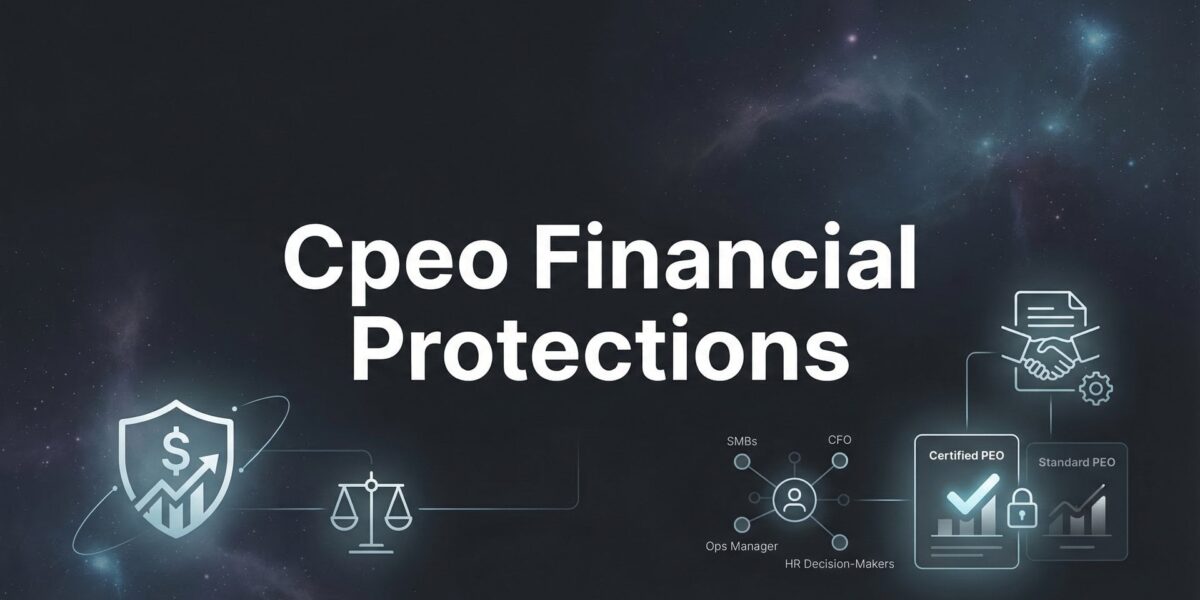
CPEO certification creates a specific federal tax liability shield. When a CPEO pays your employees’ wages, it becomes solely liable for the federal employment taxes on those wages. You’re removed from the liability chain entirely. With a standard PEO, you remain jointly liable even when the PEO handles all tax processing and remittance. If they fail to pay, the IRS can pursue you for the full amount.
This protection has real limitations. It’s federal-only. It covers a specific tax period. It doesn’t eliminate co-employment liability for other obligations. But for companies with substantial payroll volume, it addresses the single largest financial risk in the PEO relationship: tax liability exposure when a provider fails.
The Tax Liability Problem CPEOs Were Designed to Solve
Under standard PEO arrangements, you and the PEO share responsibility for employment tax compliance. The PEO typically processes payroll, calculates withholding, and remits taxes to federal and state agencies. You pay the PEO, and they handle the mechanics. But legally, you remain jointly liable.
This creates a gap. You’ve delegated tax processing to a third party, but you haven’t delegated the IRS’s ability to collect from you if that third party fails. If your PEO experiences financial distress, mismanages tax funds, or simply fails to remit what they collected, the IRS can pursue you for the full tax liability. Your contract with the PEO doesn’t matter to federal tax authorities. Joint liability means they can collect from either party.
IRC Section 3511, enacted under the Small Business Efficiency Act of 2014 and effective in 2016, created a different structure for CPEOs. When a CPEO pays wages to your employees, it becomes the sole employer for federal employment tax purposes. This isn’t a contractual arrangement. It’s a statutory designation.
The practical effect: the CPEO is solely liable for federal employment taxes on wages it pays during the certified relationship. You’re not secondarily liable. You’re not jointly liable. The IRS cannot pursue you for those taxes even if the CPEO fails to remit them.
This protection covers specific federal employment taxes under IRC sections 3401 (income tax withholding), 3101 (employee FICA), 3111 (employer FICA), and 3301 (FUTA). These are the taxes withheld from employee paychecks and the employer-side payroll taxes that fund Social Security, Medicare, and federal unemployment insurance.
The distinction matters most when things go wrong. If a standard PEO fails financially and hasn’t remitted $200,000 in quarterly employment taxes, the IRS can assess that liability against your business. If a CPEO fails under the same circumstances, the IRS cannot. The liability stays with the CPEO.
This is insurance against PEO financial failure. During normal operations, both PEO types remit taxes correctly. The difference emerges only when a provider experiences distress, mismanages funds, or collapses entirely. For most business owners, that scenario feels remote until it happens. For those it has happened to, the distinction between joint liability and sole liability represents the difference between a manageable business disruption and a potentially catastrophic tax assessment.
The IRS Certification Requirements Behind These Protections
CPEO certification isn’t automatic or permanent. It requires meeting specific financial and operational standards, ongoing compliance monitoring, and maintaining certification status. The IRS designed these requirements to ensure that only financially stable, well-managed PEOs can offer sole liability protection. Understanding how a company becomes a CPEO reveals just how rigorous this process actually is.
CPEOs must post a minimum bond of $50,000, though the actual amount scales with tax liability volume. This bond functions as a financial guarantee. If the CPEO fails to remit employment taxes, the IRS can draw against the bond to cover the shortfall. For high-volume CPEOs, bond requirements can reach several hundred thousand dollars.
Positive working capital requirements ensure CPEOs maintain sufficient liquid assets to cover short-term obligations, including tax remittances. The IRS reviews quarterly financial statements to verify compliance. If a CPEO’s working capital drops below required thresholds, it can trigger compliance review or certification suspension.
Annual independent CPA audits provide external verification of financial stability and tax compliance. These aren’t basic financial statement reviews. They’re detailed examinations of the CPEO’s tax processing systems, internal controls, and financial position. The audit results go directly to the IRS as part of ongoing certification monitoring.
Background checks on responsible individuals—owners, officers, and key personnel—screen for prior tax violations, criminal history, or disqualifying conduct. The IRS maintains discretion to deny or revoke certification based on these reviews. If a CPEO hires a new CFO with a history of tax fraud, that can jeopardize certification status.
Quarterly financial reporting keeps the IRS informed of the CPEO’s ongoing financial condition. This isn’t annual compliance. It’s continuous monitoring. If a CPEO’s financial position deteriorates between audits, the IRS can identify the problem and take action before tax liabilities accumulate.
Certification can be suspended or revoked for non-compliance. If a CPEO fails to meet bonding requirements, misses financial reporting deadlines, or violates tax obligations, the IRS can terminate certification. When that happens, the sole liability protection ends immediately for any wages paid after the revocation date.
This creates a critical verification responsibility for client companies. CPEO status isn’t permanent. The IRS maintains a public list of certified PEO companies that updates regularly. Before signing a contract, verify the provider appears on the current IRS CPEO listing. After signing, periodically recheck to confirm they’ve maintained certification. If your provider loses certification mid-contract, you revert to joint liability for taxes on wages paid after the revocation date.
What CPEO Protections Don’t Cover
The sole liability protection is federal and tax-specific. It doesn’t extend to state employment taxes, pre-existing liabilities, or non-tax employment obligations. Understanding these boundaries matters as much as understanding the protections themselves.
State employment tax treatment varies significantly. CPEO certification is a federal designation under the Internal Revenue Code. Individual states decide whether to recognize CPEO sole liability for state employment taxes. Some states have adopted similar provisions. Others have not. In states without CPEO recognition, you remain jointly liable for state unemployment insurance taxes, state disability insurance, and other state-level employment taxes even when using a CPEO.
This creates a compliance patchwork. Your CPEO relationship may eliminate federal tax liability exposure while leaving state tax exposure unchanged. If you operate in multiple states, the protection level varies by jurisdiction. Companies managing multi-state operations should verify their CPEO’s status in each state where they have employees.
The protection applies only to wages paid during the certified CPEO relationship. Taxes on wages paid before the relationship began remain your liability. If you transition to a CPEO mid-year, sole liability protection starts with the first payroll the CPEO processes. Prior quarter tax obligations stay with you. Similarly, if you terminate the CPEO relationship, sole liability protection ends with the final CPEO-processed payroll. Wages you pay afterward revert to standard employer tax liability.
Non-tax employment liabilities remain subject to standard co-employment rules. Workers’ compensation claims, ERISA obligations, wage and hour violations, employment discrimination claims, and workplace safety violations aren’t covered by CPEO tax liability protection. These fall under the co-employment relationship between you, the CPEO, and your employees.
In co-employment arrangements, both the client company and the PEO can face liability for employment law violations. CPEO certification doesn’t change this. If an employee files a wage claim, both parties may be named. If OSHA investigates a workplace injury, both parties may face penalties. If the Department of Labor finds FLSA violations, both parties may owe back wages.
The distinction between tax liability and employment liability matters because business owners sometimes assume CPEO certification provides comprehensive liability protection. It doesn’t. It’s a specific shield against federal employment tax liability on CPEO-paid wages. Everything else—state taxes, non-tax employment obligations, pre-existing liabilities—follows standard PEO shared liability rules.
This doesn’t diminish the value of CPEO protection. It clarifies what you’re actually getting. For companies primarily concerned about catastrophic federal tax liability exposure, CPEO certification addresses that specific risk. For companies concerned about broader employment liability exposure, CPEO status is only one factor in a larger risk management picture.
When CPEO Financial Protections Actually Matter
The practical value of CPEO protection scales with your payroll volume and risk exposure. For some businesses, it’s essential. For others, it’s insurance against a remote scenario that may not justify the cost premium.
High-volume payroll creates substantial tax liability exposure. If you process $2 million in quarterly payroll, your federal employment tax obligation runs approximately $300,000 to $350,000 per quarter depending on wage levels and FICA calculations. If your PEO fails to remit that amount, joint liability means the IRS can assess the full $300,000+ against your business. CPEO sole liability eliminates that exposure entirely.
For companies processing $200,000 in quarterly payroll, the math changes. Federal employment tax liability runs roughly $30,000 to $35,000 per quarter. Still significant, but the absolute dollar exposure is lower. The question becomes whether the CPEO cost premium justifies protection against a $30,000 liability risk versus implementing strong PEO due diligence and financial monitoring.
Previous PEO issues change the risk calculus. If you’ve experienced a PEO tax remittance failure, even a minor one, the psychological and practical value of sole liability protection increases. You’ve seen the scenario play out. CPEO certification provides concrete assurance it won’t happen again under the same terms.
Industry context matters. Some industries have higher PEO failure rates due to cash flow volatility, seasonal employment patterns, or thin profit margins. If your industry has seen multiple PEO failures in recent years, CPEO protection addresses a known risk rather than a theoretical one.
Lender and investor requirements sometimes drive CPEO selection. Banks extending credit lines or investors conducting due diligence may view CPEO certification as a financial control measure. If your financing agreements require eliminating joint employment tax liability, CPEO status provides clear documentation of compliance.
The protection functions as insurance against PEO financial distress, not day-to-day operational value. During normal operations, both standard PEOs and CPEOs process payroll correctly and remit taxes on time. The certification requirements ensure CPEOs maintain higher financial stability, but well-managed standard PEOs also maintain clean tax compliance.
The real question is downside protection. If your PEO experiences unexpected financial distress, what’s your exposure? With a standard PEO, you face joint liability for unpaid taxes. With a CPEO, you don’t. The value of that protection depends on how much you’re willing to pay to eliminate tail risk.
Evaluating the CPEO Premium Against Your Risk Exposure
CPEO certification carries compliance costs that often translate to higher administrative fees. Bonding requirements, quarterly financial reporting, annual audits, and ongoing IRS monitoring create overhead that standard PEOs don’t face. Most CPEOs pass some portion of these costs to clients through higher per-employee-per-month fees or percentage-of-payroll pricing.
The premium varies by provider and service package, but many businesses see CPEO administrative costs run 10% to 20% higher than comparable standard PEO offerings. Understanding professional employer organization cost structures helps you evaluate whether this premium makes sense for your situation.
Calculate your actual exposure to evaluate whether the premium makes sense. Take your quarterly gross payroll and multiply by roughly 15% to estimate federal employment tax liability (the actual rate varies based on wage levels and FICA calculations, but 15% provides a reasonable approximation). That number represents your maximum exposure if a standard PEO fails to remit taxes for a full quarter.
If you run $500,000 in quarterly payroll, your federal employment tax exposure is approximately $75,000. If your CPEO premium costs $1,500 per quarter more than a standard PEO, you’re paying 2% of your exposure for protection. That’s often reasonable insurance pricing.
If you run $100,000 in quarterly payroll, your federal employment tax exposure is approximately $15,000. If the CPEO premium is still $1,500 per quarter, you’re paying 10% of your exposure for protection. The math becomes less compelling unless you have specific risk factors that justify the higher cost.
This isn’t purely financial calculation. Risk tolerance, industry context, and operational priorities matter. Some business owners view any tax liability exposure as unacceptable and gladly pay the CPEO premium. Others prefer to invest in thorough PEO due diligence, financial monitoring, and contractual protections rather than paying for statutory liability elimination.
Standard PEO due diligence can mitigate much of the risk CPEO certification addresses. Review the provider’s financial statements. Verify they maintain adequate working capital. Check their tax compliance history. Confirm they carry errors and omissions insurance. Require quarterly attestations that all employment taxes have been remitted. Learning how to choose a PEO with strong financial controls reduces the probability of tax remittance failure even without CPEO certification.
The decision framework comes down to exposure versus cost versus risk tolerance. High payroll volume, previous PEO issues, or low risk tolerance often justify CPEO premiums. Lower payroll volume, strong PEO due diligence capabilities, or higher risk tolerance may make standard PEO relationships more cost-effective.
One factor that shouldn’t drive the decision: marketing claims. Some CPEOs position certification as comprehensive liability protection or superior service quality. Certification addresses one specific risk—federal employment tax liability. It doesn’t guarantee better customer service, more comprehensive benefits, or lower total cost. Evaluate it for what it actually provides, not what the sales pitch suggests.
Putting It All Together
CPEO financial protections are narrowly defined but genuinely valuable for the specific risk they address. Sole liability for federal employment taxes on CPEO-paid wages eliminates your exposure if the provider fails. That protection matters most when payroll volume is high, when you’ve experienced previous PEO issues, or when eliminating tax liability exposure is a financing or operational requirement.
The protection has clear boundaries. It’s federal-only. State employment tax liability depends on individual state recognition of CPEO status. It covers only wages paid during the certified CPEO relationship. It doesn’t extend to non-tax employment liabilities, which remain subject to standard co-employment rules.
CPEO certification requires meeting ongoing financial and operational standards. Bonding, quarterly reporting, annual audits, and positive working capital requirements ensure only financially stable providers maintain certification. But certification can be revoked, and protections only apply during the certified period. Verify your provider’s status on the IRS public CPEO listing before signing and periodically thereafter.
The cost premium for CPEO services reflects the compliance overhead certification requires. Whether that premium justifies the protection depends on your payroll volume, risk exposure, and tolerance for joint tax liability. Calculate your actual quarterly employment tax obligation to understand what you’re insuring against. Compare that exposure to the incremental cost of CPEO certification to determine if the math works for your situation.
This is one factor in overall PEO evaluation, not a silver bullet. CPEO status doesn’t guarantee superior service, lower total cost, or comprehensive liability protection. It provides specific federal tax liability protection. Evaluate it alongside pricing, service quality, professional employer organization benefits offerings, technology platforms, and contract terms to make a complete decision.
Before you compare your options, understand what you’re actually protected from and what you’re paying for that protection. Most businesses overpay due to bundled fees and unclear administrative markups. We break down pricing, services, and contract structures so you can make a smarter decision about whether CPEO certification justifies the premium in your specific situation.