
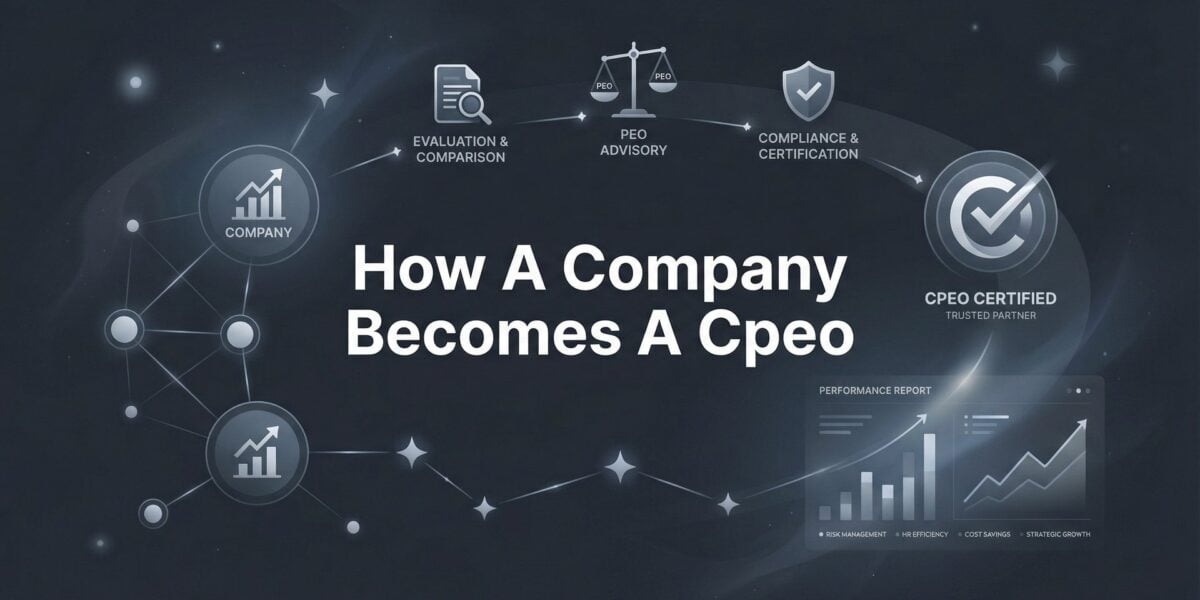
If you’re evaluating PEO providers, you’ve probably noticed some carry a ‘CPEO’ designation while others don’t. This isn’t just marketing fluff—it represents a rigorous IRS certification process that fundamentally changes the legal and financial relationship between the PEO, your business, and the federal government.
Understanding how a PEO earns this certification helps you evaluate whether that designation actually matters for your specific situation. The process reveals a lot about a provider’s operational maturity, financial stability, and willingness to accept federal scrutiny.
This guide walks through the exact steps a PEO must complete to become IRS-certified, the ongoing requirements they must maintain, and what this process reveals about a provider’s capabilities. Whether you’re comparing CPEO versus non-CPEO options or simply curious about what separates certified providers from the rest, you’ll leave with a clear picture of the certification pathway and its practical implications.
The short version: becoming a CPEO isn’t simple, and that’s by design. The IRS created this framework to identify PEOs that meet specific financial and operational standards—particularly around employment tax handling. Only about 100 out of 500+ operating PEOs hold active certification, which tells you something about the barrier to entry.
Step 1: Meet the IRS Baseline Eligibility Requirements
Before a PEO can even submit an application, it must clear several foundational hurdles. These baseline requirements exist to filter out providers with operational or compliance red flags.
First, the business structure matters. The PEO must be a legal entity in good standing—typically an LLC, corporation, or partnership. Sole proprietorships don’t qualify. The entity must be registered properly in its home state and maintain good standing status with state authorities.
The IRS also expects a minimum operational history. While there’s no explicit “you must be in business for X years” rule, the application process requires documented evidence of PEO operations, client relationships, and payroll processing history. A brand-new startup with six months of operations will struggle to demonstrate the track record the IRS wants to see.
Background checks for responsible individuals: Anyone with more than 5% ownership or significant management authority over the PEO must pass IRS background investigations. This includes owners, officers, directors, and certain key managers. The IRS looks for criminal history, tax compliance issues, and prior involvement with failed or problematic PEOs.
This is where many PEOs quietly fail before ever submitting paperwork. If a principal owner has a history of tax problems, criminal convictions related to fraud or financial crimes, or was involved in a PEO that previously lost certification or had major compliance failures, the application won’t move forward.
The IRS also reviews the PEO’s own tax compliance history. Any failures to pay federal employment taxes in the prior three years disqualify the applicant. This isn’t limited to major defaults—even smaller lapses or late payments can trigger denial.
Think of this stage as the IRS asking: “Is this a legitimate, stable business run by people we can trust with federal tax obligations?” If the answer isn’t clearly yes, the process stops here.
Some PEOs choose not to pursue certification specifically because they know they won’t pass this initial gate. That doesn’t automatically make them bad providers, but it does mean they either have operational gaps, financial constraints, or principals with backgrounds that don’t meet IRS standards.
Step 2: Establish Financial and Bonding Safeguards
Once baseline eligibility is confirmed, the PEO must demonstrate financial stability and secure bonding. This is where the process gets expensive and operationally complex.
Bond requirements: Every CPEO must post a surety bond equal to at least 5% of its federal employment tax liability from the prior year. The minimum bond is $50,000, and the maximum is capped at $1,000,000. For a PEO handling $10 million in annual federal employment taxes, that’s a $500,000 bond requirement.
Surety companies don’t issue these bonds casually. They evaluate the PEO’s financial health, operational history, and management quality before agreeing to underwrite the bond. If a PEO can’t secure bonding at reasonable rates—or at all—it can’t become a CPEO.
The bond exists to protect the federal government. If the CPEO fails to remit collected employment taxes, the surety company pays the IRS, then pursues the PEO for recovery. This creates a secondary layer of financial accountability beyond the PEO’s own balance sheet.
Working capital and net worth requirements: The IRS requires CPEOs to maintain positive working capital and positive net worth. This isn’t a one-time check—it’s an ongoing obligation verified quarterly through financial reporting.
Working capital measures the PEO’s ability to meet short-term obligations. Positive working capital means current assets exceed current liabilities. For a business that collects payroll funds and remits taxes on tight timelines, this is a basic operational necessity.
Net worth must also remain positive, meaning total assets exceed total liabilities. A PEO operating with negative net worth is technically insolvent, which creates obvious risk when handling client payroll and tax obligations.
Independent CPA verification: The IRS doesn’t take the PEO’s word for its financial position. CPEOs must submit audited financial statements prepared by an independent certified public accountant. These audits must follow Generally Accepted Accounting Principles (GAAP) and include a clean opinion from the CPA.
For smaller PEOs, the cost of annual audited financials can run $15,000 to $50,000 or more, depending on complexity. This is a recurring expense that only makes sense if the PEO has sufficient scale and client base to justify the investment. Understanding professional employer organization cost structures helps contextualize these certification expenses.
The financial requirements effectively set a minimum operational threshold. A PEO with weak financials, limited bonding capacity, or inability to afford annual audits won’t pursue certification—not because they’re necessarily bad operators, but because the economics don’t work.
Step 3: Submit the Formal IRS Application (Form 8973)
With eligibility confirmed and financial safeguards in place, the PEO submits Form 8973—the Application to Become a Certified Professional Employer Organization. This isn’t a simple form. It’s a comprehensive documentation package that requires significant preparation.
The application includes detailed information about the PEO’s business structure, ownership, responsible individuals, client relationships, payroll operations, and financial position. The IRS wants to see organizational charts, service agreements, payroll processing workflows, and evidence of operational systems.
Documentation package requirements: Along with Form 8973, the PEO must submit audited financial statements, proof of bonding, evidence of good standing in its home state, and detailed background information for all responsible individuals. Any gaps or inconsistencies in this documentation will trigger IRS requests for additional information, which delays the process.
The IRS also requires a user fee with the application. As of 2026, the fee is $1,000 for initial certification applications. This fee is non-refundable, even if the application is denied.
Common application deficiencies: The IRS frequently requests additional information when applications lack clarity or completeness. Common issues include insufficient detail about payroll processing systems, unclear ownership structures, incomplete background disclosures for responsible individuals, or financial statements that don’t clearly demonstrate positive working capital and net worth.
Each round of back-and-forth with the IRS extends the timeline. A clean, well-prepared application might move through review in 90 to 120 days. An incomplete application with multiple deficiency notices can stretch to six months or longer.
Initial certification versus annual renewal: The initial application is the most intensive. Once certified, the PEO must recertify annually by June 1 each year. The renewal process is somewhat streamlined but still requires updated financial statements, bonding verification, and confirmation that responsible individuals haven’t changed or developed disqualifying issues.
The annual recertification isn’t automatic. The IRS reviews updated information and can deny renewal if the CPEO no longer meets requirements. This creates ongoing accountability—certification isn’t a one-time achievement but a continuous commitment to maintaining standards.
Step 4: Pass the IRS Review and Due Diligence Process
Once the application is submitted, IRS examiners begin a detailed review. This isn’t a rubber-stamp process. The IRS treats CPEO certification seriously because it transfers federal tax liability from client businesses to the PEO.
What IRS examiners evaluate: The review focuses on financial stability, operational systems, tax compliance history, and the backgrounds of responsible individuals. Examiners verify that submitted financial statements are accurate, bonding is properly secured, and the PEO has systems in place to handle employment tax obligations reliably.
The IRS also conducts background investigations on all responsible individuals. This includes reviewing criminal records, tax compliance history, and involvement in prior business failures or regulatory actions. If a principal owner has a history of tax problems or was involved in a PEO that previously failed or lost certification, that raises red flags.
Tax compliance history matters: The IRS reviews the PEO’s own tax payment history closely. Any failures to remit federal employment taxes in the prior three years disqualify the applicant. Even smaller lapses or late payments can trigger denial or requests for explanation. Understanding professional employer organization tax responsibilities helps clarify why this scrutiny is so intensive.
This is where operational maturity shows up. A PEO with clean tax compliance, well-documented systems, and stable financials moves through review relatively smoothly. A PEO with inconsistent compliance, frequent late payments, or operational gaps faces tougher scrutiny and higher denial risk.
Timeline from submission to decision: For a complete, well-prepared application, the IRS typically takes 90 to 120 days to issue a certification decision. Incomplete applications or those triggering additional questions can stretch to six months or longer.
During this period, the PEO continues operating as a non-certified provider. Certification doesn’t take effect until the IRS formally approves the application and adds the PEO to the public CPEO list.
Step 5: Maintain Ongoing Compliance After Certification
Earning CPEO certification is one thing. Keeping it is another. The IRS imposes ongoing reporting, financial, and operational requirements that certified PEOs must meet continuously.
Quarterly employment tax reporting: CPEOs file Form 941 quarterly, just like other employers, but with CPEO-specific schedules. These schedules break out employment taxes by client and provide detailed reporting that allows the IRS to track tax obligations accurately.
This reporting burden is more complex than standard payroll tax filing. CPEOs must maintain meticulous records for each client, track taxes collected and remitted separately, and ensure quarterly filings are accurate and timely. The payroll responsibilities that shift to a CPEO are substantial and require robust systems.
Annual recertification requirements: Every year by June 1, the CPEO must submit updated financial statements, bonding verification, and confirmation that responsible individuals haven’t changed or developed disqualifying issues. The IRS reviews this information and can deny recertification if the CPEO no longer meets requirements.
This creates ongoing accountability. A CPEO can’t let financial position deteriorate, allow bonding to lapse, or ignore compliance obligations without risking loss of certification.
Notification requirements: CPEOs must notify the IRS within 30 days of any material changes—including changes in ownership, responsible individuals, business structure, or financial position. Failure to notify the IRS of material changes can trigger suspension or revocation.
This means a CPEO can’t quietly change ownership, bring in new principals with problematic backgrounds, or experience financial distress without the IRS knowing about it. Transparency is baked into the certification framework.
What triggers suspension or revocation: The IRS can suspend or revoke CPEO status for several reasons—failure to remit employment taxes, bonding lapses, negative working capital or net worth, material misrepresentations in certification applications, or failure to meet annual recertification deadlines.
Suspension is temporary and can be lifted if the CPEO corrects the deficiency. Revocation is permanent and requires the PEO to reapply from scratch if it wants to regain certification later.
The ongoing compliance responsibilities explain why only about 100 PEOs hold active certification out of 500+ operating providers. Many PEOs simply don’t see the value in maintaining this level of ongoing scrutiny, reporting complexity, and financial transparency—especially if their client base doesn’t demand it.
What CPEO Certification Means for Your PEO Evaluation
Now that you understand the certification process, the practical question is: what does this actually mean when you’re evaluating providers?
The sole statutory protection CPEOs provide: CPEO certification creates one specific, legally enforceable benefit—the CPEO becomes solely liable for federal employment taxes on wages it pays to your worksite employees. This is the only mechanism under federal law that fully transfers this liability from your business to the PEO.
If a CPEO collects payroll taxes from you and fails to remit them to the IRS, the IRS pursues the CPEO—not your business—for the unpaid taxes. This is meaningful protection, particularly if you’re concerned about a PEO’s financial stability or operational reliability.
Non-certified PEOs can’t offer this statutory protection. Even if their service agreement says they accept responsibility for tax remittance, that’s a contractual promise—not a federal law backing it up. If a non-certified PEO fails to remit taxes, the IRS can still come after your business for the unpaid amounts. Understanding how co-employment works helps clarify why this distinction matters.
What certification doesn’t guarantee: CPEO status doesn’t guarantee better service quality, more competitive pricing, or superior HR support. It doesn’t mean the PEO has better technology, more responsive account management, or more comprehensive benefits offerings.
Certification confirms the PEO meets specific IRS financial and operational standards around employment tax handling. That’s it. You can find non-certified PEOs with excellent service, competitive pricing, and strong client satisfaction—they simply haven’t pursued or obtained this specific federal designation.
When CPEO status should influence your decision: If your business has significant federal employment tax liability, concerns about PEO financial stability, or operates in a high-risk industry where tax compliance issues could be particularly damaging, CPEO certification adds meaningful protection.
If you’re a smaller business with straightforward payroll needs and you’re evaluating a well-established PEO with strong financials and good client references, CPEO status might be neutral—nice to have, but not a dealbreaker if absent.
How to verify certification status: The IRS maintains a searchable public list of all certified CPEOs at irs.gov. Before signing any agreement, verify the provider’s current certification status directly on this list. Don’t rely solely on the PEO’s website or sales materials—check the official IRS listing.
If a PEO claims CPEO status but doesn’t appear on the IRS list, that’s a red flag. Either they’re misrepresenting their status, or their certification was suspended or revoked.
The Practical Takeaway
The CPEO certification process exists to give businesses a verifiable signal that a PEO meets specific IRS financial and operational standards—particularly around employment tax handling. The process is rigorous by design, which explains why only about 100 out of 500+ operating PEOs hold active certification.
For your evaluation, the key takeaway is this: certification confirms a provider has passed federal scrutiny and accepts sole liability for employment taxes they collect on your behalf. That’s meaningful protection, but it’s one factor among many.
Use the IRS CPEO public listing to verify any provider’s current status. Then weigh certification alongside service fit, pricing transparency, contract terms, and operational track record when making your decision. Our guide on how to choose a PEO walks through the complete evaluation framework.
A certified PEO isn’t automatically better than a non-certified one. But knowing what certification represents—and what it doesn’t—helps you evaluate whether it matters for your specific situation.
Before you renew your PEO agreement, compare your options. Most businesses overpay due to bundled fees and unclear administrative markups. We break down pricing, services, and contract structures so you can make a smarter decision.