
PEOs are sold on benefits: lower health insurance costs, compliance headaches handled for you, payroll that just works. The pitch is clean, the value proposition feels obvious, and the sales process moves fast. But the decision to enter a co-employment relationship carries real risks that rarely surface until after the contract is signed. This isn’t about scaring you away from PEOs. It’s about giving you a clear-eyed view of what can go wrong, how to evaluate your actual exposure, and when the risk profile simply doesn’t fit your business. Because the truth is, some companies thrive under PEO arrangements. Others end up locked into contracts that limit flexibility, obscure costs, and leave them holding liability they thought they’d offloaded.
If you’re evaluating a PEO for the first time or reconsidering your current provider, you need to understand the trade-offs beyond the sales deck.
The Co-Employment Trade-Off Most Owners Underestimate
Co-employment sounds straightforward on paper. The PEO becomes the employer of record for tax and benefits purposes. You remain responsible for day-to-day management, hiring, firing, and workplace operations. Shared responsibility, divided tasks. Clean lines.
Except the lines aren’t clean.
When something goes wrong—a discrimination claim, a workers’ comp dispute, an OSHA violation—the question becomes: who’s actually responsible? The PEO handled compliance administration, but you made the hiring decision. The PEO processes payroll, but you set the schedule that led to the overtime dispute. The PEO provides the safety training platform, but your manager ignored the protocols. In practice, co-employment means you share the employer title, but you rarely share the liability equally.
Most client service agreements allocate risk in ways that protect the PEO more than the client company. You’re still the entity facing employment lawsuits. You’re still the business named in state agency audits. The PEO’s role is administrative support, not legal shield. That distinction matters when a former employee files a wrongful termination claim or when the Department of Labor shows up with questions about wage classifications.
This isn’t a dealbreaker. It’s a reality check. Co-employment gives you access to better benefits pricing and professional HR administration. But it doesn’t eliminate your exposure as an employer. It shifts some operational burden while leaving most legal and financial risk exactly where it was: on you. If you’re entering a PEO relationship expecting to offload employer liability entirely, you’re setting yourself up for a painful surprise down the road.
Financial and Contractual Risks That Catch Owners Off Guard
PEO pricing is almost always bundled. You get a per-employee-per-month rate or a percentage of payroll, and that number includes payroll processing, benefits administration, workers’ comp, and compliance support. Sounds simple. The problem is you have no idea what you’re actually paying for each component.
Is your $150 PEPM rate a good deal? Hard to say when you can’t break out the cost of workers’ comp insurance versus the administrative markup versus the benefits carrier fees. Bundled pricing makes comparison shopping nearly impossible, and it gives PEOs room to adjust rates mid-contract without clear justification. Many agreements include language allowing rate increases based on “claims experience” or “regulatory changes,” terms vague enough to justify almost anything. Understanding what you’ll actually pay for PEO services requires digging beyond the headline number.
Then there’s the cash flow issue. Most PEOs require you to fund payroll in advance—sometimes two to three business days before payday. For businesses running tight on cash, that timing shift can create real strain. And if there’s ever a dispute over how funds were handled or applied, you’re dealing with a third party that controls your payroll account. The leverage isn’t in your favor.
Early termination clauses are another common pain point. PEO contracts typically run 12 months with auto-renewal, and leaving early often triggers penalties—sometimes a flat fee, sometimes the remaining contract value, sometimes both. Switching providers mid-year isn’t just operationally disruptive. It’s expensive. And if your PEO relationship isn’t working, you’re stuck riding it out or paying a premium to leave.
Transition penalties extend beyond termination fees. Moving your benefits mid-year can trigger loss-of-coverage issues for employees. Migrating payroll data to a new system takes time, and gaps in processing create compliance exposure. The operational friction of switching providers is real enough that many business owners tolerate mediocre service rather than deal with the hassle of leaving. That’s not a feature. That’s vendor lock-in.
The financial risk isn’t that PEOs are universally overpriced. It’s that the pricing structure makes it hard to know whether you’re getting value, and the contract terms make it expensive to correct course if you’re not.
Compliance Exposure You’re Still On the Hook For
PEOs handle compliance administration. They file your payroll taxes, manage benefits enrollment, provide training modules, and maintain employee handbooks. That administrative support is valuable. But it doesn’t transfer ultimate liability.
When an employee files a discrimination claim, the lawsuit names your company, not the PEO. When OSHA investigates a workplace injury, they’re auditing your operations, not the PEO’s safety training platform. When the Department of Labor questions your overtime calculations, you’re the one explaining your pay practices. The PEO’s role is support and documentation. The legal and financial exposure remains yours. This is why understanding PEO shared liability is critical before signing any agreement.
This becomes especially problematic in multi-state operations. If your PEO lacks deep expertise in every state where you have employees, compliance gaps become your problem. State-specific wage-and-hour rules, leave laws, and unemployment insurance requirements vary significantly, and a PEO that’s strong in California may be weak in Texas. You won’t know until something goes wrong.
The IRS and state tax agencies still view you as a responsible party for employment taxes, even when a PEO processes payroll. If your PEO fails to remit taxes on time or files incorrect returns, you can be held liable. The IRS Certified Professional Employer Organization (CPEO) program provides some protection here—CPEOs assume federal employment tax liability—but not all PEOs are certified, and CPEO status doesn’t cover state tax obligations or non-tax compliance issues.
There’s also the question of what happens when your PEO’s advice turns out to be wrong. If their HR team misclassifies a worker as exempt, or advises you incorrectly on a termination, or fails to update your handbook for a new state law, you’re the one facing the penalty. PEO contracts typically include liability disclaimers that limit their responsibility for compliance errors. You get administrative support, not a compliance guarantee.
This doesn’t mean PEOs are bad at compliance. Many are excellent. But the co-employment model doesn’t eliminate your exposure. It gives you access to better tools and expertise while leaving final accountability exactly where it always was: with you as the business owner.
Operational Dependencies That Limit Your Flexibility
When you join a PEO, you’re not just outsourcing HR tasks. You’re integrating your operations into their systems, their timelines, and their processes. That creates dependencies that limit how you run your business.
Need to make a mid-year benefits change? You’re working through the PEO’s enrollment schedule. Want to adjust your payroll processing day? You’re constrained by their system capabilities. Need access to employee data for a custom report? You’re requesting exports in their format, on their timeline. The loss of direct control isn’t theoretical. It affects how quickly you can respond to operational needs.
Technology lock-in is a real issue. If the PEO’s platform doesn’t integrate cleanly with your existing accounting software, project management tools, or time-tracking systems, you’re stuck with manual workarounds. Some PEOs offer robust API integrations through their HR technology platforms. Others don’t. And switching PEOs mid-stream means migrating data, retraining employees on new systems, and dealing with inevitable gaps in historical records.
Then there are the scaling constraints. Some PEOs impose minimum headcount requirements—often five to ten employees. If you’re a startup planning to stay lean, that’s a nonstarter. Other PEOs specialize in specific industries or geographic regions and may not support your growth trajectory. If you’re planning to expand into new states or hire internationally, you need a PEO with that capability. Not all do.
There’s also the question of what happens when your business needs change faster than your PEO can adapt. If you acquire another company, spin off a division, or restructure your workforce, the PEO relationship can become a constraint rather than a support. The flexibility to move quickly matters, and co-employment arrangements inherently slow down certain decisions.
None of this means PEOs are operationally restrictive by design. But the model does create dependencies. You’re trading direct control for professional administration. That trade-off works well when the PEO’s systems align with your needs. It becomes a friction point when they don’t.
How to Evaluate Whether PEO Risk Fits Your Situation
Risk tolerance isn’t universal. A five-person startup with no HR staff has different exposure than a 50-person company with an experienced HR manager. The question isn’t whether PEOs carry risk. It’s whether the risk profile fits your operational reality.
Start with your internal HR capacity. If you have no one managing compliance, benefits, or payroll, a PEO can reduce your exposure by bringing professional administration to tasks you’re currently handling poorly or not at all. If you already have strong HR systems in place, the PEO’s value proposition is less about risk reduction and more about cost efficiency and administrative convenience. The calculus is different. Consider whether PEO cost versus hiring an HR manager makes sense for your specific situation.
Due diligence matters. Check whether the PEO holds IRS CPEO certification. Certified PEOs meet higher financial standards and assume federal employment tax liability, which reduces your exposure on that front. Review their audited financial statements to confirm they’re stable enough to meet long-term obligations. A PEO that goes under mid-contract creates serious operational disruption.
Read the client service agreement carefully. Specifically, look at how liability is allocated for compliance failures, employment claims, and tax issues. If the contract is vague or heavily weighted toward protecting the PEO, that’s a red flag. You want clear language about who’s responsible when things go wrong.
Verify state-specific licensing where required. Some states regulate PEOs heavily and require registration or bonding. If your PEO isn’t properly licensed in a state where you operate, that creates compliance exposure for you. Ask for proof of licensing and workers’ comp coverage in every state where you have employees.
Red flags that suggest walking away: A PEO that won’t share audit reports or financial statements. Contracts with excessive termination penalties or unclear rate adjustment clauses. Providers that resist answering detailed questions about liability allocation or claims handling. If the sales process feels evasive or high-pressure, trust that instinct. If you’re already stuck with a problematic provider, here’s guidance on leaving a bad PEO.
The decision to use a PEO isn’t binary. It’s about whether the operational benefits outweigh the risks you’re accepting, and whether the specific provider you’re evaluating has the expertise, stability, and contract terms that fit your situation. Some PEOs are excellent partners. Others create more problems than they solve. The difference is in the details.
Making the Risk Decision That Fits Your Business
PEO risk isn’t something to avoid. It’s something to manage. The co-employment model works well for businesses that need professional HR administration, better benefits pricing, and compliance support they can’t build in-house. It works less well for companies that value operational flexibility, direct control over employee data, or pricing transparency.
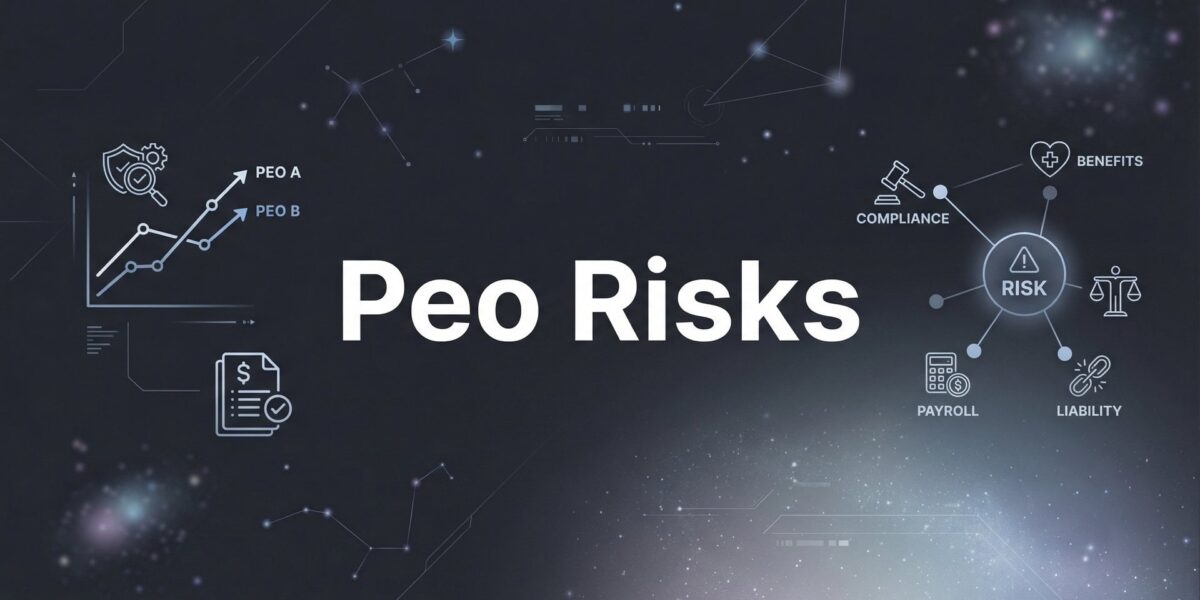
The risks outlined here—co-employment liability, financial opacity, compliance exposure, operational dependencies—aren’t hypothetical. They’re real factors that affect how your business operates and where your exposure sits. Understanding them doesn’t mean rejecting PEOs wholesale. It means entering the relationship with clear expectations and contract terms that protect your interests.
If you’re evaluating a PEO for the first time, use this framework to ask better questions during the sales process. Learning how to choose a PEO systematically will help you avoid common pitfalls. If you’re already in a PEO relationship that isn’t working, use it to identify what’s creating friction and whether those issues are fixable or structural. And if you’re coming up on a contract renewal, use it to decide whether your current provider still fits your needs or whether it’s time to explore alternatives.
Before you renew your PEO agreement, compare your options. Most businesses overpay due to bundled fees and unclear administrative markups. We break down pricing, services, and contract structures so you can make a smarter decision. The right PEO relationship reduces risk and administrative burden. The wrong one creates both. Know the difference before you sign.