
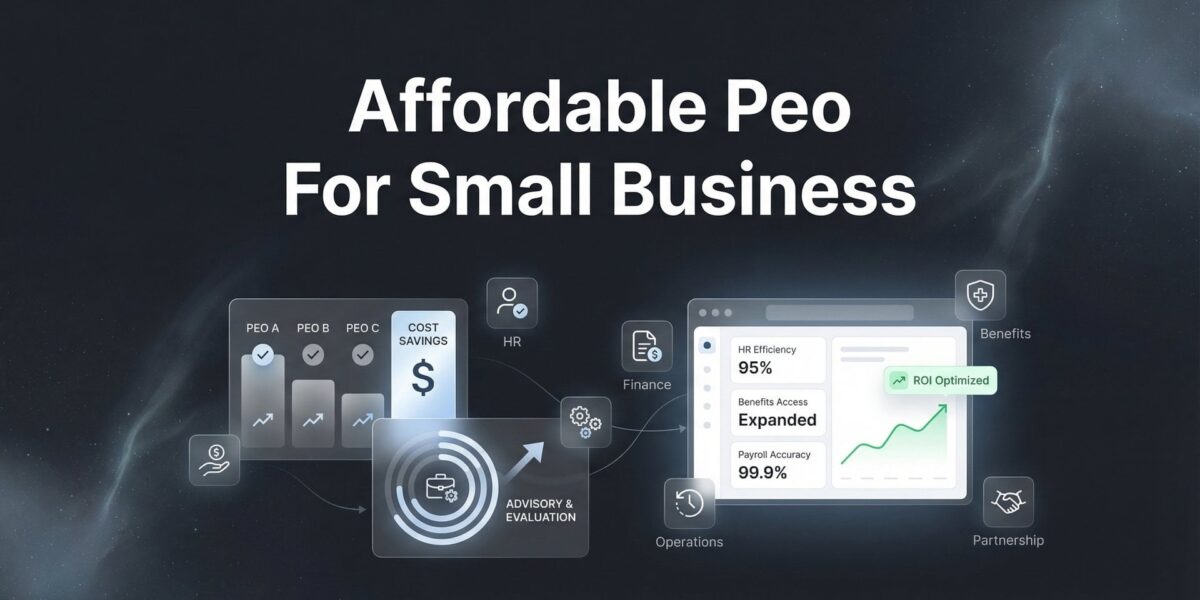
Small business owners searching for affordable PEO services often face a frustrating reality: pricing is opaque, contracts are confusing, and ‘affordable’ means different things to different providers. You’ll see quotes that vary by thousands of dollars annually for seemingly identical services. One provider quotes $150 per employee per month. Another quotes 4% of payroll. A third bundles everything together and calls it “comprehensive.” Which one is actually cheaper? Without understanding what you’re comparing, you can’t tell.
This guide cuts through the noise with practical strategies to identify PEO options that genuinely fit small business budgets—without sacrificing the services that matter. We’ll cover how to evaluate true costs, negotiate effectively, and avoid common pricing traps that inflate your bill. Whether you’re exploring PEOs for the first time or reconsidering your current provider, these strategies will help you make cost-conscious decisions grounded in real operational needs.
The goal isn’t finding the absolute cheapest option. It’s finding the right pricing structure for your business reality—one that scales reasonably as you grow and doesn’t hide costs in fine print.
1. Understand the Two Pricing Models Before You Compare Anything
The Challenge It Solves
You can’t evaluate affordability if you don’t understand what you’re paying for. PEOs use two fundamentally different pricing models, and comparing them without doing the math leads to poor decisions. A provider quoting $120 per employee per month might actually be more expensive than one charging 3.5% of payroll—or vice versa—depending on your average salaries and headcount mix.
Most small business owners accept the first model presented without calculating their effective rate under alternative structures. This is how you end up overpaying by 20-30% simply because you didn’t translate the pricing into comparable terms.
The Pricing Models Explained
Per-employee-per-month pricing charges a flat monthly fee for each employee on your payroll. If the rate is $150 PEPM and you have 15 employees, you pay $2,250 monthly regardless of what those employees earn. This model is predictable and easier to budget, but it can penalize businesses with lower average salaries because the fee doesn’t scale with actual payroll costs.
Percentage-of-payroll pricing charges a percentage of your gross monthly payroll. If your rate is 4% and your monthly payroll is $75,000, you pay $3,000 that month. This model scales with your actual labor costs, which can be advantageous if you have part-time staff or seasonal fluctuations. The percentage typically ranges from 2-12% depending on services included and your industry risk profile. Understanding professional employer organization cost structures is essential before signing any contract.
How to Calculate Your True Cost
1. Calculate your average monthly payroll: Add up three months of gross payroll and divide by three to get a realistic baseline.
2. Determine your effective PEPM rate under percentage pricing: Multiply your monthly payroll by the quoted percentage, then divide by your employee count. This gives you the per-employee cost for comparison.
3. Run the reverse calculation for PEPM quotes: Multiply the quoted PEPM rate by your employee count to get total monthly cost, then divide by your monthly payroll to see what percentage it represents.
4. Model both scenarios with payroll growth: Project what happens if you add employees or increase salaries 10% next year. Which model scales more favorably for your growth trajectory?
Pro Tips
Businesses with higher average salaries often benefit from PEPM pricing because the flat fee represents a lower percentage of total compensation. Conversely, if you employ many part-time or lower-wage workers, percentage-of-payroll pricing might work better because you’re not paying the same flat fee for employees working 15 hours a week as those working 40.
Always ask providers to quote both models. Some will resist, claiming they only offer one structure. Push back. If they can’t accommodate a simple pricing request, that’s a red flag about flexibility in other areas.
2. Right-Size Your Service Bundle—Don’t Pay for What You Won’t Use
The Challenge It Solves
PEOs often bundle services designed for 100+ employee organizations into packages marketed to businesses with 10-20 employees. You end up paying for dedicated HR consulting hours you’ll never use, recruiting support you don’t need, and compliance training platforms built for multi-state operations when you operate in one location.
The affordability problem isn’t always the base rate. It’s the service bloat that inflates your costs without delivering proportional value. Small businesses need payroll, benefits access, and workers’ comp. Everything beyond that should be evaluated critically.
The Core vs. Enhanced Service Breakdown
Core services typically include payroll processing, tax filing, workers’ compensation coverage, basic compliance support, and access to health insurance options. These are the operational necessities that justify PEO costs for most small businesses. If a provider can’t deliver these efficiently, nothing else matters.
Enhanced services include dedicated HR representatives, employee handbook customization, recruiting assistance, performance management systems, learning management platforms, and on-site HR visits. These add value for growing companies with complex HR needs—but they’re often unnecessary overhead for businesses under 25 employees who handle HR internally. Before committing, learn what professional employer organization services actually include.
The pricing trap happens when providers only offer “comprehensive” packages that bundle everything together. You pay for the full suite whether you use 40% of it or 90% of it.
How to Negotiate a Leaner Package
1. List the specific services you’ll actually use in the next 12 months: Be honest about your operational reality. If you’re not hiring, you don’t need recruiting support.
2. Ask explicitly about unbundled or tiered pricing: Request quotes for core services only, then price out enhanced services à la carte. Some providers resist this, but others offer flexibility.
3. Negotiate removal of specific features you won’t use: If the package includes a learning management system you don’t need, ask what the cost reduction would be without it.
4. Consider starting with core services and adding later: You can often upgrade mid-contract if your needs change. Starting lean gives you negotiating leverage for future additions.
Pro Tips
Watch for providers who claim their pricing is “all-inclusive” but won’t itemize what that includes. This usually means you’re subsidizing services you don’t need to support their average customer profile. The best PEO partners can justify every line item in their pricing structure.
If you’re under 15 employees and don’t have an HR manager, you probably don’t need dedicated HR consulting hours bundled into your monthly fee. Basic compliance guidance and access to HR support when issues arise is usually sufficient.
3. Target PEOs That Specialize in Your Headcount Range
The Challenge It Solves
Not all PEOs are built for small businesses. Many optimize their operations and pricing for 50-500 employee organizations, then market to smaller businesses as an afterthought. When you work with a provider whose sweet spot is 200 employees, you’re paying for infrastructure and service levels designed for a different scale.
The result is pricing that doesn’t reflect your actual service needs and support structures that feel mismatched. You’re either over-served with features you don’t need or under-served because you’re too small to get attention from account managers focused on larger clients.
Why Headcount Specialization Matters for Pricing
PEOs that specialize in 5-50 employee businesses structure their operations differently. They streamline onboarding, automate more of the routine compliance work, and build support models that don’t assume you have an internal HR team. This operational efficiency translates to better pricing because they’re not carrying overhead designed for enterprise clients.
Their pricing models also reflect small business economics. They understand that a 12-person company can’t absorb the same per-employee costs as a 75-person company, so they structure minimums and base fees accordingly. You’re not subsidizing service levels you’ll never use.
Conversely, PEOs focused on larger organizations often have minimum employee requirements or minimum monthly fees that make them prohibitively expensive for businesses under 20 employees. Even if they’ll take you on, you’re paying for infrastructure that doesn’t serve you. Exploring regional PEO companies can often yield better pricing for smaller operations.
How to Identify Small Business-Focused Providers
1. Ask directly about their typical client size and minimum requirements: If their average client has 100+ employees, you’re not their target market regardless of what their marketing says.
2. Request examples of pricing for businesses your size: Generic quotes don’t help. You need to see what they actually charge companies with your headcount and payroll profile.
3. Evaluate their onboarding and support model: Do they assume you have an HR manager who will handle employee communications? Or do they provide direct employee support that reflects your operational reality?
4. Check whether they have client minimums that signal their focus: Providers requiring 25+ employees or $50,000+ monthly minimums aren’t optimized for small business needs.
Pro Tips
Regional PEOs often serve small businesses better than national providers because they’re not trying to be everything to everyone. They understand local market dynamics, have relationships with local carriers, and price competitively because they’re not supporting massive corporate overhead.
Be skeptical of PEOs that claim to serve “businesses of all sizes.” That usually means they’re optimized for mid-market and will treat you as a small account. Look for providers who explicitly focus on businesses under 50 employees.
4. Leverage Your Workers’ Comp Profile for Lower Rates
The Challenge It Solves
Workers’ compensation is often the largest variable cost component in PEO pricing, and most small business owners accept whatever rate the PEO quotes without understanding how it’s calculated. If you’re in a low-risk industry with a clean claims history, you have significant negotiating leverage—but only if you know how to use it.
PEOs pool workers’ comp risk across their entire client base, which can work in your favor or against you depending on your industry classification. If you’re subsidizing higher-risk industries in the pool, you’re overpaying. Understanding your risk profile lets you negotiate better rates or find providers with more favorable pooling structures.
How Workers’ Comp Pricing Works in PEOs
Your workers’ comp rate is primarily determined by your industry classification code and your claims history. A professional services firm with desk workers carries dramatically less risk than a construction company, and the rates reflect that. PEOs negotiate master policies with carriers, then pass along rates to clients based on their risk profiles. Understanding professional employer organization workers compensation responsibilities helps you know what’s negotiable.
The challenge is that some PEOs apply broad rate structures across all clients in similar industries rather than individualizing based on your specific claims history. If you’ve operated for five years without a single workers’ comp claim, that should translate to lower rates—but it won’t unless you push for it.
Your experience modification rate is the key metric. An EMR of 1.0 is average. Below 1.0 means you’re lower risk than average in your industry. Above 1.0 means you’re higher risk. If your EMR is 0.75 and the PEO is quoting you standard rates, you’re leaving money on the table.
Negotiating Better Workers’ Comp Rates
1. Request your current EMR and industry classification code: If you have an existing workers’ comp policy, this information should be on your declarations page. If you’re new to workers’ comp, ask the PEO what code they’re using.
2. Get quotes from PEOs that specialize in your industry: Some providers focus on low-risk industries like professional services or technology and structure their pools accordingly. You’ll get better rates with them than with generalist PEOs.
3. Ask how they calculate your individual rate within their master policy: Push for transparency on whether they’re applying your actual claims history or pooling you with higher-risk clients.
4. Negotiate rate locks or caps tied to claims performance: If you maintain a clean claims record, your rate shouldn’t increase year-over-year beyond standard industry adjustments.
Pro Tips
If you’re in a genuinely low-risk industry—think software companies, consultancies, or marketing agencies—consider whether you need a PEO at all for workers’ comp. You might get better rates with a standalone policy and only use the PEO for payroll and benefits. Run the numbers both ways. For specific savings examples, see what workers comp savings for 5 employees actually looks like.
Always ask whether the PEO’s workers’ comp rates include a markup beyond the carrier rate. Some providers add administrative fees on top of the actual insurance cost. That markup is negotiable.
5. Time Your Search Around Contract Renewal Cycles
The Challenge It Solves
PEO pricing isn’t static throughout the year. Like most B2B services, providers face sales quotas, fiscal year pressures, and seasonal demand fluctuations that create negotiating windows. Starting your search at the right time can result in meaningfully better pricing—sometimes 10-15% lower than what you’d get during peak demand periods.
Most small business owners begin their PEO search when they’re in crisis mode—facing a compliance issue, losing their benefits broker, or scrambling before year-end. This reactive timing eliminates your negotiating leverage because providers know you need to close quickly.
When Pricing Pressure Works in Your Favor
Q4 is traditionally when PEO sales teams face end-of-year quotas. Providers become more flexible on pricing, implementation fees, and contract terms because closing deals before December 31st impacts their annual numbers. If you can credibly position yourself as ready to sign before year-end, you have leverage.
Q1 creates different pressure. Many PEOs operate on calendar fiscal years, so January-March represents the start of new sales cycles with fresh quotas to hit. Sales reps are motivated to establish momentum early, which can translate to aggressive pricing to win new business.
Conversely, Q2 and early Q3 see less pricing flexibility because providers aren’t facing immediate deadline pressure. You’ll still get competitive quotes, but you won’t see the same urgency to discount or waive fees.
How to Use Timing Strategically
1. Start your search 90 days before your ideal start date: This gives you time to evaluate options without rushing, but positions you to close during favorable negotiating windows.
2. If your current contract ends mid-year, request quotes in Q4: Even if you won’t switch until June, getting quotes locked in Q4 can secure better pricing that holds through your transition.
3. Use your current contract end date as leverage: If you’re 60 days from renewal, tell prospective providers you’re evaluating alternatives now. They’ll price more aggressively knowing you have an immediate decision point.
4. Ask about implementation fee waivers tied to timing: Many PEOs charge $2,000-$5,000 in setup fees. These are often negotiable or waivable entirely during high-pressure sales periods.
Pro Tips
If you’re happy with your current PEO but want better pricing, time your renegotiation conversation for 90 days before your renewal date. This gives you enough runway to get competitive quotes if they won’t budge, which strengthens your negotiating position. Review your professional employer organization agreement carefully before any renewal discussion.
Don’t wait until two weeks before your contract expires to start looking. You’ll have no leverage and providers will sense desperation. The best pricing goes to buyers who control the timeline.
6. Get Transparent Quotes from Multiple Providers Simultaneously
The Challenge It Solves
PEO pricing varies wildly between providers for reasons that often have nothing to do with service quality. Without competitive quotes, you have no baseline to judge whether a proposal is reasonable. Sequential shopping—getting one quote, then another, then another—takes too long and providers know they’re not competing in real-time.
The real leverage comes from creating competitive pressure. When providers know you’re evaluating multiple options on the same timeline, they price more aggressively. You also expose pricing inconsistencies that help you negotiate. If Provider A charges $150 PEPM and Provider B charges $120 for nearly identical services, you have objective evidence that Provider A is overpriced.
Structuring Parallel Quote Requests
The key is standardizing your request so you’re comparing equivalent services. Provide each prospective PEO with identical information: your current headcount, average monthly payroll, industry classification, state(s) of operation, and specific services you need. Ask them to quote both pricing models if possible—PEPM and percentage-of-payroll—so you can run your own calculations.
Set a clear timeline. Tell each provider you’re requesting quotes from multiple PEOs and expect proposals within 7-10 business days. This creates urgency and signals that you’re a serious buyer who will make a decision quickly.
Request itemized pricing breakdowns. You want to see what you’re paying for base services versus add-ons, what the workers’ comp rate is, whether there are per-transaction fees, and what implementation costs look like. Providers who resist itemization are hiding something. Learning how to choose a PEO systematically prevents costly mistakes.
Using Competitive Quotes as Negotiating Leverage
1. Share pricing ranges without naming providers: Tell Provider A that you’ve received quotes ranging from $X to $Y and ask where they can be competitive. This often prompts immediate price adjustments.
2. Identify specific cost differences and ask for justification: If one provider charges $500 monthly for HR support and another includes it in the base fee, ask the higher-priced provider to explain the difference or match.
3. Request final pricing in writing before making a decision: Verbal quotes mean nothing. Get everything documented so you can compare apples to apples.
4. Use the best quote to renegotiate with your preferred provider: If you like Provider B but Provider C came in 15% cheaper, go back to Provider B with the competing offer and ask them to match or get close.
Pro Tips
Three to four quotes is the sweet spot. More than that becomes unmanageable and you’re unlikely to find meaningfully different options. Fewer than three and you don’t have enough data to negotiate effectively. Reviewing the best PEO companies gives you a starting point for your shortlist.
Watch for providers who lowball the initial quote then add fees during implementation. Ask explicitly about setup costs, per-payroll-run fees, employee onboarding charges, and any other transaction-based pricing that doesn’t appear in the base quote.
7. Audit Your Contract for Fee Creep Before Renewal
The Challenge It Solves
If you’re already working with a PEO, the biggest affordability risk isn’t your base rate—it’s the gradual accumulation of fees that inflate your year-over-year costs. Administrative charges, technology fees, compliance surcharges, and per-employee add-ons quietly compound until you’re paying 20-30% more than your original contract without realizing it.
Most PEO contracts auto-renew unless you provide 60-90 days notice. If you don’t audit your costs before that renewal window closes, you’re locked into another year of inflated pricing. This is exactly how providers want it. They count on inertia and lack of visibility to maintain pricing that no longer reflects your actual service usage.
Common Sources of Fee Creep
Technology fees are a frequent culprit. You agreed to a base rate of $125 PEPM, but over time the provider added a $15 per employee technology access fee, a $10 compliance platform fee, and a $25 monthly account maintenance charge. Individually these seem minor. Collectively they represent a 40% increase in your effective rate.
Per-transaction charges add up faster than you expect. Some PEOs charge per payroll run, per new hire onboarding, per benefits change, or per workers’ comp claim processed. If your contract includes these fees and you’ve grown or had higher employee turnover, your monthly costs have increased without any change to your base rate. Understanding professional employer organization payroll responsibilities helps you identify which transaction fees are reasonable.
Workers’ comp rate adjustments often happen annually based on claims experience and industry trends. If your rate increased 15% at renewal and you didn’t question it, you might be overpaying. Not all increases are justified by your actual risk profile.
How to Audit Your PEO Costs
1. Pull 12 months of invoices and calculate your total annual cost: Don’t just look at your per-employee rate. Add up everything you paid including all fees, surcharges, and one-time costs.
2. Compare your current total cost to your original contract pricing: Calculate the percentage increase year-over-year. If you’re paying 25% more than you did at signing without adding services, something is wrong.
3. Identify every line item fee and ask for justification: Request a detailed explanation for each charge. What service does it cover? When was it added? Is it negotiable?
4. Review your workers’ comp rate against industry benchmarks: Ask your PEO for your current EMR and compare your rate to what you’d pay with a standalone policy. If the gap is significant, you have negotiating leverage.
Pro Tips
Start this audit 120 days before your contract renewal date. This gives you time to negotiate with your current provider or get competitive quotes from alternatives if they won’t adjust pricing. Waiting until 30 days before renewal eliminates your leverage.
If your PEO won’t itemize fees or explain cost increases, that’s a clear signal to compare your options with other providers. Transparency should be standard, not a negotiation. If the relationship has deteriorated, our guide on leaving a bad PEO walks through the exit process.
Putting It All Together
Finding an affordable PEO isn’t about choosing the cheapest option—it’s about aligning pricing structures with your business reality. Most small businesses overpay because they don’t understand what they’re comparing, accept bundled services they don’t need, or fail to audit costs after the initial contract.
Start by understanding which pricing model works for your payroll profile. Calculate your effective rate under both PEPM and percentage-of-payroll structures so you’re comparing actual costs, not marketing language. Then ruthlessly evaluate which services you’ll actually use. If you’re paying for dedicated HR consulting hours you never touch or recruiting support you don’t need, you’re subsidizing someone else’s service requirements.
Target providers who specialize in businesses your size. A PEO optimized for 200-employee organizations will never price competitively for a 15-person company because their infrastructure doesn’t match your needs. Use timing and competitive quotes as negotiating tools—Q4 and Q1 create pricing pressure that works in your favor if you control the timeline.
If you’re already working with a PEO, treat renewal as an active decision point rather than an automatic continuation. Audit your costs annually to identify fee creep, and use competitive quotes to renegotiate or switch providers if your current partner won’t adjust pricing.
The strategies above give you a framework for making cost-conscious PEO decisions that hold up over time. Affordability isn’t just about the initial quote—it’s about maintaining transparent, reasonable pricing as your business grows. Before you renew your PEO agreement, compare your options. Most businesses overpay due to bundled fees and unclear administrative markups. We break down pricing, services, and contract structures so you can make a smarter decision.