
Vensure Employer Solutions is one of the largest PEOs in the country, built largely through a rapid acquisition strategy that absorbed dozens of smaller providers over the past several years. That scale has real advantages for some businesses. But for others, it creates friction: fragmented technology, inconsistent service teams, and pricing structures that can be difficult to decode.
If you’ve been researching Vensure and something feels off, you’re not alone. Business owners in professional forums and review communities frequently raise concerns about account management continuity and opaque bundled fees — both common byproducts of aggressive M&A activity in the PEO space.
This article is for business owners who’ve identified Vensure as a potential mismatch and want to understand what else is out there. We’ll cover the business profiles that tend to struggle under Vensure’s model, then walk through alternative providers that address those specific gaps. If you want broader context on how PEOs work before diving in, our PEO comparison platform has foundational resources worth reviewing first.
No provider on this list is a universal answer. The goal is to help you match your operational reality to the right co-employment partner.
Who Tends to Struggle with Vensure
Before jumping to alternatives, it’s worth being specific about which business profiles are most likely to run into problems with Vensure’s current model.
Businesses that need pricing clarity: Vensure’s bundled pricing structure can make it hard to understand what you’re actually paying for. If you’re a CFO trying to benchmark administrative costs, this opacity creates real problems.
Companies that value service consistency: Because Vensure has absorbed many different PEO platforms and teams, clients sometimes find themselves dealing with multiple systems or rotating contacts. For businesses that rely on a consistent HR partner, this is a genuine operational risk.
Small businesses under 50 employees: Vensure’s scale tends to serve larger accounts better. Smaller employers often report feeling like low-priority clients when competing for support attention.
Tech-forward companies: If your team expects a modern, integrated HR platform, the patchwork of legacy systems from acquired companies can be a frustrating experience.
With that context in mind, here are the alternatives worth evaluating.
1. Clicks Geek PEO Comparison Platform
Best for: Business owners who want independent, unbiased help evaluating PEO options before committing.
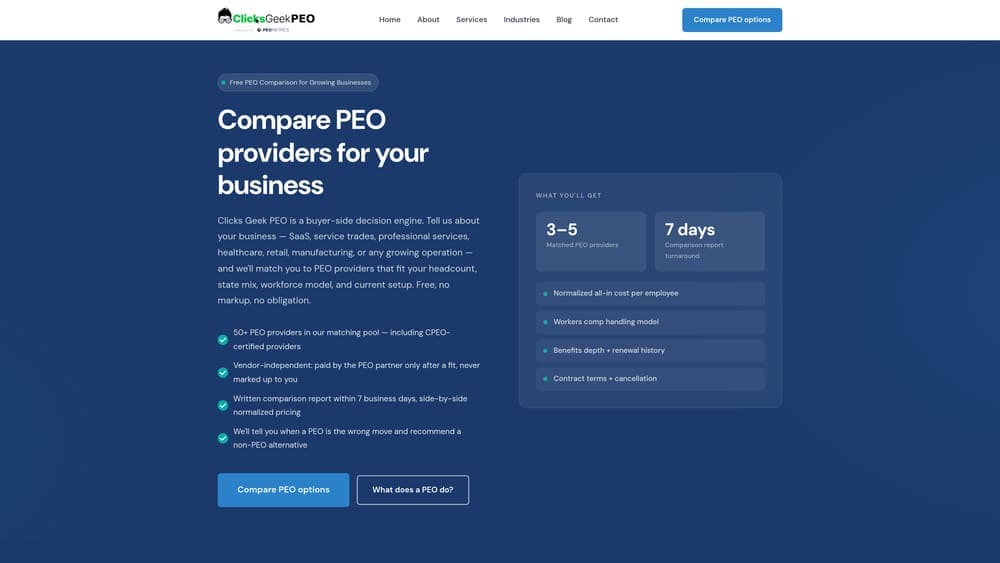
Clicks Geek PEO is not a PEO itself. It’s an independent comparison and advisory platform that helps businesses cut through provider marketing and understand what they’re actually buying.
Where This Tool Shines
Most businesses evaluate PEOs by talking directly to sales reps from each provider. That’s a bit like asking a car dealership whether you should buy a car. The Clicks Geek platform is built to sit on the other side of that conversation, giving you a framework to compare providers on pricing structure, contract terms, and service model before anyone has an incentive to sell you something.
This is particularly valuable if you’re leaving Vensure or evaluating it for the first time. The platform helps you identify red flags in contract language, understand how administrative fees are structured, and compare what different providers actually deliver for similar-sized businesses.
Key Features
Side-by-Side Provider Comparisons: Compare multiple PEOs across pricing, services, and contract terms in a structured format rather than juggling separate sales decks.
Transparent Pricing Breakdowns: Understand the difference between percentage-of-payroll and PEPM pricing models, and what each means for your actual cost at your headcount.
Contract Term Reviews: Identify renewal clauses, termination fees, and bundled cost structures that are easy to miss during a standard sales process.
Independent Advisory: No provider pays to be featured. Recommendations are driven by fit, not commission.
Educational Resources: Decision-stage content covering PEO basics, pricing benchmarks, and what questions to ask before signing.
Best For
Any business owner who feels uncertain about PEO pricing, is mid-renewal and wondering if they’re overpaying, or is switching away from a provider like Vensure and wants to evaluate alternatives without being sold to immediately. Particularly useful for CFOs and operations managers who need to justify a PEO decision internally.
Pricing
Free comparison resources and educational content. Quote comparison service available; contact for details.
2. ADP TotalSource
Best for: Mid-sized businesses that need enterprise-grade HR technology and nationwide compliance support.
ADP TotalSource is the PEO arm of ADP, one of the most established payroll and HR companies in the world. It brings that infrastructure to the co-employment model.
Where This Tool Shines
Where Vensure’s technology can feel inconsistent due to acquired legacy systems, ADP TotalSource runs on a single proprietary platform that’s been built and refined over decades. For businesses that need reliable, integrated HR technology, that consistency matters. You’re not wondering which system your data lives in.
The compliance infrastructure is also genuinely strong. For businesses operating across multiple states, ADP’s legal and compliance teams have the depth to handle complex multi-jurisdictional scenarios without the client needing to manage it.
Key Features
Proprietary HR Platform: Unified system for payroll, benefits, time tracking, and analytics — not a patchwork of acquired tools.
50-State Compliance Support: Dedicated compliance resources across all U.S. jurisdictions, including ongoing regulatory monitoring.
Fortune 500-Level Benefits Access: Group purchasing power that gives smaller businesses access to benefit plans typically reserved for large employers.
Dedicated HR Business Partner: Each client is assigned an HR professional for ongoing advisory support, not just transactional processing.
Integrated Talent Management: Recruiting, onboarding, and performance management tools built into the same platform.
Best For
Businesses with 50 or more employees that have outgrown simpler PEO platforms and need the depth of a large-scale HR infrastructure. Also well-suited for companies with multi-state operations where compliance complexity is high.
Pricing
Custom pricing based on headcount and services; typically structured as a percentage of payroll. Contact ADP directly for a quote. Generally positioned for 50+ employee businesses.
3. Justworks
Best for: Small to mid-sized businesses that want transparent, predictable pricing with no bundled fee confusion.
Justworks is a PEO built around pricing clarity and platform simplicity — two things that are often in short supply in the traditional PEO market.
Where This Tool Shines
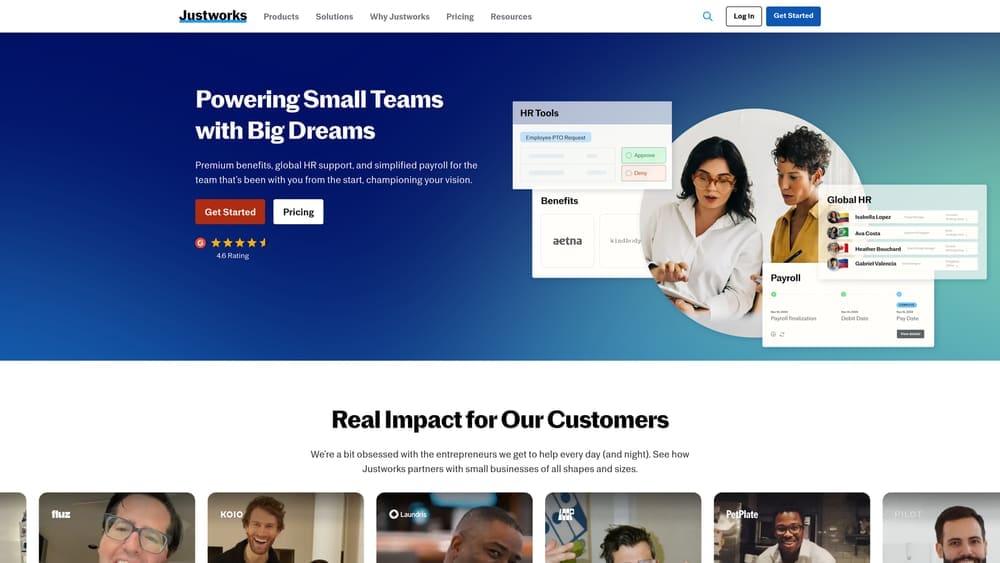
Justworks publishes its pricing on its website. That’s still rare enough in the PEO industry that it deserves to be called out directly. If you’ve been frustrated trying to reverse-engineer what Vensure’s bundled pricing actually costs you per employee, Justworks is a meaningful contrast. You know what you’re paying before you get on a sales call.
The platform itself is clean and modern, which matters for companies where HR is run by a small team or a founder wearing multiple hats. The 24/7 support model is also genuinely useful for businesses that don’t have an in-house HR director to handle issues during off-hours.
Key Features
Published Flat PEPM Pricing: Pricing listed publicly on the website — no discovery calls required to understand your baseline cost.
Modern Payroll and Benefits Platform: Clean interface designed for non-HR professionals to navigate without training.
Multi-State Compliance Tools: Built-in compliance support for businesses operating across multiple states.
24/7 Support Channels: Access via Slack, email, phone, and SMS — not limited to business hours.
Streamlined Onboarding: Simple setup process that doesn’t require weeks of implementation work.
Best For
Startups, small businesses, and growing companies with 10-100 employees that prioritize cost predictability and ease of use. Especially good for founders and small operations teams who need a PEO that doesn’t require a dedicated HR administrator to manage.
Pricing
Starts at $59/employee/month (Basic) or $109/employee/month (Plus, which includes benefits access). Pricing is publicly listed on the Justworks website.
4. Rippling PEO
Best for: Tech-forward companies that want HR, IT, and finance managed from a single integrated platform.
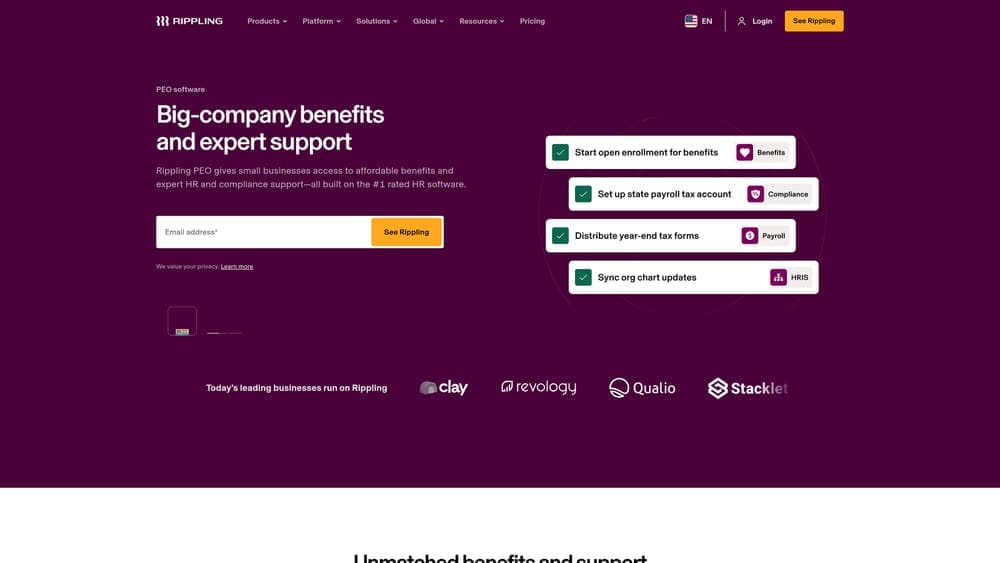
Rippling is the only PEO on this list that also manages devices, applications, and identity alongside payroll and benefits. It’s a different category of tool for a specific type of company.
Where This Tool Shines
If your business is running a distributed or remote team and you’re already managing onboarding through a mix of disconnected tools, Rippling’s unified model is genuinely compelling. When a new employee joins, Rippling can handle payroll enrollment, benefits setup, laptop provisioning, and app access simultaneously. That’s not something any traditional PEO offers.
For tech companies frustrated by legacy PEO platforms, Rippling represents a fundamentally different architecture. It’s modular, so you can add or remove capabilities as your needs change, rather than being locked into a fixed service bundle.
Key Features
Unified HR + IT + Finance Platform: Single system for payroll, benefits, device management, and app provisioning — eliminating the need for separate HR and IT tools.
Automated Device Management: Provision and manage employee devices directly through the platform during onboarding and offboarding.
Workflow Automation Engine: Build custom automated workflows for complex HR processes without manual intervention.
Global Workforce Management: Support for international employees and contractors alongside U.S. PEO clients.
Modular Architecture: Add only the modules your business needs; scale up as you grow.
Best For
Technology companies, remote-first businesses, and fast-growing startups that need a modern, integrated platform and value automation over white-glove service. Less suited for businesses that prioritize relationship-based HR support over self-service tools.
Pricing
Custom pricing; contact Rippling for a quote. Generally competitive for tech-oriented SMBs. Pricing varies based on modules selected.
5. Insperity
Best for: Mid-market businesses that want a dedicated service relationship and strategic HR advisory, not just transactional processing.
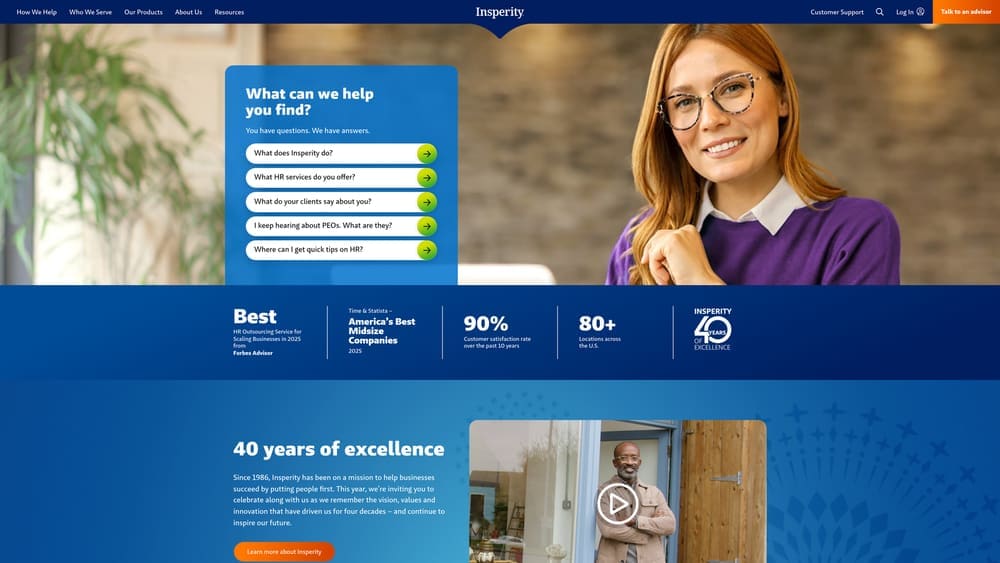
Insperity is one of the oldest and most established PEOs in the market, publicly traded and consistently ranked among the top providers for service quality.
Where This Tool Shines
Insperity’s model is built around the relationship, not the platform. Every client gets a dedicated HR service team that stays consistent over time. If your primary frustration with Vensure has been rotating contacts and difficulty getting straight answers from support, Insperity is a direct contrast to that experience.
The company also invests heavily in leadership development and performance management tools, which positions it as more of a strategic HR partner than a payroll processor. For businesses trying to build internal people operations infrastructure, that depth matters.
Key Features
Dedicated HR Service Team: A consistent team assigned to your account — not a general support queue.
Performance Management Tools: Built-in systems for goal setting, reviews, and leadership development.
Large-Group Benefits Access: Comprehensive benefit plans with competitive rates driven by Insperity’s purchasing scale.
Established Track Record: Publicly traded company with decades of operating history and financial transparency.
Strategic HR Advisory: Ongoing guidance on HR strategy, not just compliance and payroll execution.
Best For
Mid-market businesses with 50-150 employees that value a consistent, relationship-driven service model and want HR support that goes beyond transactional processing. Not the right fit if price is the primary driver or if you prefer a self-service model.
Pricing
Custom pricing; typically structured as a percentage of payroll. Best suited for businesses in the 50-150 employee range. Contact Insperity for a detailed quote.
6. Paychex PEO
Best for: Small businesses in traditional industries that need strong payroll, workers’ comp, and local service presence.
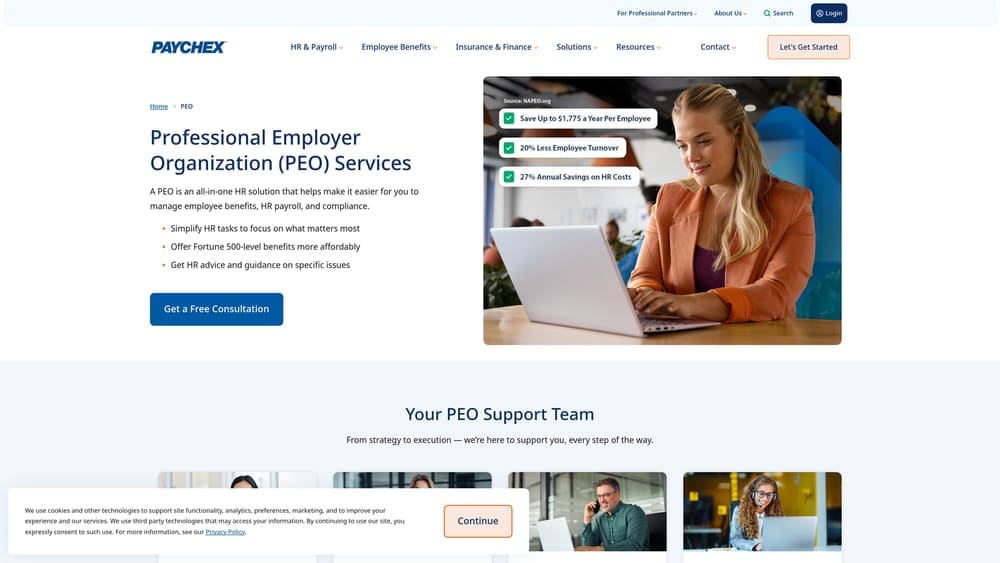
Paychex PEO brings the payroll infrastructure of one of the country’s largest providers into a co-employment model, with a local field presence that most national PEOs can’t match.
Where This Tool Shines
Paychex has local representatives in most U.S. markets. For small business owners in trades, retail, hospitality, or other industries where face-to-face service still matters, that local presence is a real differentiator. You’re not always routing issues through a national call center.
The workers’ compensation integration is also worth noting. For businesses in industries with higher injury risk or complex workers’ comp needs, Paychex’s integrated administration simplifies a process that often creates friction with other providers.
Key Features
Local Field Representatives: On-the-ground support in most U.S. markets — not just remote service teams.
Integrated Workers’ Comp Administration: Streamlined workers’ compensation management built directly into the PEO model.
Scalable Service Tiers: Options ranging from basic payroll support to full PEO co-employment, depending on what your business needs.
Payroll Processing Infrastructure: Built on Paychex’s established payroll engine, which processes payroll for businesses of all sizes.
Industry Experience: Demonstrated history serving trades, retail, hospitality, and other traditional industries.
Best For
Small businesses with 10-50 employees in traditional industries where local service relationships and workers’ comp management are high priorities. Less suited for tech companies or businesses that prioritize platform sophistication.
Pricing
Custom pricing with flexible service tiers. Contact Paychex for a quote based on headcount and services needed.
7. TriNet
Best for: Businesses in specialized industries that want benefit plans and compliance support tailored to their sector.
TriNet operates a vertical clustering model, grouping similar businesses together to deliver industry-specific benefit plans and compliance packages rather than a generic one-size-fits-all offering.
Where This Tool Shines
TriNet’s industry focus is its clearest differentiator. If you’re a technology company, professional services firm, or life sciences business, TriNet has benefit structures and compliance expertise built specifically for your sector. That’s meaningfully different from a general PEO that applies the same framework to every client regardless of industry.
The vertical clustering model also creates better group rates within industries, because you’re pooled with businesses that have similar risk profiles and benefit preferences rather than being averaged across a diverse mix of employers.
Key Features
Industry-Specific Benefit Packages: Benefit plans designed around the needs and expectations of specific sectors, not generic group plans.
Vertical Clustering for Better Rates: Businesses grouped by industry for improved group purchasing power and risk pooling.
Cloud-Based HR Platform: Real-time reporting and HR management accessible from a modern interface.
Employment Practices Liability Coverage: Risk mitigation tools relevant to businesses in higher-exposure industries.
Sector-Specific Compliance Expertise: Deep knowledge in tech, professional services, financial services, and life sciences regulatory environments.
Best For
Businesses with 10-100 employees in specialized industries where generic benefit plans and compliance support fall short. Particularly strong for tech startups, professional services firms, and life sciences companies with specific regulatory needs.
Pricing
Custom pricing; typically structured on a PEPM basis. Contact TriNet for a quote based on industry and headcount.
8. CoAdvantage
Best for: Mid-market businesses that need more personalized service than large national PEOs typically provide.
CoAdvantage targets the 50-500 employee range specifically, positioning itself as the alternative to large national PEOs that treat mid-market clients like small fish in a big pond.
Where This Tool Shines
CoAdvantage’s value proposition is straightforward: you’re not competing for attention with enterprise accounts. For businesses that have grown beyond the small-business tier but aren’t large enough to command priority service from providers like ADP or Insperity, CoAdvantage fills a real gap.
The dedicated service team model combined with flexible benefit plan design gives mid-market businesses more customization than they’d typically get from a national provider operating at scale. If your experience with Vensure has felt like you’re being processed rather than served, CoAdvantage is worth a conversation.
Key Features
Mid-Market Focus: Service model designed specifically for 50-500 employee businesses, not retrofitted from an enterprise platform.
Dedicated Service Teams: Consistent account management rather than a rotating support queue.
Flexible Benefit Plan Design: More customization in benefit structure than most large national PEOs offer at this size range.
Workers’ Compensation Management: Integrated workers’ comp administration with loss control support.
Multi-State Payroll Support: Payroll processing infrastructure for businesses operating across multiple jurisdictions.
Best For
Mid-market companies with 50-500 employees that feel underserved by large national PEOs and want a provider built around their size range rather than adapted down from an enterprise model.
Pricing
Custom pricing; contact CoAdvantage for a quote. Designed for the 50-500 employee range.
Matching the Right Provider to Your Situation
The right PEO depends on what’s actually broken in your current setup. If pricing transparency is the core issue, Justworks is the most direct fix. If you need a modern, integrated platform and you’re running a tech or remote team, Rippling is the obvious starting point. If service consistency and dedicated account management matter most, Insperity and CoAdvantage both address that directly.
For businesses in specialized industries, TriNet’s vertical model offers something generic PEOs simply can’t replicate. For small businesses in traditional industries with complex workers’ comp needs, Paychex’s local presence and integrated coverage makes sense. And if you need enterprise-grade infrastructure with proven compliance depth, ADP TotalSource is the established choice.
One thing worth doing before you commit to any provider: understand what you’re currently paying and what you’re actually getting. Most businesses that switch PEOs discover they were overpaying due to bundled fees and unclear administrative markups built into their existing contract. That’s not a Vensure-specific problem — it’s an industry-wide pattern.
Before you renew your PEO agreement, compare your options with an independent lens. We break down pricing structures, service models, and contract terms across providers so you can make a decision based on actual cost and fit — not sales pitches.
The PEO market has real options at every size and service level. You don’t have to stay somewhere that isn’t working.