
Vensure Employer Solutions has grown fast. Very fast. Over the past several years, they’ve acquired dozens of regional PEOs, making them one of the largest providers in the country by client count. That growth has come with real tradeoffs. Some clients praise their benefits access and geographic reach. Others report billing confusion after acquisition transitions, support teams that disappeared, and technology platforms that never quite got integrated.
If you’re searching this keyword, you’re probably in one of two situations: you’re already with Vensure and something feels off, or you’re evaluating them and want an honest picture before signing. Either way, this breakdown is for you.
Below, we cover what business owners are actually reporting about Vensure in 2026, then walk through the top PEO alternatives worth comparing if you decide they’re not the right fit. If you want a broader look at how to evaluate any PEO, our PEO comparisons hub is a good place to start.
What Clients Are Actually Saying About Vensure in 2026
The pattern in Vensure reviews across BBB, Trustpilot, Google, and community threads on Reddit’s r/humanresources and r/smallbusiness is consistent enough to be meaningful. This isn’t isolated noise. It’s a recurring picture shaped largely by their acquisition strategy.
Where Vensure earns genuine praise: Access to competitive group health benefits is frequently mentioned. For smaller businesses that couldn’t access large-group rates on their own, that’s real value. Payroll processing reliability is also cited positively by long-term clients who haven’t gone through an acquisition transition. Geographic coverage is broad, which matters for multi-state employers.
Where complaints concentrate: Billing discrepancies are the most common complaint category, particularly during or shortly after a client’s legacy PEO was absorbed into Vensure. Charges appear that weren’t in the original agreement. Credits don’t process correctly. And the person who originally explained the billing is no longer available.
Loss of dedicated account managers is a close second. When a regional PEO gets acquired, the local team that knew your business often gets restructured. Clients who valued that relationship frequently report being shuffled to a generalized support queue.
A meaningful distinction worth knowing: Vensure is not IRS-certified as a Certified PEO (CPEO) based on available information. That matters. CPEO status shifts certain federal tax liabilities to the PEO, which is a real protection for business owners. Providers like ADP TotalSource carry CPEO certification. If tax liability exposure is a concern for your business, that distinction deserves attention before you sign.
The BBB profile for Vensure shows a pattern of billing-related complaints, though they do generally respond. That’s not nothing, but response and resolution aren’t the same thing.
Now, onto the tools worth evaluating.
1. Clicks Geek PEO Comparison Platform
Best for: Business owners who want objective, side-by-side PEO analysis before signing or renewing.
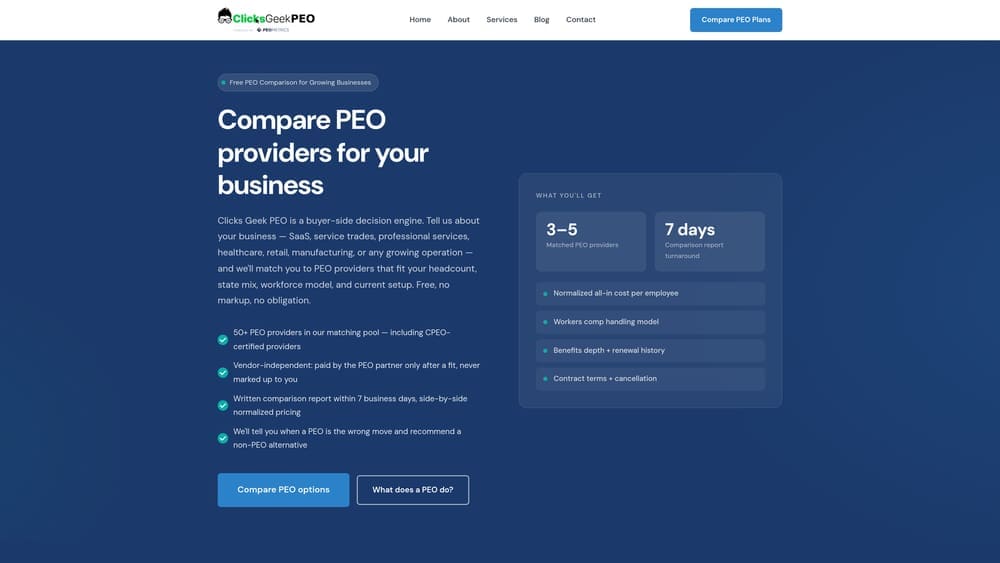
Clicks Geek PEO is an independent comparison and advisory platform built specifically for business owners evaluating PEO options — not a PEO itself, and not affiliated with any provider.
Where This Tool Shines
The core value here is independence. Most PEO “comparison” resources online are lead-generation tools that steer you toward whoever pays the highest referral fee. Clicks Geek PEO operates differently: the goal is to give you transparent pricing breakdowns, contract analysis, and provider evaluations so you can make a decision based on your actual situation.
If you’re currently with Vensure and questioning whether you’re overpaying or under-served, this is the right starting point. The platform helps you understand what you’re actually paying for versus what you could be getting elsewhere, without someone trying to close you on a specific provider.
Key Features
Side-by-Side Provider Comparisons: Compare top PEOs across services, pricing structure, and contract terms in a format that makes the differences visible.
Transparent Pricing Breakdowns: Most PEO pricing is bundled in ways that obscure the real cost. This platform breaks that down clearly.
Contract Term Analysis: Identifies red flags in PEO agreements — auto-renewals, termination fees, and clauses that catch business owners off guard.
Independent Advisory: No PEO sales agenda. The analysis isn’t shaped by which provider pays the highest commission.
Best For
Business owners currently with Vensure who are questioning renewal, or companies evaluating PEOs for the first time and wanting objective input before committing. Also useful for CFOs and operations managers who need to justify a PEO decision to leadership with clear data.
Pricing
Free comparison resources are available on the platform. Advisory services are available for businesses that want a more hands-on evaluation process.
2. ADP TotalSource
Best for: Growing companies that need enterprise-grade compliance infrastructure and CPEO-certified tax protection.
ADP TotalSource is ADP’s full-service PEO offering, carrying IRS CPEO certification and backed by one of the largest HR technology and compliance operations in the country.
Where This Tool Shines
For business owners who’ve been burned by Vensure’s lack of CPEO status, ADP TotalSource is the clearest alternative on this dimension. CPEO certification means ADP assumes certain federal tax liabilities, which is a meaningful risk transfer that non-certified PEOs can’t offer.
The benefits access is also genuinely strong. Fortune 500-level health insurance packages, 401(k) options, and ancillary benefits that smaller businesses simply can’t access on their own. The technology platform is mature, with mobile access and solid reporting capabilities.
Key Features
IRS-Certified CPEO Status: Shifts certain federal tax liabilities to ADP, reducing risk exposure for the employer.
Fortune 500-Level Benefits Access: Large-group health, dental, vision, and retirement options at rates smaller businesses can’t typically negotiate independently.
Dedicated HR Business Partner: Each client gets an assigned HR professional rather than a generic support queue.
Compliance and Risk Management: Robust tools for multi-state compliance, ACA reporting, and employment law updates.
Technology Platform: Established platform with mobile access, payroll visibility, and employee self-service features.
Best For
Companies with 50 or more employees that need enterprise-level compliance support, CPEO tax protection, and access to premium benefits. Less ideal for very early-stage startups watching every dollar.
Pricing
Custom quotes only. Generally positioned for companies with 50+ employees. Expect pricing that reflects the depth of service.
3. Justworks
Best for: Startups and growing SMBs that want transparent, flat-rate pricing and a modern platform experience.
Justworks is a PEO built around pricing clarity and a clean user experience — two things that tend to be in short supply in the PEO industry.

Where This Tool Shines
If billing confusion was part of your Vensure frustration, Justworks is a direct contrast. Their flat per-employee-per-month pricing is published, predictable, and doesn’t hide fees inside bundled line items. You know what you’re paying before you sign, and the number doesn’t change based on opaque administrative markups.
The platform itself is genuinely modern. Onboarding, benefits enrollment, payroll visibility, and compliance tools are all accessible without needing to call someone to pull a report. For teams that want HR administration to feel like a software product rather than a service relationship, Justworks fits that expectation well.
Key Features
Flat Per-Employee Pricing: No hidden fees or percentage-of-payroll surprises. Pricing is straightforward and published.
Modern Platform UI: Clean, intuitive interface for both HR administrators and employees.
Automated Compliance Support: Handles ACA reporting, new hire reporting, and multi-state compliance requirements.
Large-Group Health Insurance Access: Competitive benefits packages through their PEO umbrella.
24/7 Support: Multiple support channels available around the clock, which addresses one of the most common Vensure complaints directly.
Best For
Startups, remote-first companies, and SMBs under 100 employees that value pricing transparency and a self-service-friendly platform. Strong fit for tech-forward teams that don’t want to manage HR through phone calls and spreadsheets.
Pricing
Basic tier starts around $59 per employee per month. Plus tier is priced higher and includes additional benefits options. Pricing is publicly available on their website.
4. Paychex PEO
Best for: Companies that want scalable PEO services built on a proven payroll infrastructure with dedicated HR support.
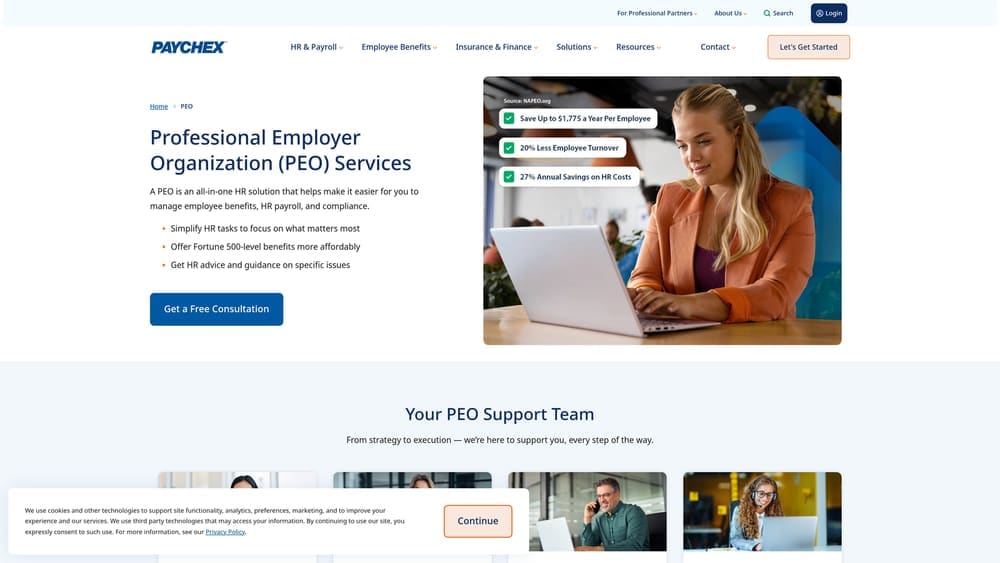
Paychex PEO layers full-service HR and benefits administration on top of Paychex’s long-established payroll platform, with dedicated HR professionals assigned to each client.
Where This Tool Shines
Paychex has been processing payroll for decades. If payroll accuracy and tax filing reliability are priorities, that track record matters. Their PEO offering extends that foundation with HR support, benefits administration, and risk management without requiring you to move to an entirely unfamiliar system.
The dedicated HR professional model is worth highlighting. Rather than a shared support queue, clients get an assigned HR professional who learns their business. For owners coming from Vensure who lost their account manager during an acquisition shuffle, that structural difference is meaningful.
Key Features
Dedicated HR Professional: Each client is assigned a specific HR contact, not rotated through a general support team.
Payroll Accuracy and Tax Filing: Built on Paychex’s established payroll infrastructure with a strong compliance track record.
Flexible Service Packages: Service tiers that can scale as headcount grows without requiring a full platform migration.
Workers’ Comp Administration: Risk management and workers’ compensation support integrated into the service.
Employee Self-Service Portal: Employees can access pay stubs, benefits information, and HR documents without going through an administrator.
Best For
Small to mid-market companies that want a stable, relationship-based PEO with strong payroll roots. Good fit for businesses that have had inconsistent support experiences and want a more accountable service model.
Pricing
Custom quotes based on headcount and selected service tier. No published pricing; requires a direct conversation with their sales team.
5. TriNet
Best for: Companies in specific industries that want a PEO with vertical expertise rather than a generic HR solution.
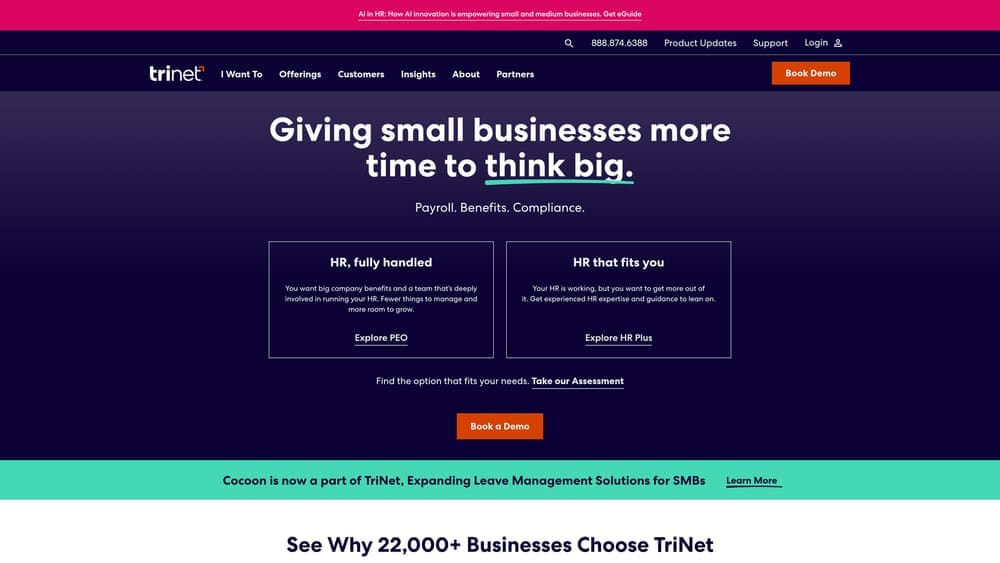
TriNet differentiates itself by organizing its PEO services around industry verticals, including technology, financial services, nonprofits, and professional services.
Where This Tool Shines
Most PEOs sell a horizontal service that works reasonably well across industries. TriNet’s bet is that your industry actually matters when it comes to benefits design, compliance exposure, and HR priorities. A fintech startup has different regulatory concerns than a nonprofit. TriNet builds that into their service model.
For companies that have felt like a generic account number at a large PEO, the industry-specific approach creates a meaningfully different experience. The compliance guidance is tailored to your sector’s actual risk profile rather than a generic checklist.
Key Features
Industry-Vertical Specialization: Service teams and benefits packages organized by industry, not just company size.
Curated Benefits by Industry: Health and ancillary benefits packages designed around what employees in specific sectors expect.
Strategic HR Consulting: Compliance guidance and HR advisory shaped by industry-specific regulatory context.
Cloud-Based Platform with Analytics: Real-time reporting and HR data visibility through a modern cloud platform.
Multi-State Compliance Support: Handles the complexity of operating across multiple states with varying employment law requirements.
Best For
Technology companies, financial services firms, nonprofits, and professional services businesses that want a PEO that understands their industry’s specific compliance and HR landscape. Less ideal for generalist industries or businesses that don’t fit a defined vertical.
Pricing
Custom quotes using a percentage-of-payroll model. Pricing varies by industry and headcount. Requires direct engagement with their sales team.
6. Insperity
Best for: Mid-market companies that want strategic HR advisory alongside traditional PEO services.
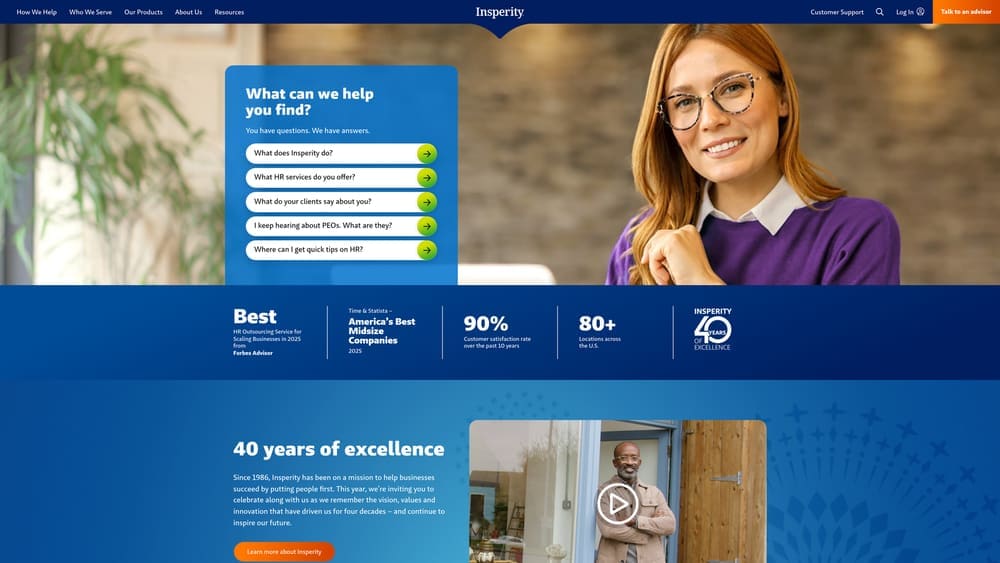
Insperity positions itself as a full-service PEO with a strong emphasis on HR consulting, employee development, and performance management — going deeper than basic payroll and benefits administration.
Where This Tool Shines
Insperity’s service model is built around a dedicated service team rather than a single account manager. That team includes HR specialists, payroll support, and benefits administration — all coordinated around your account. For businesses that want a PEO relationship that feels more like an embedded HR department than a vendor, Insperity is one of the better fits in the market.
The performance management and leadership development tools are a genuine differentiator. Most PEOs don’t go near employee development. Insperity does, which makes them a stronger fit for companies that are actively trying to build internal leadership capacity alongside outsourcing HR administration.
Key Features
White-Glove HR Consulting: Strategic HR advisory that goes beyond compliance and payroll into organizational development.
Performance Management Tools: Goal-setting, performance reviews, and leadership training built into the service offering.
Comprehensive Benefits Administration: Competitive health, dental, vision, and retirement benefits through their PEO umbrella.
Payroll and Compliance Management: Full-service payroll processing, tax filing, and multi-state compliance support.
Dedicated Service Team Model: Multiple specialists assigned to each account rather than a single point of contact.
Best For
Growing companies with 50 to 150+ employees that want more than basic HR outsourcing. Strong fit for businesses investing in culture, leadership development, and employee retention alongside administrative efficiency.
Pricing
Custom quotes only. Typically positioned for companies with 50 or more employees. Pricing reflects the depth of advisory services included.
7. Rippling PEO
Best for: Tech-forward and remote-first companies that want HR, payroll, and IT management unified in one platform.
Rippling is built differently from traditional PEOs. It started as a unified HR and IT platform, then layered PEO services on top — which means the technology experience is genuinely modern rather than retrofitted.
Where This Tool Shines
If your company manages remote employees across multiple states, Rippling’s combination of device management, app provisioning, and HR administration in one platform is a real operational advantage. Onboarding a new employee can trigger automatic laptop provisioning, software access, payroll setup, and benefits enrollment simultaneously. That level of automation is hard to find elsewhere.
The integration ecosystem is also notable. With 500+ app integrations, Rippling connects to the tools your team already uses rather than forcing you into a closed system. For companies that have been frustrated by Vensure’s fragmented technology across legacy entities, the unified Rippling environment is a meaningful contrast.
Key Features
Unified IT and HR Platform: Device management, app provisioning, payroll, and HR administration in a single system.
Automated Onboarding and Offboarding: End-to-end workflow automation that reduces manual steps significantly.
PEO Benefits Access: Competitive benefits packages through the PEO umbrella with a modern enrollment experience.
500+ App Integrations: Connects to the software stack your team already relies on.
Remote-First Friendly: Built to handle distributed teams, multi-state payroll, and remote employee management natively.
Best For
Technology companies, remote-first businesses, and fast-growing startups that want a platform-first PEO experience. Less ideal for businesses that prefer a relationship-heavy, high-touch service model over software automation.
Pricing
Base platform starts around $35 per employee per month. PEO tier is priced separately. Total cost depends on which modules and services are activated.
8. CoAdvantage PEO
Best for: Blue-collar, field-service, and high-risk industries where workers’ compensation is a primary cost driver.
CoAdvantage is a PEO with a specific focus on industries where workers’ compensation complexity and risk management are central business concerns, not afterthoughts.
Where This Tool Shines
For most PEOs, workers’ comp is one line item among many. For CoAdvantage, it’s a core competency. If you operate in construction, landscaping, manufacturing, field service, or any industry with meaningful injury risk, that specialization matters. Their claims management, loss control programs, and safety support are designed for businesses where a bad claims year can materially affect your insurance costs.
Many high-risk employers find that a generalist PEO’s workers’ comp program isn’t priced or structured for their reality. CoAdvantage’s model is built around that reality from the start, which often translates to better pricing and more relevant risk support than a one-size-fits-all PEO can offer.
Key Features
Workers’ Comp Expertise for High-Risk Industries: Specialized program design for trades, field service, construction, and manufacturing.
Risk Management and Safety Programs: Proactive loss control and safety support to reduce claims frequency.
Claims Management: Active claims management support rather than simply processing paperwork after an incident.
Payroll and Tax Administration: Standard PEO payroll and compliance services alongside the risk-focused offering.
Benefits Access for Trades Businesses: Health and ancillary benefits for industries where attracting and retaining field workers is competitive.
Best For
Construction companies, landscaping businesses, manufacturers, staffing firms, and any employer in a high-risk classification where workers’ compensation is a significant cost and operational concern.
Pricing
Custom quotes. Pricing reflects the workers’ compensation risk profile of your workforce, which means costs vary significantly by industry classification and claims history.
Which PEO Actually Makes Sense for Your Situation
If you’ve been with Vensure and the experience has been frustrating, the good news is the alternatives above cover a wide range of business needs. The decision really comes down to what broke down with Vensure and what you need fixed.
Billing confusion and lack of pricing transparency? Start with Justworks, which publishes flat-rate pricing and keeps the math simple. Lost your dedicated account manager and can’t get consistent support? Paychex PEO and Insperity both use assigned service models that give you a real human accountable to your account.
Concerned about tax liability because Vensure isn’t CPEO-certified? ADP TotalSource is the most direct answer. Running a remote or tech-forward team and tired of fragmented systems? Rippling was built for exactly that situation. Operating in a high-risk industry where workers’ comp is the real issue? CoAdvantage specializes there in ways generalist PEOs don’t.
Before you renew your PEO agreement, compare your options. Most businesses overpay due to bundled fees and unclear administrative markups. The Clicks Geek PEO platform breaks down pricing, services, and contract structures so you can make a smarter decision, without being steered toward whoever pays the highest referral commission.
The PEO market is consolidating fast, and Vensure is one of the most acquisition-active players in it. That’s not inherently bad, but it does mean your experience can change significantly based on which legacy entity you came from and how well their integration has gone. Do the comparison before you sign anything new.