
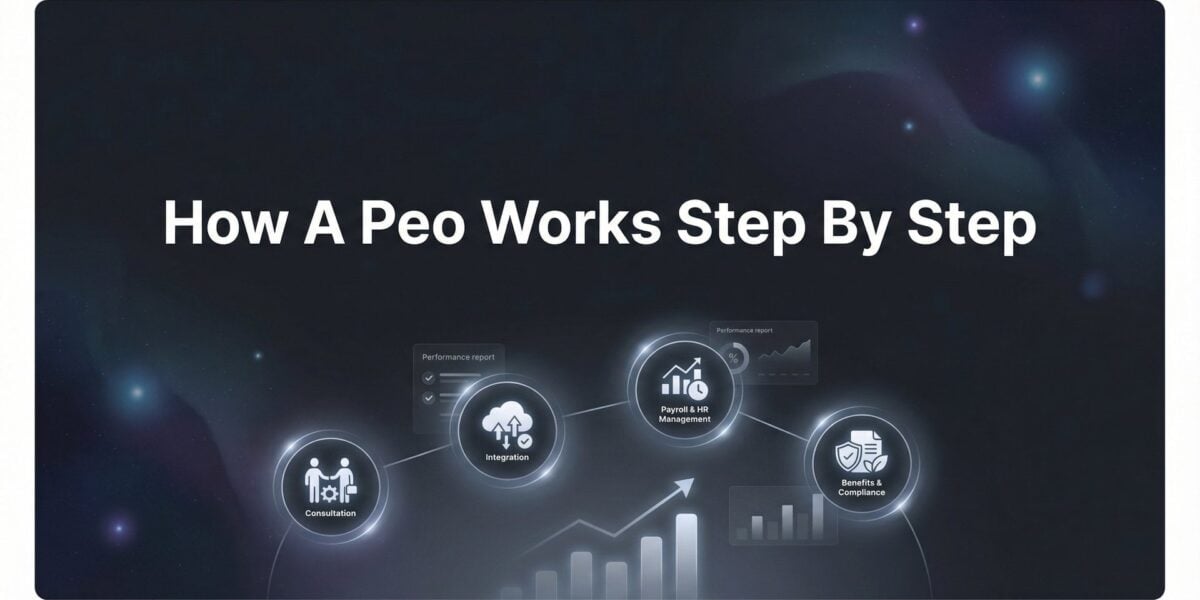
You’ve signed the PEO agreement. Now what actually happens?
Most business owners grasp the concept—outsourced payroll, better benefits, compliance support—but remain unclear on the operational mechanics. What changes on day one? What stays the same? Who does what when payroll runs?
This guide walks through the concrete sequence of events from contract signature to steady-state operations. No theory. No sales pitch. Just the practical reality of how a PEO relationship unfolds, what you’ll experience at each stage, and what you need to prepare for before implementation begins.
By the end, you’ll understand exactly how co-employment translates into daily operations—and whether that operational shift makes sense for your business.
Step 1: The Co-Employment Agreement Gets Signed
The Client Service Agreement (CSA) establishes the legal framework for co-employment. You retain operational control—hiring decisions, firing decisions, day-to-day management, strategic direction. The PEO becomes the employer of record for tax and benefits administration purposes.
This distinction matters more than most contracts explain. You still run your business. You still decide who works for you and what they do. The PEO handles the administrative and compliance layers that sit underneath those decisions. Understanding the co-employment model before signing helps clarify these boundaries.
Three sections of the CSA deserve careful scrutiny before signing.
Service Scope: Which HR functions transfer to the PEO and which remain your responsibility? Payroll processing typically transfers completely. Benefits administration transfers. Workers’ comp administration transfers. But employee discipline, performance management, and termination decisions stay with you—the PEO advises, you decide.
Fee Structure: How are costs calculated and billed? Most PEOs charge a percentage of payroll (typically 3-8%) plus benefits pass-through costs. Others use per-employee-per-month (PEPM) pricing. The invoice breakdown should separate administrative fees from benefits costs and payroll taxes. If it doesn’t, you’ll struggle to evaluate value over time. Review our breakdown of professional employer organization cost to understand typical pricing structures.
Termination Clauses: What happens if you want to leave? Notice periods typically range from 30 to 90 days. Some PEOs charge exit fees. Some require you to remain through the end of their benefits plan year. Read this section twice—getting locked into an underperforming PEO relationship costs more than most businesses anticipate.
Timeline reality: expect 2-4 weeks from initial agreement to final signature if you involve legal counsel. Larger companies often take longer due to internal approval processes and contract negotiation rounds.
Success indicator: you can explain to your leadership team exactly which employer responsibilities transfer to the PEO and which remain internal. If that distinction feels fuzzy, pause before signing.
Step 2: Employee Data Migration and System Setup
Once the agreement is signed, the PEO’s implementation team begins collecting employee data. This isn’t a quick form—it’s a comprehensive transfer of your entire HR infrastructure.
The PEO needs complete records for every employee: full legal names, addresses, Social Security numbers, birth dates, hire dates, salary or wage rates, tax withholding elections (W-4 and state equivalents), direct deposit information, current benefits elections, and accrued PTO balances.
Here’s where implementation often stalls. Most businesses discover their employee records contain gaps, outdated information, or inconsistencies between payroll systems and HR files. The PEO can’t process payroll with incomplete W-4s or missing direct deposit details. You’ll need to clean this up before go-live.
The PEO assigns new Employer Identification Numbers (EINs) for payroll tax reporting. Your employees now appear under the PEO’s federal tax ID for payroll tax purposes. This doesn’t affect their Social Security credits or tax liability—it’s purely an administrative change—but it does mean their W-2s at year-end will show the PEO as the employer of record. Our guide on PEO tax responsibilities explains exactly how this works.
System integration comes next. If you’re using accounting software, time tracking tools, or HRIS platforms, the PEO will attempt to connect their payroll system to your existing infrastructure. Some integrations work smoothly. Others require manual data entry each pay period. Ask specifically how time and attendance data flows into their payroll system—this determines your ongoing workload.
Most PEOs provide their own employee self-service portal where workers can view pay stubs, update withholdings, and manage benefits elections. Your employees will need to create accounts and learn a new interface. Plan for confusion during the first few pay cycles.
Common friction point: historical payroll data. The PEO typically doesn’t migrate your full payroll history—they start fresh from the go-live date. If you need historical reporting for tax purposes or audits, you’ll maintain access to your old system separately.
Step 3: Benefits Enrollment Opens Under the PEO’s Master Plans
Your employees gain access to the PEO’s pooled benefits plans. This is often the most tangible advantage of co-employment—small and mid-sized businesses can access enterprise-grade health insurance, dental, vision, and voluntary benefits at rates they couldn’t negotiate independently.
But the transition isn’t seamless. Your employees will experience a complete benefits changeover: new insurance carriers, new provider networks, new member ID cards, new claims processes, and a new enrollment portal.
Open enrollment timing typically aligns with the PEO’s plan year, not yours. If you join mid-year, you might face a choice: wait until the PEO’s next open enrollment period (which could be months away) or trigger a special enrollment event to transition immediately. Immediate transitions often come with higher administrative costs and tighter enrollment windows.
Employees who are mid-treatment or have established relationships with specific providers need advance notice. A carrier change can disrupt ongoing care, especially if their current providers aren’t in-network with the new plans. Expect pushback from employees with chronic conditions or specialized care needs.
Decision point: which benefits to adopt from the PEO versus carving out existing plans. Most businesses adopt the full PEO benefits package for simplicity. But if you’ve negotiated favorable terms on a specific plan—or if your workforce has strong preferences—you can sometimes carve out certain benefits and maintain them separately. This complicates administration but preserves continuity where it matters most. Learn more about the full range of PEO services and benefits available.
The PEO provides benefits enrollment support, but you’re responsible for communicating the change to your team. Schedule benefits orientation sessions, provide comparison materials between old and new plans, and give employees time to evaluate their options before enrollment deadlines.
Step 4: First Payroll Runs Through the PEO
The first payroll cycle reveals how co-employment actually functions day-to-day.
You approve hours worked (for hourly employees) and confirm salary amounts (for exempt employees) through the PEO’s payroll platform. This happens according to your established pay schedule—biweekly, semi-monthly, weekly—which typically remains unchanged unless you negotiate a shift during implementation.
The PEO processes payroll: calculates gross pay, withholds federal and state taxes, deducts benefits premiums and other voluntary deductions, and determines net pay. They handle the tax deposits under their EIN and assume liability for timely filing with federal and state agencies. Understanding PEO payroll responsibilities clarifies exactly what shifts to them versus what stays with you.
Funds disbursement happens in one of two ways. Some PEOs require you to fund a payroll account in advance—you transfer the total payroll amount (gross wages plus employer taxes) before the pay date. Others use a sweep model where they process payroll and withdraw funds from your operating account on payday. Understand which model your PEO uses and how much advance notice you need for funding.
Your employees receive payment via direct deposit or, less commonly, physical paychecks. Pay stubs now come from the PEO’s system and reflect the PEO’s name as employer of record. The stub format will differ from what employees are accustomed to—expect questions about line item labels and deduction codes.
Your ongoing role in payroll: you approve time and attendance data, notify the PEO of salary changes or bonuses, submit new hire information before their first pay date, and confirm termination details when employees leave. The PEO handles everything downstream from your approval—tax calculations, filings, payments, and compliance reporting.
Common first-cycle issues: timing mismatches between your approval deadlines and the PEO’s processing schedule, employees whose direct deposit information didn’t transfer correctly, and confusion over how paid time off accruals appear on the new pay stubs. Most PEOs assign a dedicated implementation specialist to troubleshoot these issues during the first few cycles.
Step 5: Compliance and HR Support Becomes Accessible
One of the less visible but operationally significant changes: you now have access to the PEO’s HR support infrastructure.
What does HR support actually mean in practice? You gain access to HR advisors who can answer compliance questions, review termination decisions for legal risk, update your employee handbook to reflect current regulations, provide policy templates for new situations, and send compliance alerts when federal or state employment laws change.
This isn’t unlimited consulting. Most PEOs provide advisory support—they’ll tell you what the law requires and recommend courses of action, but they won’t make employment decisions for you. If you’re considering terminating an employee, the PEO can review the documentation and flag potential legal risks. They won’t tell you whether to fire that person. That decision remains yours. Our detailed guide on PEO compliance responsibilities breaks down exactly where the PEO’s role ends and yours begins.
Workers’ compensation administration shifts to the PEO’s master policy. Your employees are now covered under the PEO’s workers’ comp program, which typically offers better rates than small businesses can secure independently. When an employee gets injured, they file a claim through the PEO’s system. The PEO manages the claims process, coordinates with medical providers, and handles return-to-work planning.
Your role: report workplace injuries promptly to the PEO, cooperate with their claims investigation, and implement any safety recommendations they provide. The PEO’s workers’ comp rates are based on your industry classification and claims history—if your workplace has frequent injuries, your costs will increase over time. Review our breakdown of PEO workers compensation responsibilities for the complete picture.
State-specific compliance is where PEO support proves most valuable. Employment regulations vary significantly by state—minimum wage rates, paid sick leave requirements, meal and rest break rules, final paycheck timing after termination. The PEO monitors these changes and alerts you when new requirements affect your operations. You’re still responsible for implementing their recommendations, but you’re no longer tracking regulatory changes across multiple jurisdictions independently.
Limits of support: PEOs provide frameworks and guidance, but they don’t manage employee performance, handle interpersonal conflicts, or make strategic workforce decisions. If you’re expecting the PEO to function as an outsourced HR department that handles employee relations issues, you’ll be disappointed. They provide tools and advice. You still manage people.
Step 6: Ongoing Operations and Your Monthly Rhythm
After the initial transition settles, a predictable operational rhythm emerges.
Every pay period, you approve time and attendance data, review the payroll register for accuracy, and authorize the PEO to process payroll. This typically happens 2-3 days before payday to allow processing time. If you miss the deadline, payroll delays—and your employees notice immediately.
Benefits questions from employees now route to the PEO’s benefits team rather than your internal HR contact. Employees call the PEO’s support line for claims issues, coverage questions, and enrollment changes. You’re no longer the intermediary between employees and insurance carriers—the PEO handles that relationship directly.
Monthly invoicing reveals the full cost structure. Your PEO invoice typically includes: administrative fees (the percentage of payroll or PEPM charge you agreed to), benefits premiums (passed through at cost), payroll taxes (employer portion of FICA, federal and state unemployment taxes), and workers’ comp premiums (based on your payroll and risk classification).
Understanding this breakdown matters. Many businesses focus exclusively on the administrative fee percentage without scrutinizing the benefits costs and workers’ comp rates. Over time, benefits premiums and workers’ comp can increase significantly—especially if the PEO’s master plans experience adverse claims experience or if your workplace safety record deteriorates. Track these components separately to evaluate whether the PEO relationship remains cost-effective. Our PEO pricing guide helps you benchmark what you’re paying against industry norms.
Quarterly business reviews with your PEO representative provide an opportunity to assess service quality, discuss upcoming regulatory changes, review workers’ comp claims trends, and address any operational friction points. These meetings are optional but valuable—use them to raise concerns before they become serious problems.
When to engage your PEO rep versus handle issues internally: payroll discrepancies, benefits enrollment problems, compliance questions, and workers’ comp claims go to the PEO. Employee performance issues, workplace conflicts, scheduling decisions, and strategic workforce planning remain internal. The line isn’t always clear, but the general rule: if it’s administrative or compliance-related, the PEO handles it. If it’s operational or interpersonal, you handle it.
Annual events require planning. Open enrollment for benefits happens once per year, typically with a 2-3 week window for employees to make elections. The PEO coordinates this process, but you’re responsible for communicating deadlines and ensuring participation. Compliance audits—both internal PEO audits and external regulatory audits—require you to provide documentation and cooperate with the review process. Contract renewal negotiations happen annually or biannually, depending on your agreement terms. This is your opportunity to renegotiate pricing, adjust service scope, or evaluate whether the PEO relationship still makes sense.
Your PEO Implementation Timeline: What to Expect
The operational sequence from contract signature to steady-state typically spans 6-8 weeks for mid-sized businesses. Smaller companies can move faster. Larger or multi-state operations take longer.
What changes immediately: your employer identification number for payroll taxes, your benefits carriers and plans, your payroll processing system, and your workers’ comp policy.
What stays the same: your operational control over hiring and firing, your management structure, your business strategy, and your day-to-day workforce decisions. The professional employer organization structure preserves your authority while shifting administrative burden.
The transition requires active participation from your team. You can’t simply sign the agreement and expect the PEO to handle everything. Employee data needs cleaning. Benefits communication needs planning. Payroll approval deadlines need meeting. HR questions need routing to the right support channels.
Common implementation pitfalls: underestimating the time required for data cleanup, failing to communicate benefits changes clearly to employees, missing payroll deadlines during the first few cycles, and assuming the PEO will proactively manage issues that require your input.
Most businesses find their rhythm within 2-3 months. The first few payroll cycles feel unfamiliar. Benefits questions spike during the initial enrollment period. Employees adjust to new systems and processes. But once the operational patterns stabilize, the PEO relationship becomes largely invisible—payroll happens automatically, benefits administration runs smoothly, and compliance support operates in the background.
Whether that operational shift delivers value depends on your specific situation. If your internal HR capacity is stretched, your benefits costs are high, or your compliance risk keeps you up at night, a PEO can solve real problems. If you’re already running efficient HR operations with strong benefits negotiation leverage, the PEO’s administrative layer might add cost without delivering proportional value.
Before you renew your PEO agreement, compare your options. Most businesses overpay due to bundled fees and unclear administrative markups. We break down pricing, services, and contract structures so you can make a smarter decision.