
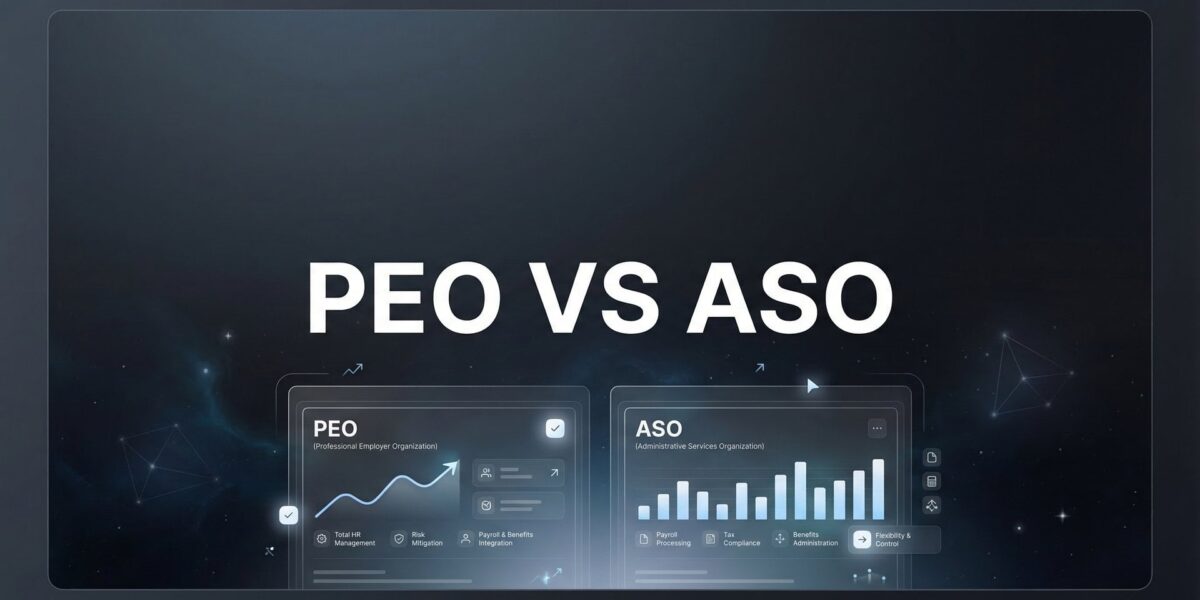
Most businesses treat the PEO vs ASO decision like a software comparison. They list features. They compare pricing tiers. They ask which one has better reviews. That approach misses what actually matters.
The real question isn’t which model offers more services. It’s whether you want to fundamentally change your employer structure or keep it intact while outsourcing administrative work.
A PEO becomes your co-employer. They share legal responsibility for your workforce. They become the employer of record for tax purposes. They provide benefits under their master policies. You gain access to their pooled risk programs and compliance infrastructure.
An ASO provides HR services without touching your employer status. You remain the sole employer. They process payroll, handle benefits administration, manage compliance paperwork — but the legal responsibility stays with you.
Neither model is universally better. The right choice depends on seven specific factors: how you think about risk, what your benefits situation looks like, where you operate, how much control you need, what your growth trajectory requires, and how clean you need your exit options to stay.
This guide breaks down each decision factor without the feature-list theater. No invented case studies. No percentage claims we can’t verify. Just the practical tradeoffs you need to evaluate before you sign anything.
1. Understand the Core Structural Difference First
The Challenge It Solves
Most business owners evaluate PEOs and ASOs based on service descriptions without understanding the fundamental legal structure underneath. That leads to signing contracts that don’t match how their business actually operates.
The confusion starts because both models handle similar administrative tasks. Both process payroll. Both manage benefits enrollment. Both help with compliance documentation. On the surface, they look like competing versions of the same service.
They’re not. The structural difference shapes everything from your insurance policies to your M&A readiness to how you terminate employees.
The Strategy Explained
A PEO operates through co-employment. When you engage a PEO, they become a legal employer alongside you. Your employees get added to the PEO’s payroll system. The PEO becomes the employer of record for federal tax purposes. Benefits run through the PEO’s master policies. Workers’ compensation coverage comes from the PEO’s program.
You maintain day-to-day operational control. You still manage who does what work, set schedules, determine compensation, and make hiring and firing decisions. But the legal employer responsibilities get shared. Understanding PEO co-employment is essential before making this decision.
An ASO provides the same administrative services without changing employer status. You remain the sole employer. The ASO processes transactions on your behalf, but your business stays the employer of record. Your employees remain your employees legally, not co-employees of a third party.
This structural difference determines who signs tax documents, whose name appears on benefits policies, how workers’ comp gets structured, and what happens during audits or legal disputes.
Implementation Steps
1. Ask potential providers directly: “Will you become a co-employer, or will my business remain the sole employer?” If they hedge or use vague language about “partnerships,” push for clarity on the legal structure.
2. Request sample employee documentation from each provider. Look at who gets listed as the employer on pay stubs, tax forms, and benefits enrollment materials. PEO documentation will show co-employment. ASO documentation will show your business as sole employer.
3. Review how workers’ compensation gets handled. PEOs typically provide coverage under their master policy with you as a client. ASOs help you secure your own policy as the direct employer. This difference affects your experience modification rate and long-term workers’ comp costs.
Pro Tips
If you’re considering acquisition or sale within the next few years, co-employment adds complexity to due diligence. Buyers often require PEO relationships to be unwound before closing. ASO relationships are simpler to transition or terminate because the employer structure never changed.
The IRS maintains a Certified Professional Employer Organization (CPEO) program. If you choose the PEO route, verify CPEO certification. It provides additional federal oversight and protections around tax compliance.
2. Map Your Risk Tolerance to the Right Model
The Challenge It Solves
Employment-related liability keeps growing. Wage and hour disputes. Discrimination claims. Workers’ compensation exposure. Benefits compliance failures. OSHA violations. Most small and mid-sized businesses lack the infrastructure to manage this risk effectively.
The question becomes: do you want to transfer some of that risk, or do you want to retain full control while building your own compliance systems?
The Strategy Explained
PEO co-employment shifts certain employer liabilities to the PEO. They typically assume responsibility for payroll tax compliance, benefits administration accuracy, and workers’ compensation claims management. Because they’re a legal co-employer, they share exposure to employment practices liability.
That doesn’t mean you’re completely protected. You still carry responsibility for workplace safety, discrimination claims related to your management decisions, and wrongful termination disputes. But the administrative compliance burden — tax filings, benefits reporting, wage calculations — shifts to the PEO’s systems. Learn more about PEO shared liability to understand exactly what transfers and what stays with you.
ASO relationships keep all employer liability with you. The ASO provides tools and guidance, but they’re not co-employers. If payroll taxes get miscalculated, you’re responsible. If benefits administration creates compliance issues, you face the penalties. The ASO processes transactions based on your instructions, but the legal accountability stays in your name.
The tradeoff is control. PEOs standardize processes to manage their own risk exposure. ASOs give you more flexibility because they’re not sharing liability.
Implementation Steps
1. List your current risk exposures honestly. High workers’ comp mod? Multi-state payroll tax complexity? Benefits compliance gaps? Industries with elevated employment litigation risk? Quantify what these exposures actually cost you annually in insurance premiums, legal fees, and staff time.
2. Ask PEO providers specifically what liability they assume and what remains with you. Get it in writing. Many businesses assume PEO co-employment provides broader protection than it actually delivers. Understand exactly where the risk transfer stops.
3. Compare your current employment practices liability insurance (EPLI) coverage against what a PEO relationship would change. Some PEOs include EPLI in their service bundle. Others require you to maintain separate coverage. Factor this into total cost analysis.
Pro Tips
If your business operates in high-risk industries — construction, healthcare, manufacturing — the workers’ comp pooling advantage through a PEO can deliver measurable savings. Lower experience mods translate directly to reduced premiums. Get specific quotes comparing your current workers’ comp costs against PEO pooled rates before deciding.
ASOs work better when you already have strong HR infrastructure and want to maintain direct insurance relationships. If you’ve built favorable workers’ comp rates through good safety programs, co-employment might actually increase your costs by pooling you with higher-risk employers.
3. Compare True Cost Structures, Not Just Quoted Fees
The Challenge It Solves
PEO and ASO providers quote fees differently, making direct comparison nearly impossible. PEOs typically charge a percentage of payroll. ASOs usually charge flat per-employee fees. Both models hide costs in different places.
Business owners compare a “3% of payroll” PEO quote against a “$150 per employee per month” ASO quote and have no idea which costs more. The real expense includes benefits markups, workers’ comp rates, technology fees, and administrative charges that don’t show up in the headline number.
The Strategy Explained
PEO pricing bundles multiple cost components into a single percentage-of-payroll fee. That percentage covers HR administration, benefits access, payroll processing, compliance support, and workers’ compensation. Sounds simple. But the percentage gets applied to gross payroll, which means your cost scales directly with wages and headcount.
The percentage model creates hidden inflation. Give employees raises? Your PEO fee increases proportionally, even though the administrative work didn’t change. Hire higher-paid employees? You pay more for the same HR services.
PEOs also mark up benefits. They negotiate group rates, then charge you a premium above the carrier cost. That markup doesn’t appear in the quoted percentage — it gets buried in your benefits billing. Understanding hidden PEO fees helps you identify these buried costs before signing.
ASO pricing typically uses flat per-employee-per-month (PEPM) fees. You pay the same amount whether an employee earns $40,000 or $140,000. Administrative costs stay predictable as wages increase. But ASO quotes often exclude benefits administration, workers’ comp, and compliance modules that get charged separately.
The real cost comparison requires breaking down every component: base administrative fees, benefits markups or carrier direct costs, workers’ comp rates, technology platform fees, compliance add-ons, and any per-transaction charges.
Implementation Steps
1. Request itemized pricing from every provider. Don’t accept a single percentage or PEPM number. Demand a breakdown showing administrative fees separate from benefits costs, workers’ comp rates, and any additional charges. Most providers resist transparency here — push back.
2. Run your actual payroll numbers through both models. Take your current annual gross payroll and employee count. Calculate what you’d pay under each provider’s structure. Include benefits markups, workers’ comp estimates, and all ancillary fees. The total annual cost comparison often looks very different from the quoted headline rates.
3. Model cost growth scenarios. What happens to your fees if you give a 5% across-the-board raise next year? PEO costs increase automatically. ASO costs might not change. What if you add ten employees? Calculate the marginal cost under each model. Growth trajectory matters for long-term cost planning.
Pro Tips
PEOs often provide better benefits pricing for smaller employers who lack negotiating leverage with carriers. If you’re under 50 employees and struggling with high benefits costs, the PEO’s pooled buying power might offset their administrative markup. Get specific benefits quotes from carriers directly and compare against PEO bundled rates.
ASO models give you more control over benefits spending. You can change carriers, adjust plan designs, or shop for better rates without renegotiating your entire HR outsourcing relationship. That flexibility has value if benefits costs are a major line item.
4. Evaluate Benefits Access Against Your Workforce Needs
The Challenge It Solves
Small and mid-sized employers face a structural disadvantage in benefits markets. Carriers price based on risk pools. A 30-person company gets worse rates than a 300-person company. Limited negotiating power means higher premiums, fewer plan options, and less flexibility.
This creates a retention problem. Talented employees compare your benefits package against what larger employers offer. If your health insurance costs more and covers less, you lose people.
The Strategy Explained
PEOs aggregate employees from hundreds of client companies into large risk pools. A PEO with 10,000 employees across 200 clients negotiates as a 10,000-employee group, not as 200 small companies. That pooling creates access to Fortune 500-level benefits programs at small business scale.
The benefits advantage includes more than just pricing. PEOs typically offer multiple carrier options, broader plan designs, and supplemental benefits that small employers can’t access independently. Dental, vision, life insurance, disability coverage, FSAs, HSAs — the full benefits menu becomes available.
But you lose control. The PEO determines which carriers and plans are available. You select from their menu, but you can’t bring your own carrier relationships or negotiate custom plan designs. Benefits standardization is how PEOs manage their pooled risk.
ASO relationships keep benefits decisions with you. You select carriers, negotiate rates, design plans, and manage renewals directly. If you have strong existing carrier relationships or unique benefits needs, you maintain that flexibility. But you negotiate as your actual company size, not as part of a larger pool.
The tradeoff depends on your current benefits situation. If you’re paying high premiums for limited coverage, PEO pooling might deliver immediate savings. If you’ve built competitive benefits programs through good broker relationships, ASO flexibility might serve you better.
Implementation Steps
1. Get current renewal quotes for your existing benefits programs. Compare your per-employee costs and coverage levels against what PEO providers offer through their pooled programs. Focus on total employer contribution, not just premium rates. Factor in deductibles, coverage networks, and plan quality.
2. Survey your workforce about benefits priorities. Do employees want more plan options? Better coverage? Lower out-of-pocket costs? Different carriers? Understanding what your team actually values helps determine whether PEO standardization or ASO flexibility matters more.
3. Calculate benefits cost as a percentage of total compensation. If benefits represent a major expense and you’re struggling with annual increases, PEO pooling might provide cost stability. If benefits are competitive and employees are satisfied, maintaining your current structure through an ASO makes sense.
Pro Tips
PEO benefits access delivers the most value for companies under 50 employees in states with expensive health insurance markets. The pooling advantage shrinks as your company grows. Once you reach 100+ employees, your own negotiating power might match or exceed what PEOs offer.
If you operate in industries where benefits are a primary recruitment tool — healthcare, technology, professional services — maintaining benefits flexibility through an ASO lets you differentiate your offerings. Standardized PEO plans work fine for general employee populations but limit customization for specialized talent needs.
5. Assess Compliance Complexity in Your Operating States
The Challenge It Solves
Multi-state employment creates exponential compliance complexity. Each state has different wage and hour laws, paid leave requirements, tax withholding rules, unemployment insurance systems, and workers’ compensation regulations. Staying current across jurisdictions requires dedicated expertise most small businesses don’t have.
The compliance burden isn’t theoretical. Misclassified employees, incorrect tax withholding, missed paid leave accruals, or improper overtime calculations create real liability. State labor departments actively audit employers. The penalties compound quickly.
The Strategy Explained
PEOs handle multi-state compliance as part of their core service. Because they operate as co-employers across all 50 states, they maintain compliance infrastructure for every jurisdiction. State tax registrations, unemployment insurance accounts, workers’ comp coverage, paid leave tracking — the PEO manages these requirements across your operating locations.
When employment laws change, PEOs update their systems and processes. You don’t need to track new paid sick leave ordinances in six different cities or monitor changing overtime thresholds across states. The PEO’s compliance team handles regulatory monitoring and implementation.
This matters most when you employ people in multiple states with different regulatory environments. California, New York, Massachusetts, Washington — these states have complex employment laws that change frequently. Managing compliance across these jurisdictions requires specialized knowledge. National PEO companies specialize in handling these multi-state complexities.
ASOs provide compliance tools and guidance, but implementation responsibility stays with you. They’ll help you understand requirements and process transactions correctly, but you need to maintain your own multi-state tax accounts, track changing regulations, and ensure your policies meet each state’s requirements.
The ASO model works when you operate in a single state or a few states with similar regulatory environments. It becomes challenging when you expand into high-complexity jurisdictions without internal HR expertise.
Implementation Steps
1. Map your current and planned operating locations. List every state where you have employees or plan to hire within the next two years. Research the employment law complexity in each jurisdiction. States like California, New York, and Massachusetts require significantly more compliance infrastructure than states like Texas or Florida.
2. Audit your current compliance status honestly. Are you properly registered for state taxes in every jurisdiction where you have employees? Do you track paid leave accruals according to each state’s requirements? Are your overtime calculations correct for each state’s rules? If you find gaps, quantify what it would cost to fix them internally versus through a PEO relationship.
3. Calculate the cost of multi-state compliance expertise. Hiring an experienced HR manager who understands multi-state employment law typically costs $80,000-$120,000 annually plus benefits. Compare that against PEO fees using a PEO cost vs HR manager analysis. If the PEO’s compliance infrastructure costs less than building your own, the value proposition becomes clear.
Pro Tips
If you operate exclusively in one state with straightforward employment laws, the PEO’s multi-state compliance advantage doesn’t apply to you. ASO relationships provide sufficient support for single-state operations without the co-employment commitment.
Remote work expansion drives many businesses toward PEOs. If you’ve shifted to remote hiring and now have employees scattered across ten states, managing compliance independently becomes exponentially harder. PEO co-employment simplifies the administrative burden significantly.
6. Determine How Much Operational Control You Need to Retain
The Challenge It Solves
HR outsourcing creates tension between standardization and flexibility. Providers build efficient systems by standardizing processes. Your business might need customization that doesn’t fit their templates.
This tension shows up everywhere. Payroll processing schedules. Benefits enrollment procedures. Performance review systems. Onboarding workflows. Time tracking requirements. Every business operates slightly differently. The question is whether you’re willing to adapt to the provider’s standard processes or whether you need to maintain your own approach.
The Strategy Explained
PEOs operate through standardization. Because they’re co-employers managing thousands of employees across hundreds of clients, they need consistent processes to manage risk and maintain efficiency. Their payroll systems, benefits administration, compliance procedures, and HR workflows follow established templates.
You can customize within limits, but fundamental processes stay standardized. Payroll runs on the PEO’s schedule. Benefits enrollment follows the PEO’s timeline. Performance management uses the PEO’s tools. Compliance documentation follows the PEO’s templates.
This standardization delivers value through reliability and reduced administrative burden. You don’t need to build HR systems from scratch. But you lose the ability to design processes that match your specific operational needs.
ASO relationships provide more flexibility. Because the ASO isn’t a co-employer, they’re not managing shared risk across a client base. They process transactions according to your specifications. You can maintain custom payroll schedules, design your own onboarding workflows, use your preferred time tracking systems, and structure benefits enrollment around your business calendar.
The ASO adapts to how you operate rather than requiring you to adapt to their systems. That flexibility matters when your business has unique operational requirements or when you’ve built HR processes that work well and don’t want to change them.
Implementation Steps
1. Document your current HR processes in detail. How does payroll actually run? When do benefits enrollments happen? What systems do you use for time tracking, performance reviews, onboarding, and offboarding? Map your existing workflows before evaluating providers.
2. Ask potential providers specifically what customization they allow. Can you maintain your current payroll schedule? Can you use your existing time tracking system? Can you design custom onboarding workflows? Can you integrate with your current HR technology stack? PEOs will have more restrictions than ASOs. Understand the limitations upfront.
3. Identify which processes are negotiable and which aren’t. Some standardization might actually improve efficiency. Other processes might be critical to how your business operates. Be clear about where you need flexibility and where you can adapt to the provider’s systems.
Pro Tips
If you’re a fast-growing company that needs to move quickly, PEO standardization can actually accelerate scaling. You don’t need to build HR infrastructure as you grow — you plug into the PEO’s existing systems. The tradeoff is worth it when speed matters more than customization.
ASO flexibility matters most for businesses with complex operational structures. Multiple entities, varied compensation models, industry-specific compliance requirements, or unique benefits designs all benefit from ASO customization. If your HR needs don’t fit standard templates, ASO relationships preserve operational control.
7. Factor Exit Flexibility Into Your Initial Decision
The Challenge It Solves
Most businesses evaluate PEO and ASO relationships based on current needs. They compare pricing, services, and immediate operational fit. Almost no one thinks about what happens when they need to leave.
Exit planning matters because business circumstances change. You might get acquired. You might grow large enough to justify bringing HR in-house. You might find a better provider. You might need to restructure for financial reasons. The relationship you enter today needs to be one you can exit cleanly when circumstances change.
The Strategy Explained
PEO relationships are harder to exit because of the co-employment structure. Your employees are on the PEO’s payroll system. Benefits run through the PEO’s master policies. Workers’ comp coverage comes from the PEO’s program. Tax accounts are under the PEO’s federal employer identification number.
Leaving requires unwinding all of these relationships simultaneously. You need to establish your own payroll system, secure new benefits coverage, obtain workers’ comp policies, set up state tax accounts, and transfer employee records. This transition takes planning, creates administrative burden, and introduces risk of gaps in coverage.
The timing matters too. Benefits transitions need to align with plan years. Workers’ comp coverage needs to transfer without gaps. Payroll systems need to cutover cleanly. Most PEO exits take 60-90 days of careful coordination. A comprehensive PEO exit strategy guide can help you plan this transition properly.
ASO relationships are simpler to exit because the employer structure never changed. Your employees remained your employees throughout. You already maintain your own tax accounts, benefits policies, and workers’ comp coverage. The ASO was processing transactions on your behalf, not serving as co-employer.
Exiting an ASO relationship mainly involves transitioning administrative processes. You can bring payroll processing in-house, switch to a different ASO provider, or move to a PEO if circumstances change. The transition doesn’t require restructuring your entire employer infrastructure.
Implementation Steps
1. Read the termination provisions in any contract before signing. How much notice is required? What fees apply if you terminate early? What transition support does the provider offer? PEO contracts often include longer notice periods and more complex exit requirements than ASO agreements.
2. Ask providers directly about their exit process. Request a written overview of what’s required to terminate the relationship. How long does the transition take? What support do they provide? What are the common challenges? Understanding the exit process upfront helps you evaluate the total commitment you’re making.
3. Consider your business trajectory over the next 3-5 years. Are you likely to get acquired? Planning rapid growth? Considering going public? Evaluating restructuring options? Any of these scenarios might require exiting your HR outsourcing relationship. Choose the model that preserves your future flexibility.
Pro Tips
If you’re considering sale or acquisition within the next few years, ASO relationships create less due diligence complexity. Buyers often require PEO relationships to be unwound before closing, which adds time and risk to transactions. Maintaining direct employer status through an ASO keeps your options cleaner.
PEO contracts typically run 1-3 years with auto-renewal provisions. Read the renewal terms carefully. Some contracts make it difficult to exit without significant notice or penalties. Knowing how to compare PEO contracts helps you identify problematic terms before signing. ASO agreements often offer more flexible terms, but verify this before signing.
Your Next Steps
The PEO vs ASO decision isn’t about which model has better features. It’s about whether co-employment serves your specific business needs better than maintaining sole employer status while outsourcing administrative work.
PEOs make sense when you need liability protection through risk transfer, when you want access to better benefits programs through pooled buying power, or when multi-state compliance complexity exceeds your internal capacity. The co-employment structure delivers real value in these scenarios — if the cost premium is justified by what you gain.
ASOs work when you have strong existing benefits relationships you want to maintain, when you need operational flexibility that standardized PEO processes don’t provide, or when you want to keep your employer structure clean for future transactions. You get administrative support without changing your fundamental employer status.
Start by mapping your actual pain points. What keeps you up at night? Workers’ comp exposure? Benefits costs? Multi-state compliance gaps? Payroll processing errors? Administrative burden on internal staff? The problems you’re solving determine which model fits.
Then run the numbers honestly. Get specific quotes from multiple providers in both categories. Break down total costs including all fees, markups, and ancillary charges. Model what happens to your costs as you grow, give raises, or expand into new states.
Factor in your business trajectory. Where will you be in three years? Five years? Will you need to exit this relationship for acquisition, growth, or strategic reasons? Choose the model that preserves your future flexibility.
Before you renew your PEO agreement, compare your options. Most businesses overpay due to bundled fees and unclear administrative markups. We break down pricing, services, and contract structures so you can make a smarter decision.
The right choice depends on your specific numbers, risk profile, and operational needs. No general advice changes that. Get the data, understand the tradeoffs, and make the decision that actually fits how your business operates.