
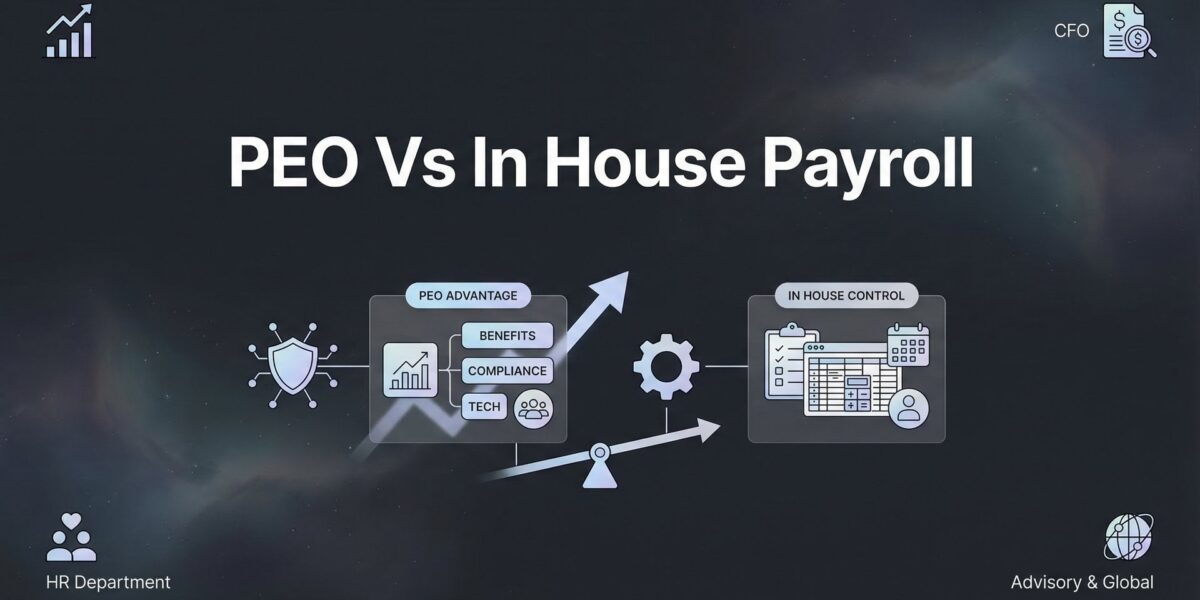
The PEO vs in-house payroll decision isn’t really about payroll at all. It’s about what kind of operational infrastructure your business needs right now—and what it’ll need in 18 months.
Most comparison guides treat this like a feature checklist: PEOs do X, in-house does Y. That’s not useful.
The real question is which model fits your specific situation, growth trajectory, and risk tolerance. This guide breaks down the seven decision factors that actually move the needle, with honest assessments of when each approach makes sense and when it doesn’t.
No sales pitch. Just the tradeoffs you need to weigh.
1. Calculate Your True Cost Baseline
Most businesses compare PEO pricing against their current payroll software subscription and think they’ve done the math. They haven’t.
The real cost of in-house payroll includes everything your team does to make payroll happen correctly: researching tax changes, updating withholding tables, reconciling benefit deductions, responding to employee questions, fixing errors, filing corrections, and managing year-end reporting.
What Actually Goes Into In-House Costs
Start with your payroll platform fee. Then add the time your finance or HR person spends on payroll administration each month. If they’re spending six hours per pay period on payroll tasks, that’s real labor cost.
Include benefits administration overhead. Someone is managing enrollment changes, reconciling carrier invoices, handling COBRA notices, and answering employee questions about coverage. That time counts.
Factor in compliance research and updates. Tax law changes constantly. Someone has to track those changes, update your system, and verify accuracy. Most businesses underestimate this significantly.
Building Your Comparison
1. List your current payroll software costs including all modules and add-ons
2. Calculate actual labor hours spent on payroll and benefits administration monthly
3. Add estimated costs for compliance research, error correction, and year-end filing complexity
4. Include any third-party services like benefits brokers or tax filing assistance
5. Compare that total against PEO per-employee-per-month pricing for your actual headcount
When The Numbers Shift
In-house often looks cheaper on paper until you account for the hidden time drain. If your office manager is spending 15 hours a month on payroll tasks instead of operational priorities, you’re paying for that inefficiency whether you track it or not.
PEO pricing becomes more competitive when you factor in what you’re actually spending to maintain in-house infrastructure—not just what shows up on your software invoice. Understanding how to calculate PEO savings requires looking beyond surface-level costs.
2. Assess Your Multi-State Complexity Level
Operating in multiple states changes the entire decision calculus. This is where in-house payroll goes from manageable to genuinely burdensome.
Each state has different income tax withholding rules, unemployment insurance requirements, disability insurance mandates, and wage payment regulations. Tracking all of that correctly requires constant attention.
The Compliance Burden Multiplier
Single-state operations deal with one set of tax rules, one unemployment system, one wage and hour framework. That’s manageable with decent payroll software and someone who understands the basics.
Add a second state and complexity doesn’t double—it triples. You’re now managing two tax jurisdictions, two unemployment accounts, potentially different wage payment timing requirements, and varying rules around final paychecks and termination pay.
By the time you’re operating in four or five states, you’re essentially running parallel compliance processes for each jurisdiction. Most small businesses don’t have the bandwidth for that.
Geographic Footprint Questions
1. How many states do you currently have employees in?
2. Are you planning to hire remotely or expand geographically in the next 12 months?
3. Do any of your states have particularly complex requirements like California or New York?
4. Does your team have the capacity to track regulatory changes across multiple jurisdictions?
When Geographic Complexity Justifies a PEO
If you’re operating in three or more states with under 50 employees, the administrative overhead of maintaining multi-state compliance in-house usually outweighs the cost of PEO services.
PEOs already have infrastructure in all 50 states. They’re tracking regulatory changes, managing tax filings, and handling unemployment claims across jurisdictions daily. Businesses with multi-location payroll challenges often find this infrastructure invaluable.
For single-state businesses with no expansion plans, this factor becomes irrelevant. But if geographic growth is part of your strategy, plan for the compliance complexity now rather than scrambling later.
3. Evaluate Your Benefits Buying Power
The benefits angle is where PEO marketing gets aggressive—and where business owners need to think clearly about their actual leverage.
PEOs claim superior benefits access through pooled purchasing power. Sometimes that’s true. Sometimes it’s not. It depends entirely on your size, industry, and current broker relationships.
When Pooled Purchasing Actually Helps
If you’re a 15-person company trying to negotiate health insurance rates independently, you have almost no leverage. Carriers view you as high-risk because your small group size creates volatility. One major claim can spike your renewal rates significantly.
PEOs pool thousands of employees across their client base, which gives them negotiating leverage with carriers. For very small businesses, this can genuinely improve plan options and pricing stability.
But the advantage diminishes as you grow. Once you’re past 50 employees, you start developing meaningful standalone negotiating power. By 100 employees, you may get better rates working directly with a broker than through PEO pooled plans.
Industry and Geography Matter
If you’re in a high-risk industry—construction, manufacturing, certain service sectors—your standalone workers’ comp rates might be punitive. PEOs can sometimes improve that through their master policy, though you’ll still pay experience-rated adjustments.
Geography affects benefits leverage too. In markets with limited carrier options, PEO access to national networks might expand your choices. In competitive metro markets, you may already have strong standalone options.
Questions to Answer Honestly
1. What are your current benefits costs per employee across health, dental, vision, and ancillary coverage?
2. Have you gotten competitive quotes from independent brokers recently?
3. Does your industry or claims history create standalone rating challenges?
4. How important is plan customization versus standardized options?
The Customization Tradeoff
PEO benefits are pooled, which means limited customization. You’re choosing from their menu of plans, not building a custom benefits strategy. For some businesses, that’s fine. For others, it’s a constraint.
If benefits are a key talent differentiator in your market, maintaining standalone control might matter more than marginal cost savings. Knowing how to compare PEO services helps you evaluate benefits offerings alongside other factors.
4. Map Your Compliance Risk Exposure
Some industries attract regulatory scrutiny. Others don’t. That reality should influence your decision more than it typically does.
If you’re operating in a heavily regulated sector—healthcare, finance, professional services with licensing requirements—your compliance risk profile is fundamentally different than a low-regulation business.
Understanding Co-Employment Risk Transfer
When you engage a PEO, you’re entering a co-employment relationship. The PEO becomes the employer of record for tax and regulatory purposes, which shifts certain compliance responsibilities to them.
That doesn’t eliminate your liability entirely, but it does transfer day-to-day compliance execution. The PEO handles tax filings, manages unemployment claims, processes wage garnishments, and maintains regulatory documentation. Understanding PEO shared liability helps clarify what actually transfers.
For businesses operating in high-scrutiny environments, that transfer can be valuable. You’re still responsible for workplace safety, employee treatment, and operational compliance, but payroll tax accuracy and employment documentation become the PEO’s problem.
When Risk Transfer Justifies the Cost
If you’re in an industry with frequent audits, complex wage and hour requirements, or significant penalties for compliance errors, the risk mitigation value of a PEO can outweigh the cost premium.
Construction companies dealing with certified payroll requirements and prevailing wage compliance often find PEO infrastructure worth the expense. The alternative is maintaining that expertise in-house, which requires dedicated staff and constant training.
Professional services firms with multi-state licensing requirements and strict recordkeeping mandates sometimes reach the same conclusion—not because PEOs are better at compliance, but because they’re already set up to handle it at scale.
Assessing Your Risk Profile
1. How frequently does your industry face regulatory audits or investigations?
2. What are the typical penalties for payroll tax errors or employment documentation failures in your sector?
3. Do you have internal expertise to manage complex compliance requirements confidently?
4. How much would a significant compliance failure cost your business in fines, legal fees, and operational disruption?
The Control Tradeoff
Risk transfer comes with reduced control. You’re relying on the PEO’s processes, timelines, and responsiveness. If compliance control matters more than risk mitigation, that tradeoff might not work for you.
But if you’re in a high-risk environment without deep internal compliance capability, the math often favors transferring that burden to someone who handles it professionally. Working with a certified PEO company provides additional tax liability protections.
5. Factor In Growth Trajectory
Your current headcount matters less than where it’s headed. Infrastructure decisions should account for the business you’re becoming, not just the one you’re running today.
If you’re planning to double headcount in the next 18 months, your payroll and HR needs will change significantly. Plan for that now rather than scrambling mid-growth.
Scaling In-House Infrastructure
In-house payroll works fine at 10 employees. It starts showing strain at 25. By 50, you typically need someone who owns HR and payroll administration as their primary responsibility.
Scaling in-house means adding headcount, implementing more sophisticated systems, and building processes that can handle increased complexity. That’s manageable if you’re growing gradually, but it becomes problematic during rapid expansion.
If you’re hiring aggressively across multiple locations or states, in-house infrastructure struggles to keep pace. You’re onboarding new employees faster than you can refine processes, which creates errors and administrative drag.
PEO Scalability Advantages
PEOs are built to scale. Adding 20 employees in six months doesn’t require you to rebuild your HR infrastructure—it just increases your per-employee fee.
That scalability matters most during high-growth phases. You’re not hiring an HR manager, implementing new systems, or training staff on expanded compliance requirements. You’re leveraging infrastructure that already exists.
The tradeoff is cost. PEO fees scale linearly with headcount, which means your administrative costs grow proportionally. In-house infrastructure has higher fixed costs but better economies of scale once you’re large enough to justify dedicated staff. Comparing PEO cost vs hiring an HR manager helps identify that crossover point.
Growth Planning Questions
1. What’s your realistic headcount projection for the next 12-24 months?
2. Are you planning geographic expansion or remote hiring that adds state complexity?
3. Will your current team be able to absorb increased administrative workload?
4. At what headcount would you need to hire a dedicated HR person to manage in-house operations?
The Transition Cost
Switching from in-house to PEO mid-growth is disruptive. You’re migrating payroll data, transitioning benefits, and changing employee-facing processes during a period when you need operational stability.
If growth is part of your near-term plan, choose infrastructure that can handle that growth without requiring a mid-flight transition.
6. Weigh Control vs Convenience
Some business owners want direct control over every operational process. Others want administrative tasks handled by someone else so they can focus on running the business.
Neither approach is wrong, but you need to know which type you are before making this decision.
What Control Actually Means
In-house payroll gives you complete control over timing, processes, customization, and employee interactions. You decide when payroll runs, how exceptions are handled, and how employee questions get answered.
You can customize workflows to match your operational preferences. You can integrate payroll with other systems exactly how you want. You can make changes immediately without waiting for a PEO service team.
That control matters if your business has unique payroll requirements, non-standard pay structures, or frequent process adjustments. It also matters if you want direct oversight of compliance decisions rather than relying on third-party judgment.
The Convenience Value Proposition
PEOs handle the entire administrative process. You submit hours, approve payroll, and they manage everything else—tax filings, benefit deductions, compliance updates, employee questions.
For business owners who view payroll as a necessary but non-strategic function, that convenience has real value. You’re not spending mental energy on payroll mechanics. You’re trusting someone else to execute it correctly.
The tradeoff is reduced flexibility. PEOs operate on standardized processes and timelines. If you need something done outside their normal workflow, you’re working within their constraints, not yours. Understanding how a PEO works step by step clarifies what you’re delegating.
Operational Fit Questions
1. How important is process customization to your business operations?
2. Do you have non-standard pay structures that require flexible payroll handling?
3. How comfortable are you delegating compliance decisions to a third party?
4. Would removing payroll administration from your plate free up meaningful time for higher-value work?
The Employee Experience Factor
In-house payroll means employees come directly to you with questions and issues. That creates closer connection but also ongoing administrative interruption.
PEO arrangements route employee questions through the PEO’s support team. That removes the burden from your staff but also adds a layer between you and your employees for HR-related matters.
Some businesses prefer keeping that connection internal. Others are happy to outsource it. Know which matters more to you.
7. Test Internal HR Capacity
This is the factor most businesses ignore until it becomes a problem. Do you actually have the internal capacity to own payroll and HR administration, or would it pull leadership away from work that matters more?
Be honest about this. The answer determines whether in-house is genuinely viable or just theoretically cheaper.
Capacity vs Capability
Capability means your team knows how to run payroll and handle HR administration. Capacity means they have time to do it well without sacrificing other priorities.
Many small businesses have the capability—someone on the team understands payroll mechanics and can manage the process. Fewer have the capacity to do it consistently without creating bottlenecks elsewhere.
If your office manager is handling payroll, benefits administration, vendor management, and operational coordination, adding more to their plate doesn’t make them more efficient—it makes them a constraint.
The Opportunity Cost Reality
Time spent on payroll administration is time not spent on revenue-generating activities, strategic planning, or operational improvement. That opportunity cost is real even if it’s hard to quantify.
For businesses where leadership time is the limiting factor for growth, outsourcing HR to a PEO often makes sense even when it costs more on paper. You’re buying back time to focus on what actually moves the business forward.
For businesses where administrative efficiency is already strong and leadership isn’t operationally constrained, maintaining in-house control might be the better play.
Honest Assessment Questions
1. Who would own payroll and HR administration if you keep it in-house?
2. What other responsibilities does that person currently handle?
3. Would adding payroll administration create operational bottlenecks or reduce effectiveness in other areas?
4. Is payroll administration pulling leadership away from higher-value strategic work?
The Scalability Test
Even if your team can handle current payroll administration, can they absorb growth without adding headcount? If you’re planning to hire aggressively, when does the administrative workload justify bringing on a dedicated HR person?
For many businesses, that inflection point is around 30-40 employees. Below that threshold, PEO services often cost less than hiring a full-time HR manager. Above it, in-house starts making more financial sense—if you have someone capable of owning the function.
If you don’t have that person and don’t want to hire for it, PEO infrastructure remains the more practical option regardless of headcount.
Making the Call Based on Your Actual Situation
Start with your constraints, not your preferences.
If you’re operating in multiple states with under 50 employees and no dedicated HR person, the math usually favors a PEO—not because it’s better, but because the alternative requires building infrastructure you don’t have.
If you’re a single-state operation with stable headcount and someone who can own HR administration, in-house might make more sense financially. You’re not dealing with multi-state complexity, you have internal capacity, and you value the control that comes with managing processes directly.
Run the numbers on your actual situation. Factor in the costs you’d rather ignore—the time drain, the compliance overhead, the opportunity cost of leadership attention on administrative tasks.
Then make the call based on what your business needs today and where it’s headed. If you’re already working with a PEO and questioning whether it still makes sense, compare your options. Most businesses overpay due to bundled fees and unclear administrative markups. We break down pricing, services, and contract structures so you can make a smarter decision.
The right answer isn’t universal. It’s specific to your headcount, geographic footprint, growth trajectory, and internal capacity. Evaluate those factors honestly, and the decision becomes clearer.