
Choosing a PEO often feels like navigating a maze blindfolded. Pricing is deliberately opaque, service quality varies wildly between providers, and most “best PEO” lists are pay-to-play arrangements designed to funnel you toward whoever paid the most for placement. If you’re evaluating PEO options—or reconsidering your current provider—you need straight answers about what actually differentiates these companies beyond marketing claims. Here are the top PEO companies and resources worth considering in 2026, based on real service differentiation, pricing transparency, and operational value.
1. Clicks Geek PEO
Best for: Business owners who want independent PEO comparisons before signing or renewing a contract
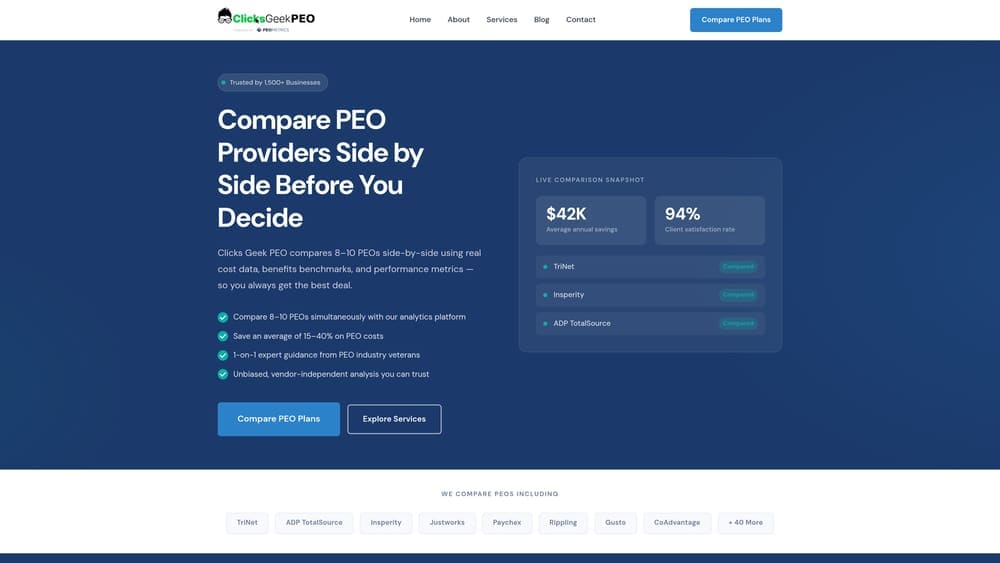
Clicks Geek PEO is not a PEO itself—it’s an independent comparison platform that helps you evaluate PEO providers objectively.
Where This Platform Shines
Most PEO selection happens in an information vacuum. Providers don’t publish pricing. Comparison sites are affiliate-driven. Contract terms are buried in legalese. Clicks Geek PEO addresses this by providing side-by-side provider evaluations, pricing breakdowns, and contract analysis without affiliate bias.
This matters because most businesses renew PEO contracts without knowing whether they’re overpaying or if better options exist. The platform helps you understand what you’re actually buying before you commit to multi-year agreements with automatic renewal clauses.
Key Features
Side-by-Side Provider Comparisons: Direct comparison of service models, pricing structures, and contract terms across major PEO providers.
Transparent Pricing Analysis: Breakdowns of how PEOs actually charge—percentage of payroll vs. flat fees, administrative markups, and hidden costs.
Contract Term Breakdowns: Analysis of renewal clauses, termination requirements, and what you’re actually agreeing to in PEO contracts.
Independent Evaluations: No affiliate relationships or pay-to-play arrangements—evaluations based on actual service differentiation and operational fit.
Best For
Business owners evaluating PEO options for the first time, companies reconsidering their current PEO relationship, or CFOs and operations managers who need objective comparison data before renewal decisions. Particularly valuable if you’re tired of sales pitches and want to understand the actual cost and service tradeoffs.
Pricing
Free comparison resources and educational content. No cost to access provider evaluations or pricing analysis.
2. Justworks
Best for: Startups and growing companies that want transparent pricing and a modern self-service platform
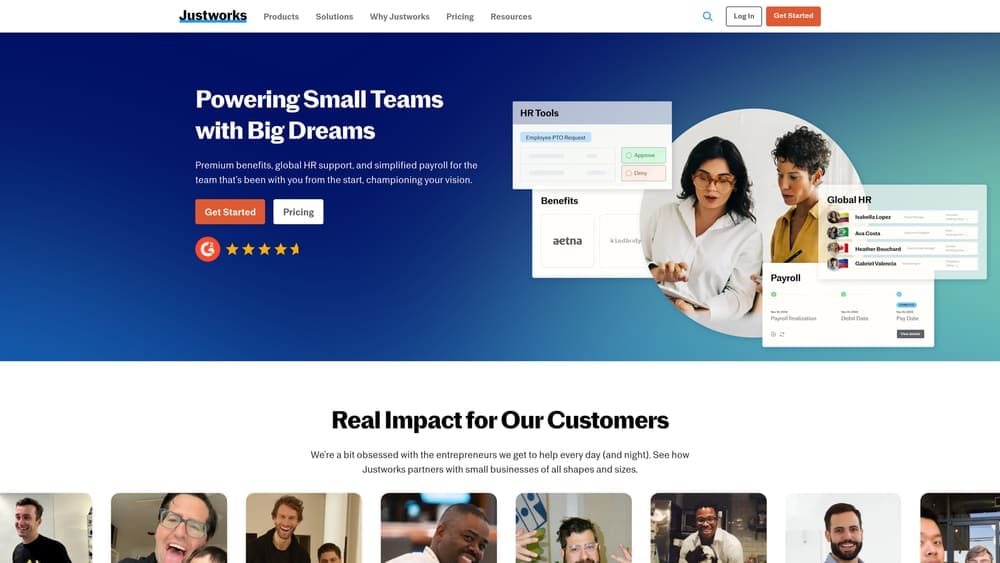
Justworks is a modern PEO platform with flat per-employee pricing and an intuitive interface designed for tech-forward businesses.
Where This Tool Shines
Justworks stands out for pricing transparency in an industry that typically hides costs. You pay a flat monthly fee per employee—no percentage of payroll calculations, no hidden administrative markups. This makes budgeting straightforward and removes the incentive misalignment where your PEO benefits from higher payroll costs.
The platform itself feels more like modern SaaS software than legacy HR systems. Onboarding is self-service. Benefits enrollment is clean. Employees can access everything through a mobile app without calling an 800 number. For companies that value operational efficiency over hand-holding, this model works well.
Key Features
Flat Monthly Per-Employee Pricing: Transparent $59 or $99 per employee monthly fee structure with no percentage-of-payroll calculations.
Modern Self-Service Platform: Clean interface for payroll, benefits, compliance, and HR tasks without requiring dedicated HR staff interaction for routine operations.
Transparent Benefits Options: Clear benefits packages with upfront cost breakdowns and employee contribution visibility.
24/7 Support: Access to support resources and HR guidance outside traditional business hours for distributed or flexible work environments.
Best For
Startups, tech companies, and growing businesses with 5-100 employees that prefer self-service platforms over dedicated account reps. Works well if your team is comfortable with technology and doesn’t need constant HR hand-holding. Less ideal if you want deep industry-specific compliance guidance or prefer relationship-driven service models.
Pricing
Starts at $59/employee/month (Basic) or $99/employee/month (Plus). No percentage-of-payroll fees. Additional costs for workers’ comp vary by state and risk classification.
3. TriNet
Best for: Companies that need enterprise-grade benefits and industry-specific HR expertise
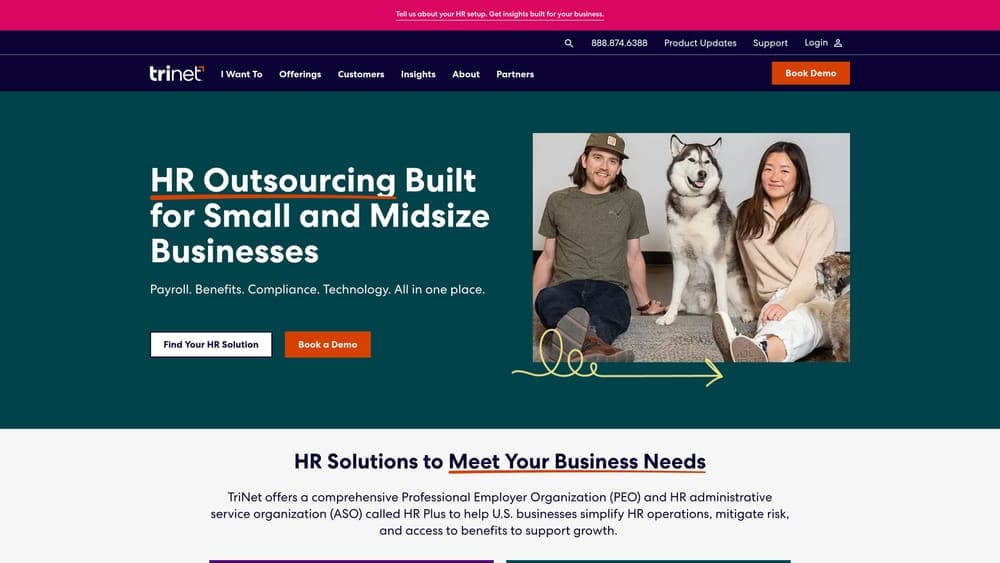
TriNet is a full-service PEO known for strong benefits packages and specialized HR teams organized by industry vertical.
Where This Tool Shines
TriNet’s primary advantage is benefits buying power. They aggregate employees across thousands of client companies to negotiate enterprise-level health insurance, retirement plans, and supplemental benefits that small businesses couldn’t access independently. This matters when you’re competing for talent against larger companies with better benefits packages.
The industry-specific HR model means you’re not getting generic HR advice. Their teams specialize in verticals like technology, financial services, nonprofits, and professional services—understanding the compliance nuances, compensation benchmarks, and operational patterns specific to your industry. This depth matters more as regulatory complexity increases.
Key Features
Enterprise-Grade Benefits Access: Health insurance, dental, vision, life, disability, and retirement plans typically available only to Fortune 500 companies.
Industry-Specific HR Teams: Dedicated HR professionals who specialize in your vertical and understand industry-specific compliance, compensation, and operational challenges.
Risk Mitigation Services: Proactive compliance monitoring, employment practices liability insurance, and regulatory change management.
Compliance Expertise: Multi-state employment law guidance, wage and hour compliance, and regulatory filing management across jurisdictions.
Best For
Companies with 10-500 employees in industries with complex compliance requirements or competitive talent markets. Particularly strong fit for tech companies, professional services firms, and businesses operating across multiple states. The value proposition weakens if you’re in a low-complexity industry or don’t need premium benefits to attract talent.
Pricing
Custom pricing based on headcount, services, and risk profile—typically structured as a percentage of payroll. Expect 2-8% of gross payroll depending on company size and service level, plus workers’ comp costs.
4. ADP TotalSource
Best for: Growing companies that need IRS-certified CPEO status and deep compliance infrastructure
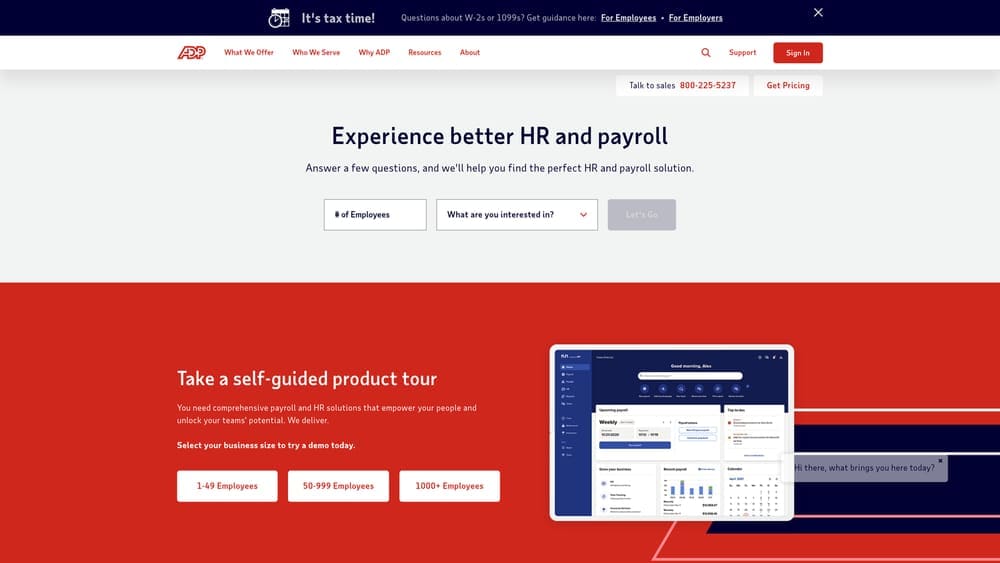
ADP TotalSource is the PEO arm of ADP, offering comprehensive HR outsourcing with CPEO certification and integration into ADP’s broader ecosystem.
Where This Tool Shines
CPEO certification matters more than most businesses realize. It’s an IRS designation that requires financial audits, bonding, and strict compliance standards. When a CPEO pays your payroll taxes, the IRS holds them accountable—not you—for any errors or delays. This shifts meaningful liability away from your business in ways that non-certified PEOs cannot.
ADP’s infrastructure advantage is real. They process payroll for millions of employees, maintain relationships with every major benefits carrier, and have compliance teams tracking regulatory changes across all 50 states. This scale translates into operational reliability that smaller PEOs struggle to match, particularly if you’re growing rapidly or operating in multiple jurisdictions.
Key Features
CPEO Certification: IRS-certified status providing additional tax liability protection and regulatory accountability beyond standard PEO arrangements.
Extensive Compliance Support: Multi-state employment law expertise, regulatory change monitoring, and proactive compliance guidance across jurisdictions.
Scalable for Growing Companies: Infrastructure designed to support businesses from 10 to 1,000+ employees without platform limitations or service degradation.
Integration with ADP Ecosystem: Seamless connection to ADP’s broader HR, payroll, time tracking, and benefits administration tools for unified data management.
Best For
Companies with 20-500 employees that prioritize operational reliability, tax liability protection, and compliance infrastructure over cost optimization. Strong fit if you’re growing quickly, operating in multiple states, or in a highly regulated industry. Less compelling if you’re cost-sensitive or prefer relationship-driven service over platform-based support.
Pricing
Custom pricing based on company size and service configuration—typically structured as a percentage of payroll. Pricing tends to be higher than regional PEOs but competitive with other national providers offering CPEO certification.
5. Paychex PEO
Best for: Companies with significant workers’ compensation exposure or variable headcount
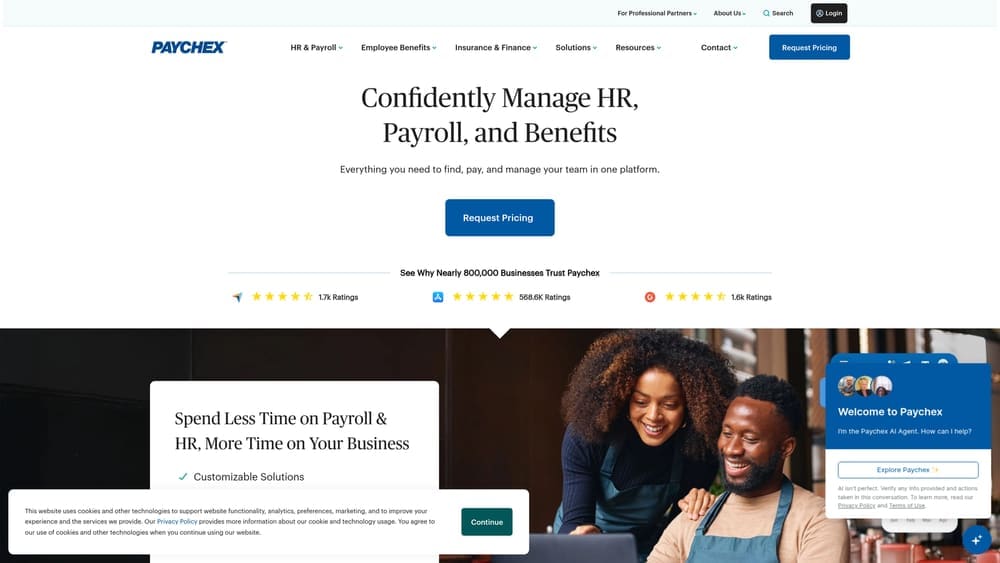
Paychex PEO is an established PEO with particular strength in workers’ compensation management and flexible pay-as-you-go options.
Where This Tool Shines
Workers’ compensation is often the hidden cost driver in PEO relationships. Paychex has built strong workers’ comp programs with pay-as-you-go options that tie premiums directly to actual payroll rather than requiring large upfront deposits based on estimated annual payroll. This matters significantly for businesses with seasonal fluctuations or variable headcount.
The dedicated HR professional model means you have a named contact who understands your business rather than calling a general support line. For businesses that value relationship continuity over self-service platforms, this approach reduces friction when handling complex HR situations or compliance questions that require context.
Key Features
Strong Workers’ Comp Programs: Specialized workers’ compensation management with industry-specific safety programs and claims support.
Pay-As-You-Go Workers’ Comp Options: Premium payments tied to actual payroll rather than large upfront deposits based on estimated annual costs.
Dedicated HR Professional: Named HR specialist assigned to your account for relationship continuity and context-aware guidance.
Retirement Plan Options: Access to 401(k) plans with recordkeeping, compliance testing, and employee education support.
Best For
Companies with 10-200 employees in industries with elevated workers’ compensation exposure—construction, manufacturing, healthcare, or hospitality. Also strong fit for businesses with seasonal workforce fluctuations that make traditional workers’ comp deposits problematic. Less differentiated if you’re in a low-risk industry or primarily need benefits administration rather than workers’ comp management.
Pricing
Custom pricing based on services, headcount, and workers’ comp risk classification. Pay-as-you-go workers’ comp typically costs 3-5% of gross payroll depending on industry risk, with base PEO services adding additional percentage points.
6. Insperity
Best for: Companies that want dedicated HR specialists and employee development programs
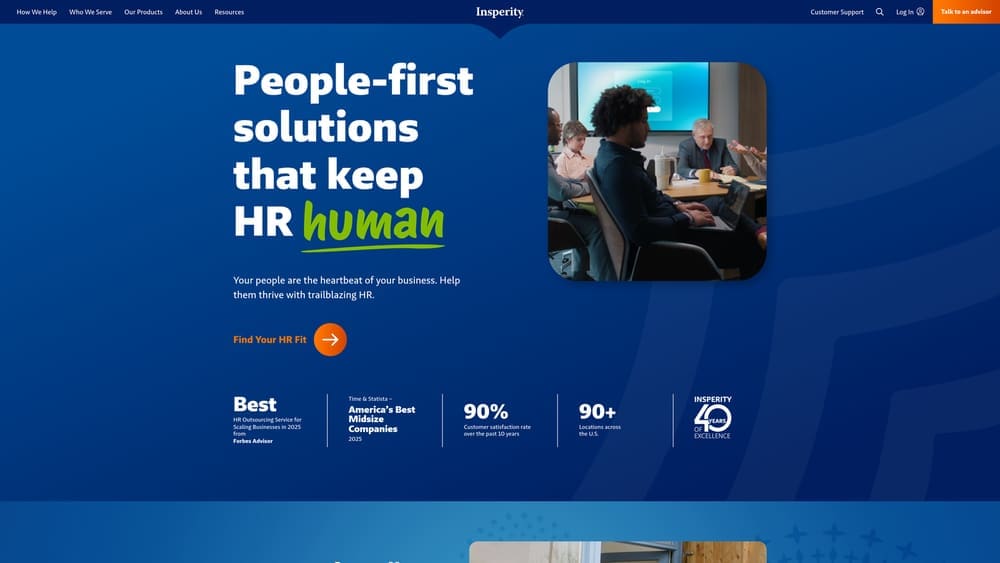
Insperity is a PEO emphasizing dedicated HR support with named specialists assigned to client accounts and robust training resources.
Where This Tool Shines
Insperity’s model centers on relationship-driven HR support. You get a dedicated HR specialist who learns your business, understands your culture, and provides context-aware guidance rather than generic compliance answers. This matters when you’re dealing with complex employee situations—performance issues, accommodation requests, or terminations—where nuance and judgment matter more than policy templates.
The employee training and development programs go beyond basic compliance training. Insperity offers leadership development resources, performance management tools, and structured training programs that help you build management capability internally. This adds value if you’re growing and need to develop first-time managers or strengthen leadership bench strength.
Key Features
Dedicated HR Specialists: Named HR professionals assigned to your account who learn your business and provide relationship-based guidance.
Employee Training Programs: Access to structured training content, compliance courses, and professional development resources for employees at all levels.
Performance Management Tools: Systems for goal setting, performance reviews, and employee development tracking integrated into the HR platform.
Leadership Development Resources: Management training programs, coaching resources, and tools for developing first-time managers and building leadership capability.
Best For
Companies with 5-500 employees that value HR relationship depth over self-service efficiency. Strong fit if you’re building management capability, dealing with complex employee situations regularly, or want strategic HR partnership rather than transactional service. Less compelling if you’re cost-sensitive or prefer platform-based self-service over dedicated account management.
Pricing
Custom pricing typically for companies with 5-5,000 employees—structured as a percentage of payroll. Pricing tends toward the higher end of the PEO market, reflecting the dedicated service model and training resources included.
7. Rippling PEO
Best for: Tech-forward companies that want unified HR, IT, and device management
Rippling PEO combines HR, IT, and device management in a unified platform designed for modern distributed workforces.
Where This Tool Shines
Rippling’s differentiation is the unified HR and IT management model. When you onboard a new employee, the system can simultaneously set up payroll, enroll them in benefits, provision software accounts, and ship a pre-configured laptop—all from a single workflow. This matters significantly for tech companies or distributed teams where IT provisioning is as operationally critical as HR administration.
The automation capabilities go deeper than traditional PEOs. You can build workflows that trigger actions across HR, IT, and finance systems based on employee status changes. When someone gets promoted, the system can automatically adjust their compensation, update their software access, notify relevant managers, and trigger equity grants—without manual intervention in multiple systems.
Key Features
Unified HR and IT Management: Single platform managing payroll, benefits, software provisioning, device management, and access control without multiple system integrations.
Device Management Integration: Laptop and mobile device provisioning, configuration, and security management integrated with employee onboarding and offboarding.
Automated Workflows: Custom automation for employee lifecycle events that trigger actions across HR, IT, and finance systems simultaneously.
App Provisioning with Onboarding: Automatic software account creation, access management, and application provisioning integrated into new hire workflows.
Best For
Tech companies, startups, and distributed teams with 10-500 employees that need unified HR and IT management. Particularly strong fit if you’re managing remote employees across multiple states, provisioning significant software tools, or want operational automation beyond basic payroll and benefits. Less relevant if you’re in a traditional industry with minimal IT complexity or prefer relationship-driven HR support over platform automation.
Pricing
Starts at $35/employee/month for the base platform, with PEO services adding additional per-employee costs. Total cost typically ranges from $80-$150/employee/month depending on service configuration and company size.
8. CoAdvantage
Best for: Companies in the Southeast and Texas that want regional compliance expertise
CoAdvantage is a regional PEO with strong presence in the Southeast and Texas, offering flexible service tiers and local market knowledge.
Where This Tool Shines
Regional PEOs like CoAdvantage compete on relationship depth and local compliance expertise that national providers struggle to match. Their teams understand state-specific employment law nuances, workers’ comp market conditions, and regulatory enforcement patterns in their core markets. This matters when you’re dealing with Texas non-subscriber workers’ comp decisions, Florida PEO regulations, or Georgia wage and hour enforcement—situations where generic national guidance falls short.
The flexible service level approach lets you buy what you actually need rather than accepting a bundled package. If you have internal HR capability and only need payroll, benefits administration, and workers’ comp, you can structure a lighter engagement. If you need full HR outsourcing, that’s available too. This flexibility reduces the “paying for services we don’t use” problem common with national PEOs.
Key Features
Regional Compliance Expertise: Deep knowledge of employment law, workers’ comp markets, and regulatory enforcement patterns in Southeast and Texas markets.
Flexible Service Levels: Customizable service tiers from payroll and benefits administration only to full HR outsourcing, allowing you to buy what you need.
Local Market Knowledge: Understanding of regional wage benchmarks, benefits market conditions, and talent competition dynamics in core geographic markets.
Personalized Service Approach: Relationship-driven model with local account teams rather than national call center support.
Best For
Companies with 10-300 employees operating primarily in the Southeast or Texas that value regional expertise and relationship-driven service. Strong fit if you’re dealing with state-specific compliance complexity or want a PEO that understands your local market conditions. Less relevant if you’re operating nationally or prefer platform-based self-service over relationship models.
Pricing
Custom pricing based on location, services selected, and headcount. Regional PEOs often price competitively against national providers while offering more flexible service configurations.
9. Amplify PEO
Best for: Companies with specific or niche requirements that don’t fit standard PEO packages
Amplify PEO offers customizable à la carte services for businesses with unique operational needs or industry-specific requirements.
Where This Tool Shines
Most PEOs sell bundled packages—you get payroll, benefits, HR, compliance, and workers’ comp whether you need all of it or not. Amplify’s à la carte model lets you select specific services and build a custom arrangement. This matters if you have internal HR capability but need benefits buying power, or if you want workers’ comp management but handle payroll internally, or if you need compliance support in specific jurisdictions without full HR outsourcing.
The industry-specific solutions address niche operational requirements that general-purpose PEOs don’t handle well. If you’re in construction, healthcare, hospitality, or another industry with unique compliance patterns, wage structures, or workforce management needs, Amplify can structure services around those requirements rather than forcing you into a standard package designed for generic office environments.
Key Features
À La Carte Service Selection: Ability to select specific PEO services—payroll, benefits, HR, compliance, workers’ comp—without bundled packages requiring services you don’t need.
Industry-Specific Solutions: Customized service configurations for industries with unique requirements like construction, healthcare, hospitality, or professional services.
Flexible Contract Terms: More negotiable contract structures and terms compared to standard PEO agreements with rigid multi-year commitments.
Customized Compliance Support: Tailored compliance guidance for specific regulatory requirements, multi-state operations, or niche industry regulations.
Best For
Companies with 20-500 employees that have specific operational needs not addressed by standard PEO packages. Strong fit if you have internal HR capability but need specific services, operate in a niche industry with unique requirements, or want more control over service configuration. Less relevant if you want comprehensive full-service HR outsourcing or prefer standardized packages with predictable pricing.
Pricing
Custom pricing based on selected services, company size, and industry risk profile. À la carte pricing can be more cost-effective if you only need specific services, or more expensive if you end up needing comprehensive coverage due to per-service pricing structures.
Making the Right Decision
The PEO market breaks into clear segments. If you want transparent pricing and modern self-service tools, Justworks and Rippling deliver platform-first experiences. If you need enterprise benefits and deep compliance infrastructure, TriNet and ADP TotalSource provide the scale and certification to support complex operations. If workers’ comp management or regional expertise matters most, Paychex and CoAdvantage offer specialized strength in those areas.
The harder question is whether you’re making this decision with complete information. Most businesses evaluate PEOs based on sales presentations and marketing materials—not objective comparison of pricing structures, contract terms, and actual service delivery models. The difference between a good PEO relationship and an expensive mistake often comes down to understanding what you’re actually buying before you sign.
Before you renew your PEO agreement, compare your options. Most businesses overpay due to bundled fees and unclear administrative markups. We break down pricing, services, and contract structures so you can make a smarter decision. The goal isn’t finding the “best” PEO universally—it’s finding the right operational fit for your specific business model, industry requirements, and growth trajectory.
The providers listed here represent different operational philosophies and service models. Your decision should align with whether you value self-service efficiency or relationship depth, whether you need comprehensive HR outsourcing or specific services, and whether pricing transparency or benefits buying power matters more for your business. Most importantly, understand what you’re agreeing to contractually before you commit to multi-year relationships with automatic renewal clauses that are difficult to exit.