
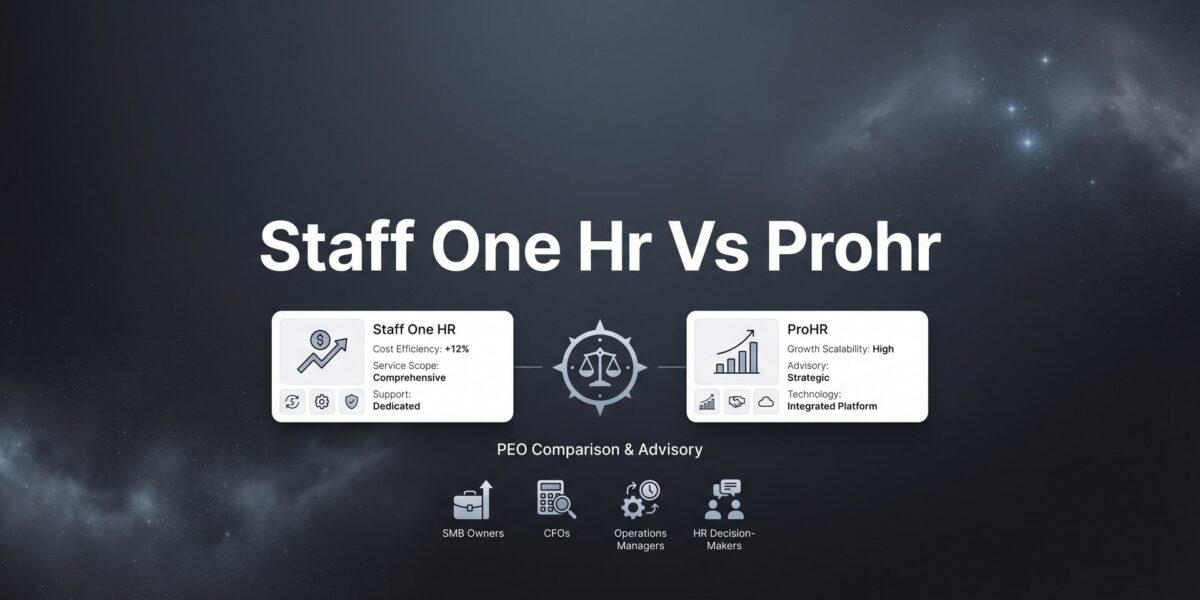
Both Staff One HR and ProHR serve the small-to-mid business market, but they approach PEO services from different angles. Staff One HR operates primarily in the Southeast with a hands-on service model, while ProHR positions itself as a technology-forward option with broader geographic reach.
This comparison isn’t about declaring a winner. It’s about identifying which provider aligns with your specific operational needs, headcount, industry, and growth trajectory.
We’ll walk through the decision factors that separate these two providers in ways that actually affect your day-to-day operations and bottom line.
1. Geographic Coverage and State Compliance Capabilities
Why Regional Footprint Matters
Staff One HR operates with concentrated expertise in the Southeast, particularly Alabama and surrounding states. ProHR maintains broader geographic coverage across multiple regions.
This distinction affects more than just where they can legally operate. It shapes how deeply each provider understands local employment law nuances, wage regulations, and state-specific compliance requirements.
If you’re a Tennessee-based manufacturer planning to stay regional, Staff One HR’s concentrated focus often translates to faster answers on state-specific questions. If you’re a software company planning to hire across six states within two years, ProHR’s broader infrastructure becomes more relevant. Companies with multi-state operations need to evaluate this carefully.
Compliance Depth vs Geographic Breadth
Regional PEOs often develop deeper relationships with state regulators and local workers’ compensation carriers. They typically handle state-specific situations more efficiently because they see the same scenarios repeatedly.
Multi-state PEOs invest in broader compliance infrastructure but may rely more on centralized processes rather than state-specific expertise.
Neither approach is inherently better. The right fit depends on whether you need deep local knowledge or multi-state operational flexibility.
Expansion Implications
If you’re planning to expand beyond your current state within 18 months, verify how each provider handles new state additions. Some regional PEOs partner with other providers for coverage outside their core territory, which can create service inconsistencies.
Ask specifically: Do you handle payroll processing directly in all states where we operate, or do you subcontract certain functions? How do state-specific compliance questions get routed?
The answers reveal whether expansion will be seamless or introduce operational friction.
2. Pricing Structure and Fee Transparency
The Quote Problem
Neither Staff One HR nor ProHR publishes standard pricing online. Both require custom quotes based on your headcount, industry classification, and state.
This makes direct cost comparison difficult without obtaining proposals from both providers at your specific parameters.
PEO pricing typically includes a per-employee-per-month (PEPM) administrative fee plus benefits markups. The administrative fee usually ranges from $80 to $150 PEPM for companies with 10-50 employees, but can vary significantly based on services included and negotiation. Understanding a detailed PEO cost breakdown helps you evaluate proposals accurately.
Hidden Fee Patterns
Regional PEOs sometimes offer lower base administrative fees but charge separately for services that larger providers bundle. Common unbundled items include:
Implementation and onboarding fees: One-time charges ranging from $500 to $3,000 depending on complexity and employee count.
State registration fees: Charges for establishing presence in new states, typically $200-$500 per state.
Technology access fees: Monthly platform fees that may not be included in the base PEPM rate.
Workers’ compensation audit fees: Year-end reconciliation charges that some providers absorb and others pass through.
Request a complete fee schedule during proposal review. Ask specifically about charges beyond the base PEPM rate.
Benefits Markup Transparency
PEOs earn revenue by marking up health insurance and other benefits above carrier rates. This markup typically ranges from 3% to 15% depending on the provider and your negotiating position.
Smaller regional PEOs may have less negotiating leverage with national carriers, potentially affecting benefits pricing. Larger providers with more lives under management sometimes secure better carrier rates but may apply higher administrative markups.
The only way to evaluate this accurately is comparing total employee cost (base PEPM + benefits markup + all ancillary fees) across both providers at your exact headcount and benefits selections.
3. Technology Platform and Self-Service Capabilities
Platform Philosophy Differences
ProHR positions technology as a core differentiator, emphasizing self-service workflows and digital processes. Staff One HR takes a relationship-first approach where technology supports service delivery rather than replacing it.
Neither approach is wrong, but they serve different operational preferences.
If your team prefers handling routine HR tasks through intuitive interfaces without calling support, technology-forward platforms matter. If you value picking up the phone to talk through situations with someone who knows your business, high-touch service models fit better.
Employee Self-Service Functionality
Most PEO platforms now offer basic employee self-service for paystub access, benefits enrollment, and time-off requests. The difference lies in execution quality and mobile experience.
During evaluation, ask for a demo account with test employee credentials. Have team members actually navigate the interface on their phones. Check whether common tasks require multiple clicks or feel intuitive.
Poor employee experience creates internal friction that falls back on your HR team to resolve. Reviewing the best PEO HR technology platforms can help you benchmark what good looks like.
Integration Capabilities
If you use accounting software, applicant tracking systems, or time-tracking tools, integration capability matters significantly.
Ask both providers: What systems do you integrate with natively? What data syncs automatically versus requiring manual export/import? Do integrations cost extra?
Smaller regional PEOs sometimes have limited integration ecosystems, requiring manual data transfer for accounting reconciliation or applicant onboarding. This creates ongoing administrative burden that offsets some of the value a PEO should provide.
4. Benefits Access and Health Insurance Options
Carrier Network Reality
PEOs aggregate employees across client companies to access group health insurance rates. The quality of that access depends on carrier relationships and total lives under management.
Staff One HR’s regional focus may provide strong relationships with Southeast-based carriers but limited options if you operate in states outside their core territory. ProHR’s broader footprint potentially offers more carrier variety across different states.
Request the actual carrier list available in your specific state. Don’t accept generic statements about “access to major carriers.” You need to see which Blue Cross network, which UnitedHealthcare plans, and which regional carriers are actually available at your location.
Plan Design Flexibility
Some PEOs offer limited plan designs where all clients choose from the same three or four options. Others allow more customization based on your workforce demographics and budget.
If your current health plan has specific features your employees value—particular provider networks, low deductibles, HSA compatibility—verify whether each PEO can match or improve on what you currently offer. Understanding professional employer organization benefits helps you evaluate what’s actually available.
Switching to a PEO that forces a worse benefits package creates employee dissatisfaction that undermines the entire relationship.
Ancillary Benefits Depth
Beyond health insurance, evaluate dental, vision, life insurance, disability coverage, and voluntary benefits access. These ancillary offerings vary significantly between providers.
Smaller PEOs may have fewer ancillary options but sometimes negotiate better rates on the plans they do offer. Larger providers offer more variety but may apply higher markups across all ancillary products.
Calculate total benefits cost including all ancillary products your team actually uses, not just the headline health insurance rate.
5. HR Support Model and Response Times
Dedicated vs Shared Support Structures
Staff One HR emphasizes relationship-based account management where you work with the same HR representative consistently. ProHR’s model may route inquiries through shared support teams depending on your account size.
Dedicated support means your representative knows your business context, remembers previous conversations, and can provide proactive guidance. Shared support means faster initial response times but less continuity across interactions.
Ask both providers: Will we have a dedicated HR representative? What’s their typical client load? What happens when they’re on vacation or leave the company?
Proactive Guidance vs Reactive Support
Some PEOs operate reactively, responding when you reach out with questions. Others provide proactive compliance updates, policy recommendations, and operational guidance.
If you lack internal HR expertise, proactive support becomes significantly more valuable. Many businesses find that small business HR outsourcing through a PEO fills critical knowledge gaps. If you have an experienced HR manager who just needs compliance backup and benefits administration, reactive support may suffice.
During the sales process, pay attention to whether representatives explain potential issues you haven’t thought about or simply answer the questions you ask. That behavior pattern typically continues post-sale.
Response Time Expectations
Verify actual response time commitments in writing. “We respond quickly” means nothing without specific service level agreements.
Reasonable expectations for non-emergency inquiries: email response within 4-8 business hours, phone callback within same business day. For compliance emergencies or employee relations issues, you should have access to immediate support.
Ask current clients of both providers about real-world response times, not just contractual commitments.
6. Contract Terms and Exit Flexibility
Commitment Period Reality
PEO contracts typically run 12 months with automatic renewal. The critical difference lies in termination provisions and what happens if the relationship isn’t working.
Regional PEOs sometimes offer more flexible contract terms, particularly for established businesses with strong financials. Larger providers may have more rigid contract structures but clearer termination processes.
Before signing, negotiate these specific terms: termination notice period (60-90 days is standard), early termination fees, and conditions under which you can exit without penalty. Learning how to compare PEO contracts helps you identify red flags before committing.
Data Portability and Transition Support
When you leave a PEO, you need complete employee data, payroll history, benefits documentation, and compliance records. Some providers make this easy. Others create friction through data export fees or incomplete record transfer.
Ask explicitly: If we terminate the relationship, what data do we receive? In what format? Are there fees for data export? How long does the transition process take?
Verify that you’ll receive complete W-2 data, benefits enrollment records, and workers’ compensation claim history in usable formats, not just PDF printouts. Having a solid PEO exit strategy protects you if the relationship doesn’t work out.
Mid-Contract Price Increase Protections
Most PEO contracts allow price increases at renewal, but some include provisions for mid-contract adjustments based on claims experience or regulatory changes.
Read the pricing adjustment clause carefully. Understand what triggers potential increases and whether you have the right to terminate if prices rise beyond agreed thresholds.
This matters particularly for workers’ compensation pricing, where claims experience can significantly affect renewal rates.
7. Risk Profile and Workers’ Compensation Handling
Industry Risk Appetite
PEOs evaluate risk differently based on their carrier relationships and historical claims experience. Some providers avoid high-risk industries entirely. Others specialize in them.
If you operate in construction, manufacturing, healthcare, or other industries with elevated workers’ compensation exposure, verify that both providers actively work with similar businesses. Certain industries benefit from specialized providers—for example, PEOs for construction companies understand unique jobsite risks.
A PEO that reluctantly accepts your industry will price accordingly and may create friction around safety requirements. A provider comfortable with your risk profile offers better service and often better pricing.
Claims Management Approach
Workers’ compensation claims handling varies significantly between PEOs. Some providers actively manage claims with dedicated specialists who challenge questionable filings and negotiate settlements. Others take a more passive approach that can result in higher experience modifications over time.
Ask both providers: How do you handle workers’ compensation claims? Do you have dedicated claims specialists? What’s your process for investigating incidents and managing return-to-work programs?
Effective claims management directly affects your long-term workers’ compensation costs, which can represent a significant portion of total PEO expenses for certain industries. Understanding workers’ compensation responsibilities clarifies what the PEO handles versus what remains your obligation.
Safety Program Support
Proactive safety programs reduce workplace incidents and lower workers’ compensation costs. Some PEOs provide meaningful safety support including site visits, training resources, and policy development. Others offer generic materials with limited practical value.
If workplace safety is a significant concern for your business, evaluate what each provider actually delivers beyond basic compliance posters.
Request examples of safety training materials, ask about site visit frequency, and verify whether safety consultation is included or costs extra.
Making the Decision
Choosing between Staff One HR and ProHR comes down to matching your operational priorities with each provider’s strengths.
If you’re a Southeast-based company valuing high-touch service and regional compliance expertise, Staff One HR deserves serious consideration. If multi-state operations and technology-first workflows are priorities, ProHR may fit better.
Before signing with either, request detailed pricing breakdowns at your specific headcount, verify benefits carrier access in your state, and negotiate contract exit terms upfront.
Before you renew your PEO agreement, compare your options. Most businesses overpay due to bundled fees and unclear administrative markups. We break down pricing, services, and contract structures so you can make a smarter decision.
The right PEO relationship should simplify operations, not create new dependencies. Take the time to evaluate both providers against your actual needs, not their marketing promises.