
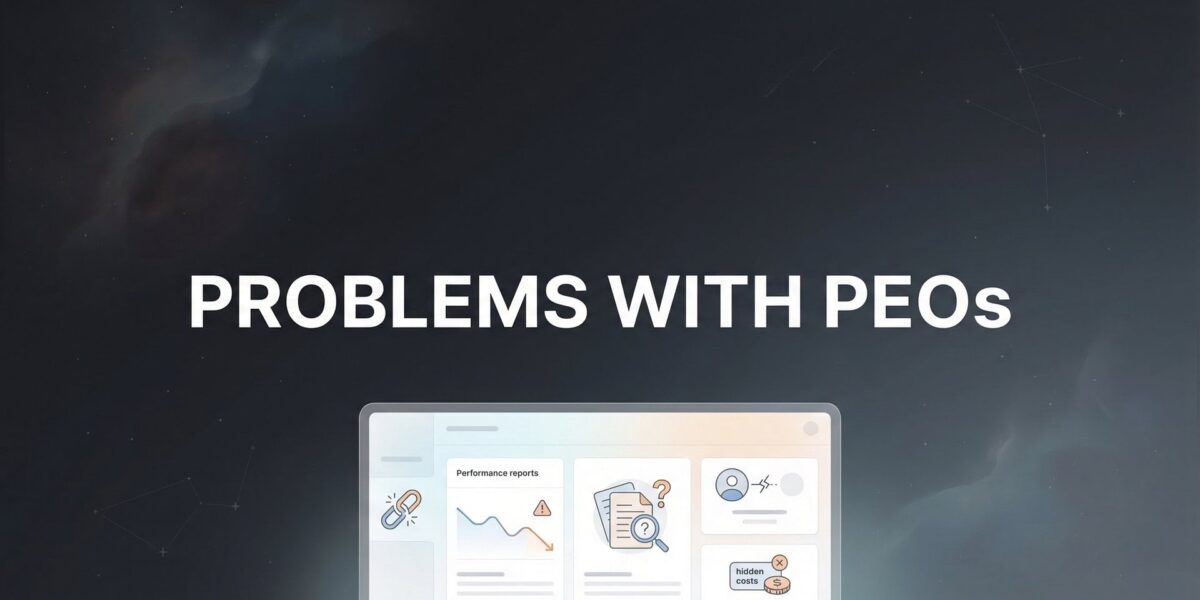
PEOs can streamline HR, reduce compliance headaches, and unlock better benefits—but they’re not without friction. Business owners who’ve been in a PEO relationship for a year or more often encounter issues that weren’t obvious during the sales process. Some are structural. The co-employment model itself creates certain tensions around decision-making authority. Others are operational: technology gaps, service inconsistencies, pricing surprises that show up after renewal.
This guide breaks down the most common problems businesses face with PEOs, explains why they happen, and gives you concrete strategies to prevent or resolve each one. Whether you’re evaluating a PEO for the first time or reconsidering your current provider, understanding these pitfalls upfront can save you significant cost and frustration.
Not every issue is a dealbreaker. Some are trade-offs inherent to the model. Others signal a poor provider fit or a contract that wasn’t negotiated carefully. The key is knowing which problems you can work around, which require contract protections, and which mean you should walk away.
1. Loss of Control Over HR Decisions
The Challenge It Solves
Co-employment means shared authority. Your PEO becomes the employer of record for tax and compliance purposes, which creates legal and operational overlap. In theory, this protects you from liability and gives you access to better benefits and HR expertise. In practice, it means you no longer have unilateral control over employee-related decisions.
Many business owners don’t realize this until they try to terminate an underperforming employee and the PEO’s HR team pushes back, citing documentation requirements or suggesting a performance improvement plan instead. Or they want to implement a new company policy and discover it conflicts with the PEO’s standardized employee handbook.
The Strategy Explained
The best way to avoid control conflicts is to clarify decision-making authority before you sign. Most PEO agreements include vague language about “joint employer responsibilities” without specifying who has final say in hiring, firing, compensation changes, or policy enforcement.
You need explicit contract language that preserves your authority over day-to-day operational decisions while allowing the PEO to handle compliance, benefits administration, and payroll processing. Some PEOs are more flexible than others. If a provider insists on veto power over terminations or policy changes, that’s a red flag.
Implementation Steps
1. During contract negotiation, request specific language defining which employment decisions require PEO approval and which remain solely within your authority.
2. Ask for examples of situations where the PEO has overridden a client’s termination decision or policy change—and what their process looks like when disagreements arise.
3. Clarify who owns employee discipline documentation and whether you can maintain your own internal HR files separate from the PEO’s system.
Pro Tips
If you’re already in a PEO relationship and experiencing control conflicts, document every instance where the PEO blocks or delays a decision you believe is within your authority. This creates leverage for renegotiation or early termination. Some contracts include service level agreements that specify response times for approvals—if your PEO consistently misses those timelines, you may have grounds to exit without penalty.
2. Hidden Costs and Pricing Opacity
The Challenge It Solves
Bundled pricing obscures true costs. Most PEO agreements charge a percentage of payroll or a per-employee-per-month fee that includes HR support, benefits administration, payroll processing, and workers’ comp coverage. That sounds simple until you encounter mid-year workers’ comp adjustments, add-on fees for compliance services, or administrative markups on benefits premiums.
The first-year pricing often looks competitive because PEOs use introductory rates to win business. After renewal, many business owners discover their costs have increased significantly—sometimes 15-20% or more—without corresponding improvements in service or benefits quality.
The Strategy Explained
Pricing transparency requires asking the right questions upfront and getting specific cost breakdowns in writing. Don’t accept a single bundled rate without understanding what’s included, what triggers additional fees, and how renewal pricing is calculated.
Workers’ comp is a common source of surprise costs. PEOs pool all clients into a single policy, which means your rate depends partly on the claims history of other businesses in the pool. If the PEO has clients in high-risk industries, you may pay more than you would with a standalone policy—even if your own claims history is clean. Understanding professional employer organization cost structures before signing helps you avoid these surprises.
Implementation Steps
1. Request an itemized cost breakdown showing the administrative fee, workers’ comp premium, benefits costs, and any additional charges for compliance, technology, or HR consulting.
2. Ask how workers’ comp rates are calculated and whether your rate is based on your company’s individual experience modifier or pooled across all PEO clients.
3. Clarify renewal pricing terms—specifically, whether your rate can increase year-over-year and what triggers adjustments beyond standard inflation or headcount growth.
Pro Tips
Some PEOs mark up benefits premiums by 5-10% as an administrative fee. Ask whether the benefits costs in your quote reflect actual carrier rates or include a PEO markup. If you’re already with a PEO and suspect hidden fees, request a full reconciliation of your annual costs compared to the original proposal. Discrepancies often reveal charges that weren’t disclosed during sales.
3. Benefits Lock-In and Limited Flexibility
The Challenge It Solves
You’re typically locked into the PEO’s master health policy with limited ability to customize plans or make mid-year changes. PEOs negotiate group rates by pooling all client employees into a single benefits program, which gives small businesses access to better pricing and plan options than they could secure independently.
The trade-off is flexibility. If your employees want a specific carrier, a different deductible structure, or additional voluntary benefits that aren’t part of the PEO’s standard offering, you’re usually out of luck. Mid-year changes are rare because the PEO’s master policy operates on a fixed plan year.
The Strategy Explained
Before signing, review the PEO’s full benefits portfolio and confirm it aligns with your employees’ needs. Pay attention to carrier networks, plan tiers, and voluntary benefit options like dental, vision, disability, and life insurance. If the PEO offers multiple carrier choices, ask whether you can switch carriers at renewal or if you’re locked in for multiple years.
Some PEOs allow limited customization—such as choosing between two or three plan designs or adding voluntary benefits—but most operate with standardized offerings that apply across all clients. Understanding the full scope of professional employer organization benefits helps you evaluate whether the trade-offs work for your team.
Implementation Steps
1. Request the PEO’s full benefits guide and carrier network details before signing, and compare them against your current plan or employee preferences.
2. Ask whether you can opt out of the PEO’s health plan and maintain your own group policy while using the PEO for payroll and HR services—some providers allow this, though it’s less common.
3. Clarify what happens if the PEO’s carrier changes or if plan options are reduced at renewal—and whether you have an exit clause if benefits quality declines.
Pro Tips
If your employees are unhappy with the PEO’s benefits, document their complaints and share them with your account manager. Some PEOs will add voluntary benefits or adjust plan offerings if enough clients request changes. If benefits flexibility is non-negotiable, consider an ASO (Administrative Services Organization) instead—they handle payroll and HR without requiring you to adopt their benefits program.
4. Technology Platform Limitations
The Challenge It Solves
PEO platforms may not integrate well with your existing systems, and data portability can become a problem if you decide to leave. Most PEOs provide an all-in-one HRIS platform that handles payroll, time tracking, benefits enrollment, and employee self-service. These systems work fine in isolation, but they often lack robust API integrations with accounting software, project management tools, or CRM platforms.
If your business relies on tight integration between payroll and financial reporting, or if you need employee data to flow seamlessly into other operational systems, a PEO’s closed platform can create manual workarounds and data silos.
The Strategy Explained
Evaluate the PEO’s technology stack before signing. Ask for a demo that focuses specifically on integrations, data exports, and API capabilities. Reviewing the best PEO HR technology platforms can help you understand what modern systems should offer.
Data portability is equally important. If you leave the PEO, you need to extract payroll history, employee records, benefits data, and time-off balances. Some PEOs make this easy with bulk export tools. Others restrict data access or charge fees for historical records.
Implementation Steps
1. Request a list of native integrations and confirm the PEO’s platform connects with your accounting software, time tracking tools, and any other systems that rely on employee data.
2. Ask for a walkthrough of the data export process and confirm you can download payroll history, employee records, and benefits information in standard formats without additional fees.
3. Clarify whether the PEO retains your data after termination and for how long—and whether you’ll have ongoing access to historical records if needed for audits or legal purposes.
Pro Tips
If you’re already locked into a PEO with poor technology, check whether they allow third-party integrations or API access. Some PEOs restrict API usage to enterprise clients, but you may be able to negotiate access if integration gaps are creating operational problems. If not, start planning your exit early—data migration takes longer than most businesses expect.
5. Service Quality Inconsistency
The Challenge It Solves
The attentive service during sales often gives way to call center support and slower response times post-implementation. During the sales process, you typically work with a dedicated account executive who responds quickly, answers detailed questions, and makes the PEO feel like a true partnership. After you sign, that relationship often shifts to a shared account manager who handles dozens of clients and relies on support tickets for most requests.
Business owners with fewer than 20 employees frequently report feeling like lower-priority clients after onboarding. Response times slow down. Simple requests take days instead of hours. The proactive guidance you were promised during sales never materializes.
The Strategy Explained
Service quality varies widely across PEOs, and it’s often correlated with client size. Larger PEOs with thousands of clients typically operate call center models where you don’t have a consistent point of contact. Smaller, regional PEOs may offer more personalized service but lack the technology and compliance expertise of national providers.
The best way to avoid service disappointments is to clarify the post-sale support model before signing. Understanding common complaints about PEOs helps you ask the right questions during evaluation.
Implementation Steps
1. Ask whether you’ll have a dedicated account manager post-implementation or if support requests go through a general queue.
2. Request references from current clients in your size range and ask specifically about service responsiveness and whether the PEO delivers on its promises after the first year.
3. Clarify the escalation process for urgent issues—such as payroll errors, benefits enrollment problems, or compliance questions—and confirm whether after-hours support is available.
Pro Tips
If your current PEO’s service quality has declined, document every delayed response and missed commitment. Many contracts include service level agreements that specify response times for different types of requests. If the PEO consistently fails to meet those standards, you may have grounds for early termination or fee reductions. Some PEOs will reassign you to a different account manager if you escalate service complaints to senior leadership.
6. Compliance Gaps and Liability Confusion
The Challenge It Solves
Co-employment doesn’t transfer all liability—business owners often misunderstand what the PEO is actually responsible for. Many companies sign with a PEO believing it eliminates their compliance risk entirely. It doesn’t. The PEO handles payroll tax filings, benefits administration, and certain employment law obligations, but you remain liable for workplace safety, discrimination claims, wrongful termination lawsuits, and industry-specific regulations.
CPEO (Certified Professional Employer Organization) status provides specific IRS-backed protections, but certification doesn’t eliminate all liability concerns. Understanding what certified professional employer organization status actually covers helps set realistic expectations.
The Strategy Explained
Understanding liability allocation requires reading your contract carefully and asking direct questions about what the PEO covers versus what remains your responsibility. Most agreements include indemnification clauses that shift certain liabilities back to you—especially for workplace injuries, employment practices claims, and regulatory violations that occur due to your actions rather than the PEO’s administrative errors.
Multi-state companies frequently encounter compliance gaps when their PEO lacks expertise in specific state regulations. Labor laws, wage and hour rules, and leave policies vary significantly by state. Reviewing professional employer organization compliance responsibilities clarifies who handles what across different jurisdictions.
Implementation Steps
1. Request a written breakdown of which compliance obligations the PEO handles versus which remain your responsibility, and confirm this aligns with the indemnification language in the contract.
2. Ask whether the PEO has dedicated compliance staff for every state where you operate, and request examples of how they’ve handled state-specific regulatory changes for other clients.
3. Clarify whether the PEO carries Employment Practices Liability Insurance (EPLI) that covers both the PEO and your business, or if you need to maintain separate coverage.
Pro Tips
If you’re in a highly regulated industry—such as healthcare, construction, or financial services—ask whether the PEO has experience with industry-specific compliance requirements. General PEOs often lack the specialized knowledge needed for OSHA reporting, licensing, or sector-specific labor laws. If compliance gaps are creating risk, consider whether a specialized PEO or an in-house compliance consultant would be a better fit.
7. Difficult Exit Transitions
The Challenge It Solves
Leaving a PEO involves migrating payroll, benefits, and HR data—often complicated by termination clauses and notice requirements. Exit transitions are frequently cited as a major pain point because the PEO controls critical business systems and employee data. If you decide to leave, you need to stand up new payroll processing, migrate benefits enrollment, extract employee records, and ensure zero gaps in tax filings or benefits coverage.
Some contracts include termination fees, 60-90 day notice requirements, or restrictions on when you can leave (such as only at year-end). These clauses create switching costs that make it harder to exit even if the PEO’s service quality has declined significantly.
The Strategy Explained
The best way to avoid a painful exit is to negotiate favorable termination terms before you sign. Specifically, you want short notice periods, no termination fees, and clear data portability guarantees. Reviewing the professional employer organization agreement carefully before signing prevents many exit headaches.
If you’re already in a PEO relationship and planning to leave, start the transition process at least 90 days before your desired exit date. You’ll need time to select a new payroll provider, set up benefits with a new carrier or broker, and migrate employee data without disrupting operations.
Implementation Steps
1. Before signing, negotiate for 30-60 day termination notice with no fees, and confirm you can leave at any time rather than only at year-end or plan renewal.
2. Request written confirmation that you’ll receive all employee data, payroll history, and benefits records in standard formats upon termination, at no additional cost.
3. If you’re planning to exit, create a transition checklist covering payroll setup, benefits migration, workers’ comp policy transfer, and employee communication—and assign clear ownership for each task.
Pro Tips
Some PEOs will waive termination fees if you can document service failures or contract violations. If your PEO has consistently missed service level agreements, failed to resolve payroll errors, or created compliance gaps, compile that evidence before initiating termination discussions. You may have leverage to negotiate an early exit without penalty. If not, weigh the cost of staying in a poor relationship against the termination fee—sometimes paying to leave is worth it.
Putting It All Together
Not every PEO problem is a dealbreaker. Some are inherent trade-offs of the co-employment model—you gain access to better benefits and outsourced HR expertise, but you lose some operational control. Others signal a poor provider fit or a contract that wasn’t negotiated carefully.
The key is knowing which issues you can negotiate around, which require contract protections, and which mean you should walk away. Before signing or renewing, audit your agreement against these seven problem areas. If your current PEO is causing friction in multiple categories—especially around pricing transparency, service responsiveness, and compliance support—it may be time to compare your options.
Most businesses overpay due to bundled fees and unclear administrative markups. If you’re evaluating a PEO for the first time, focus on contract terms that preserve flexibility: short notice periods, clear cost breakdowns, and explicit decision-making authority. If you’re already in a PEO relationship, document service issues and use them as leverage for renegotiation or early exit.
PEOs work well for many businesses, but they’re not a one-size-fits-all solution. Understanding these common problems upfront gives you the clarity to make a smarter decision—whether that means choosing the right provider, negotiating better terms, or recognizing when a PEO isn’t the right fit for your business.