

Paychex operates on both sides of this decision, and that’s exactly what makes it confusing. Their PEO product (formerly Oasis Outsourcing, now branded as Paychex PEO) is a co-employment arrangement with shared legal liability, bundled benefits, and dedicated HR support. Paychex Flex, their standalone payroll platform, is a completely different relationship: you remain the sole employer, you handle compliance, and you pay a simpler per-employee fee for payroll processing.
These aren’t just different price points. They’re different operating models with different risk profiles. If you’re trying to decide which one fits your business, or whether a competitor does it better, this breakdown covers both sides of the equation. For a deeper grounding on what separates a PEO from a payroll vendor at the structural level, the PEO comparison hub is a good starting point before you dig into provider specifics.
Here are the top options to consider, covering both full PEO services and payroll-only alternatives, so you can match the right model to where your business actually is.
1. Clicks Geek PEO
Best for: Business owners who want independent, unbiased analysis before choosing or renewing a PEO.
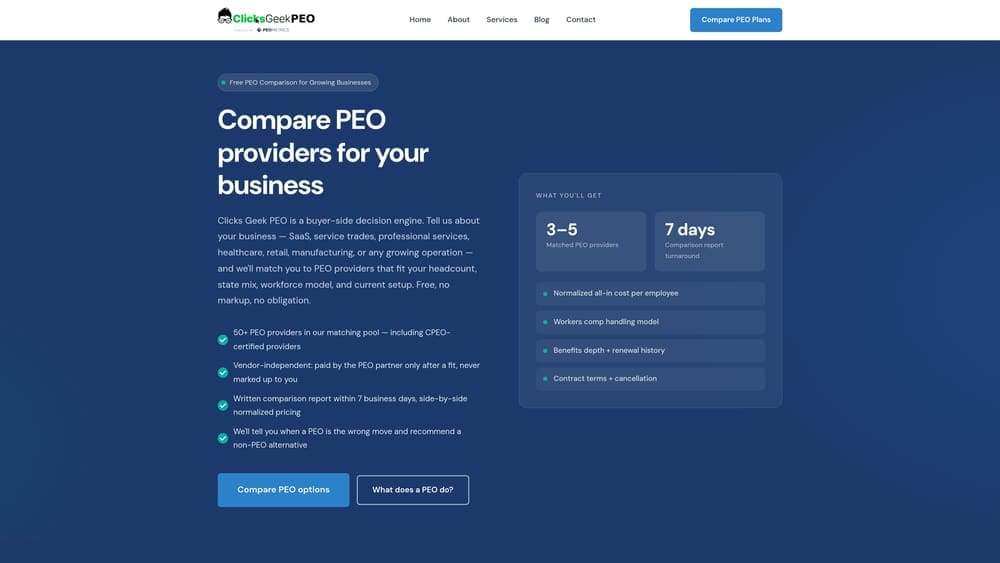
Clicks Geek PEO is an independent comparison platform that helps businesses evaluate PEO providers without the pressure of a sales process.
Where This Tool Shines
Most PEO providers require you to go through a sales rep before you see any real pricing. That means you’re comparing proposals that are designed to look favorable, not to give you a clear picture of what you’re actually paying. Clicks Geek cuts through that by giving you transparent pricing breakdowns and side-by-side provider comparisons before you ever get on a call.
This matters most when you’re renewing a contract or switching providers. Many businesses stay with a PEO longer than they should because switching feels complicated and the pricing comparison work is genuinely tedious. Having an independent platform to run that analysis changes the dynamic significantly.
Key Features
Side-by-Side Provider Comparisons: Compare PEO providers including Paychex PEO, ADP TotalSource, TriNet, and others on a level playing field.
Transparent Pricing Analysis: Breaks down cost structures, administrative fees, and markup patterns that are often buried in PEO proposals.
Contract and Scope Evaluation: Reviews contract terms, service inclusions, and exit provisions so you know what you’re committing to.
Independent Advisory Model: Not a PEO, not a broker with a commission incentive. The platform has no contracts to sell you.
Best For
Business owners evaluating a PEO for the first time, CFOs reviewing an upcoming renewal, or HR decision-makers who want objective data before negotiating with a provider. Particularly useful if you’ve received a Paychex PEO proposal and want to benchmark it against alternatives.
Pricing
Free to use. No cost to access comparison resources or pricing breakdowns. No subscription required.
2. Paychex PEO (formerly Oasis Outsourcing)
Best for: Mid-market businesses that want a full-service PEO backed by a nationally recognized payroll brand.
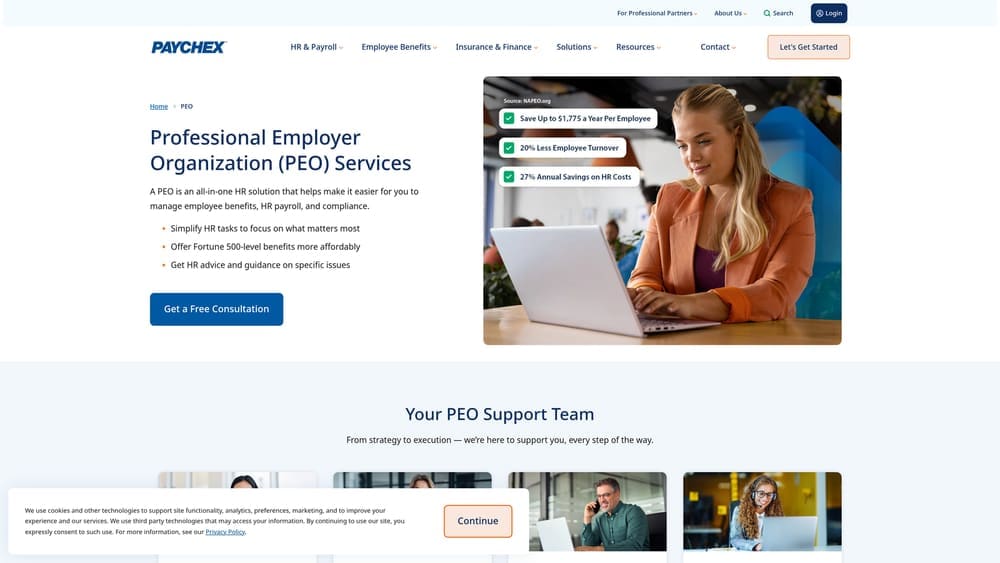
Paychex PEO is a co-employment PEO offering bundled HR, benefits, workers comp, and compliance support under the Paychex umbrella.
Where This Tool Shines
The Paychex name carries weight, and for businesses that are already running payroll through Paychex Flex, the PEO feels like a natural upgrade path. The integration between their payroll ecosystem and PEO infrastructure is tighter than most competitors can offer, which reduces friction during onboarding and data migration.
Where Paychex PEO earns its place is in compliance depth and benefits access. Co-employment means your employees join a larger benefits pool, which typically translates to better health insurance rates than a small business could negotiate independently. The dedicated HR business partner model also gives you a named contact for employment law questions, which is worth something when you’re navigating a difficult termination or a leave of absence situation.
Key Features
Co-Employment Model: Shared employer responsibilities with a dedicated HR business partner assigned to your account.
Bundled Workers Comp: Workers compensation coverage included and managed within the PEO arrangement.
Benefits Administration: Access to group health, dental, vision, and ancillary benefits through the PEO’s pooled purchasing power.
Federal and State Compliance Support: Ongoing monitoring and guidance for employment law changes at both levels.
Paychex Ecosystem Integration: Connects directly with Paychex Flex and other Paychex tools for businesses already in their environment.
Best For
Companies with 50 to 500+ employees that want a full-service HR infrastructure without building an internal HR department. Strongest fit for businesses already using Paychex products who want to move up to co-employment without switching platforms.
Pricing
Custom quotes only. Typically structured as a percentage of payroll. Contact Paychex directly for pricing specific to your headcount and benefit selections.
3. Paychex Flex (Payroll-Only)
Best for: Businesses that want Paychex’s payroll infrastructure without co-employment obligations or PEO overhead.
Paychex Flex is Paychex’s standalone payroll platform offering tiered plans, optional HR add-ons, and no co-employment relationship.

Where This Tool Shines
If you don’t need co-employment and you’re not ready to pay PEO-level fees, Paychex Flex gives you access to the same underlying payroll infrastructure at a significantly lower cost. You retain full employer status, which means full control over hiring, firing, and HR policy without needing to coordinate with a PEO’s HR team.
The tiered structure is useful for businesses that want to grow into more HR functionality over time. You can start with basic payroll processing and layer on time tracking, benefits administration, or HR support modules as your needs expand, without committing to a full co-employment arrangement.
Key Features
Full-Service Payroll Processing: Automated payroll runs with tax filing and direct deposit across all employee types.
Tiered Plan Options: Multiple plan levels from basic payroll to more comprehensive payroll-plus-HR packages.
Optional Add-On Modules: Time tracking, benefits administration, and HR support available as additions, not bundled requirements.
Sole Employer Status Retained: No co-employment. The business owner remains the employer of record in all legal and operational respects.
Broad Scalability: Serves businesses from a single employee to well over a thousand.
Best For
Small to mid-sized businesses that need reliable payroll processing and tax compliance without the cost or complexity of a full PEO. Also a reasonable choice for businesses that tried a PEO and decided the co-employment model wasn’t the right fit.
Pricing
Custom quotes; generally starts lower than Paychex PEO pricing. Per-employee fee structure. Contact Paychex for a quote based on your specific plan and headcount.
4. ADP TotalSource
Best for: Businesses that want enterprise-grade PEO infrastructure with IRS-certified CPEO status.
ADP TotalSource is ADP’s full-service PEO with CPEO certification, Fortune 500-level benefits access, and national compliance coverage.
Where This Tool Shines
ADP TotalSource’s CPEO certification matters more than it might seem at first glance. Certified Professional Employer Organizations carry specific IRS-recognized status that affects how federal employment tax liability is allocated between the PEO and the client business. For businesses that care about tax risk clarity, that certification is a meaningful differentiator.
The benefits access is another real advantage. ADP’s scale means smaller businesses can access group health plans that would normally require hundreds of employees to qualify for. If your current benefits package is weak and you’re losing candidates because of it, that pooled purchasing power is worth serious consideration.
Key Features
IRS-Certified CPEO Status: Provides specific federal tax liability protections and clarity not available with non-certified PEOs.
Fortune 500-Level Benefits Access: Large-group health, dental, vision, and retirement plan options available to smaller businesses.
Dedicated HR Business Partner: Named HR specialist assigned to each client account for ongoing support.
National Compliance Coverage: Risk management and employment law monitoring across all 50 states.
ADP Platform Integration: Works within ADP’s broader payroll and workforce management ecosystem.
Best For
Businesses with 20 to 1,000 employees that want a proven, enterprise-grade PEO with strong compliance credentials and benefits leverage. Good alternative to Paychex PEO for companies not already embedded in the Paychex ecosystem.
Pricing
Custom quotes only. Typically percentage-of-payroll structure. Requires a consultation with ADP to receive specific pricing.
5. Justworks
Best for: Startups and small teams that want a PEO with publicly listed, predictable per-employee pricing.
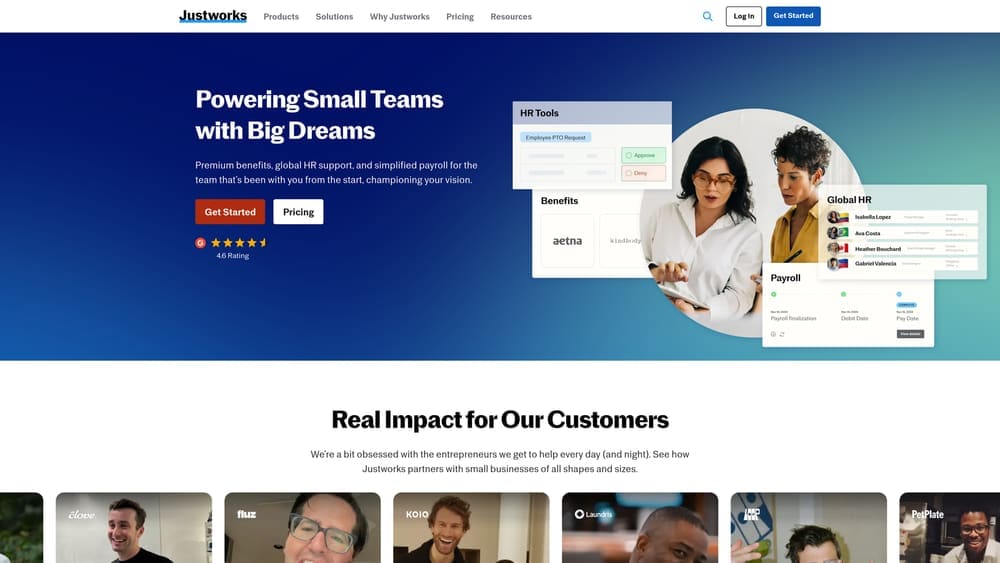
Justworks is a PEO built for smaller businesses that prioritizes pricing transparency and a modern, streamlined platform experience.
Where This Tool Shines
Justworks is one of the few PEO providers that actually publishes their pricing. That alone is worth noting in an industry where almost everyone requires a custom quote before revealing any numbers. For a small business owner trying to budget accurately without sitting through a sales cycle, that transparency is genuinely useful.
The platform is also cleaner and more intuitive than most legacy PEO providers. If your team is under 50 people and you want PEO benefits without the administrative complexity that comes with larger providers, Justworks hits a reasonable balance between functionality and simplicity.
Key Features
Publicly Listed Pricing: Flat per-employee monthly rates published on their website, no sales call required to see numbers.
Full PEO Model: Co-employment with payroll, benefits, compliance, and HR tools included.
Modern User Interface: Clean, intuitive platform designed for teams without dedicated HR staff.
Large-Group Health Insurance Access: Employees gain access to health plans typically reserved for larger employers.
Simple Onboarding: Faster setup process than most traditional PEO providers.
Best For
Startups and growing small businesses with fewer than 50 employees that want the co-employment benefits of a PEO without the opacity of custom-quote-only pricing. Strong fit for tech-forward teams that value platform usability.
Pricing
Basic plan starts at $59 per employee per month; Plus plan at $109 per employee per month, as publicly listed on their website.
6. Gusto
Best for: Small businesses that need modern payroll with built-in HR tools but don’t want co-employment.
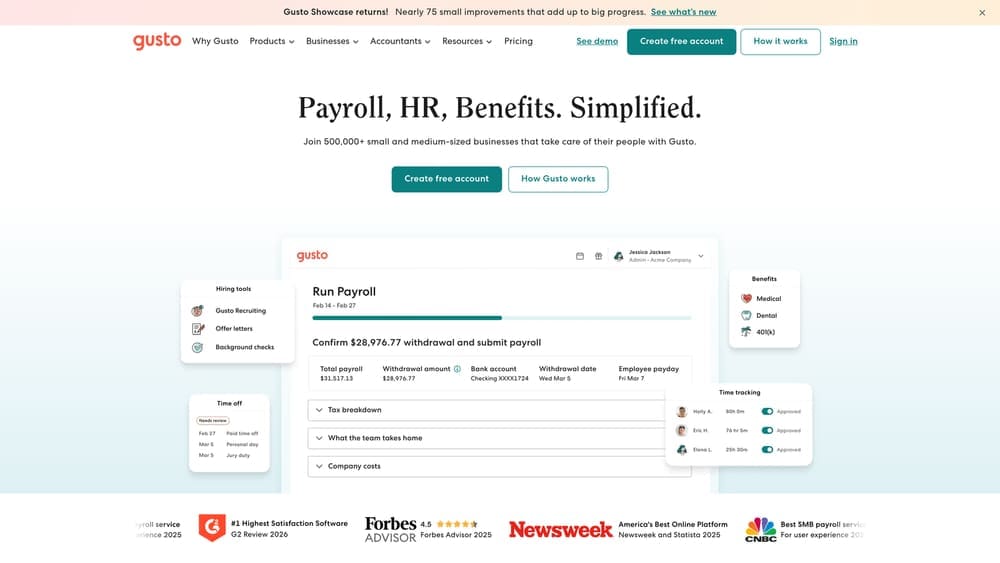
Gusto is a payroll-first platform with integrated HR features, benefits administration, and a clean interface designed for businesses that want to stay in the employer seat.
Where This Tool Shines
Gusto is the payroll-only alternative most often compared to Paychex Flex, and for good reason. The platform experience is noticeably more modern, and the base pricing is transparent in a way that Paychex Flex’s custom quote model isn’t. For a small business owner who wants to know exactly what they’re paying before getting on a call, that matters.
The built-in HR tools add real value without pushing you into a PEO model. Offer letters, compliance alerts, org charts, and onboarding checklists are all included at the platform level. You’re not co-employed, you don’t share employer liability, and you’re not paying PEO-level fees. That’s the right trade-off for many businesses under 25 employees.
Key Features
Automated Payroll and Tax Filing: Full-service payroll processing with state and federal tax filing handled automatically.
Built-In Benefits Administration: Health insurance, 401(k), and other benefits managed within the platform.
HR Tools Included: Offer letters, compliance alerts, onboarding, and org charts without needing a separate HR system.
No Co-Employment: Business retains full employer status and all associated control.
Broad Integration Support: Connects with QuickBooks, Xero, time-tracking tools, and other small business software.
Best For
Small businesses with fewer than 50 employees that want a well-designed payroll platform with solid HR functionality and no interest in co-employment. A strong Paychex Flex alternative for businesses that prioritize interface quality and pricing transparency.
Pricing
Simple plan starts at $40 per month plus $6 per employee per month. Higher tiers add additional HR and compliance features.
7. TriNet
Best for: Businesses in regulated or niche industries that need compliance and HR support tailored to their specific vertical.
TriNet is a PEO that differentiates itself through industry-specific expertise, offering tailored compliance, benefits, and HR support for businesses in sectors with distinct regulatory demands.

Where This Tool Shines
Most PEOs apply a generalist model to compliance and HR. TriNet organizes its service delivery around industry verticals: technology, financial services, life sciences, nonprofits, and others. That vertical focus means the HR support and compliance guidance you receive is shaped by someone who understands the specific employment law nuances in your sector, not just generic federal standards.
For a biotech startup navigating California employment law, or a fintech company dealing with financial industry HR requirements, that specialization is more than a marketing claim. It translates into more relevant guidance and fewer situations where you’re getting generic advice that doesn’t account for your industry’s specific exposure.
Key Features
Industry-Vertical PEO Solutions: Dedicated service tracks for tech, finance, life sciences, nonprofits, and other regulated sectors.
Vertical-Specific Compliance: Risk management and employment law guidance calibrated to your industry’s regulatory environment.
Competitive Group Benefits: Access to health and ancillary benefits plans through TriNet’s pooled purchasing.
Dedicated HR Team with Industry Knowledge: HR support staff with experience in your specific sector.
Cloud-Based Platform: Unified payroll, benefits, and HR management through a single interface.
Best For
Businesses in regulated industries with 10 to 500 employees that need more than a generalist PEO. Particularly strong for companies in California or other states with complex employment law environments where industry-specific guidance is a genuine operational need.
Pricing
Custom quotes only. Pricing varies by industry vertical and headcount. Typically percentage-of-payroll or per-employee structure. Requires a consultation for specific numbers.
8. Rippling
Best for: Growing businesses that want to start with payroll and add PEO or HR modules as they scale, without being locked into a model on day one.
Rippling is a modular workforce platform that bridges the gap between payroll-only and full PEO, letting businesses add capabilities as their needs evolve.
Where This Tool Shines
The core problem Rippling solves is the binary choice most platforms force on you: you’re either in a full PEO arrangement or you’re running standalone payroll. Rippling lets you start with payroll processing, then layer in HR, IT management, benefits, and eventually PEO services when the time is right. That flexibility is genuinely useful for businesses at an inflection point.
The automation capabilities are also a real differentiator. Rippling can trigger workflows across HR, IT, and finance simultaneously when an employee is hired or offboarded. For a growing company that’s starting to feel the friction of manual processes across disconnected systems, that unified approach reduces operational overhead in a way that neither a basic payroll tool nor a traditional PEO typically delivers.
Key Features
Modular Architecture: Start with payroll and add HR, IT, benefits, or PEO modules as your business grows.
Unified Employee Management: Single platform spanning HR, IT provisioning, and finance for a complete employee lifecycle view.
Workflow Automation: Automated triggers across departments for onboarding, offboarding, and role changes.
PEO Option Without Lock-In: Co-employment available as a module, not a prerequisite for using the platform.
Extensive App Integrations: Connects with hundreds of third-party tools across accounting, benefits, and productivity categories.
Best For
Scaling businesses that are outgrowing basic payroll but aren’t ready to commit to a full PEO model. Particularly useful for companies that want to consolidate HR and IT operations into a single platform while keeping the option to add co-employment later.
Pricing
Core platform starts at $8 per employee per month. PEO services require a separate custom quote. Full pricing depends on which modules you activate.
Which Option Actually Fits Your Business
The honest answer is that most businesses searching “Paychex PEO vs payroll company” are trying to solve one of two problems: they’re paying PEO-level fees and wondering if they actually need co-employment, or they’re running basic payroll and wondering if a PEO would reduce their compliance exposure.
If you’re in the first camp, the question is whether the co-employment model is delivering real value relative to what you’re paying. PEO pricing, especially on a percentage-of-payroll structure, gets expensive as your headcount and salaries grow. Many businesses find they’ve outgrown the model, or that they never needed it to begin with.
If you’re in the second camp, the decision hinges on a few concrete factors. Do you have the internal HR capacity to handle compliance independently? Can you access competitive benefits without pooling through a PEO? Is your headcount large enough that a PEO’s administrative overhead makes sense?
For most businesses under 10 employees, a modern payroll platform like Gusto or Paychex Flex is likely sufficient. For businesses between 15 and 200 employees with limited HR infrastructure, a PEO is worth serious consideration. Justworks is the most transparent entry point for smaller teams. ADP TotalSource and Paychex PEO make more sense for mid-market companies that want enterprise-level infrastructure. TriNet earns its place if your industry has specific regulatory complexity. Rippling is the right call if you want flexibility to grow into more without committing to a model upfront.
Before you renew your current agreement or sign anything new, it’s worth taking a hard look at what you’re actually getting relative to what you’re paying. Most businesses overpay due to bundled fees and unclear administrative markups. You can compare your options with transparent pricing breakdowns and provider-level analysis before you commit to anything.