
Paychex and Cornerstone both deliver core PEO functions—payroll, benefits administration, HR compliance, risk management. But they operate from fundamentally different service philosophies. Paychex built its reputation as a national payroll and HR infrastructure provider, scaling technology-first solutions across thousands of clients. Cornerstone positions itself as a regional specialist prioritizing direct client relationships and hands-on service.
Neither approach is inherently better. The right choice depends on how your business actually operates.
If you run multi-state operations with distributed teams, need self-service technology that scales without additional support overhead, or anticipate rapid headcount growth, Paychex’s infrastructure may align better. If you prefer working with a dedicated account team, operate primarily within a specific region, or value direct access to decision-makers when issues arise, Cornerstone’s model might fit more naturally.
This comparison isn’t about declaring a winner. It’s about identifying which provider’s operational structure matches your company’s priorities, growth trajectory, and internal capacity. The following seven factors break down the practical differences that affect day-to-day operations—not marketing promises.
Before diving in, if you’re still evaluating whether a PEO makes sense for your business at all, start with foundational PEO mechanics first. This comparison assumes you’ve already decided a PEO fits your needs and you’re now choosing between specific providers.
1. Company Size and Scalability Fit
Where Provider Infrastructure Matches Business Reality
Paychex operates at enterprise scale. They serve clients ranging from 10 employees to thousands, but their platform and service delivery model optimizes for volume. Their technology stack handles complex multi-entity structures, consolidated reporting across divisions, and standardized processes that work when you’re managing 200 employees the same way you managed 50.

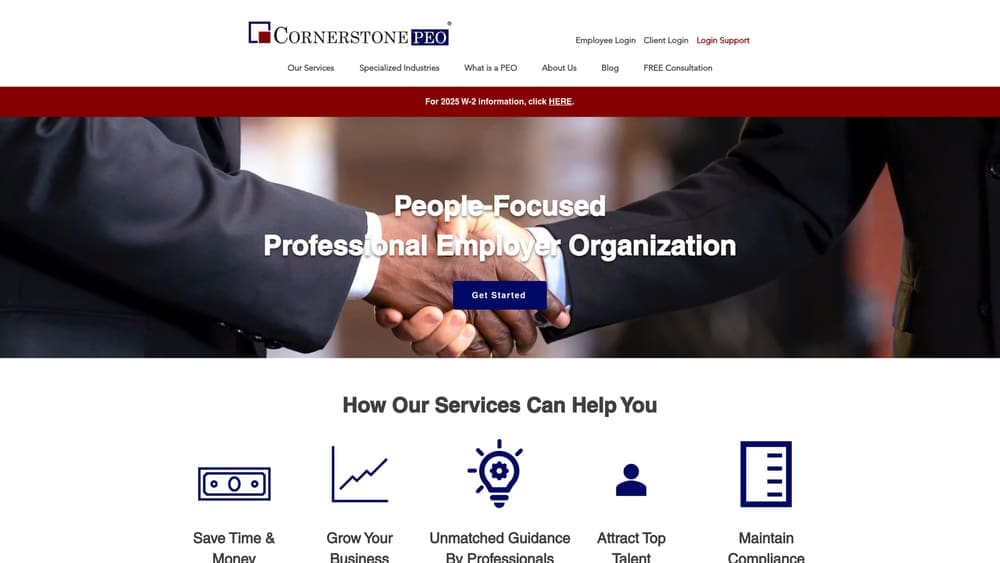
Cornerstone typically works with smaller client bases within their regional footprint. Their service model doesn’t scale the same way—and that’s intentional. Account teams carry fewer clients, which allows deeper familiarity with individual businesses but limits how quickly they can absorb rapid growth or geographic expansion.
How This Affects Your Operations
If you’re at 30 employees today and planning to reach 150 within two years, Paychex’s infrastructure won’t require a service model change as you scale. You’ll stay within the same platform, same reporting structure, same support channels. The experience remains consistent even as complexity increases.
If you’re at 25 employees with stable headcount and no immediate expansion plans, Cornerstone’s hands-on approach may feel more responsive. Your account manager knows your business personally, understands your specific challenges, and doesn’t treat you like account number 4,872 in a queue. For businesses evaluating whether a PEO makes financial sense at smaller team sizes, understanding PEO value for small teams helps frame the decision.
The Tradeoff
Scalability comes with standardization. Paychex’s processes work efficiently because they’re repeatable across thousands of clients. That means less customization and more reliance on self-service tools. Cornerstone’s personalized service requires more human touchpoints, which becomes harder to maintain as you grow beyond their typical client profile.
Ask yourself: Do you need a provider that scales invisibly, or one that knows your business intimately right now?
2. Geographic Coverage and Multi-State Operations
When Regional Expertise Conflicts With National Expansion
Paychex operates in all 50 states with established infrastructure for multi-state payroll tax compliance, workers’ compensation administration, and unemployment claims management. If you hire employees across state lines, their systems handle withholding variations, reporting requirements, and regulatory differences without requiring manual intervention.
Cornerstone focuses on specific regional markets where they’ve built deep relationships with benefits carriers, workers’ comp providers, and local regulatory resources. Their expertise runs deep within those geographies but doesn’t extend uniformly nationwide. If you operate primarily within their service area, that regional focus delivers tangible advantages. Outside those boundaries, you’re working with a provider operating beyond their core strength.
Operational Implications
Multi-state operations introduce compliance complexity that scales exponentially. Each state maintains different wage and hour laws, unemployment insurance requirements, disability insurance mandates, and paid leave regulations. A national provider like Paychex absorbs that complexity within their platform. You’re not managing state-by-state nuances manually.
Regional providers excel when your operations stay concentrated. If you run three locations across two neighboring states within Cornerstone’s footprint, their localized knowledge often translates to faster issue resolution and better carrier relationships. They’re not routing your questions through a national call center—they’re working with the same state agencies and insurance brokers they’ve partnered with for years. See how Insperity compares to Cornerstone for another perspective on regional versus national coverage.
The Decision Point
Geographic footprint isn’t just about where you operate today. Consider where you might expand. If you’re opening locations in new states over the next 18 months, verify that your PEO’s infrastructure supports that growth without requiring a provider switch mid-expansion.
If your business model keeps you regionally focused, Cornerstone’s concentrated expertise may outweigh Paychex’s broader but less specialized coverage.
3. Service Model: Self-Service Tech vs. Dedicated Support
How You Actually Access Help When Issues Arise
Paychex built a technology-first service model. Their platform includes self-service portals for payroll processing, benefits enrollment, time tracking, and HR document management. When you need support, you’re typically routed through tiered service channels—online knowledge bases, chatbots, general support lines, then escalation to specialists if needed. This works efficiently for straightforward issues but adds friction when problems require context about your specific business.
Cornerstone operates relationship-first. You work with a dedicated account team that handles most issues directly. Need to adjust a benefits enrollment outside the standard window? Your account manager processes it. Questions about a workers’ comp audit? Same person who knows your claim history. This model prioritizes direct access over scalable efficiency.
What This Means Day-to-Day
Self-service platforms reduce dependency on support availability. If you process payroll at 9 PM on a Sunday, Paychex’s system handles it without requiring human intervention. Their technology stack integrates with accounting software, time tracking tools, and HRIS platforms, which matters if your team prefers managing HR functions through existing workflows.
Dedicated support means fewer handoffs. When you call Cornerstone, you’re speaking with someone who already understands your pay structure, benefits setup, and organizational quirks. You’re not re-explaining context every time. But that relationship depends on your account team’s availability and workload. Understanding how a PEO works operationally clarifies what daily interactions look like with either model.
Internal Capacity Matters
If you have an internal HR manager or operations lead comfortable navigating software platforms, Paychex’s self-service model may feel more efficient. You’re not waiting for callbacks or scheduling meetings to complete routine tasks.
If HR responsibilities fall on a business owner or office manager already stretched thin, Cornerstone’s hands-on approach removes administrative burden. You’re delegating tasks rather than learning another software system.
Neither model is objectively better. The right fit depends on how your team actually works and where you prefer spending time versus outsourcing complexity.
4. Pricing Structure Transparency
Beyond Per-Employee-Per-Month Rates
PEO pricing isn’t straightforward. Both Paychex and Cornerstone use variations of per-employee-per-month (PEPM) pricing, but the total cost of ownership includes administrative fees, benefits markups, workers’ compensation premiums, state unemployment insurance charges, and technology access fees. How those costs get bundled and disclosed varies significantly.
Paychex typically structures pricing with separate line items for payroll administration, benefits administration, HR support, and compliance services. This allows more granular visibility into what you’re paying for, but it also means comparing quotes requires understanding which services are included versus optional add-ons. Their pricing scales with headcount and service tier selection.
Cornerstone often presents more consolidated pricing that bundles core services into a single PEPM rate. This simplifies comparison but can obscure where costs actually accumulate. Benefits administration, for example, might include markup on health insurance premiums that isn’t immediately visible in the headline rate. Many businesses discover hidden PEO fees only after signing contracts.
Where Hidden Costs Appear
Workers’ compensation pricing deserves specific attention. PEOs negotiate master policies that theoretically deliver better rates than small businesses can access independently. But how those savings get passed through varies. Some PEOs charge administrative fees on top of the base workers’ comp premium. Others build margin into the rate itself. Paychex’s size gives them leverage with carriers, but their pricing structure includes administrative overhead. Cornerstone’s regional focus may deliver better rates within their markets, but verify whether those savings actually reach your invoice.
Benefits administration follows similar patterns. PEOs access master health plans that small businesses can’t negotiate alone. But the cost advantage depends on how much markup the PEO adds for administration, enrollment support, and carrier relationship management. Ask both providers for a breakdown showing the actual insurance premium versus their administrative fee.
What to Request During Quotes
Don’t accept a single PEPM number. Request itemized breakdowns showing payroll administration, benefits administration, workers’ comp premiums, HR support fees, technology access charges, and any additional compliance or risk management costs. Ask specifically about renewal pricing—many PEOs offer competitive first-year rates that increase significantly upon renewal.
Compare total annual cost projections, not just monthly rates. A lower PEPM rate that includes fewer services may cost more once you add required functionality. Use a PEO cost comparison approach to calculate your actual spend across providers.
5. Benefits Administration and Health Plan Access
Carrier Networks and Renewal Processes
PEOs provide access to master health plans by pooling employees from multiple client companies under a single group policy. This theoretically delivers better rates and plan options than a 30-person company could negotiate independently. But the actual advantage depends on the PEO’s carrier relationships, geographic coverage, and how they manage annual renewals.
Paychex partners with national carriers and offers a broad range of plan options across medical, dental, vision, life, and disability insurance. Their size gives them negotiating leverage, but their plans serve a diverse client base. You’re not getting a plan designed specifically for your industry or region—you’re selecting from standardized options that work across their entire book of business.
Cornerstone’s regional focus allows deeper relationships with local and regional carriers. If you operate within their core markets, they may offer plans with better local provider networks or more competitive pricing for your specific geography. But their carrier options are narrower. If your employees are spread across multiple states, Cornerstone’s regional carrier relationships may not cover everyone effectively.
Renewal Process Differences
Annual benefits renewals determine whether your PEO relationship remains cost-effective. Health insurance premiums increase regularly—sometimes dramatically. How your PEO handles those increases matters.
Larger PEOs like Paychex spread risk across thousands of employees, which can stabilize renewal rates. But you’re also absorbing the claims experience of their entire client base. If their overall population has high utilization, your rates increase even if your employees are healthy.
Smaller regional PEOs like Cornerstone may offer more personalized renewal negotiations, but their smaller risk pool means individual claims can affect rates more significantly. One high-cost claim within their client base could drive premiums up across all participants. Knowing the right questions to ask PEO providers about renewal processes prevents surprises.
Employee Experience Matters
Benefits administration isn’t just about cost. Consider how employees actually use their coverage. Does the carrier network include providers near your office locations? How does the PEO handle enrollment support, claims issues, and mid-year qualifying events?
Paychex provides technology-driven enrollment with self-service portals. Employees manage their selections online, which works well for tech-comfortable teams but may frustrate employees who prefer direct support.
Cornerstone’s hands-on approach typically includes more direct enrollment assistance. If your workforce includes employees less comfortable with online platforms, that personalized support reduces administrative burden on your internal team.
6. Technology Platform and Integration Capabilities
Where Software Efficiency Meets Operational Reality
Paychex operates a comprehensive HR technology platform that integrates payroll, time tracking, benefits administration, onboarding, performance management, and compliance tools. Their platform connects with major accounting software, expense management systems, and third-party HR applications. If you’re already using QuickBooks, Xero, or similar tools, Paychex’s integrations reduce duplicate data entry.
Their mobile app allows employees to view pay stubs, request time off, update direct deposit information, and access tax documents without contacting HR. This self-service functionality reduces administrative questions but requires employees to adopt another platform. For a broader view of platform capabilities, explore the best PEO HR technology platforms available today.
Cornerstone’s technology infrastructure focuses on core PEO functions—payroll processing, tax filing, benefits administration, and compliance reporting. Their platform handles essential tasks effectively but doesn’t offer the same breadth of integrated HR tools. If you need performance review software, applicant tracking, or learning management systems, you’re adding third-party solutions that may not integrate seamlessly.
Integration Complexity
Platform integration matters more as your business grows. If you’re running separate systems for time tracking, expense management, and accounting, manual data transfer creates error risk and administrative overhead. Paychex’s established integration ecosystem reduces that friction.
Smaller operations with simpler workflows may not need extensive integrations. If you’re processing payroll for 20 employees and not using sophisticated accounting or HR software, Cornerstone’s streamlined platform may feel more intuitive than navigating Paychex’s feature-rich but more complex interface.
User Experience Differences
Technology sophistication doesn’t automatically mean better usability. Paychex’s platform includes extensive functionality, but that complexity can overwhelm users who just need to process payroll and manage benefits. Their interface assumes a certain level of HR and payroll knowledge.
Cornerstone’s simpler platform may feel more accessible for business owners managing HR responsibilities without dedicated staff. But simpler also means fewer customization options and less flexibility when your needs evolve.
Request demos from both providers. Test how you’d actually complete common tasks—processing an off-cycle payroll run, adding a new employee, adjusting benefits elections, generating compliance reports. The platform you’ll use weekly matters more than the feature list in their sales deck.
7. Contract Terms and Exit Flexibility
What Happens When You Need to Leave
PEO contracts typically run 12 months with automatic renewal clauses. But the specifics around termination, data portability, and transition support vary significantly. Understanding these terms before signing prevents expensive complications if the relationship doesn’t work out.
Paychex contracts generally include standard termination provisions requiring 30 to 60 days’ notice. Their size and established infrastructure mean they have documented processes for client offboarding, data export, and final payroll processing. But their contracts may include provisions that extend your obligation beyond the initial term if you don’t provide notice within a specific window.
Cornerstone’s contract terms should be reviewed carefully. Regional providers sometimes include longer notice periods or more restrictive termination clauses. Their smaller scale means fewer clients leave, so they may not have as streamlined an exit process. Verify specifically how they handle data export, final benefits reconciliation, and workers’ comp policy transitions. If you’re locked into an agreement that isn’t working, learn how to leave a PEO mid-contract without derailing operations.
Data Portability Matters
When you leave a PEO, you need access to historical payroll records, tax filings, benefits information, and employee data. Some PEOs provide comprehensive data exports in standard formats. Others offer limited access or charge fees for historical data retrieval.
Ask both providers specifically: What data do you provide upon termination? In what format? Are there fees for data export or historical record access? How long do you retain client data after termination?
This isn’t hypothetical. If you switch PEOs or bring HR functions in-house, incomplete data creates compliance risk and operational disruption.
Transition Support
Leaving a PEO means transitioning payroll tax accounts, benefits coverage, workers’ comp policies, and unemployment insurance back to your company or to a new provider. Some PEOs assist with this transition. Others provide minimal support once you’ve terminated.
Paychex’s established processes typically include transition checklists and support resources. Their scale means they’ve handled thousands of client departures and have documented procedures.
Cornerstone’s transition support may be more personalized but less formalized. If you’ve worked closely with a dedicated account team, they may provide hands-on assistance. But verify this is contractually guaranteed rather than goodwill-dependent. Knowing how to compare PEO contracts helps you evaluate exit terms before signing.
Read the Fine Print
Before signing with either provider, have your attorney review the contract specifically for:
– Termination notice requirements and windows
– Automatic renewal provisions
– Data ownership and export rights
– Post-termination access to historical records
– Fees associated with early termination or data retrieval
– Dispute resolution and arbitration clauses
PEO contracts create a co-employment relationship that affects your business operations fundamentally. Understanding exit terms before you’re locked in prevents expensive surprises later.
Making the Decision That Fits Your Business
Paychex and Cornerstone serve different business profiles effectively. Paychex fits companies prioritizing scalability, national coverage, self-service technology, and standardized processes that work across distributed teams. Their infrastructure handles complexity through platform efficiency rather than relationship intensity.
Cornerstone appeals to businesses valuing direct relationships, regional expertise, and hands-on support. Their model works best when your operations stay concentrated within their service area and you prefer delegating HR complexity to a dedicated team rather than managing it through software.
Neither provider is universally better. The right choice depends on how your business actually operates, where you’re headed, and what kind of support model fits your team’s capacity and preferences.
Work through the seven factors systematically. Assess your current headcount and growth trajectory. Map your geographic footprint against each provider’s coverage. Evaluate whether your team prefers self-service platforms or direct support relationships. Request itemized pricing that reveals total cost of ownership. Compare benefits carrier networks against where your employees actually live. Test their technology platforms through demos. Read contract terms carefully with legal review.
Most businesses choose a PEO based on initial pricing or a sales conversation. But the decision affects payroll accuracy, benefits administration, compliance risk, and employee experience for years. Taking time to evaluate these factors properly prevents expensive mistakes and provider switches that disrupt operations.
Before you renew your PEO agreement, compare your options. Most businesses overpay due to bundled fees and unclear administrative markups. We break down pricing, services, and contract structures so you can make a smarter decision.