
Paychex PEO, operating under the Paychex HR Solutions brand, is one of the most recognized names in the PEO payroll space. The brand recognition is real. So is the sales pressure that often comes with it.
But recognition isn’t the same as fit. Before you sign or renew, the smarter question is: how does Paychex PEO actually compare to the alternatives, and what should you be evaluating beyond the sales pitch?
This guide covers Paychex alongside seven other PEO providers with strong payroll capabilities. For each one, we’ll look at what they do well, where they fall short, and who they’re genuinely built for. The goal isn’t to rank them in some arbitrary order — it’s to give you a practical frame for making a real decision.
Payroll processing itself has become fairly commoditized across established PEOs. The real differences show up in pricing transparency, how services are bundled, multi-state compliance depth, and how cleanly you can exit if the relationship stops working. Those are the factors worth focusing on.
1. Clicks Geek PEO
Best for: Business owners who want independent, unbiased analysis before choosing or switching PEO providers.
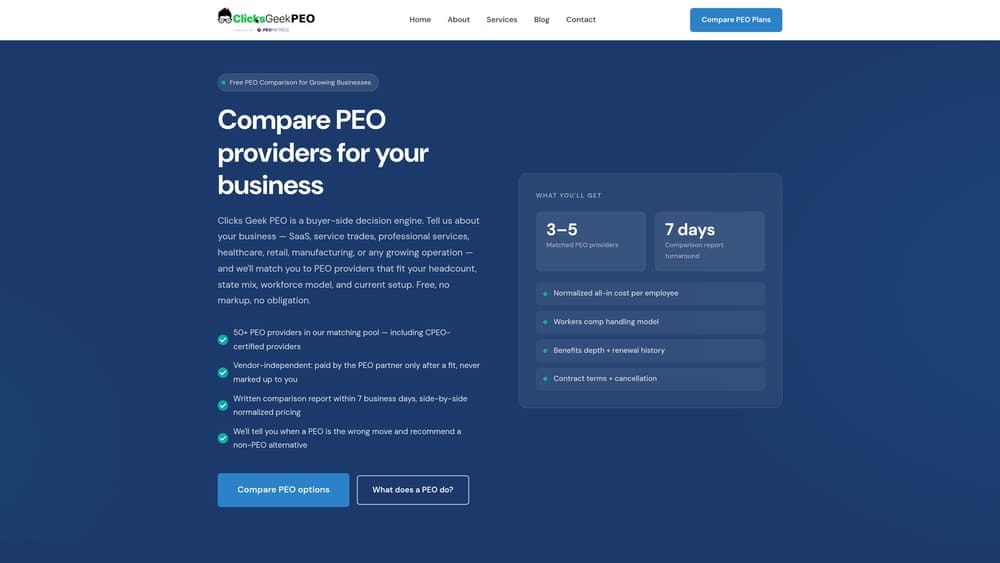
Clicks Geek PEO is an independent PEO comparison and advisory platform built to help businesses evaluate providers like Paychex without the noise of broker incentives or provider marketing.
Where This Tool Shines
Most businesses approach PEO evaluation without a clear benchmark. They take a quote, compare it loosely to one or two competitors, and sign — often without understanding what’s bundled, what’s marked up, or what the exit looks like. Clicks Geek PEO is built specifically to close that gap.
The platform provides side-by-side breakdowns of providers, transparent pricing analysis, and contract term reviews designed to surface red flags before you’re locked in. Critically, it operates as an independent advisory resource, not as a broker earning commissions from PEO referrals. That distinction matters when you’re trying to get an honest read on whether Paychex (or anyone else) is actually the right fit for your headcount, industry, and budget.
Key Features
Side-by-Side Provider Comparisons: Compare Paychex and other PEOs across payroll capabilities, benefits access, compliance support, and pricing structure in one place.
Transparent Pricing and Cost Breakdowns: Understand what you’re actually paying, including administrative fees, benefits markups, and workers’ comp margins that often get buried in bundled quotes.
Contract Term Analysis: Identify renewal traps, auto-renewal clauses, and exit penalties before you sign.
Red-Flag Identification: Flags common contract and pricing structures that tend to cost businesses more over time.
Independent Advisory Model: No broker commissions. No provider relationships that influence recommendations. Objective analysis only.
Best For
Business owners, CFOs, and HR decision-makers who are evaluating a PEO for the first time, considering switching from their current provider, or preparing to renew and want to know whether they’re getting a fair deal. Especially useful for companies that received a Paychex quote and want a second opinion before committing.
Pricing
Free comparison resources are available on the platform. Advisory services are available for businesses that want a more hands-on evaluation of their specific situation and provider options.
2. Paychex PEO (Paychex HR Solutions)
Best for: Mid-sized businesses that want a full-service PEO built on a mature, established payroll platform with dedicated specialist support.
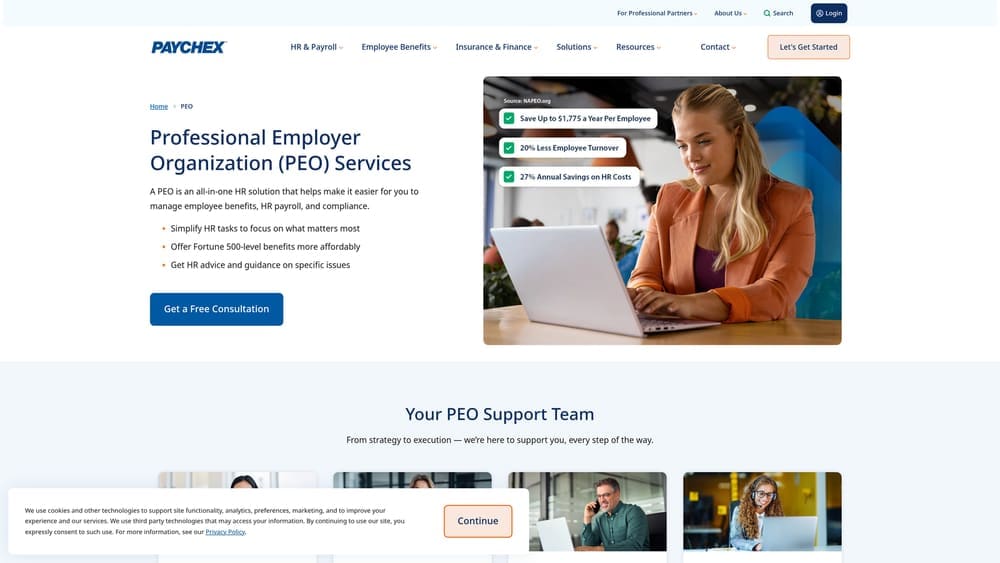
Paychex PEO operates under the Paychex HR Solutions brand, formerly Oasis Outsourcing, which Paychex acquired in 2018 and has since integrated with its flagship Paychex Flex payroll system.
Where This Tool Shines
The Paychex Flex platform is genuinely capable. It handles automated tax filing, direct deposit, garnishments, W-2 and 1099 processing, and multi-state compliance with a level of infrastructure that smaller PEOs can’t easily replicate. The CPEO certification from the IRS adds a layer of credibility that matters when payroll accuracy is non-negotiable.
Where Paychex earns its reputation is in scale and stability. If you’re running a multi-state workforce and need a provider that won’t stumble on state-specific payroll compliance, Paychex has the infrastructure to handle it. The dedicated payroll specialist model also means you have a named contact, not just a support ticket queue. That’s not universal in this space.
Key Features
Paychex Flex Payroll Platform: Automated tax filing, direct deposit, garnishment management, and W-2/1099 processing in one system.
CPEO-Certified: IRS certification as a Certified Professional Employer Organization, which carries specific tax liability protections for co-employed businesses.
Multi-State Payroll Compliance: Handles payroll tax registration, filing, and compliance across multiple states without requiring the employer to manage each jurisdiction separately.
Bundled HR and Benefits: Payroll, HR support, benefits administration, and risk management delivered as an integrated package.
Dedicated Payroll Specialist: A named specialist assigned to your account rather than a general support line.
Best For
Companies with 50 to several hundred employees, particularly those operating across multiple states where payroll compliance complexity is high. Less ideal for early-stage startups or businesses that want pricing transparency upfront — Paychex doesn’t publish rates, and quotes can vary significantly based on headcount and negotiation.
Pricing
Custom quotes only. Pricing is typically structured as a percentage of payroll or a per-employee-per-month fee depending on headcount and selected services. Expect bundled pricing that may include services you don’t need.
3. ADP TotalSource
Best for: Larger SMBs and lower-middle-market companies that want enterprise-grade payroll infrastructure within a full co-employment model.
ADP TotalSource is the largest PEO in the U.S. by co-employed headcount and operates as a full co-employment PEO backed by ADP’s broader payroll and HCM ecosystem.
Where This Tool Shines
Scale is ADP TotalSource’s clearest advantage. The sheer size of their co-employed workforce gives them meaningful buying power on benefits, which can translate into better health insurance rates for smaller companies than they’d access independently. The integration with ADP’s payroll and analytics infrastructure is also mature, with reporting capabilities that go well beyond what most mid-market PEOs offer.
The dedicated HR Business Partner model adds a consultative layer that distinguishes TotalSource from purely transactional PEO relationships. That said, ADP’s scale can also mean less flexibility and a more rigid service structure. If you need something highly customized, TotalSource may feel constraining.
Key Features
ADP HCM Ecosystem Integration: Payroll, HR, time tracking, and analytics connected within ADP’s broader platform.
Benefits Buying Power: Large-group benefits access driven by the scale of TotalSource’s co-employed workforce.
CPEO-Certified: IRS-certified PEO status with the associated tax liability protections.
HR Business Partner Model: Dedicated HR consultants assigned to your account for strategic and operational support.
Robust Reporting and Analytics: Payroll and workforce analytics tools that are more advanced than what smaller PEOs typically offer.
Best For
Companies with 50 or more employees that want a full-service PEO with strong payroll infrastructure and are willing to trade some flexibility for the stability and buying power that comes with the largest PEO in the market.
Pricing
Custom quotes only. ADP TotalSource generally requires a minimum of 50 employees and does not publish pricing. Expect bundled service packages with limited à la carte flexibility.
4. Justworks
Best for: Startups and small businesses that want transparent, flat-rate PEO pricing with a clean payroll interface and no surprises.
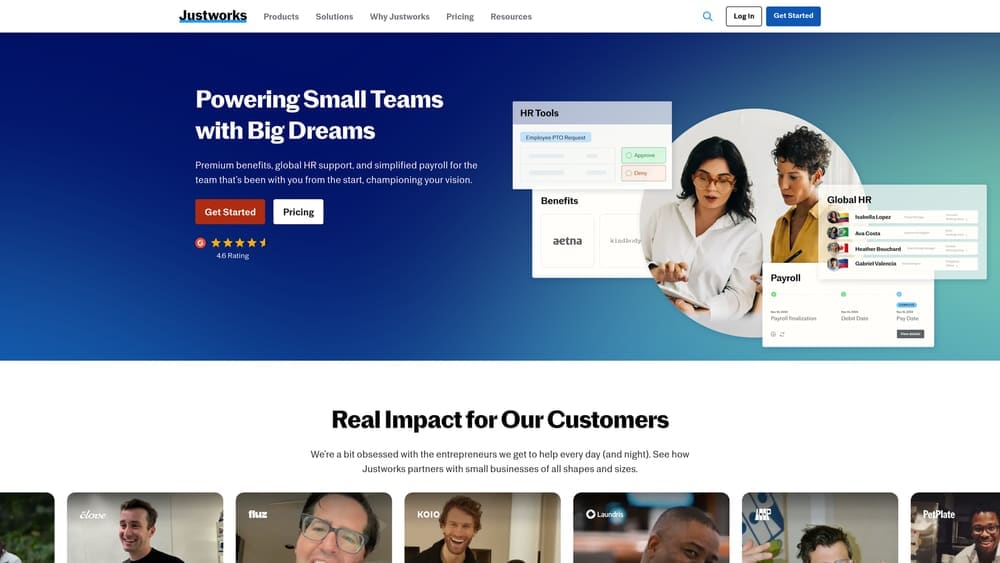
Justworks is a PEO built specifically for smaller businesses and startups, differentiating itself with published per-employee pricing and a modern, straightforward payroll experience.
Where This Tool Shines
Pricing transparency is Justworks’ defining characteristic. In a space where almost every provider hides rates behind a sales call, Justworks publishes its per-employee-per-month fees directly on its website. For business owners who are tired of getting three different quotes from the same provider depending on who picks up the phone, that clarity is genuinely valuable.
The payroll setup is clean and the onboarding process is notably faster than most enterprise PEOs. Multi-state compliance tools are built in, which matters for distributed teams. The tradeoff is depth: Justworks is built for simplicity, so businesses with complex payroll scenarios, large headcounts, or specialized compliance needs may outgrow it faster than they expect.
Key Features
Published Flat-Rate Pricing: Per-employee-per-month fees listed publicly on the website — no sales call required to understand the cost structure.
Simple Payroll Setup and Interface: Clean onboarding process designed for teams without dedicated HR staff.
Automated Tax Withholding and Filing: Handles federal, state, and local payroll tax compliance automatically.
Multi-State Compliance Tools: Built-in support for distributed teams operating across multiple states.
PEO and Payroll-Only Plans: Flexibility to choose between full co-employment or a lighter payroll-focused plan.
Best For
Startups and growing businesses under 100 employees that prioritize pricing clarity and ease of use over deep customization. Particularly well-suited for founders who want to understand exactly what they’re paying before committing.
Pricing
Starts at $59 per employee per month for the Basic plan; $109 per employee per month for the Plus plan. Pricing is published on the Justworks website and does not require a sales conversation to access.
5. TriNet
Best for: Companies in specific industries — tech, professional services, financial services — that want a PEO with vertical-specific payroll and compliance expertise.
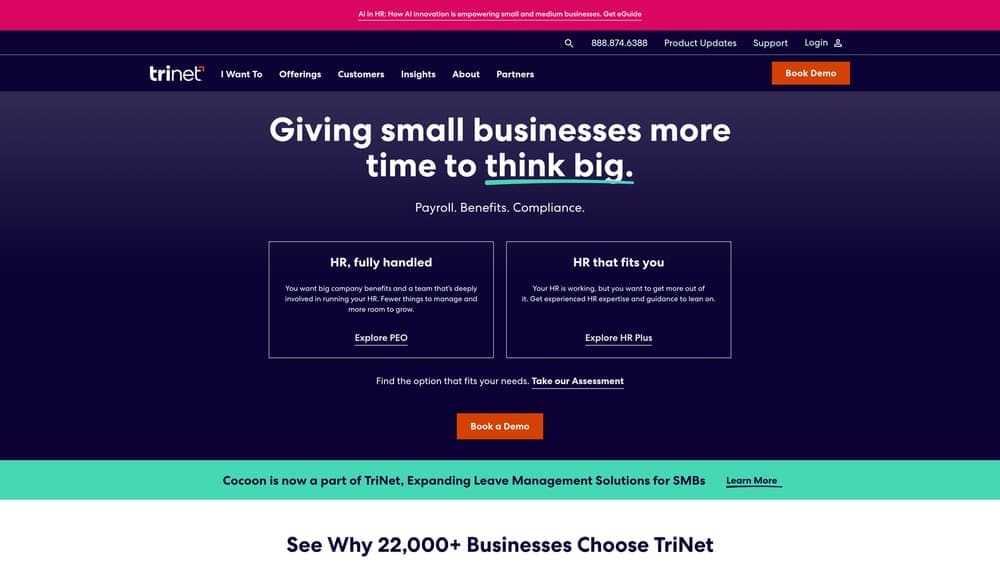
TriNet is a publicly traded PEO that structures its service model around industry verticals, offering tailored payroll, benefits, and compliance packages rather than a one-size-fits-all approach.
Where This Tool Shines
Most PEOs treat every client roughly the same regardless of industry. TriNet takes a different approach by organizing its expertise around specific verticals. A tech startup and a professional services firm have meaningfully different payroll structures, equity compensation considerations, and compliance exposures. TriNet’s vertical teams are built to understand those differences rather than apply a generic framework to every engagement.
The benefits packages are competitive, leveraging TriNet’s size to offer large-group rates. The cloud-based payroll platform handles expense management integration, which reduces friction for companies with active expense reporting needs. The downside is that TriNet’s pricing model is opaque, and some businesses find the percentage-of-payroll structure becomes expensive as headcount grows.
Key Features
Vertical-Specific Expertise: Industry-focused HR and payroll teams for tech, professional services, financial services, and other verticals.
Comprehensive Benefits with Large-Group Rates: Benefits packages backed by TriNet’s co-employed scale.
Industry-Specific Compliance Guidance: Risk mitigation support tailored to the regulatory exposures of specific industries.
Cloud-Based Payroll Platform: Accessible payroll management with reporting and audit capabilities.
Expense Management Integration: Built-in expense tracking connected to payroll processing.
Best For
Companies in knowledge-economy industries — particularly tech and professional services — where generic HR and payroll support misses important nuances. Less ideal for businesses in trades, construction, or high-risk industries where workers’ compensation complexity is the primary driver.
Pricing
Custom quotes only. TriNet typically uses a percentage-of-payroll pricing model, which can become a significant cost factor as salaries and headcount scale. Exact rates are not published.
6. Insperity
Best for: Established SMBs with 50 to 5,000 employees that want high-touch HR support layered on top of solid payroll infrastructure.
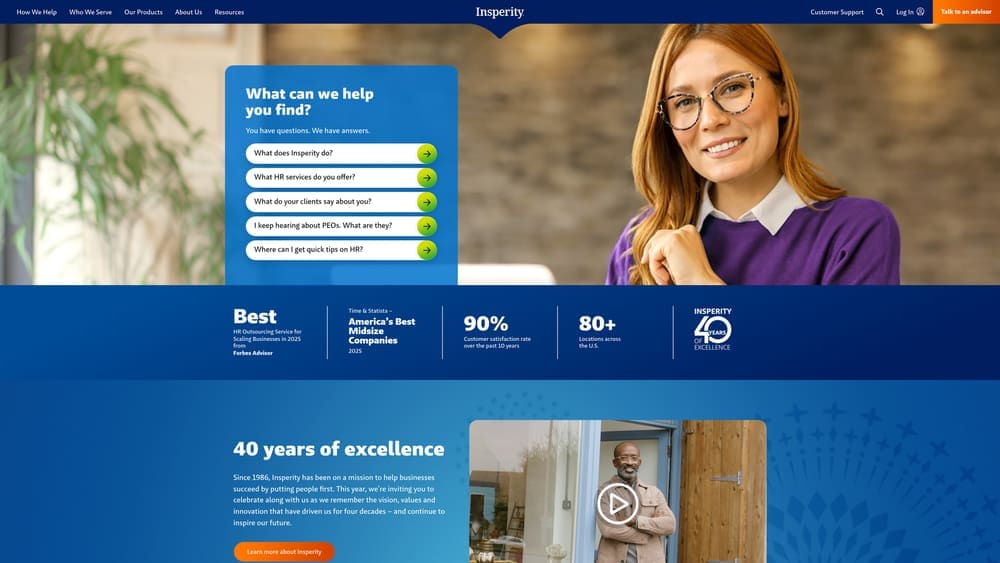
Insperity is a publicly traded, full-service PEO known for its premium service model and dedicated HR team structure, targeting businesses that want more than transactional payroll processing.
Where This Tool Shines
Insperity’s service model is genuinely more hands-on than most PEOs in this space. Clients get a dedicated HR service team with payroll specialists who know your account, not a rotating cast of support reps. For businesses that have had bad experiences with impersonal PEO service, that consistency matters.
The payroll infrastructure covers all 50 states with strong tax administration, and the platform includes time tracking, performance management, and an employee self-service portal that reduces administrative burden on internal HR staff. Insperity is priced at a premium, which is a real consideration — but for businesses where HR complexity is high and internal capacity is limited, the service depth can justify the cost.
Key Features
Dedicated HR Service Team: Named payroll specialists and HR contacts assigned to your account with continuity across the relationship.
Payroll Tax Administration Across All 50 States: Full multi-state compliance coverage without requiring the employer to manage state registrations independently.
Time Tracking and Performance Management: Integrated tools that connect workforce management to payroll processing.
Employee Self-Service Portal: Employees can access pay stubs, benefits information, and HR documents without routing requests through internal staff.
Scalable Service Model: Designed to grow with businesses from 50 employees up to several thousand without requiring a platform change.
Best For
Established SMBs that have moved past the startup phase and need a PEO that can handle real HR complexity. Companies that have outgrown lighter-weight PEOs like Justworks but aren’t large enough for enterprise HCM systems will find Insperity’s service model well-matched.
Pricing
Custom quotes only. Insperity is generally priced at a premium compared to mid-market PEOs, reflecting the higher-touch service model. Pricing details require a sales conversation.
7. Rippling PEO
Best for: Tech-forward companies that want payroll, HR, IT, and device management unified in a single platform rather than managed across separate systems.
Rippling PEO entered the PEO market more recently than most providers on this list, but brings a genuinely differentiated approach: a unified platform that connects payroll, benefits, IT provisioning, and device management to a single employee record.
Where This Tool Shines
The core insight behind Rippling is that onboarding and offboarding aren’t just HR events — they’re IT events too. When someone joins or leaves your company, payroll, benefits, app access, and equipment all need to change simultaneously. Rippling automates those workflows across all of those domains at once, which reduces the manual coordination that typically falls on HR and IT separately.
For companies with distributed or remote-first teams, that automation has real operational value. Global payroll capabilities extend the platform beyond U.S.-only coverage. The modular pricing model means you can add or remove components as your needs evolve, though the full platform becomes most powerful when multiple modules are active together.
Key Features
Unified Employee Platform: Payroll, benefits, IT, and device management connected to a single employee record and lifecycle.
Automated Onboarding and Offboarding Workflows: Employment status changes trigger automated updates across payroll, apps, and devices simultaneously.
Global Payroll Capabilities: Extends beyond U.S. payroll to support international employees and contractors.
Custom Workflow Automation: Policy enforcement and HR workflows built on a flexible rules engine.
App Provisioning Tied to Employment Status: Software access is automatically granted or revoked based on role and employment status.
Best For
Tech companies and remote-first businesses where IT and HR operations overlap significantly. Less well-suited for businesses in traditional industries where the IT management angle isn’t relevant and a simpler payroll-focused PEO would suffice.
Pricing
Custom quotes with modular pricing based on which products are selected. The cost scales with the number of modules activated, so businesses using only the PEO and payroll components will pay less than those using the full platform stack.
8. CoAdvantage
Best for: Blue-collar businesses, contractors, and high-risk industry employers that need workers’ compensation-forward payroll and risk management.
CoAdvantage is a PEO with a distinct focus on industries where workers’ compensation complexity is the primary driver of PEO value: construction, staffing, trades, and field-service operations.
Where This Tool Shines
Most PEOs are optimized for office-based, knowledge-economy workforces. CoAdvantage is built for businesses where payroll and workers’ comp are deeply intertwined — where experience modification rates, job classification accuracy, and pay-as-you-go billing structures matter more than software integrations or employee self-service portals.
The pay-as-you-go workers’ compensation model is particularly valuable for businesses with variable headcount or seasonal workforces. Instead of paying a large annual premium upfront and reconciling at year-end, payroll and workers’ comp premiums are calculated and billed together each pay period. For cash-flow-sensitive businesses, that structure can make a meaningful difference in how they manage working capital.
Key Features
Workers’ Compensation-Forward PEO Model: Risk management and workers’ comp access structured as a core service, not an add-on.
Pay-As-You-Go Workers’ Comp Billing: Premiums calculated per payroll cycle rather than paid as a large annual lump sum.
Payroll Processing for Hourly and Field-Service Workforces: Payroll infrastructure designed for variable hours, job costing, and field-based employees.
Risk Management and Safety Program Support: Compliance and safety resources tailored to high-risk industries.
Industry Experience in Construction, Staffing, and Trades: Familiarity with classification rules, audit exposure, and compliance requirements specific to these sectors.
Best For
Construction companies, staffing firms, trade contractors, and other businesses with high workers’ compensation exposure where a generalist PEO’s risk management offering would be inadequate. Not the right fit for office-based businesses where workers’ comp isn’t a primary cost driver.
Pricing
Custom quotes only. CoAdvantage is often competitively priced for high-risk industry classifications where workers’ comp access is the primary value driver. Exact rates depend on industry, headcount, and claims history.
Picking the Right PEO Payroll Provider for Your Business
Here’s the honest summary: payroll processing across established PEOs is largely comparable at the technical level. The real differences are in pricing transparency, service depth, industry fit, and how cleanly you can leave if the relationship stops working.
A few practical scenarios worth thinking through:
If you’re a startup or small business under 100 employees: Justworks is worth a serious look. The published pricing alone saves you hours of back-and-forth with sales reps, and the platform is built for teams without dedicated HR infrastructure.
If you’re in tech or professional services: TriNet’s vertical expertise is a real differentiator. Rippling is worth evaluating if IT and HR operations overlap significantly in your day-to-day.
If you’re in construction, trades, or a high-risk industry: CoAdvantage’s workers’ comp model is built for your situation in a way that most generalist PEOs aren’t.
If you’re an established SMB that wants high-touch service: Insperity and Paychex are the natural comparisons. Both are capable — the question is whether the service depth justifies the premium relative to your actual HR complexity.
If you already have a Paychex quote or are considering renewal: Don’t sign without benchmarking it. Most businesses overpay on PEO contracts because bundled fees and administrative markups are difficult to decode without a frame of reference. Before you commit, compare your options with an independent breakdown of what you’re actually paying and what alternatives are available at your headcount and industry.
The right PEO payroll provider isn’t the most recognized name or the one with the slickest demo. It’s the one that fits your workforce, your budget, and your tolerance for complexity — and gives you a clear path out if it stops doing that.