
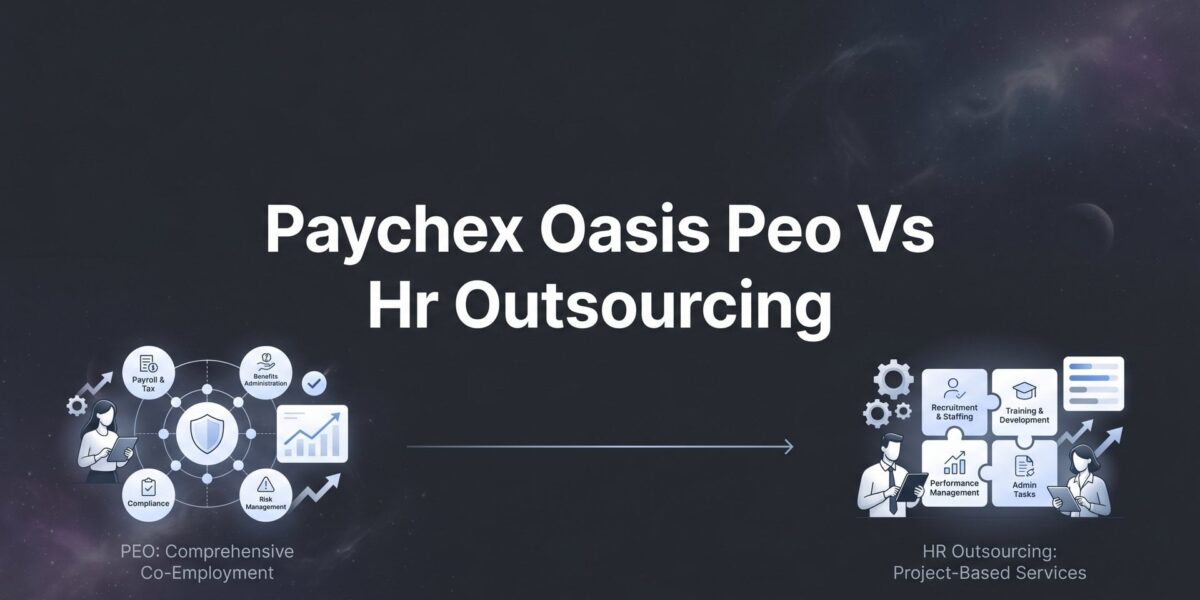
If you’re searching for a direct comparison between Paychex Oasis’s PEO model and standalone HR outsourcing, you’re probably not looking for a definition lesson. You already know you need help with HR. What you’re trying to figure out is which structure actually fits your business — and those two options are more different than they might appear on the surface.
This isn’t a matter of preference or brand loyalty. The PEO model and HR outsourcing differ in legal structure, how risk is allocated, how costs are built, and how much control you retain over your own workforce. Choosing the wrong one doesn’t just create friction — it can lock you into a contract that’s expensive to exit and misaligned with where your business is headed.
These seven strategies give you a concrete decision framework. Each one targets a real variable that should influence your choice: your actual HR pain points, the co-employment implications, total cost of ownership, benefits access, compliance exposure, exit complexity, and your business stage. Work through them in order if you can — they build on each other.
If you need a foundational overview of what a PEO is before diving into this comparison, start there first. Here, we’re going straight into the evaluation.
1. Map Your Actual HR Pain Points Before Comparing Models
The Challenge It Solves
Most businesses start shopping for HR help with a vague sense of being overwhelmed — payroll is messy, compliance feels risky, benefits are hard to manage. But “overwhelmed” isn’t a buying criterion. If you don’t know which specific functions are breaking down, you’ll end up comparing two very different models on the wrong variables and picking the one with the better sales pitch rather than the better fit.
The Strategy Explained
Before you evaluate Paychex Oasis or any HR outsourcing vendor, do a quick internal audit. List every HR function your team currently handles: payroll processing, tax filings, benefits administration, workers’ comp management, onboarding, compliance tracking, employee relations, and so on. Then mark each one as either “working fine,” “struggling,” or “completely broken.”
This matters because a PEO like Paychex Oasis delivers HR as a bundled, integrated package. You get most of it whether you need it or not. HR outsourcing vendors typically let you pick and choose — you can contract for payroll only, or compliance only, or a combination. If your pain points are narrow and specific, paying for a full PEO bundle may not be the right trade. For a deeper look at what’s actually included in that bundle, our Paychex PEO services overview breaks it down in detail.
Implementation Steps
1. List every HR function your business currently manages, even informally.
2. Rate each function: working fine, struggling, or broken. Be honest about what’s actually costing you time or creating risk.
3. Separate your list into “must fix now” and “nice to improve.” Focus your model comparison on the must-fix items.
4. If your must-fix list covers three or more interconnected functions (payroll, benefits, compliance), a bundled PEO may be efficient. If it’s one or two isolated areas, modular outsourcing is worth exploring.
Pro Tips
Don’t let a vendor audit your pain points for you — they’ll find problems that match their solution. Do this internally first. The goal is to walk into any vendor conversation knowing exactly what you need, so you can evaluate whether their structure actually delivers it rather than just promises it.
2. Understand the Co-Employment Line and What It Means for Control
The Challenge It Solves
Co-employment is the most misunderstood aspect of the PEO model. Business owners sometimes sign PEO agreements without fully grasping that they’re entering a legal arrangement where the PEO becomes a co-employer of their workforce for specific purposes. That’s not a minor administrative detail — it changes how certain decisions get made and who carries certain responsibilities.
The Strategy Explained
Under Paychex Oasis’s PEO model, your employees are technically co-employed by both your company and Paychex Oasis. Paychex Oasis becomes the employer of record for payroll tax purposes and benefits sponsorship. This is the standard PEO structure as defined by NAPEO (the National Association of Professional Employer Organizations), and it’s what enables the PEO to pool employees across clients to access better benefits rates and absorb certain compliance responsibilities.
With an HR outsourcing vendor, you remain the sole employer. The vendor handles administrative tasks on your behalf, but the legal employer relationship stays entirely with you. That means you carry more compliance risk directly, but you also retain full operational control without a co-employment layer in the mix. If you’re weighing whether payroll alone might be enough, our comparison of PEO vs payroll outsourcing explores that specific distinction.
Neither structure is inherently better. But you need to understand what you’re agreeing to before you sign anything.
Implementation Steps
1. Ask any PEO vendor — including Paychex Oasis — to walk you through exactly what co-employment means in their specific contract: what decisions they control, what you control, and where shared responsibility exists.
2. Review how co-employment affects your workers’ comp policy, unemployment insurance, and benefits plan sponsorship.
3. Evaluate whether any of your existing employment practices, policies, or culture considerations would conflict with a co-employment arrangement.
4. If control over HR policy and employer branding matters significantly to your business, document that as a weighted factor before comparing costs.
Pro Tips
Pay attention to how a PEO handles employee disputes and terminations under co-employment. In some arrangements, the PEO has a say in how certain HR situations are managed. That’s not necessarily a problem, but it’s something you should understand clearly before you’re in the middle of a difficult employee situation.
3. Compare Total Cost Structures, Not Just Monthly Fees
The Challenge It Solves
Comparing PEO pricing to HR outsourcing pricing on a monthly fee basis is like comparing a bundled cable package to individual streaming subscriptions by looking only at the headline number. The real cost picture is almost always more complicated — and more revealing — when you dig into what’s actually included and what you’re still paying for elsewhere.
The Strategy Explained
Paychex Oasis, like most PEOs, typically prices on either a per-employee-per-month (PEPM) basis or as a percentage of gross payroll. That fee covers a bundle of services: payroll processing, tax administration, HR support, benefits administration, and often workers’ comp management. It sounds comprehensive, but the bundling means you’re paying for services you may not use heavily.
HR outsourcing vendors usually price on an à la carte or modular basis. You pay for what you contract. That sounds cheaper until you account for the internal admin time your team still spends coordinating between vendors, the cost of any compliance gaps you’re managing yourself, and the benefits costs you’re absorbing without group purchasing leverage. Our Paychex PEO review covers several of these hidden cost factors in more depth.
The only honest comparison is total cost of ownership on both sides.
Implementation Steps
1. Get a full PEO quote from Paychex Oasis that includes all fees — administration fees, benefits markups, workers’ comp premiums, and any add-on charges.
2. Build a parallel cost model for HR outsourcing: list each function you’d outsource, get pricing for each, and add internal staff time for coordination and oversight.
3. Add your current benefits costs to the HR outsourcing side of the comparison. If you’re a small employer, factor in whether you’re paying retail rates for health insurance versus what a PEO’s group rates might look like.
4. Compare total annual spend, not monthly fees. Annualized figures reveal the real gap.
Pro Tips
Watch for administrative markups embedded in PEO pricing that aren’t always visible at the quote stage. Ask Paychex Oasis — or any PEO — to break out their administration fee separately from benefits pass-through costs. That transparency matters when you’re doing a real apples-to-apples comparison.
4. Stress-Test Your Benefits Access Gap
The Challenge It Solves
One of the most commonly cited advantages of a PEO is access to large-group health insurance rates. For small employers, this can be genuinely significant. But “can be” is doing a lot of work in that sentence — the actual savings depend on your headcount, your current plan, your location, and your employee demographics. You need to verify the gap rather than assume it exists.
The Strategy Explained
PEOs like Paychex Oasis pool employees across their entire client base to negotiate health insurance at large-group rates. For employers with fewer than 50 employees — who are otherwise buying coverage in the small-group or individual market — this pooling effect can meaningfully reduce premiums. NAPEO and industry analysts have widely documented this structural advantage for smaller employers.
But as your headcount grows, the gap narrows. Employers with 75, 100, or more employees often have enough purchasing leverage to negotiate competitive rates independently or through a benefits broker. At that scale, the PEO’s benefits advantage may not justify the bundled administrative fee you’re paying to access it. For a focused look at how this pooling works in practice, our guide to benefits outsourcing through a PEO covers the mechanics.
HR outsourcing vendors don’t typically offer group benefits pooling, but a good benefits broker can still shop the market on your behalf. The question is whether what they can access competes with what Paychex Oasis can offer at your specific headcount.
Implementation Steps
1. Get your current benefits costs per employee per month, including both employer and employee contributions.
2. Ask Paychex Oasis for a benefits comparison showing what their group rates would look like for your workforce at your location.
3. Simultaneously, get a quote from an independent benefits broker for comparable coverage outside the PEO structure.
4. Calculate the annual difference. If the PEO’s benefits savings exceed the administrative fee you’d pay for the bundled service, the math may favor the PEO — at least on benefits alone.
Pro Tips
Don’t evaluate benefits in isolation. Even if Paychex Oasis offers better rates, you’re also buying the entire PEO administrative structure with it. Make sure the benefits savings justify the full cost of the arrangement, not just the benefits line item.
5. Evaluate Compliance Risk Based on Your State and Industry
The Challenge It Solves
Compliance is often the reason business owners lean toward a PEO — the idea that shared liability under co-employment shifts some of the regulatory burden off their plate. That’s partially true, but it’s not a blanket protection. Your actual compliance exposure depends heavily on your state, your industry, and the specific risks you’re managing. A PEO isn’t always the most cost-effective way to address that exposure.
The Strategy Explained
Under the co-employment model, Paychex Oasis takes on certain employer-of-record responsibilities, including payroll tax compliance and benefits plan compliance at the federal level. For businesses operating in states with complex labor laws — California, New York, Illinois, and others with layered wage and hour rules — having a PEO with dedicated compliance infrastructure can reduce your exposure meaningfully.
For businesses in lower-complexity regulatory environments or industries with simpler workforce structures, the compliance value proposition of a PEO may be less compelling. An HR outsourcing vendor with solid compliance support, or even a dedicated HR consultant, might cover your actual exposure at lower cost. Understanding how Insperity approaches this same tradeoff can add useful perspective — our Insperity PEO vs HR outsourcing analysis covers similar ground from a different provider’s angle.
Industry matters too. Businesses in healthcare, construction, staffing, and other high-liability sectors face different compliance profiles than professional services firms with salaried employees and straightforward HR needs.
Implementation Steps
1. List your primary compliance exposure areas: wage and hour, workers’ comp, benefits compliance, leave laws, multi-state employment, OSHA requirements, or industry-specific regulations.
2. Research your state’s specific labor law complexity. States like California have notoriously layered requirements that create genuine risk for employers managing compliance internally.
3. Ask Paychex Oasis specifically what compliance responsibilities they assume under co-employment and what remains with you as the client employer.
4. Compare that coverage against what an HR outsourcing vendor with compliance support would provide — and what you’d still need to manage independently.
Pro Tips
Co-employment doesn’t eliminate your compliance liability — it shares it. You’re still responsible for how you manage employees day-to-day. Don’t assume a PEO agreement is a compliance shield. Understand exactly what it covers and what it doesn’t before you factor it into your decision.
6. Pressure-Test the Exit Strategy Before You Enter
The Challenge It Solves
Most businesses evaluate a PEO based on what it’s like to enter the arrangement. Very few think carefully about what it costs to leave. That’s a significant oversight, because exiting a PEO is operationally complex in ways that exiting an HR outsourcing vendor typically isn’t. If your business changes direction, grows past the PEO’s sweet spot, or simply finds a better arrangement, the exit process matters.
The Strategy Explained
When you leave a PEO like Paychex Oasis, you’re unwinding a co-employment relationship — not just canceling a service contract. That involves transitioning your Employer Identification Number (EIN) back to standalone status, re-enrolling employees in new benefits plans (often mid-year, which creates gaps and complications), securing independent workers’ compensation coverage, and managing mid-year payroll tax reporting that spans two employer-of-record periods.
These aren’t hypothetical complications. They’re documented operational realities that businesses face when exiting PEO arrangements, and they take meaningful time and administrative effort to manage correctly. If workers’ comp is a major factor in your evaluation, understanding the workers’ comp audit process under a PEO can help you anticipate what unwinding that coverage actually looks like.
Exiting an HR outsourcing vendor is typically much simpler. Because you never transferred employer-of-record status, most of the infrastructure stays with you. You’re ending service contracts, not restructuring legal employment relationships.
Implementation Steps
1. Before signing with Paychex Oasis, ask for their standard off-boarding process in writing. Understand the timeline, the steps, and who is responsible for each transition task.
2. Ask specifically about mid-year exit scenarios: what happens to benefits enrollment, workers’ comp coverage, and W-2 reporting if you leave outside of a standard renewal window.
3. Review the contract termination clause carefully. Understand notice requirements, any termination fees, and how the co-employment relationship formally ends.
4. Compare that exit complexity against the off-boarding process for the HR outsourcing vendors you’re considering. Factor the difference into your total evaluation.
Pro Tips
The time to ask about exit is before you sign, not when you’re frustrated and trying to leave. A vendor that resists walking you through the off-boarding process clearly during the sales conversation is worth noting. Straightforward providers should be able to explain the exit process without hesitation.
7. Use a Decision Matrix Weighted to Your Business Stage
The Challenge It Solves
After working through the previous six strategies, you’ll likely have a clearer picture — but possibly still a close call. A weighted decision matrix forces you to quantify your priorities rather than relying on gut feel or whichever vendor made the stronger impression in the last meeting.
The Strategy Explained
Not every factor in this decision carries equal weight for every business. A 15-person company with no HR staff and complex compliance exposure should weight compliance support and benefits access very differently than a 90-person company with an internal HR manager and straightforward regulatory requirements. The matrix makes those differences explicit.
Build a simple scoring grid with the key decision factors on one axis and your two options — Paychex Oasis PEO and your best HR outsourcing alternative — on the other. Assign a weight to each factor based on how much it matters to your specific situation. Score each option on each factor. Multiply score by weight. Total the columns. You can also check a provider’s track record as part of your scoring — our analysis of Paychex PEO’s BBB rating and reputation offers one useful data point.
The result won’t make the decision for you, but it will surface where the real tradeoffs are and whether your intuition is aligned with your actual priorities.
Implementation Steps
1. List your key decision factors: total cost, compliance coverage, benefits access, operational control, contract flexibility, exit complexity, and HR support quality.
2. Assign a weight to each factor from 1 to 5 based on how important it is to your business right now. Be honest — weight toward your current reality, not your ideal future state.
3. Score both Paychex Oasis and your HR outsourcing alternative on each factor from 1 to 5 based on what you’ve learned in your evaluation.
4. Multiply each score by its weight, total each column, and compare. If the scores are close, revisit your weighting — it usually means one factor is being under-weighted.
Pro Tips
Run this matrix twice: once for your business as it is today, and once for where you expect to be in two to three years. If the answers diverge significantly, that’s useful information. A PEO that makes sense at 20 employees may not make sense at 60. Build your decision around trajectory, not just current state.
Putting It All Together: Choosing Your Path Forward
The PEO versus HR outsourcing decision doesn’t have a universal right answer. It has a right answer for your business, at your current stage, with your specific compliance exposure, benefits needs, and budget structure. Paychex Oasis is a legitimate, well-resourced PEO with the infrastructure of a large national provider behind it. That’s not nothing. But it also doesn’t automatically make it the right fit.
If your pain points are narrow, your compliance environment is manageable, and you value flexibility over bundled convenience, modular HR outsourcing may deliver exactly what you need at lower cost and with a simpler exit path. If you’re a smaller employer with genuine benefits access gaps and meaningful compliance exposure, the PEO model may justify its cost structure.
The seven strategies in this article are designed to help you answer that question based on your actual situation, not a vendor’s pitch. Work through the pain point audit. Understand co-employment clearly. Build the total cost comparison. Verify the benefits gap. Assess your compliance exposure honestly. Think about the exit before you enter. And use a weighted matrix to make the tradeoffs explicit.
Most businesses that overpay for HR services do so because they compared options at the surface level — monthly fees, feature lists, and sales presentations — without digging into the structural differences that actually drive long-term cost and fit.
Before you renew your PEO agreement or commit to a new one, compare your options with a clear view of what you’re actually buying. Most businesses overpay due to bundled fees and unclear administrative markups. We break down pricing, services, and contract structures so you can make a smarter decision. And if you want to see how Paychex Oasis stacks up against other PEO providers specifically, our independent PEO comparisons are a good next step.