
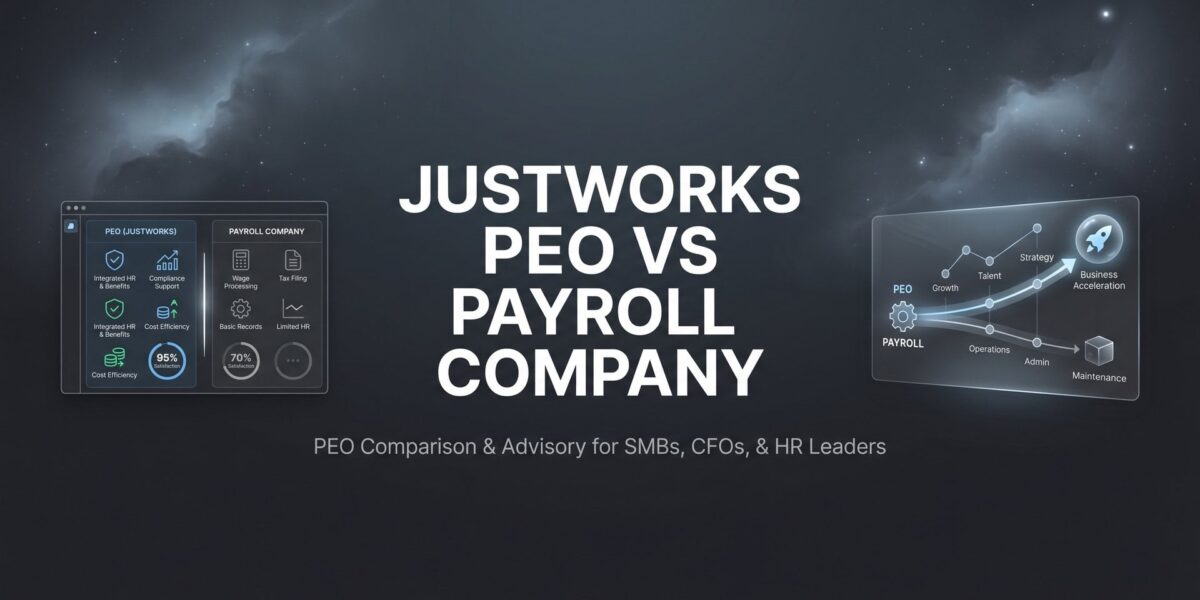
Justworks operates as a Professional Employer Organization, meaning it enters a co-employment relationship with your business, bundles payroll, benefits, compliance, and HR into one monthly fee, and takes on shared employer responsibilities. A standalone payroll company does none of that. It processes wages, files taxes, and steps back. You remain the sole employer.
That distinction matters more than most business owners realize when they’re shopping. The right answer depends on what you actually need beyond cutting paychecks. Are benefits access and compliance coverage worth co-employment? Or do you just need reliable payroll without the overhead of a bundled platform?
This list covers Justworks alongside seven other options spanning both PEO and payroll-only models. Some are pure payroll tools. Some are full PEOs. A couple offer both tracks under one roof. The goal is to give you a clear picture of where each fits and what you’d be trading off. For a deeper look at how PEOs work and when they make sense, the foundational PEO comparison resources are worth reviewing before you commit to any path.
1. Clicks Geek PEO
Best for: Business owners who want independent, unbiased analysis before choosing a PEO or payroll provider.
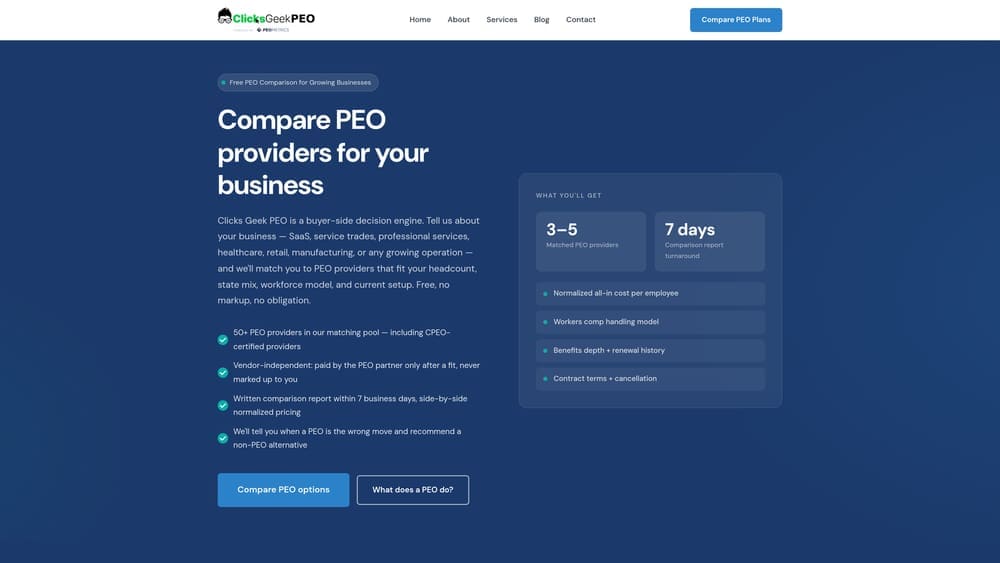
Clicks Geek PEO is an independent comparison and advisory platform built to help SMB owners evaluate PEO providers and payroll companies without the bias of a provider affiliation.
Where This Tool Shines
Most businesses approach PEO decisions with limited information and end up comparing marketing pages instead of actual pricing structures. Clicks Geek fills that gap by offering side-by-side provider breakdowns, transparent cost analysis, and contract term reviews that flag the clauses most business owners miss the first time around.
Because the platform isn’t a PEO and doesn’t earn commissions from provider placements, the analysis stays focused on your actual business needs. That independence is harder to find than it sounds in this space, where most “comparison” resources are quietly affiliated with one provider or another.
Key Features
Side-by-Side Provider Comparisons: Compare PEOs and payroll companies across pricing structure, services, contract terms, and compliance coverage in one place.
Transparent Pricing Breakdowns: Breaks down per-employee fees, administrative markups, and bundled costs that providers don’t always surface upfront.
Contract Term Reviews: Identifies red flags in PEO agreements including auto-renewal clauses, termination penalties, and hidden fee structures.
No Provider Affiliation: Completely independent, meaning the analysis isn’t shaped by referral relationships or preferred partner agreements.
Educational Decision Resources: Guides specifically designed for business owners weighing PEO co-employment against standalone payroll options.
Best For
Business owners who are evaluating a PEO for the first time, renewing an existing agreement, or trying to determine whether switching from a PEO to a payroll-only model actually saves money. Also valuable for CFOs and operations managers who want a second opinion before signing a multi-year contract.
Pricing
Free comparison resources are available on the platform. Advisory services for more in-depth analysis are available; contact the team directly for details.
2. Justworks
Best for: Startups and small businesses that want a clean, modern PEO with flat-rate pricing and bundled benefits access.
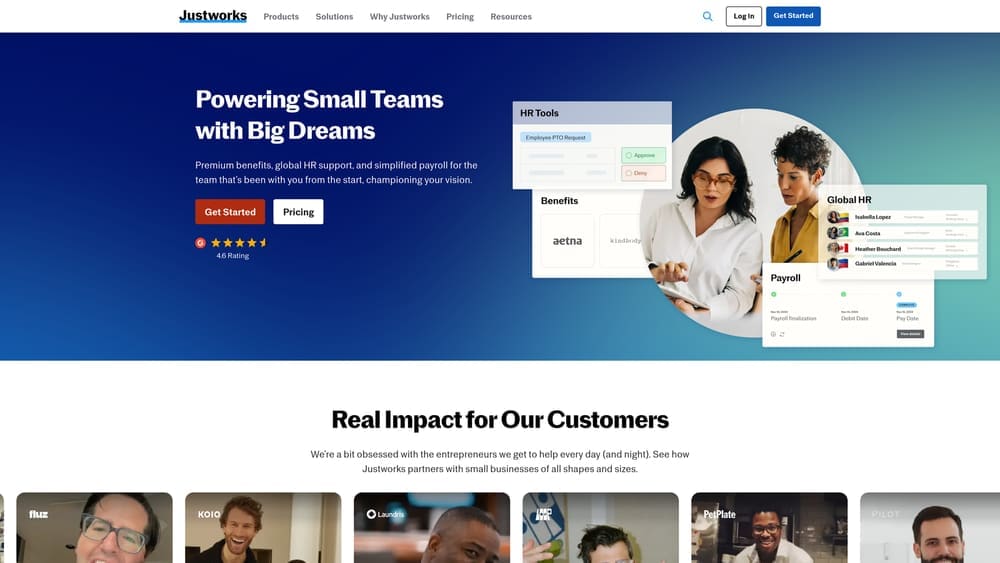
Justworks is an IRS-certified CPEO offering co-employment, bundled payroll, benefits, compliance, and HR tools under a straightforward per-employee monthly fee.
Where This Tool Shines
Justworks is one of the few PEOs that publicly lists its pricing, which immediately sets it apart from competitors who require a sales call to get a number. That transparency makes budgeting more predictable and the comparison process less frustrating for small business owners who don’t want to spend three weeks in a sales cycle.
The platform’s interface is genuinely clean and intuitive compared to legacy PEO systems. Employees can handle their own onboarding, benefits enrollment, and payroll visibility through a self-service portal that doesn’t require hand-holding from HR staff.
Key Features
Flat Per-Employee Pricing: Basic and Plus tiers with publicly listed rates, making cost forecasting straightforward as you hire.
Co-Employment and CPEO Certification: IRS-certified PEO status, which carries specific tax and compliance advantages over non-certified providers.
Bundled Benefits Access: Access to large-group medical, dental, vision, and other benefits that most small businesses can’t access independently.
Built-In Compliance Tools: State tax registration, ACA compliance, and employment law support included in the platform.
Employee Self-Service Portal: Modern interface that reduces administrative back-and-forth between employees and HR or payroll staff.
Best For
Startups and small businesses with 5 to 100 employees that want a bundled PEO experience without a complex implementation process. Particularly well-suited for companies hiring across multiple states who need compliance support without building an internal HR function.
Pricing
Basic starts at $59 per employee per month; Plus at $109 per employee per month. Verify current rates directly at justworks.com, as pricing can change.
3. Gusto
Best for: Small businesses that want solid full-service payroll with optional HR tools and no co-employment relationship.
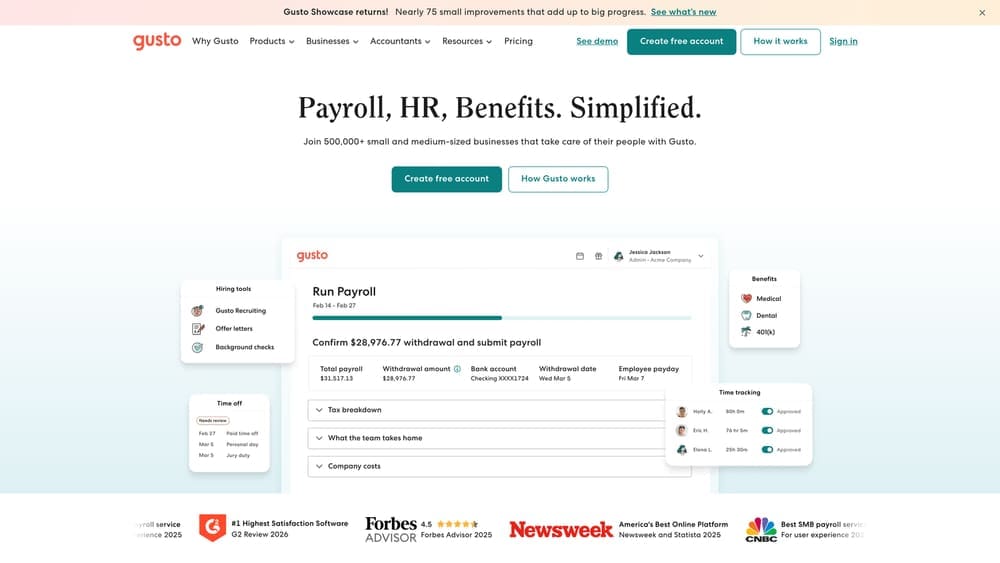
Gusto is a payroll-first platform with benefits brokerage and HR tools layered on top, operating entirely outside the co-employment model.
Where This Tool Shines
Gusto is the most natural comparison point for businesses considering Justworks but unsure whether co-employment is worth it. Both platforms have clean interfaces and appeal to similar company sizes. The core difference is structural: Gusto keeps you as the sole employer, which means full control and no shared liability, but also no access to large-group benefits or the compliance backstop a PEO provides.
For businesses with straightforward payroll needs and a handle on their own compliance, Gusto delivers reliable payroll processing without the overhead of a bundled PEO fee structure.
Key Features
Full-Service Payroll: Automated tax filings, direct deposit, and year-end W-2 and 1099 processing included across all plans.
Benefits Brokerage: Health insurance, dental, vision, and 401(k) options available, though as a broker rather than through a large-group PEO pool.
Onboarding and Time Tracking: Streamlined employee onboarding and time tracking tools available on mid-tier and higher plans.
No Co-Employment: You remain the sole employer, maintaining full control over employment decisions and liability.
Tiered Plans: Simple, Plus, and Premium tiers with increasing HR functionality as your needs grow.
Best For
Small businesses under 50 employees that need dependable payroll and basic HR without the commitment of co-employment. A strong fit for companies with straightforward operations in one or two states.
Pricing
Simple plan starts at $40 per month base plus $6 per employee per month. Verify current rates at gusto.com before budgeting.
4. ADP Run / ADP TotalSource
Best for: Businesses that want the option to start with payroll and scale into a full PEO without switching vendors.
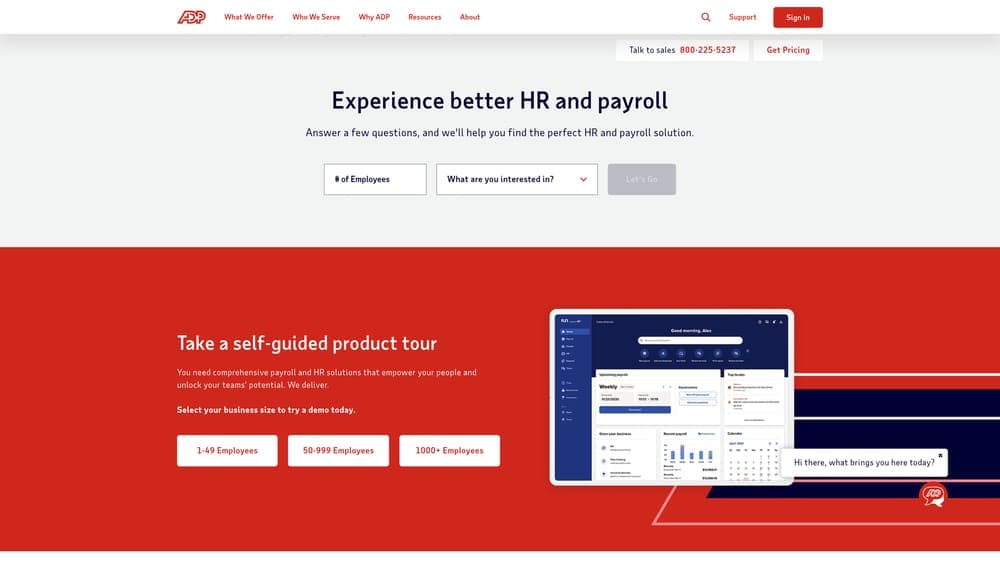
ADP offers two distinct products: ADP Run for standalone small business payroll, and ADP TotalSource, a full IRS-certified PEO for companies ready to enter co-employment.
Where This Tool Shines
The dual-track model is ADP’s real advantage here. If you’re not sure whether you need a PEO today but want the option later, staying within the ADP ecosystem means you’re not rebuilding your payroll infrastructure when you make that transition. That migration path is a genuine operational benefit that most single-track providers can’t offer.
ADP TotalSource also includes a dedicated HR business partner, which is meaningful for companies that need hands-on HR guidance rather than just software access. That level of support typically requires a larger PEO or a separate HR consultant elsewhere.
Key Features
ADP Run Payroll: Small business payroll with tax filing, garnishments, and basic HR tools for companies that don’t need co-employment.
ADP TotalSource PEO: Full CPEO with benefits, compliance, risk management, and dedicated HR support under co-employment.
Scalable Migration Path: Move from payroll-only to full PEO within the same vendor without data migration headaches.
Extensive Integration Ecosystem: Connects with a wide range of accounting, time tracking, and ERP systems.
Dedicated HR Business Partner: Assigned HR professional included with TotalSource for strategic and compliance guidance.
Best For
Growing businesses that want flexibility to scale their HR infrastructure over time without switching providers. Also well-suited for companies that value having a dedicated HR contact rather than relying entirely on self-service tools.
Pricing
Custom quotes required for both ADP Run and TotalSource. Pricing is not publicly listed; expect a sales conversation to get numbers.
5. Paychex Flex / Paychex PEO
Best for: Businesses that want modular payroll and HR services with a clear upgrade path to certified PEO co-employment.
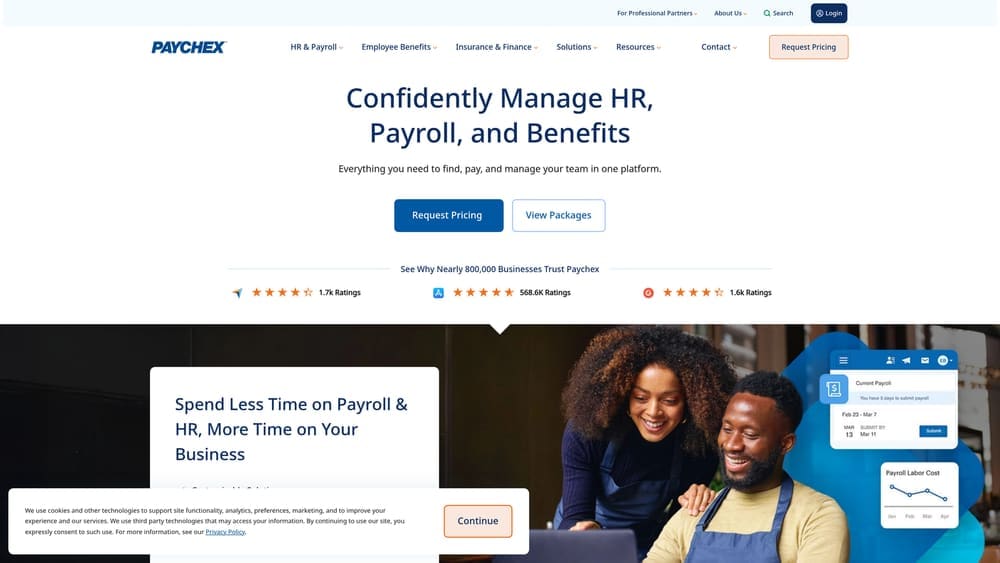
Paychex offers Paychex Flex for scalable payroll and HR, with Paychex PEO available for businesses ready to move into a full IRS-certified co-employment arrangement.
Where This Tool Shines
Paychex’s modular design is genuinely useful for businesses in transition. You can start with payroll, add time tracking or benefits administration as standalone services, and eventually move to the full PEO without a platform change. That incremental approach suits businesses that aren’t ready to commit to co-employment but want to keep options open.
Retirement plan administration is a particular strength. If 401(k) access and plan management are priorities for your team, Paychex has more depth here than most competitors at the small business level.
Key Features
Paychex Flex Payroll: Scalable payroll platform with add-on HR, benefits, and time tracking modules for businesses that want to build incrementally.
Paychex PEO: IRS-certified CPEO with full co-employment services including benefits, compliance, and risk management.
Modular Service Structure: Add or remove services without switching platforms as your needs evolve.
Retirement Plan Administration: Strong 401(k) and retirement plan options with dedicated support.
Dedicated Payroll Specialist: Assigned payroll contact included, which reduces the self-service burden for smaller teams.
Best For
Small to mid-sized businesses that want a long-term vendor relationship with room to grow. Particularly well-suited for companies prioritizing retirement benefits or those that prefer working with a dedicated specialist over a purely digital experience.
Pricing
Custom quotes required. Base payroll plans reportedly start around $39 per month plus per-employee fees, but verify current rates directly at paychex.com.
6. OnPay
Best for: Very small businesses that need clean, affordable full-service payroll without PEO complexity or confusing tier structures.
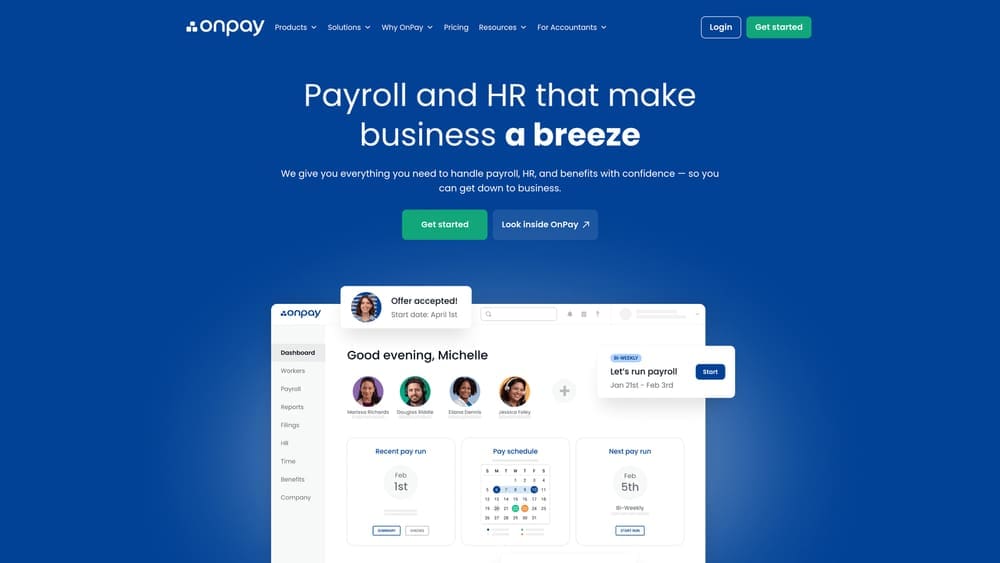
OnPay is a straightforward full-service payroll platform with a single pricing plan and benefits administration included, designed for businesses that want reliable payroll without the overhead.
Where This Tool Shines
OnPay’s single-tier pricing model is refreshingly simple in a market full of confusing plan structures. There’s no upsell ladder to navigate and no features gated behind a higher tier. What you see is what you get, which makes budgeting predictable and onboarding fast.
Benefits administration is included at no additional cost, which is unusual at this price point. It’s not a PEO benefits pool, so you won’t access large-group rates, but for small businesses that just need a place to manage health insurance enrollment, it covers the basics without an extra fee.
Key Features
Full-Service Payroll: All tax filings, direct deposit, and year-end forms included with no add-on fees for core payroll functions.
Benefits Administration Included: Health, dental, vision, and 401(k) administration available without upgrading to a higher plan.
Single Pricing Plan: No tier confusion. One plan covers all features for all users.
Employee Self-Service Portal: Employees can access pay stubs, tax forms, and benefits information independently.
Multi-State Payroll Support: Handles payroll across multiple states without requiring an upgrade or add-on.
Best For
Businesses with fewer than 25 employees that want dependable payroll at a predictable cost. A strong fit for companies that don’t need co-employment and want to avoid the complexity of tiered platforms.
Pricing
$40 per month base plus $6 per employee per month. Verify current rates at onpay.com before committing.
7. Rippling
Best for: Tech-forward businesses that want a unified platform covering payroll, HR, and IT with the option to add PEO co-employment.
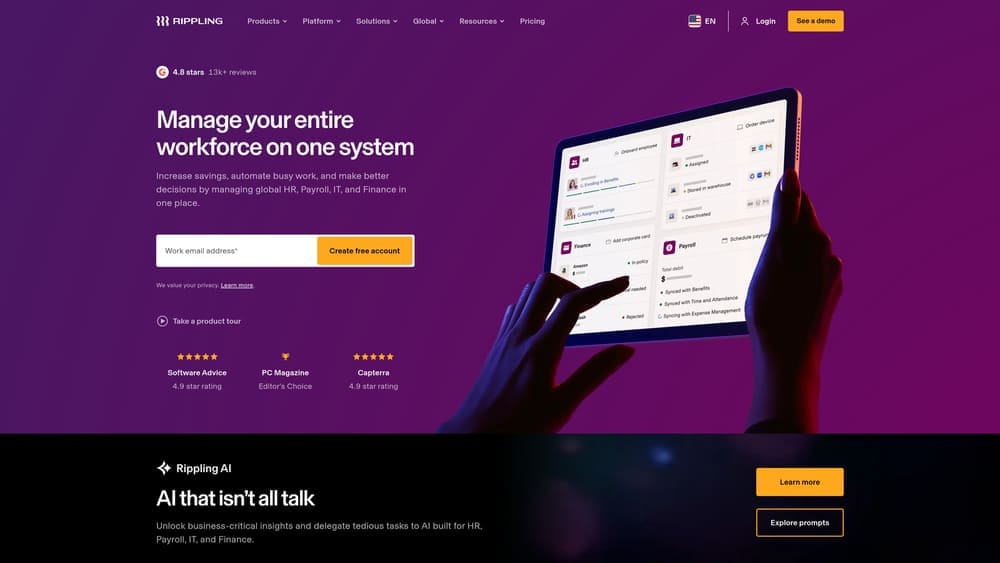
Rippling is a modular workforce platform that spans payroll, HR, and IT device management, with a PEO product available for businesses that want co-employment through a modern interface.
Where This Tool Shines
Rippling’s real differentiation is the breadth of what it connects. Payroll, benefits, app provisioning, device management, and global payroll all live in one platform with deep automation workflows between them. For companies with distributed or remote teams, that integration depth reduces the administrative fragmentation that comes from running multiple disconnected tools.
The PEO option is a more recent addition to the platform and is worth evaluating carefully against more established PEO providers if co-employment is a priority. Rippling’s strength is the tech stack integration, not necessarily the depth of HR advisory support you’d get from a legacy PEO.
Key Features
Unified Workforce Platform: Payroll, HR, IT device management, and app provisioning in a single system with automated workflows across modules.
Rippling PEO Add-On: Co-employment option available for businesses that want PEO services layered onto the core platform.
Deep Integration Library: Connects with hundreds of third-party tools, reducing manual data entry across systems.
Modular Pricing: Buy only the modules you need rather than paying for a bundled suite you won’t fully use.
Global Payroll Capabilities: Supports international payroll for companies with employees or contractors outside the US.
Best For
Growth-stage companies with distributed teams that want a single platform to manage workforce operations across payroll, HR, and IT. Also suitable for businesses with international team members who need global payroll support.
Pricing
Core platform starts at $8 per employee per month. PEO pricing requires a custom quote. Verify current rates at rippling.com.
8. TriNet
Best for: Small and mid-sized businesses in specific industries that need a full-service PEO with deeper compliance and benefits customization than most competitors offer.
TriNet is a longstanding full-service PEO with industry-vertical packaging, offering deeper compliance advisory, risk management, and large-group benefits access for companies that need more than a standard bundled PEO.
Where This Tool Shines
TriNet’s industry-vertical approach is its clearest differentiator. Rather than offering a one-size-fits-all PEO package, TriNet builds service bundles around specific industries including technology, financial services, nonprofits, and professional services. That means the compliance guidance and benefits structure are shaped around the regulatory environment your business actually operates in, not a generic SMB template.
For companies in regulated industries where employment law nuance matters, that specialization is worth paying for. TriNet also provides workforce analytics and strategic HR consulting that go beyond what most small-business-focused PEOs include at the base level.
Key Features
Industry-Vertical PEO Packages: Tailored service bundles for technology, financial services, nonprofits, and other sectors with industry-specific compliance and benefits structures.
Comprehensive Risk Mitigation: Employment practices liability coverage and compliance advisory built into the co-employment relationship.
Large-Group Benefits Access: Medical, dental, vision, and ancillary benefits through large-group pools that small businesses can’t access independently.
Workforce Analytics: Reporting and analytics tools that give HR and finance teams visibility into workforce costs and trends.
Dedicated Team Support: Assigned HR and benefits support team rather than a fully self-service model.
Best For
Businesses in regulated or specialized industries where generic PEO compliance coverage isn’t sufficient. Also a strong fit for companies that want strategic HR support alongside the operational co-employment relationship, rather than just a payroll and benefits platform.
Pricing
Custom quotes required. TriNet typically prices on a percentage-of-payroll model rather than flat per-employee fees. Verify current structure directly at trinet.com.
Making the Right Call for Your Business
The core question isn’t really “Justworks vs. payroll company.” It’s whether you need what co-employment actually provides, or whether you’re paying for services you could get more cheaply through a standalone payroll tool.
If benefits access is the driver, a PEO like Justworks or TriNet gives you large-group rates that most small businesses can’t replicate on their own. If you’re hiring across multiple states and compliance is a real operational burden, co-employment shifts meaningful risk to the PEO. Those are legitimate reasons to pay the premium.
If you have straightforward payroll needs, one or two states, and in-house HR capacity, Gusto or OnPay will likely handle everything you need at a fraction of the cost. Rippling makes sense if you’re building a distributed team and want payroll, HR, and IT in one system. ADP and Paychex both offer the flexibility to start with payroll and scale into PEO co-employment without switching vendors.
The trap most business owners fall into is renewing a PEO contract without checking whether the bundled fee still makes sense for where the company is today. Services that were worth it at 10 employees may be redundant at 40, or vice versa.
Before you sign or renew anything, it’s worth doing a proper comparison. Most businesses overpay due to bundled fees and unclear administrative markups. We break down pricing, services, and contract structures so you can make a smarter decision. Compare your options before you commit.