
The decision between G&A Partners and a standalone payroll company comes down to more than features on a spec sheet. It’s about how much employer liability you want to carry, whether co-employment makes sense for your business model, and what level of HR support you actually need day-to-day. G&A Partners is a legitimate, well-regarded PEO with strong regional roots in Texas and the Southwest. But it’s not the right fit for every business — and for some, a payroll-only platform is the smarter, leaner choice.
This guide puts G&A Partners side by side with the leading payroll and PEO alternatives so you can evaluate scope, pricing structure, and operational tradeoffs clearly — before you get on a sales call or sign anything.
1. Clicks Geek PEO Comparison Tool
Best for: Business owners who want independent, unbiased PEO and payroll comparisons before committing.
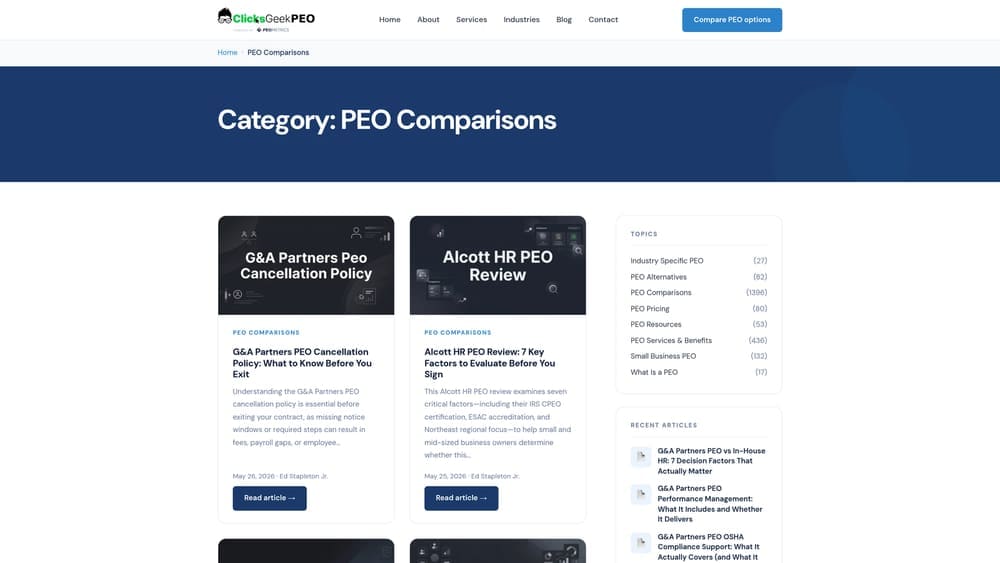
Clicks Geek PEO Comparison Tool is an independent platform that helps SMB owners evaluate G&A Partners alongside other PEO and payroll providers with transparent pricing analysis and no sales pressure.
Where This Tool Shines
Most business owners evaluating G&A Partners hit the same wall: the provider won’t share pricing until you’re already in a sales conversation. That information asymmetry makes it hard to compare options objectively. This tool exists specifically to close that gap — giving you a structured way to understand what different providers actually offer, what their fee structures look like, and where the hidden costs tend to appear.
It’s particularly useful if you’re mid-funnel: you’ve heard of G&A Partners, you’re not sure whether a PEO is even necessary, and you want a clear-headed comparison before you invest time in vendor conversations. There’s no provider affiliation, which matters when you’re trying to get a straight answer.
Key Features
Independent provider evaluations: No affiliation with G&A Partners or any other PEO — assessments are based on service scope, pricing structure, and contract terms.
Transparent pricing breakdowns: Explains PEPM and percentage-of-payroll structures so you can understand what you’re actually paying for.
Side-by-side PEO comparisons: Includes G&A Partners alongside other regional and national PEOs for direct comparison.
Contract and fee transparency analysis: Flags common bundled fees and administrative markups that often go unnoticed until renewal.
Built for SMB decision-makers: Designed for business owners and HR managers making real decisions — not researchers or consultants.
Best For
Business owners who are evaluating G&A Partners for the first time, considering switching providers, or approaching a contract renewal and want to understand whether they’re getting fair value. Also useful for CFOs who want pricing context before entering vendor negotiations.
Pricing
Free to use. No consultation required to access comparison resources and pricing analysis.
2. G&A Partners
Best for: Small and mid-sized businesses in Texas and the Southwest that want full-service co-employment with dedicated HR support.
G&A Partners is a Texas-headquartered, IRS-certified PEO founded in 1995, offering full co-employment services including payroll, HR administration, benefits, workers’ comp, and compliance support.
Where This Tool Shines
G&A Partners’ strongest differentiator is the dedicated HR advisor model. You’re not calling a general support line — you get a named HR professional who knows your account. For businesses in industries like construction, healthcare, or professional services in Texas and surrounding states, that regional expertise and hands-on support is genuinely valuable.
The IRS CPEO certification and ESAC accreditation are also meaningful. These aren’t just marketing badges — they signal financial stability and operational standards that matter when you’re entering a co-employment relationship and trusting a third party with payroll tax liability. If you’re a Texas-based business with 20–200 employees and want to offload HR complexity without going enterprise, G&A Partners is worth a serious look.
Key Features
IRS CPEO certification and ESAC accreditation: Two of the most important trust signals in the PEO industry — both verified by independent bodies.
Dedicated HR advisor model: Each client is assigned a specific HR professional, not a rotating support team.
Full co-employment structure: Shared compliance liability, which reduces your exposure on employment law, payroll taxes, and workers’ comp.
Workers’ compensation administration: Included as part of the co-employment package — significant for industries with elevated risk profiles.
Regional expertise: Deep operational knowledge in Texas, Oklahoma, and surrounding states — including state-specific regulatory nuances.
Best For
Texas-based or Southwest-region businesses with 10–500 employees, particularly those in industries with complex HR or compliance needs. Not ideal for fully distributed national or global teams where regional expertise is less relevant.
Pricing
Custom quote required — pricing is not publicly disclosed. G&A Partners typically uses a percentage of payroll or PEPM structure depending on the client profile and services included.
3. Gusto
Best for: Small businesses under 50 employees that want clean, transparent payroll software without co-employment complexity.
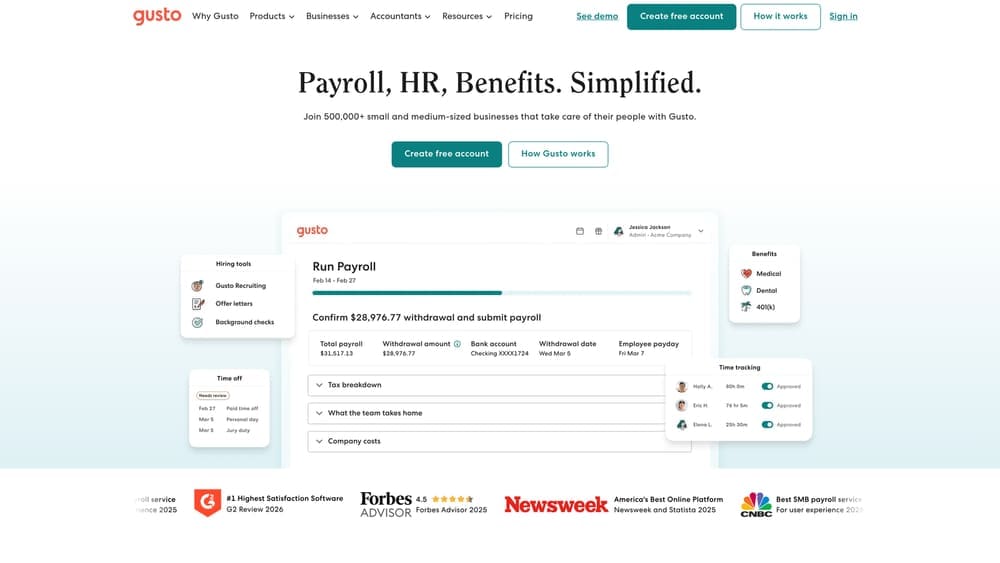
Gusto is a cloud-based payroll and HR platform with publicly listed pricing, no co-employment, and a straightforward interface that handles payroll taxes, benefits, and basic HR tools.
Where This Tool Shines
Gusto’s biggest advantage over G&A Partners isn’t features — it’s transparency. You can see exactly what you’ll pay before you talk to anyone. For a business owner who wants to run payroll reliably, stay compliant with tax filings, and not deal with a co-employment agreement, Gusto is one of the cleanest options on the market.
It’s worth being direct about the tradeoff: Gusto does not assume co-employer liability. You’re still the employer of record. That means you carry the compliance risk, and your benefits purchasing power stays at your company’s headcount. For businesses with straightforward payroll needs and low HR complexity, that’s often a perfectly acceptable tradeoff — especially given the price difference.
Key Features
Transparent, publicly listed pricing: No sales call required to understand what you’ll pay — tiers are clearly listed on their website.
No co-employment: You retain full employer status — no shared liability, no co-employment agreement to navigate.
Automated payroll tax filing: Handles federal, state, and local tax filings across all 50 states automatically.
Basic HR tools included: Onboarding workflows, offer letters, and time tracking available depending on the plan tier.
Health benefits administration: Available as an add-on, though not at large-group rates like a PEO would provide.
Best For
Small businesses with under 50 employees that have relatively simple HR needs, don’t need co-employment benefits access, and want predictable, transparent software pricing without a long-term contract.
Pricing
Starts at approximately $46/month base plus a per-employee fee. Multiple tiers publicly listed on the Gusto website — one of the most pricing-transparent options in this comparison.
4. ADP TotalSource
Best for: Mid-market businesses that want enterprise-level PEO infrastructure and national compliance coverage.
ADP TotalSource is ADP’s full-service PEO offering, combining large-group benefits access, national compliance support, and ADP’s integrated HR platform under a co-employment structure.
Where This Tool Shines
ADP TotalSource operates at a different scale than G&A Partners. The brand recognition, national infrastructure, and large-group benefits negotiating power are genuine advantages — particularly for companies approaching 100+ employees or those with employees spread across multiple states. If you’re outgrowing a regional PEO or need consistent HR support across a geographically distributed workforce, TotalSource has the infrastructure to support that.
The flip side is that ADP is a large organization, and smaller clients sometimes find the service experience less personalized than what a regional PEO like G&A Partners delivers. If the dedicated advisor relationship matters to you, that’s a real consideration.
Key Features
Full co-employment PEO model: National scale with shared compliance liability across all states.
Large-group benefits access: Health, dental, and vision benefits at rates that reflect ADP’s pooled purchasing power.
ADP compliance infrastructure: Regulatory support backed by one of the largest HR and payroll organizations in the country.
Integrated platform: Payroll, HR, and benefits management in a single system — no patchwork of tools.
Better suited for larger teams: Designed to scale effectively for companies in the 50–500+ employee range.
Best For
Mid-market businesses that need national PEO coverage, have employees across multiple states, or are scaling past what a regional PEO handles well. Less ideal for small businesses under 25 employees where the cost-to-value ratio may not hold up.
Pricing
Custom quote required. ADP TotalSource uses a PEPM or percentage-of-payroll structure — pricing is not publicly disclosed and requires a consultation.
5. Paychex Flex
Best for: Growing businesses that want to start with payroll and scale into PEO services without switching platforms.
Paychex Flex is a modular HR and payroll platform that lets businesses layer in services over time — from basic payroll processing up to full PEO — without migrating to a new system.
Where This Tool Shines
The modularity is the real differentiator here. Most businesses don’t start out needing a full PEO. Paychex Flex lets you begin with payroll-only and add HR services, benefits administration, or access to Paychex PEO as your needs evolve. That continuity — staying on the same platform as you grow — removes a friction point that many businesses hit when they try to upgrade from a payroll tool to a PEO mid-growth.
It’s worth noting that Paychex PEO is a separate offering from Paychex Flex. If you eventually want co-employment, that’s a distinct service with its own pricing and agreement structure. But the ability to grow into it without rebuilding your HR stack has real operational value.
Key Features
Modular service tiers: Start with payroll only and add HR, benefits, or PEO services as your business grows.
Dedicated HR professional: Available at higher service tiers for businesses that want advisory support.
Payroll tax compliance: Automated filing and payments across all states.
Workers’ comp and benefits: Available as add-ons or included in PEO tier depending on the service level selected.
Scalable without platform migration: One of the few platforms that genuinely supports growth from micro-business to mid-market without forcing a system switch.
Best For
Businesses in a growth phase that aren’t sure yet whether they need a full PEO, or those that want the option to scale HR services over time without committing to co-employment upfront.
Pricing
Payroll-only plans are publicly quoted and start at a relatively accessible price point. PEO tier pricing is custom and requires a consultation with Paychex.
6. Rippling
Best for: Tech-forward or remote-first businesses that want payroll, HR, and IT management unified in one platform.
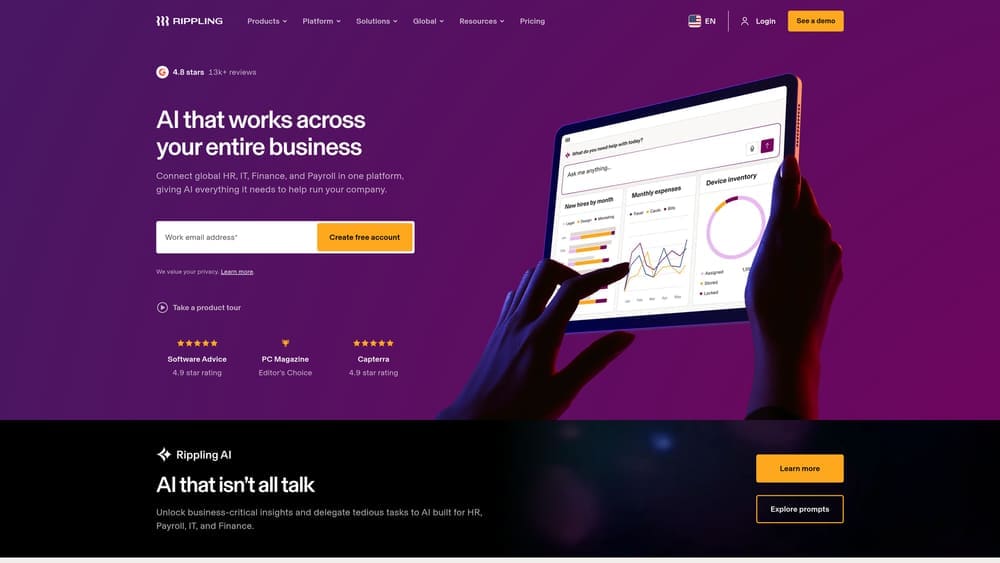
Rippling is a unified workforce platform that combines payroll, HR, and IT management — including device provisioning and app access — in a single system built for automation-first teams.
Where This Tool Shines
Rippling is genuinely different from everything else on this list. It’s not trying to be a traditional PEO, and it’s not a simple payroll tool. The platform connects payroll, HR onboarding, device management, and software access provisioning in a way that makes it unusually efficient for companies with distributed or remote teams. When you hire someone, you can set up their payroll, benefits enrollment, laptop, and app permissions in one workflow.
That said, Rippling does not offer co-employment. You remain the employer of record. If your primary need is benefits purchasing power or shared compliance liability, Rippling won’t solve that. But if your pain point is operational fragmentation across HR, IT, and payroll systems, it’s worth a close look — especially for tech companies and remote-first operations.
Key Features
Unified payroll, HR, and IT platform: One system manages people operations and technology provisioning — unusually integrated for this category.
Automated onboarding and offboarding: Cross-system automation that handles payroll, benefits, devices, and app access simultaneously.
Strong integration library: Connects with a wide range of third-party tools, making it easier to fit into an existing tech stack.
Global payroll capability: Supports distributed teams across multiple countries — a meaningful advantage for remote-first companies.
Not a co-employment PEO: No shared employer liability — you retain full employer status and compliance responsibility.
Best For
Technology companies, remote-first teams, and businesses with complex IT and HR overlap. Not the right fit for businesses that need co-employment benefits access or dedicated HR advisory support.
Pricing
Core platform starts at approximately $8/employee/month. Total cost depends on which modules are selected — pricing is modular and can increase significantly with add-ons.
7. Justworks
Best for: Smaller companies that want PEO-level benefits access with transparent, predictable pricing and a simple contract structure.
Justworks is a PEO platform with publicly listed per-employee pricing, strong large-group health benefits, and a co-employment model designed to be more accessible than traditional PEO contracts.
Where This Tool Shines
Justworks fills a gap that G&A Partners doesn’t address well: transparent pricing for smaller companies. If you’re running a team of 10–50 employees and want co-employment benefits — particularly access to large-group health insurance rates — without navigating an opaque pricing conversation, Justworks is one of the few PEOs that lets you see what you’ll pay before you talk to anyone.
The contract structure is also simpler than most traditional PEOs. For businesses that have been burned by complex PEO agreements or unexpected fees at renewal, that simplicity is a real selling point. It’s not as regionally specialized as G&A Partners, and the dedicated advisor model isn’t as robust — but for straightforward co-employment needs, it’s a strong option.
Key Features
Transparent PEPM pricing: Publicly listed on their website — one of the very few PEOs that publishes pricing without requiring a sales conversation.
Co-employment with large-group benefits: Access to health, dental, and vision benefits at group rates that small businesses can’t typically access independently.
Payroll, compliance, and HR tools included: Core PEO services bundled into the platform without heavy customization requirements.
Simpler onboarding and contract terms: Designed to reduce the friction and complexity that often comes with traditional PEO agreements.
Strong fit under 100 employees: Pricing and service model scale well for smaller teams — less optimized for larger mid-market companies.
Best For
Startups and small businesses under 100 employees that want co-employment benefits access and compliance support without the opacity of traditional PEO pricing or complex contract negotiations.
Pricing
PEPM pricing publicly listed on the Justworks website, with different tiers based on headcount and services selected. One of the most pricing-transparent PEO options available.
8. QuickBooks Payroll
Best for: Micro-businesses already using QuickBooks accounting that need payroll processing without additional HR complexity.
QuickBooks Payroll is Intuit’s native payroll solution, built to integrate directly with QuickBooks accounting software for small businesses that want straightforward payroll processing in one system.
Where This Tool Shines
If your business already runs on QuickBooks, adding QuickBooks Payroll is the path of least resistance. The native integration means payroll entries flow directly into your books without manual reconciliation — a genuine time saver for small business owners who are also managing their own accounting. It’s not trying to be a PEO, and it doesn’t pretend to be.
The honest limitation is scope. QuickBooks Payroll is a payroll processing tool. It handles tax filings and direct deposit reliably, but it doesn’t offer meaningful HR advisory support, it doesn’t provide access to large-group benefits, and it carries no co-employment relationship. For a business with complex HR needs, compliance exposure, or employees in multiple states with varying regulations, it’s likely not enough on its own.
Key Features
Native QuickBooks integration: Payroll data syncs directly with QuickBooks accounting — no manual data entry or third-party connectors needed.
Automated payroll tax filing: Federal and state tax filings handled automatically, with penalty protection available at higher tiers.
Same-day or next-day direct deposit: Faster payment options available depending on the plan selected.
Basic HR features at higher tiers: Some HR tools available on premium plans, though scope is limited compared to dedicated HR platforms.
No co-employment: Purely payroll processing — you retain full employer status and all associated liability.
Best For
Very small businesses (under 20 employees) that are already embedded in the QuickBooks ecosystem, have simple payroll needs, and don’t require HR advisory support or co-employment benefits access.
Pricing
Starts at approximately $45/month plus a per-employee fee. Multiple tiers publicly listed on the Intuit website.
9. TriNet
Best for: Companies in technology, life sciences, financial services, or professional services that need industry-specific HR and benefits packages.
TriNet is an industry-vertical PEO that structures its HR, benefits, and compliance offerings by sector — providing specialized support for companies where generic HR packages don’t fit the regulatory or talent environment.
Where This Tool Shines
TriNet’s industry-vertical model is genuinely differentiated. Rather than offering a one-size-fits-all PEO package, they build HR and benefits structures around the specific needs of sectors like tech, life sciences, and financial services. For a biotech startup with 30 employees competing for talent against larger companies, access to industry-calibrated benefits packages and compliance support that reflects sector-specific regulations is a real advantage.
Where TriNet becomes a harder sell is cost. It’s generally positioned at the mid-to-upper end of PEO pricing, and the industry-specific value only pays off if your sector genuinely benefits from that specialization. A general services business in Texas, for example, might find G&A Partners’ regional expertise and dedicated advisor model more practical than TriNet’s vertical focus.
Key Features
Industry-specific HR and benefits packages: Tailored to the talent and regulatory environment of specific sectors — not a generic PEO package applied uniformly.
Full co-employment PEO model: Shared employer liability with access to large-group health and ancillary benefits.
Sector-specific compliance support: Regulatory guidance informed by the specific rules and risks of your industry.
Large-group benefits access: Health, dental, vision, and ancillary benefits at group rates that reflect TriNet’s pooled purchasing power.
Dedicated HR support with industry expertise: HR professionals with background knowledge in your sector, not just general HR generalists.
Best For
Technology companies, life sciences firms, financial services businesses, and professional services organizations where industry-specific HR and compliance nuance genuinely matters. Less compelling for general industries where a regional PEO like G&A Partners would deliver comparable value at a potentially better price point.
Pricing
Custom quote required. TriNet uses a PEPM pricing structure that is not publicly disclosed — generally positioned at a mid-to-upper price point relative to the broader PEO market.
Making the Right Call for Your Business
Here’s the honest summary: G&A Partners is a strong PEO for the right business profile. If you’re a Texas-based or Southwest-region company with 20–200 employees, you want a dedicated HR advisor, and you need co-employment benefits — workers’ comp administration, large-group health access, shared compliance liability — G&A Partners deserves serious consideration. The CPEO certification and ESAC accreditation are meaningful, and the regional depth is real.
But if your business is small, your payroll is straightforward, and you’re not carrying significant HR or compliance exposure, a payroll-only platform like Gusto or QuickBooks Payroll may be the smarter, leaner choice. You’ll pay less, retain full employer control, and avoid the complexity of a co-employment agreement. The scope difference is real — but so is the cost difference, and not every business needs what a PEO provides.
A few quick matches worth noting. Justworks is worth evaluating if you want PEO-level benefits access with transparent pricing and a simpler contract than G&A Partners typically offers. TriNet makes sense if your business is in tech, life sciences, or financial services and the industry-vertical model is worth the premium. Rippling is the right conversation if your pain point is operational fragmentation across HR and IT, not co-employment coverage.
Before you renew your PEO agreement or commit to a new provider, compare your options. Most businesses overpay due to bundled fees and unclear administrative markups — and the only way to know whether G&A Partners is priced competitively for your situation is to see what else is available. We break down pricing, services, and contract structures so you can make a smarter decision without sitting through five sales calls first.