
At 500 employees, your HR infrastructure either scales with you or becomes the bottleneck that slows everything down. Most PEO comparison guides focus on small businesses with 10-50 employees, but the decision factors at enterprise scale are fundamentally different. You’re evaluating dedicated account teams, custom benefit plan design, multi-state compliance complexity, and technology integrations that smaller companies never encounter.
This guide compares top PEO providers with proven track records serving companies at the 500+ employee threshold, focusing on the operational realities that matter at this scale: implementation capacity, pricing structures that don’t penalize growth, and the compliance infrastructure needed for complex organizations.
1. Clicks Geek PEO Comparison Platform
Best for: Businesses evaluating or renewing PEO services who need objective pricing analysis before committing
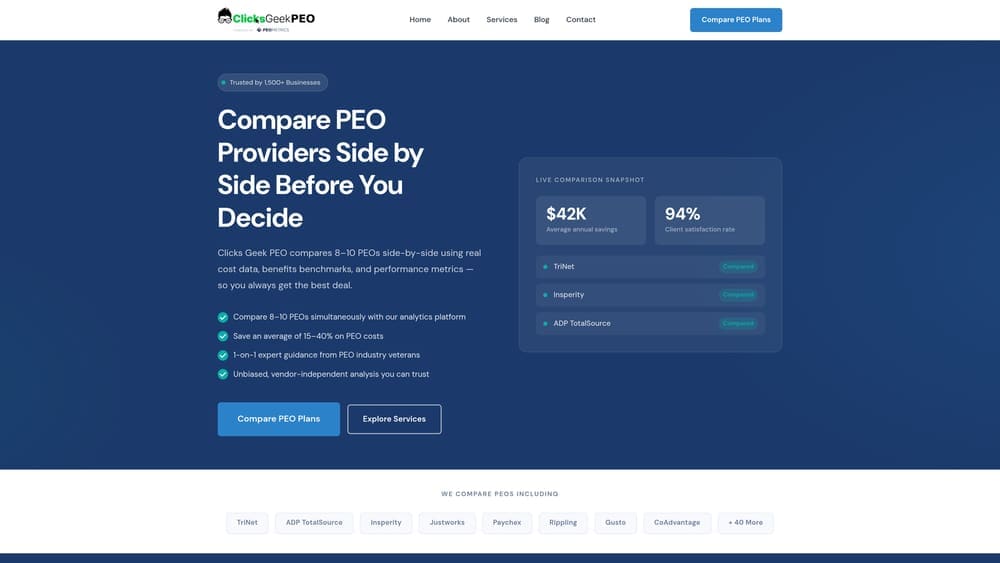
Clicks Geek PEO Comparison Platform is an independent advisory service that helps mid-sized and enterprise companies compare PEO providers objectively.
Where This Platform Shines
Most businesses sign PEO agreements without understanding what they’re actually paying for. Administrative fees get bundled into per-employee charges, and contract terms lock you into services you don’t need. Clicks Geek breaks down pricing structures across providers so you can see exactly what you’re paying versus what competitors charge for identical services.
The platform focuses specifically on transparency around contract terms and fee structures. At 500 employees, a 2% difference in administrative markup translates to tens of thousands annually. This service helps you identify those gaps before renewal.
Key Features
Side-by-Side Provider Comparisons: Direct feature and pricing breakdowns across multiple PEO providers tailored to your headcount and industry.
Transparent Pricing Breakdowns: Detailed analysis of per-employee fees, administrative markups, and bundled service costs that most providers obscure.
Contract Term Analysis: Review of termination clauses, renewal structures, and fee escalation terms that impact long-term costs.
Independent Advisory: Not a PEO itself, so recommendations aren’t tied to sales commissions or provider partnerships.
Best For
CFOs and operations managers at companies with 200+ employees who are evaluating PEO renewals or considering switching providers. Particularly valuable if you’re currently locked into a contract and want to understand your options before the next renewal cycle.
Pricing
Free comparison resources available online. Advisory services for detailed contract reviews and provider negotiations are available on a project basis.
2. ADP TotalSource
Best for: Enterprise companies needing Fortune 500-level benefits and deep multi-state compliance infrastructure
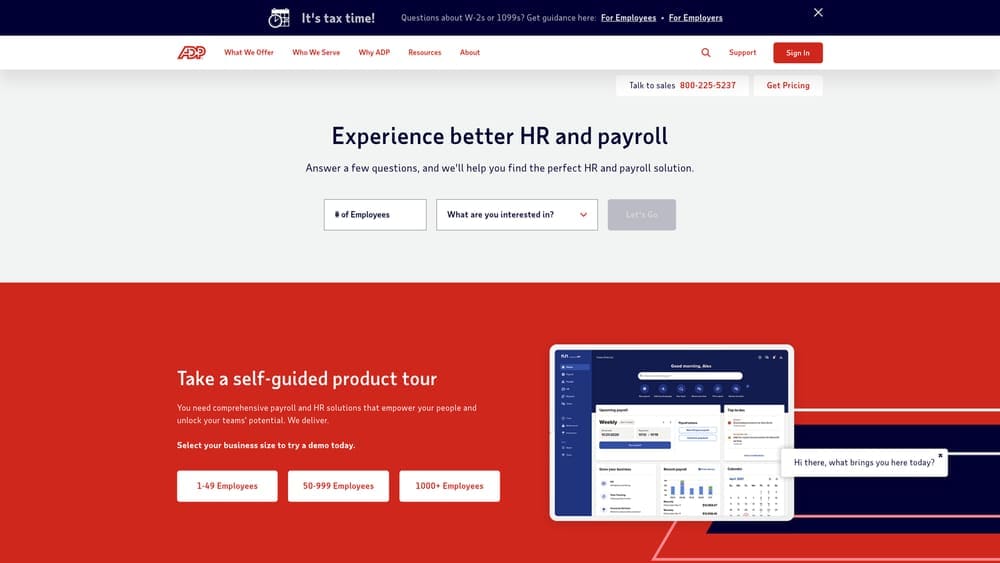
ADP TotalSource is the enterprise-grade PEO arm of ADP, the largest HR services provider globally.
Where This Tool Shines
ADP’s scale creates real advantages at the enterprise level. Their benefit plans leverage Fortune 500 purchasing power, which means your 500-employee company accesses health insurance rates typically reserved for 10,000+ employee organizations. The cost differential on benefits alone can justify their service fees.
Their multi-state compliance infrastructure is genuinely comprehensive. If you operate in 15+ states, ADP maintains dedicated state compliance specialists who track regulatory changes in real time. Smaller PEOs often rely on third-party compliance vendors, which introduces lag time and potential gaps.
Key Features
Multi-State Compliance Infrastructure: Dedicated state specialists monitoring regulatory changes across all 50 states with proactive client notifications.
Integration with ADP Ecosystem: Seamless connection to ADP payroll, time tracking, and talent management platforms if you’re already using their services.
Fortune 500-Level Benefit Plans: Access to health insurance carriers and plan designs typically unavailable to mid-market companies.
Dedicated HR Business Partners: Named account managers with enterprise experience, not shared support pools.
Best For
Companies operating in multiple states with complex compliance requirements, or organizations already using ADP payroll systems who want unified HR infrastructure. Particularly strong for businesses in highly regulated industries like financial services or healthcare.
Pricing
Custom enterprise pricing based on headcount, service scope, and benefit selections. Typically structured as a percentage of total payroll, with negotiation leverage increasing significantly above 500 employees.
3. Insperity
Best for: Mid-market companies prioritizing dedicated support teams and performance management tools
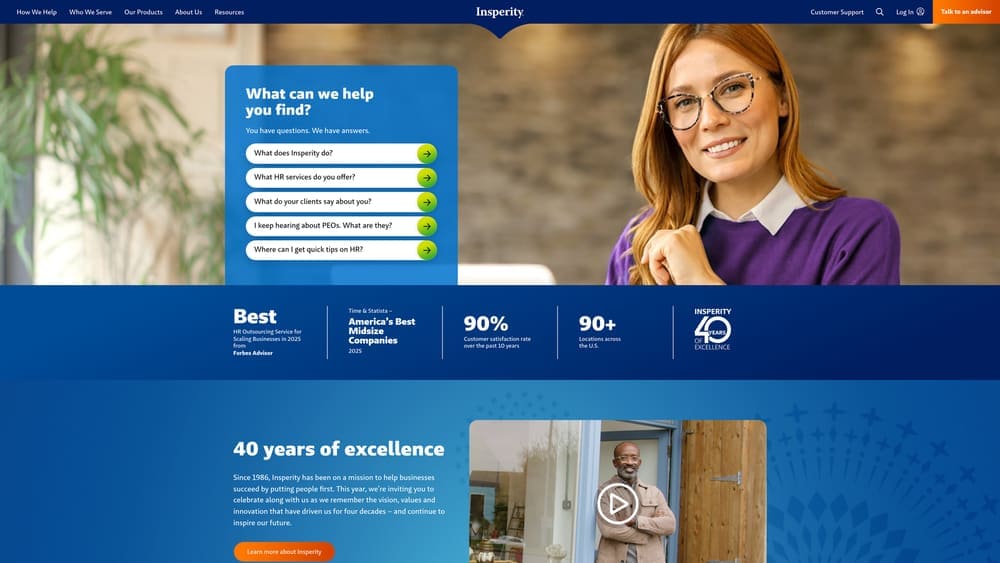
Insperity is a mid-market focused PEO with a strong track record serving growing companies in the 100-1,000 employee range.
Where This Tool Shines
Insperity’s dedicated account team model stands out at this scale. You get named HR business partners who learn your business over time, not rotating support staff reading from scripts. This continuity matters when you’re managing complex employee relations issues or navigating organizational restructuring.
Their performance management platform integrates directly into the PEO relationship, which most competitors don’t offer. If you’re trying to standardize performance reviews or implement competency frameworks across departments, having this built into your HR infrastructure eliminates the need for separate tools.
Key Features
Named Account Teams: Dedicated HR business partners and compliance specialists assigned to your company, not shared support queues.
Performance Management Tools: Integrated goal-setting, review cycles, and competency tracking within the PEO platform.
Scalable Service Model: Service tiers that adjust as you grow from 500 to 1,000+ employees without requiring platform migration.
Strong Compliance Support: Proactive audit support and regulatory guidance, particularly for wage and hour compliance.
Best For
Companies that value relationship-based service over self-service technology. Particularly strong for organizations with complex employee relations needs or those implementing structured performance management for the first time.
Pricing
Per-employee-per-month pricing model with custom quotes for companies above 500 employees. Expect pricing conversations to focus on service tier selection and benefit plan design choices.
4. TriNet
Best for: Technology, financial services, and life sciences companies needing industry-specific compliance expertise
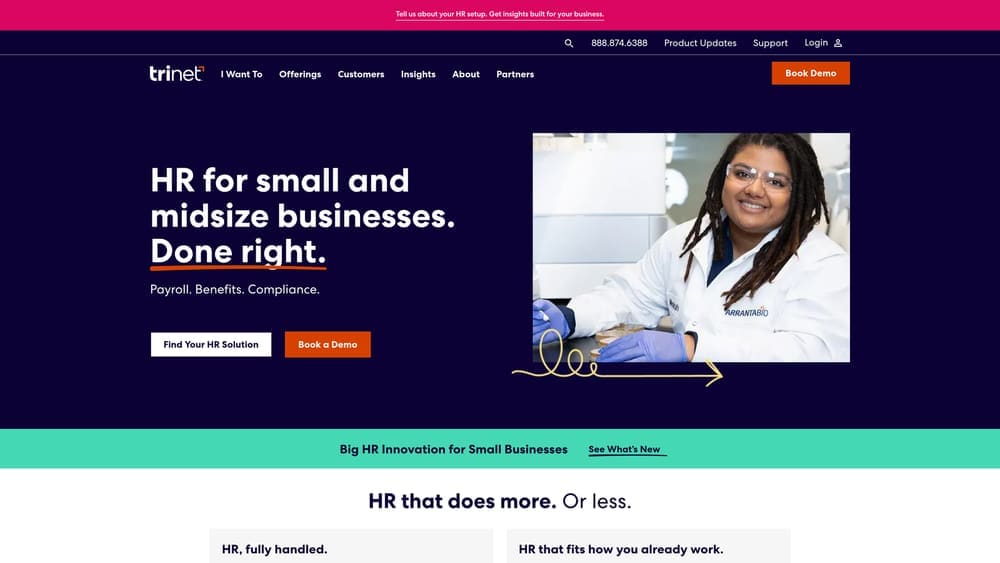
TriNet is an industry-specialized PEO offering vertical expertise in select high-growth sectors.
Where This Tool Shines
TriNet’s vertical specialization creates real value if you operate in their focus industries. Their technology sector team understands equity compensation structures, stock option administration, and the compliance nuances of remote-first organizations. These aren’t generic HR generalists reading compliance manuals.
Their risk management approach is more sophisticated than most PEOs. They proactively identify employment practices liability exposures specific to your industry and help you implement preventive policies before issues escalate. For companies in litigation-prone sectors, this matters.
Key Features
Industry-Specific Compliance Expertise: Dedicated teams for technology, financial services, life sciences, and professional services with deep vertical knowledge.
Vertical Benefit Packages: Health plans and ancillary benefits designed specifically for industry workforce demographics and competitive requirements.
Risk Management Focus: Proactive employment practices liability identification and policy development tailored to industry-specific exposures.
Strategic HR Consulting: Access to HR consultants with experience in your specific industry, not generalist support staff.
Best For
Technology companies with complex equity structures, financial services firms navigating FINRA compliance, or life sciences organizations managing clinical trial workforce regulations. Less relevant if you operate outside their core verticals.
Pricing
Per-employee-per-month pricing with industry-specific tiers. Technology and financial services pricing typically runs higher than general market rates due to specialized compliance requirements and risk profiles.
5. Paychex PEO
Best for: Companies wanting modular service selection rather than all-or-nothing PEO bundles
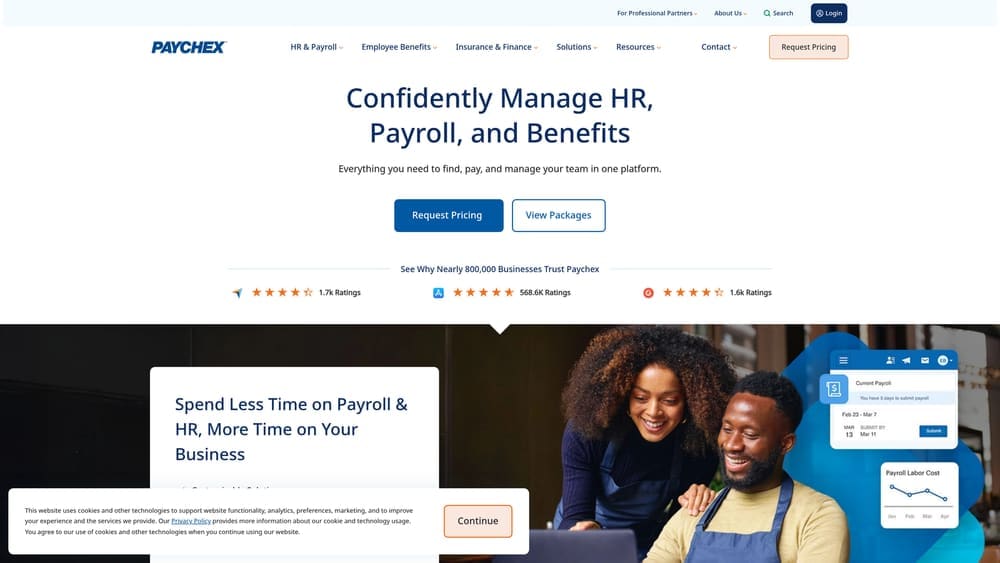
Paychex PEO offers flexible PEO services with modular tiers allowing companies to scale support up or down.
Where This Tool Shines
Paychex’s modular approach solves a common enterprise problem: you don’t need full-service PEO support across every function. Maybe you have a strong internal benefits team but need compliance support and workers’ compensation management. Paychex lets you select specific services without paying for comprehensive bundles you won’t use.
Their payroll platform integration is seamless if you’re already using Paychex for payroll processing. This eliminates the data synchronization issues that plague companies trying to connect separate payroll and PEO systems.
Key Features
Modular Service Selection: Choose specific PEO services (benefits, compliance, risk management) without committing to full-service bundles.
Integrated Payroll Platform: Native connection to Paychex payroll systems eliminates data synchronization issues and duplicate entry.
Flexible Benefit Options: Access to multiple carrier options and plan designs without being locked into single-carrier relationships.
Scalable Compliance Support: Add or remove state-specific compliance support as you expand or contract geographic footprint.
Best For
Companies with existing internal HR capabilities who need targeted PEO support in specific areas. Particularly valuable for organizations already using Paychex payroll who want to add PEO services without switching platforms.
Pricing
Custom pricing based on services selected and headcount. The modular approach can reduce costs compared to full-service PEO bundles, but requires clear understanding of which services you actually need.
6. Justworks
Best for: Companies prioritizing transparent pricing and strong self-service capabilities
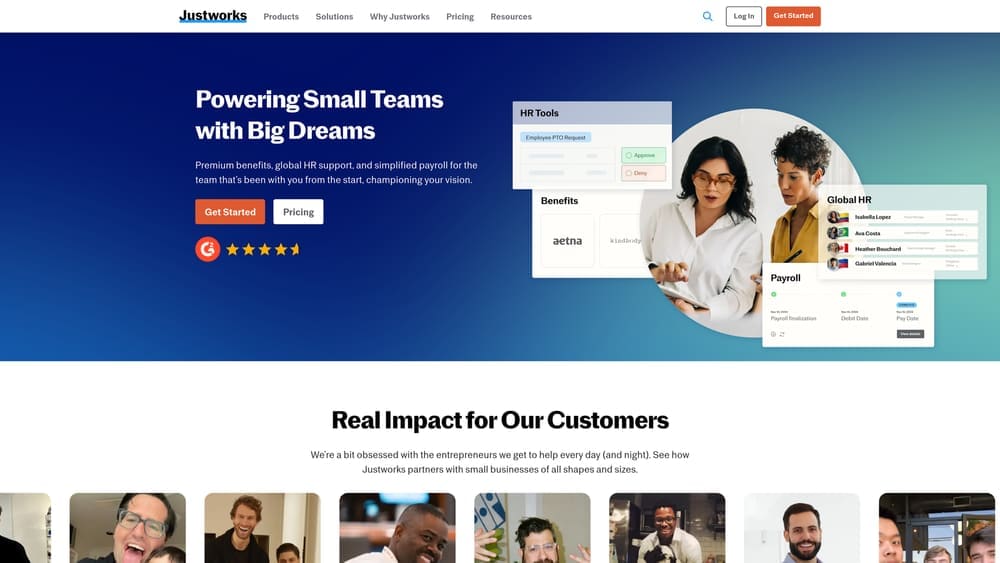
Justworks is a modern PEO platform with transparent flat-rate pricing and robust self-service tools.
Where This Tool Shines
Justworks publishes their pricing online, which almost no enterprise PEO does. This transparency matters when you’re budgeting for next fiscal year and don’t want to wait three weeks for a sales rep to send a custom quote. You can model costs accurately before engaging in lengthy sales conversations.
Their self-service platform is genuinely well-designed. If your HR team is comfortable managing day-to-day administration without constant hand-holding, Justworks gives you the tools to handle most tasks independently. This reduces dependency on account manager availability for routine operations.
Key Features
Transparent Flat-Rate Pricing: Published per-employee-per-month rates with no hidden administrative fees or percentage-of-payroll markups.
Modern User Interface: Intuitive platform design that reduces training time and improves adoption across HR teams and employees.
Strong Self-Service Tools: Comprehensive employee and manager portals for benefits enrollment, time-off management, and document access.
Straightforward Benefits Administration: Clear benefit plan options without overwhelming choice complexity or carrier management burden.
Best For
Tech-forward companies with capable internal HR teams who prefer self-service platforms over relationship-based support models. Works well for organizations that value pricing transparency and want to avoid lengthy enterprise sales cycles.
Pricing
Flat per-employee-per-month pricing published on their website. Rates vary by state and benefit selections, but the structure remains consistent and predictable as you scale.
7. Rippling PEO
Best for: Technology companies needing unified HR and IT management in a single platform
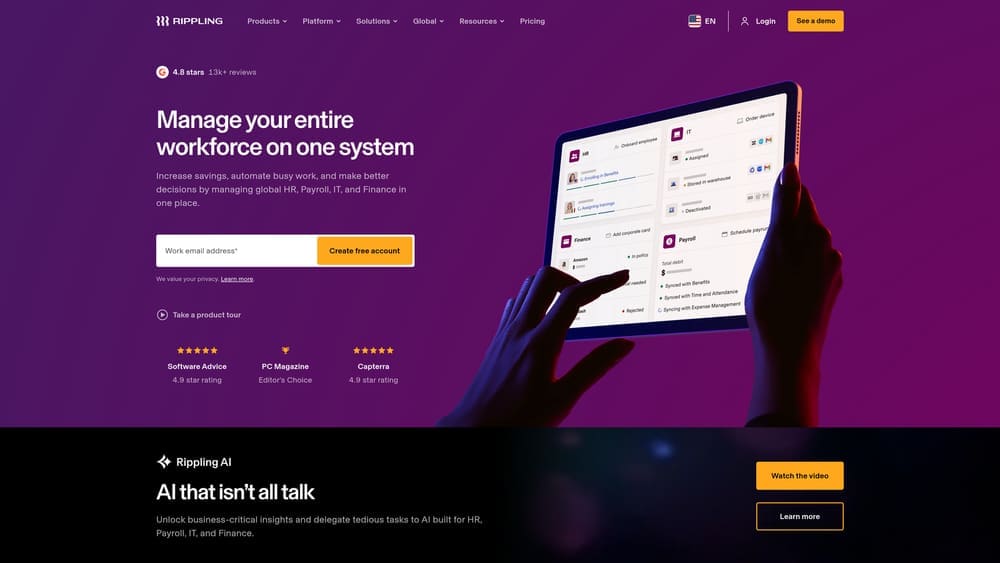
Rippling PEO combines PEO services with IT and device management for tech-forward organizations.
Where This Tool Shines
Rippling’s unified approach to HR and IT administration solves real operational friction. When you hire someone, the same workflow that enrolls them in benefits also provisions their laptop, grants software access, and creates email accounts. When they leave, everything deactivates simultaneously. This eliminates the coordination gaps that create security vulnerabilities and compliance issues.
Their workflow automation is more sophisticated than traditional PEO platforms. You can build custom approval chains, automate state-specific compliance tasks, and create conditional logic for different employee types. This matters at scale when manual processes become bottlenecks.
Key Features
Unified HR and IT Management: Single platform managing employee data, benefits, payroll, device provisioning, and software access.
Device and App Provisioning: Automated laptop setup, software licensing, and access management integrated with HR workflows.
Workflow Automation: Custom approval chains and conditional logic for onboarding, offboarding, and role changes.
Global Workforce Support: International contractor and employee management capabilities beyond domestic PEO services.
Best For
Technology companies with distributed teams who need tight integration between HR and IT operations. Particularly valuable for organizations managing significant software licensing costs or complex device provisioning requirements.
Pricing
Per-employee-per-month pricing with modular add-ons for specific IT management features. PEO services and platform features are priced separately, allowing customization based on actual usage.
8. Amplify PEO
Best for: Mid-sized companies wanting high-touch service without enterprise-level pricing
Amplify PEO is a boutique-style PEO offering personalized service for mid-sized companies.
Where This Tool Shines
Amplify operates in the sweet spot between enterprise PEO scale and boutique service quality. You get dedicated account management with actual responsiveness, not the “dedicated team” that’s really managing 50 other clients. Their account managers have decision-making authority to solve problems without escalating through three approval layers.
Their benefit plan design flexibility stands out. Unlike larger PEOs that push you toward standardized plan options, Amplify works with you to structure benefit packages that match your specific workforce demographics and budget constraints. This customization matters when you’re competing for talent in tight labor markets.
Key Features
High-Touch Account Management: Dedicated account managers with actual availability and decision-making authority, not shared support queues.
Flexible Benefit Design: Custom benefit plan structuring based on workforce demographics and budget, not standardized package options.
Responsive Support Model: Direct access to compliance specialists and HR consultants without navigating multi-tier support systems.
Mid-Market Focus: Service model designed specifically for companies in the 200-1,000 employee range, not scaled-down enterprise approaches.
Best For
Companies that have outgrown small-business PEOs but don’t need (or want to pay for) enterprise-level infrastructure. Particularly strong for organizations that value relationship-based service and benefit customization over platform sophistication.
Pricing
Custom pricing based on headcount and service scope. Typically competitive with larger providers while offering more personalized service and greater benefit design flexibility.
Making the Right Choice for Your Organization
At 500 employees, the PEO decision involves fundamentally different considerations than small business evaluations. Implementation capacity becomes critical. Larger providers like ADP and Insperity maintain dedicated implementation teams that can onboard complex organizations without disrupting operations. Smaller PEOs may struggle with the scope and timeline requirements at this scale.
Pricing structures shift significantly above 500 employees. Per-employee-per-month models create substantial annual costs, and negotiation leverage increases dramatically. A 500-employee company paying $150 per employee monthly spends $900,000 annually. A $10 per-employee reduction saves $60,000. Understanding exactly what you’re paying for matters.
Multi-state compliance complexity is where many mid-sized PEOs fall short. If you operate across 10+ states, you need providers with dedicated state compliance specialists, not generalists relying on third-party vendors. ADP and TriNet maintain this infrastructure. Smaller providers often don’t.
Technology integration requirements increase at scale. You likely have existing HRIS, payroll, or ERP systems. Rippling excels here with native integrations. Traditional PEOs often require manual data synchronization or expensive custom API development.
Service model preference matters more than most companies realize. If you value relationship-based support, Insperity and Amplify deliver dedicated teams that learn your business. If you prefer self-service platforms, Justworks and Rippling provide robust tools without requiring constant account manager interaction.
Before you renew your PEO agreement, compare your options. Most businesses overpay due to bundled fees and unclear administrative markups. We break down pricing, services, and contract structures so you can make a smarter decision.
At this headcount, you should also evaluate whether a PEO remains optimal versus bringing HR in-house or using an Administrative Services Organization (ASO) model that avoids co-employment. The right answer depends on your internal HR capabilities, risk tolerance, and growth trajectory. Not every 500-employee company needs a PEO, but if you do, choose one built for your scale and complexity.