
Vensure Employer Solutions has grown fast. Through a string of acquisitions, they’ve assembled a broad national footprint and positioned themselves as a go-to PEO for industries that other providers avoid. But scale and fit are different things, and “we serve everyone” often means “we’re optimized for no one in particular.”
If you’re evaluating Vensure, or you’re already a client wondering whether to renew, the honest question isn’t just “is Vensure good?” It’s whether Vensure is the right match for your headcount, your industry, your risk profile, and what you actually need from a co-employment relationship.
This breakdown covers who Vensure genuinely works well for, where the gaps show up, and which alternative PEOs deserve a side-by-side look before you sign anything. We’ve also included an independent comparison resource at the top of the list, because the smartest thing you can do before choosing a PEO is evaluate your options with clean, unbiased data.
1. Clicks Geek PEO Comparisons
Best for: Business owners who want objective, side-by-side PEO analysis before committing to a provider.
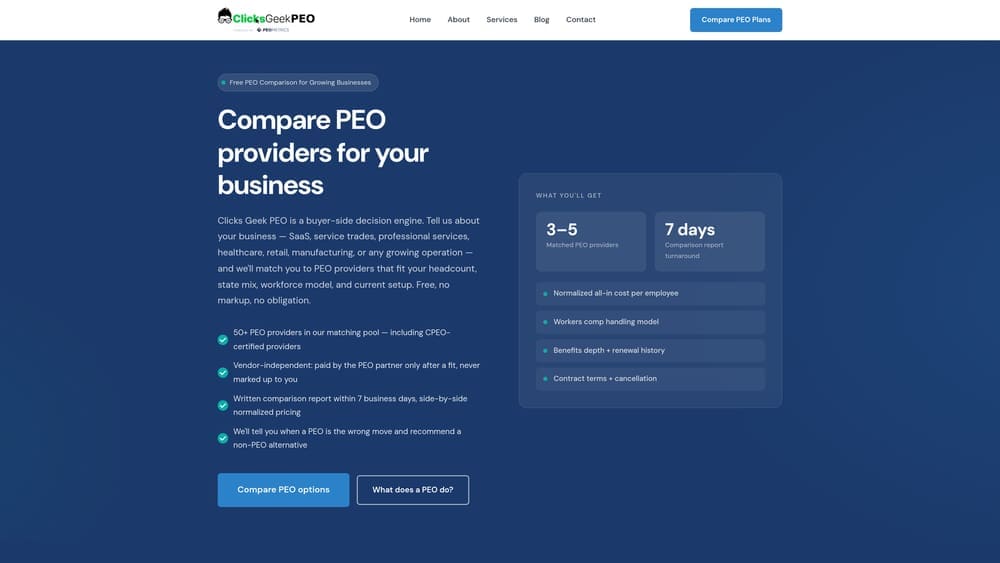
Clicks Geek PEO Comparisons is an independent PEO comparison platform built to give business owners the pricing clarity and provider context they rarely get from the providers themselves.
Where This Tool Shines
Most PEO evaluation processes start with a sales call, which means you’re getting information filtered through someone with a commission on the line. Clicks Geek flips that dynamic. The platform gives you access to transparent pricing breakdowns, contract term evaluations, and side-by-side provider comparisons before you ever pick up the phone.
The partnership with PEO Metrics adds a data layer that’s genuinely useful, especially for buyers who are renewing and want to know whether what they’re paying is actually in line with market rates. It’s particularly valuable if you’ve been with the same PEO for a few years and haven’t benchmarked your costs recently.
Key Features
Independent Provider Comparisons: Unbiased evaluations across major PEO providers without vendor influence or referral incentives.
Transparent Pricing Analysis: Breaks down administrative fees, per-employee costs, and bundled markups so you can see what you’re actually paying for.
Side-by-Side Contract Evaluations: Compares contract structures, termination clauses, and service level commitments across providers.
PEO Metrics Partnership: Data-driven insights on provider performance and market pricing benchmarks.
Educational Resources: Practical guides for first-time PEO buyers and businesses evaluating whether to renew, switch, or exit their current arrangement.
Best For
Small and mid-sized business owners, CFOs, and HR decision-makers who are entering a new PEO agreement or approaching a renewal and want objective data before making a commitment. Also useful for anyone who suspects they’re overpaying but doesn’t have a benchmark to compare against.
Pricing
Free to access. Provider comparisons, pricing guides, and contract evaluation resources are available at no cost, with no sales pressure attached.
2. Vensure Employer Solutions
Best for: Multi-state employers in high-risk industries like construction, staffing, manufacturing, and hospitality.
Vensure Employer Solutions is a large-scale PEO built primarily through acquisitions, offering broad geographic coverage and specialized strength in industries where workers’ compensation risk is a central concern.
Where This Tool Shines
Vensure’s acquisition strategy has given them something most mid-size PEOs can’t match: deep penetration in states and industries that premium PEOs often avoid or price punitively. If you’re running a construction firm across multiple states, or managing a staffing agency with fluctuating headcount and complex workers’ comp classifications, Vensure has infrastructure built around those scenarios.
That said, the acquisition model cuts both ways. Clients sometimes end up on legacy platforms from absorbed brands, and service consistency can vary depending on which regional team handles your account. Reviews on platforms like Trustpilot and G2 reflect this unevenness. Vensure works best for companies that prioritize risk management and multi-state compliance over a polished HR technology experience.
Key Features
Multi-State Payroll and Compliance: Broad coverage across states, including jurisdictions with complex regulatory requirements.
Workers’ Compensation Administration: Strong risk management infrastructure for industries with elevated injury exposure.
Industry Expertise: Established service models for construction, staffing, hospitality, and manufacturing.
Geographic Footprint: Expanded reach through acquired regional brands gives Vensure coverage in markets where national PEOs have thinner presence.
Benefits and HR Administration: Standard PEO benefits access and HR support, though depth varies by account tier.
Best For
Mid-sized businesses in blue-collar or high-risk industries operating across multiple states. Companies that need workers’ comp expertise and multi-jurisdictional payroll more than they need a cutting-edge HR platform. Not the strongest fit for white-collar professional services firms or tech companies prioritizing integrations and automation.
Pricing
Typically percentage-of-payroll. Rates vary significantly by industry risk classification and state. Opaque without independent benchmarking — request a custom quote and compare it against market data before committing.
3. ADP TotalSource
Best for: Established mid-size to enterprise companies that want a PEO backed by institutional-grade infrastructure.
ADP TotalSource is the PEO arm of ADP, one of the largest payroll and HR technology companies in the world, offering deep integrations, robust compliance tools, and dedicated HR support.
Where This Tool Shines
ADP TotalSource’s main advantage is the infrastructure behind it. You’re not just getting a PEO, you’re getting access to ADP’s compliance engine, reporting capabilities, and integration ecosystem. For companies that already use ADP products or need serious analytics and third-party software connectivity, TotalSource is a natural fit.
The dedicated HR business partner model also means you have a named contact who understands your account, not just a rotating support queue. The tradeoff is cost: TotalSource tends to run at the higher end of the market, and smaller companies may find the pricing hard to justify relative to simpler alternatives.
Key Features
ADP Payroll Infrastructure: Built on one of the most established payroll platforms globally, with strong audit trails and compliance history.
Integration Ecosystem: Extensive API connectivity and third-party integrations for finance, benefits, and HR systems.
Dedicated HR Business Partners: Named HR professionals assigned to your account for ongoing advisory support.
Compliance and Risk Management: Comprehensive tools for employment law compliance, multi-state filings, and regulatory changes.
Reporting and Analytics: Strong dashboards and workforce analytics for data-driven HR decisions.
Best For
Companies with 50+ employees that need enterprise-grade compliance, deep software integrations, and a PEO they can scale into. Also a strong option for businesses already embedded in the ADP ecosystem.
Pricing
Custom pricing, generally structured as percentage-of-payroll or per-employee. Tends toward the premium end of the market. Request a quote and benchmark it independently before signing.
4. Justworks
Best for: Startups and small teams that want transparent pricing and a clean, modern HR experience without complexity.
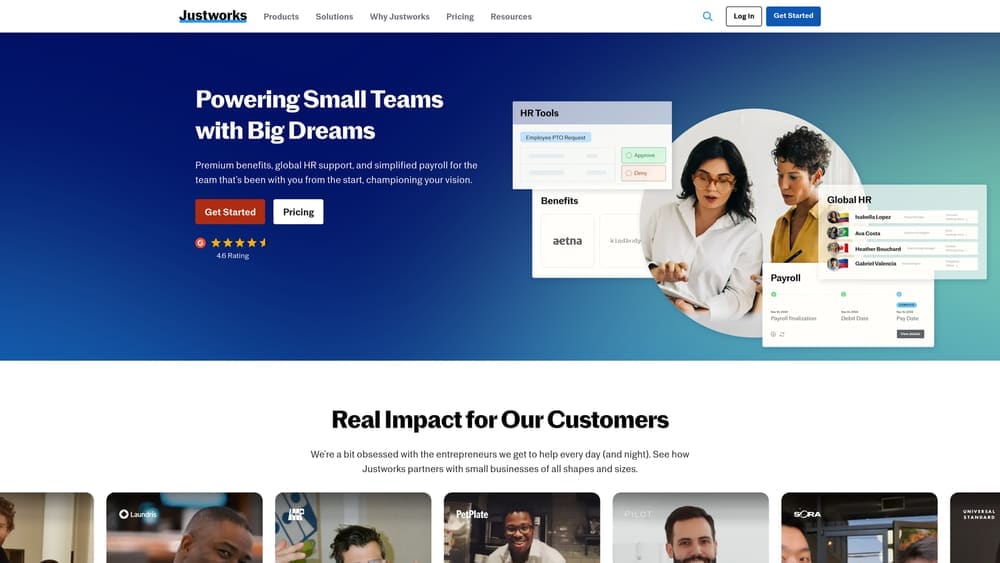
Justworks is a modern PEO built around simplicity, publicly listed pricing, and a user interface that doesn’t require HR expertise to navigate.
Where This Tool Shines
Justworks is one of the few PEOs that actually publishes its pricing, which immediately changes the evaluation dynamic. For founders and small business owners who’ve spent time trying to decode percentage-of-payroll quotes, the flat per-employee-per-month structure is a genuine relief.
The platform is clean, onboarding is fast, and access to large-group health insurance plans gives smaller companies benefits purchasing power they’d otherwise lack. Where Justworks is weaker is in complexity: if you need deep workers’ comp risk management, multi-state construction compliance, or highly customized HR workflows, you’ll likely outgrow it.
Key Features
Transparent Per-Employee Pricing: Publicly listed rates with no hidden administrative markups to decode.
Modern Platform UI: Intuitive self-service portal for employees and administrators with minimal learning curve.
Large-Group Health Insurance Access: Gives small teams access to benefits packages typically reserved for larger employers.
Compliance Tools: Built-in state tax registration, ACA compliance, and new hire reporting.
Minimal Onboarding Friction: Fast setup with straightforward documentation requirements.
Best For
Startups, early-stage companies, and small teams under 100 employees, especially in white-collar or knowledge-work environments. Not ideal for companies with complex workers’ comp classifications or high-risk industry profiles.
Pricing
Starts at $59/employee/month (Basic) or $109/employee/month (Plus, which includes benefits access). Pricing is publicly listed on their website, which is unusual and worth appreciating in this industry.
5. Paychex PEO
Best for: Small businesses already using Paychex payroll that want to step up to full PEO co-employment without switching platforms.
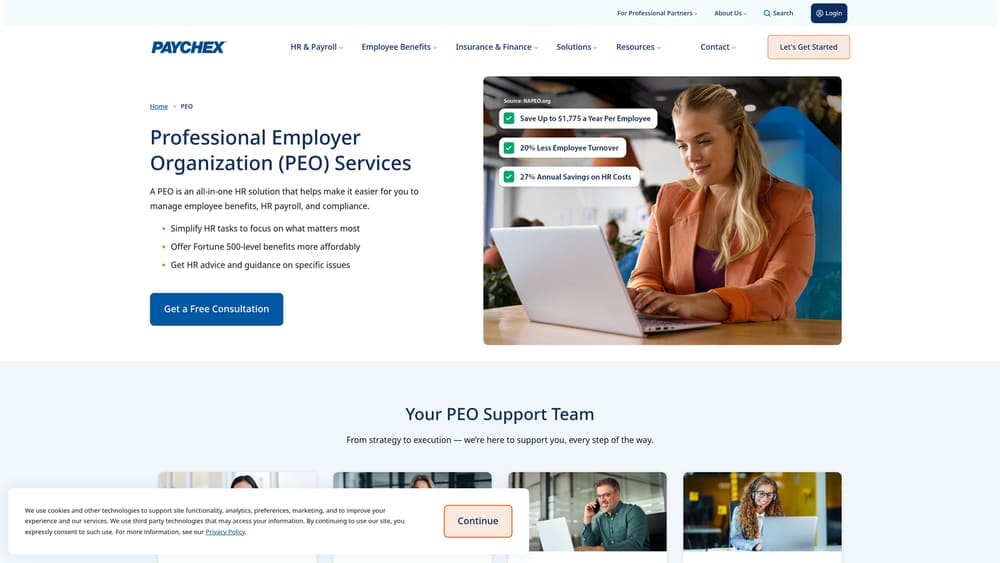
Paychex PEO is the co-employment offering from Paychex, designed to extend existing payroll relationships into full HR outsourcing with a dedicated HR professional on your account.
Where This Tool Shines
The upgrade path is Paychex PEO’s clearest advantage. If you’re a small business that’s been running on Paychex payroll and you’re ready to add benefits administration, workers’ comp coverage, and HR support without migrating to a new system, this is a low-friction transition. Your data stays in place, your team already knows the interface, and you get a dedicated HR professional without starting from scratch.
Paychex also has a strong local sales and service presence, which matters for business owners who prefer working with someone they can actually call. The platform isn’t as modern as Justworks or Rippling, but it’s reliable and well-supported for small business use cases.
Key Features
Seamless Payroll Upgrade: Existing Paychex payroll clients can transition to PEO without data migration or platform changes.
Dedicated HR Professional: A named HR contact assigned to your account for compliance guidance and HR advisory support.
Local Service Presence: Regional Paychex representatives available for in-person support, which is rare at this price tier.
Benefits and Workers’ Comp Administration: Standard PEO co-employment benefits including group health access and workers’ comp coverage.
Scalable Structure: Designed to grow with your headcount without requiring a platform switch.
Best For
Small businesses under 100 employees already on Paychex payroll. Also a solid option for business owners who value relationship-based service over tech-forward platforms.
Pricing
Custom pricing; contact for a quote. Generally competitive for small businesses, though you should still benchmark it against alternatives before renewing or upgrading.
6. Insperity
Best for: Professional services firms and white-collar businesses that want premium benefits and a high-touch HR partnership.
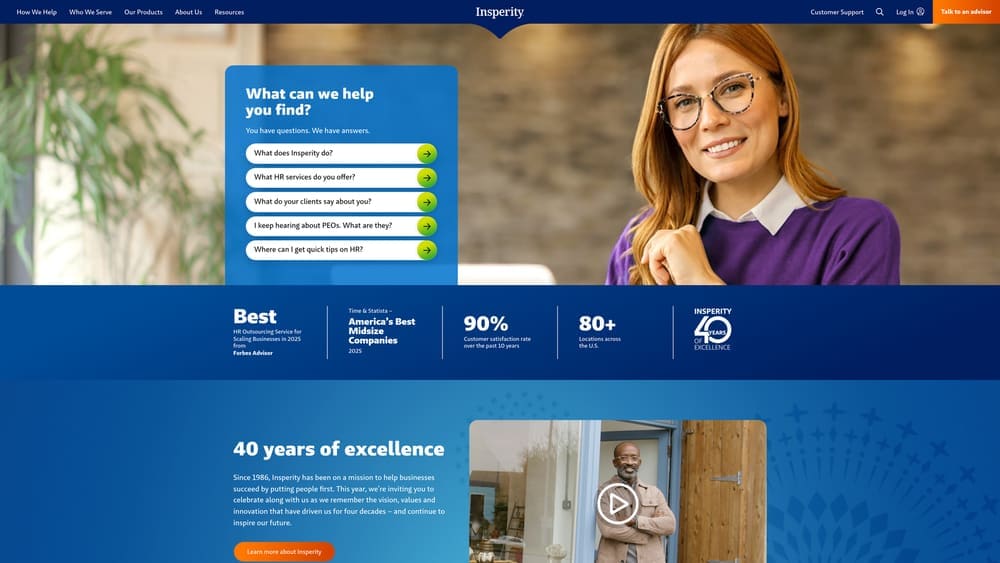
Insperity is a premium PEO with a long track record of serving professional services companies, offering Fortune 500-caliber benefits packages and a dedicated HR business partner model.
Where This Tool Shines
Insperity’s benefits packages are genuinely strong. The medical, dental, vision, and 401(k) options available through their large group purchasing power are a meaningful competitive advantage for companies trying to attract and retain professional talent. If your employees compare offers and benefits matter in your hiring market, Insperity delivers in a way that budget PEOs typically can’t.
The dedicated HR business partner model is also more substantive than what you get from most providers. You’re not calling a general support line. You have an HR professional who knows your account, understands your history, and can give real advisory guidance on employment decisions. The cost reflects this, so it’s not the right fit for cost-sensitive small businesses or high-risk industries.
Key Features
Premium Benefits Packages: Large-group medical, dental, vision, and 401(k) plans competitive with enterprise employers.
Dedicated HR Business Partner: A named HR professional who functions as an embedded strategic advisor, not just a support contact.
Performance Management Tools: Talent development, performance review systems, and employee engagement resources.
Compliance and Employment Law Support: Proactive guidance on regulatory changes and employment law risk.
Employee Self-Service Portal: Well-designed interface for employee benefits enrollment, time tracking, and HR documentation.
Best For
Professional services firms, law practices, consulting agencies, and white-collar businesses with 25 to 500 employees. Companies where talent retention depends on competitive benefits and HR quality. Not the right fit for high-risk or blue-collar industries.
Pricing
Per-employee-per-month model; pricing reflects the premium service tier. Expect to pay more than budget alternatives. Request a custom quote and compare against what you’d pay for equivalent benefits and HR support independently.
7. TriNet
Best for: Companies in regulated or niche industries that need vertical-specific compliance expertise and tailored HR support.
TriNet is an industry-vertical PEO that organizes its service model around specific sectors, including financial services, life sciences, technology, nonprofits, and professional services.
Where This Tool Shines
Most PEOs offer generic compliance support. TriNet’s differentiation is that their service teams are organized by industry, which means the people handling your HR and compliance questions actually understand your regulatory environment. For a registered investment advisor, a clinical research organization, or a nonprofit with specific grant-funded staffing structures, that context matters.
The cloud-based platform is solid and mobile-accessible, and the vertical-specific benefits packages are designed to match what employees in those industries actually expect. TriNet is a reasonable choice when industry-specific compliance is a primary concern, though companies with simpler needs may find the structure more than they require.
Key Features
Industry-Specific Service Teams: HR and compliance professionals organized by vertical, not generalist pools.
Vertical-Tailored Benefits: Benefits packages designed to match the expectations and norms of specific industries.
Cloud-Based HR Platform: Mobile-accessible system for employee self-service, payroll, and compliance documentation.
Regulated Industry Compliance: Specialized support for industries subject to sector-specific employment regulations.
Flexible Plan Options: Service structures that can be adjusted based on company size and sector requirements.
Best For
Companies in financial services, life sciences, technology, nonprofits, or other regulated sectors where generic HR compliance support isn’t sufficient. Also strong for companies hiring across multiple states within a single industry vertical.
Pricing
Custom pricing by industry and headcount. Structured as percentage-of-payroll or flat per-employee depending on the arrangement. Request a quote and benchmark it against alternatives in your vertical before committing.
8. Rippling PEO
Best for: Tech-forward companies and remote or distributed teams that want HR, IT, and payroll managed in a single unified platform.
Rippling PEO layers co-employment services on top of Rippling’s unified HR, IT, and finance platform, giving you payroll, device management, app provisioning, and benefits administration in one system.
Where This Tool Shines
Rippling’s core advantage isn’t the PEO itself — it’s the platform it sits inside. When you onboard an employee through Rippling, you can provision their laptop, set up their software access, enroll them in benefits, and run their first paycheck through a single workflow. For remote-first companies or businesses with distributed teams, that level of automation reduces real operational overhead.
The workflow automation and custom policy engine are genuinely powerful for companies that want to build repeatable HR processes without manual intervention. The tradeoff is complexity and cost: Rippling is more platform than most small businesses need, and the pricing layers can add up quickly once you start adding modules.
Key Features
Unified HR and IT Platform: Device management, app provisioning, payroll, and HR in a single system — not separate tools stitched together.
Workflow Automation: Custom policy engine that automates onboarding, offboarding, compliance tasks, and HR workflows.
PEO Services on Existing Platform: Co-employment benefits layered on top of the Rippling platform without requiring a separate system.
Integration Ecosystem: Connects with 500+ third-party applications across finance, productivity, and HR tools.
Remote and Distributed Team Support: Built for companies managing employees across multiple states or countries.
Best For
Tech companies, remote-first businesses, and operations-minded teams that want automation and unified system management as much as they want PEO co-employment benefits. Less suited to businesses that just need basic payroll and HR support without the platform complexity.
Pricing
Core platform starts at $35/employee/month. PEO services are priced separately on top of that. Contact Rippling for a combined quote, and factor in the full module stack before comparing against simpler alternatives.
Which PEO Actually Fits Your Situation
No PEO is universally the best option. The right fit depends on your industry, your headcount, your risk profile, and what you actually need from co-employment beyond payroll processing.
Here’s a practical breakdown by scenario:
High-risk or blue-collar industries (construction, staffing, manufacturing): Vensure is worth evaluating seriously. Their workers’ comp infrastructure and multi-state coverage are genuine strengths in these sectors.
Startups and small teams under 50 employees: Justworks is the most transparent starting point. Flat pricing, fast onboarding, and strong benefits access without the complexity.
Professional services and white-collar firms: Insperity or TriNet. Insperity for premium benefits and high-touch HR; TriNet if you’re in a regulated vertical with specific compliance needs.
Companies already on Paychex payroll: Paychex PEO is the lowest-friction upgrade path. Don’t switch platforms unnecessarily if your current setup works.
Enterprise-scale or ADP-embedded businesses: ADP TotalSource brings infrastructure and integrations that justify the premium at the right company size.
Tech-forward or remote-first teams: Rippling is built for exactly this use case. The unified platform pays off if you’re managing distributed headcount and want automation baked in.
Before you renew your PEO agreement, compare your options. Most businesses overpay due to bundled fees and unclear administrative markups. We break down pricing, services, and contract structures so you can make a smarter decision. The comparison is free, and the clarity is worth it.