
If you’re searching for “Paychex Oasis PEO services,” here’s the quick context: Paychex acquired Oasis Outsourcing in 2018 for approximately $1.2 billion, and the Oasis brand has since been largely retired. What you’re actually evaluating today is Paychex PEO, built on the Paychex Flex platform.
That rebranding matters because it changes how you should evaluate the service. Paychex PEO is a legitimate, IRS-certified CPEO with real infrastructure behind it. But it’s also one provider in a competitive market where pricing is opaque, contract terms vary, and the “right fit” depends heavily on your business size, industry, and what you actually need from an HR partner.
This article covers Paychex PEO as the anchor, then walks through strong alternatives worth comparing before you sign anything. If you’re new to PEOs entirely, our foundational guide on what a PEO is covers the basics. For pricing context, our PEO cost breakdown is worth reading before any vendor conversation.
1. Clicks Geek PEO Comparison Platform
Best for: Business owners who want independent, unbiased PEO comparisons before committing to a provider.
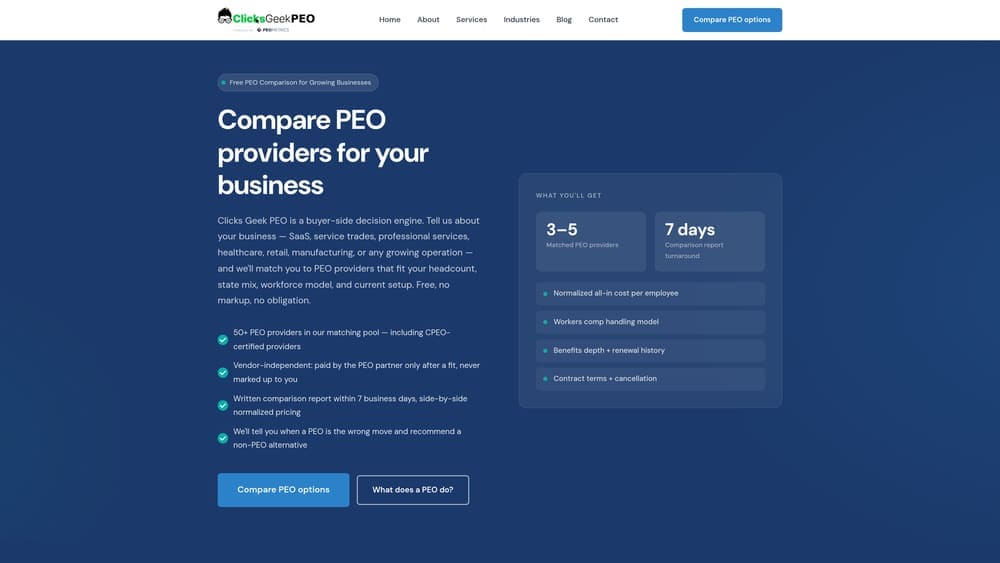
Clicks Geek PEO is an independent comparison and advisory platform that helps businesses evaluate PEO providers side by side without going through a sales rep with a quota.
Where This Tool Shines
Most PEO research happens through vendor websites or brokers who earn commissions on placements. That creates an obvious conflict of interest. Clicks Geek sits outside that dynamic entirely: it’s not a PEO, doesn’t sell PEO services, and doesn’t earn placement fees from providers.
What it does instead is give business owners a clearer picture of what they’re actually buying. That includes pricing structure breakdowns, contract term analysis, and side-by-side comparisons that surface the differences that actually affect your bottom line — things like administrative fee markups, benefits cost pass-throughs, and renewal terms that are easy to miss when you’re reading a proposal under time pressure.
Key Features
Side-by-Side Provider Comparisons: Evaluate multiple PEOs against each other on pricing structure, service depth, and contract terms without managing multiple vendor conversations simultaneously.
Transparent Pricing Analysis: Breaks down how PEO fees are structured — flat PEPM, percentage of payroll, bundled vs. unbundled — so you can compare apples to apples.
Contract Term Reviews: Identifies red flags in PEO agreements, including auto-renewal clauses, termination penalties, and fee escalation language.
No Sales Bias: The platform is independent, which means recommendations aren’t influenced by provider relationships or commission structures.
Best For
Business owners, CFOs, and HR decision-makers who are either evaluating a PEO for the first time or coming up on a renewal and want to know whether they’re getting a fair deal. Particularly useful if you’ve received a proposal from Paychex PEO or another major provider and want a second opinion on the terms before signing.
Pricing
Free to use. The comparison resources and advisory tools are available at no cost, with no obligation to purchase anything through the platform.
2. Paychex PEO (Formerly Oasis)
Best for: Small to mid-sized businesses that want a nationally recognized PEO with established payroll infrastructure and dedicated HR support.
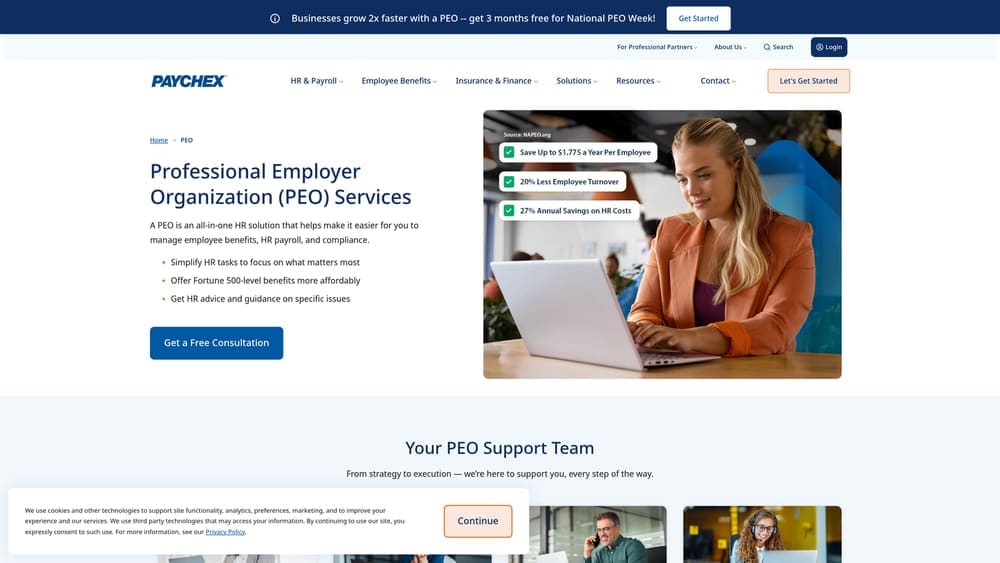
Paychex PEO is a national PEO provider backed by Paychex’s payroll infrastructure, offering HR administration, benefits, compliance support, and the Paychex Flex technology platform. It holds IRS-certified CPEO status.
Where This Tool Shines
Paychex’s biggest advantage is scale. The company serves over 730,000 clients overall (per Paychex’s own public filings), which translates into real purchasing power for employee benefits. That group buying leverage can make a meaningful difference for small businesses that wouldn’t otherwise qualify for large-group health plan rates.
The dedicated HR professional model is also worth noting. Rather than routing every question through a call center, Paychex PEO assigns a named HR contact to your account. For business owners who want someone who knows their situation, that structure is more functional than ticket-based support systems used by some competitors.
Key Features
Paychex Flex Platform: Integrated system covering payroll processing, HR administration, benefits enrollment, and time tracking in a single interface.
Dedicated HR Professional: A named HR contact assigned to your account rather than a general support queue.
Large-Group Benefits Access: Purchasing power from Paychex’s client base enables access to medical, dental, and vision plans that small businesses typically can’t access independently.
IRS-Certified CPEO Status: Provides certain federal tax liability protections that standard PEOs don’t offer, which matters for compliance-sensitive businesses.
Workers’ Comp and Risk Management: Integrated workers’ compensation administration and risk management support as part of the PEO package.
Best For
Businesses with 10 to 150 employees that want an established, recognizable PEO with solid technology and the security of a large parent company. Also a reasonable fit for businesses that already use Paychex for payroll and want to deepen that relationship.
Pricing
Custom quotes only. Paychex PEO does not publish pricing, and rates vary by company size, industry, benefits selections, and location. Expect per-employee-per-month pricing, but the exact structure requires a direct conversation with their sales team.
3. ADP TotalSource
Best for: Mid-sized businesses with 50+ employees that need enterprise-grade compliance infrastructure and deep HR support.
ADP TotalSource is the PEO arm of ADP, offering comprehensive HR outsourcing with robust compliance tools and benefits access built on ADP’s established payroll ecosystem.
Where This Tool Shines
ADP TotalSource is probably Paychex PEO’s closest direct competitor in terms of scale and service depth. Both are IRS-certified CPEOs with large-group benefits purchasing power and dedicated HR support models. The distinction tends to come down to technology preference and account management style.
Where ADP pulls ahead for some buyers is compliance depth. ADP has invested heavily in legal and regulatory support infrastructure, which can be valuable for businesses operating across multiple states or in industries with complex employment law exposure. The HR business partner model is also well-regarded for businesses that want a more consultative relationship rather than transactional support.
Key Features
ADP Payroll and HR Integration: Full integration with ADP’s existing payroll and HR technology stack, which is an advantage for businesses already in the ADP ecosystem.
Dedicated HR Business Partner: Assigned HR professional with a consultative approach, not just administrative support.
Compliance and Legal Support: Robust regulatory guidance, employment law resources, and compliance monitoring across jurisdictions.
IRS-Certified CPEO Status: Same federal tax liability protections as Paychex PEO, relevant for businesses with complex payroll tax situations.
Fortune 500-Level Benefits Access: Medical, dental, vision, and ancillary benefits options through major national carriers.
Best For
Businesses with 50 or more employees that prioritize compliance infrastructure and want a PEO backed by the largest payroll company in the country. Less ideal for very small businesses or those looking for simple, self-service tools.
Pricing
Custom quotes only. ADP TotalSource does not publish pricing, and rates are determined by headcount, industry, benefits selections, and geographic footprint.
4. Justworks
Best for: Startups and small businesses that want transparent, published pricing and a clean, low-friction PEO experience.
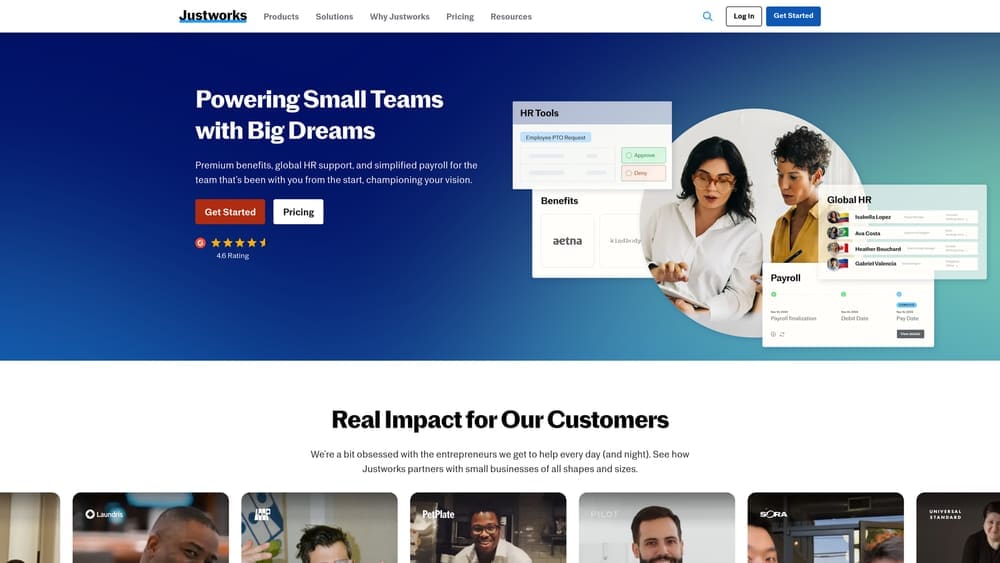
Justworks is a PEO designed specifically for smaller businesses and startups, notable for publishing its pricing openly in a market where most providers require a sales call to get a number.
Where This Tool Shines
Pricing transparency is Justworks’ clearest differentiator. In an industry where custom quotes are the default and fee structures are notoriously difficult to compare, Justworks puts its rates on its website. That alone changes the evaluation dynamic significantly. You can run a rough cost estimate before talking to anyone in sales.
The platform itself is clean and modern, built for founders and HR generalists who don’t want to spend hours learning a complex system. Onboarding is straightforward, support is accessible through multiple channels including Slack, and the overall experience is designed for companies that don’t have a dedicated HR department to manage the relationship.
Key Features
Published Flat-Rate Pricing: Publicly listed per-employee-per-month rates, which is genuinely rare in the PEO space and simplifies early-stage comparisons.
Clean User Interface: Modern, intuitive platform that doesn’t require significant training to use effectively.
Full PEO Services: Payroll, benefits administration, compliance support, and HR tools bundled into a single platform.
Multi-Channel Support: 24/7 support accessible via phone, email, and Slack — practical for teams that work outside standard business hours.
Best For
Startups, early-stage companies, and small businesses under 100 employees that value pricing clarity and ease of use over deep HR consulting. Also a strong fit for remote-first teams that need accessible support outside traditional hours.
Pricing
Starts at $59 per employee per month for the Basic plan; $109 per employee per month for the Plus plan, which includes benefits. Pricing is publicly listed on their website, which makes it easy to model costs before any vendor conversation.
5. TriNet
Best for: Small and mid-sized businesses in specific industries that want PEO packages tailored to their vertical.
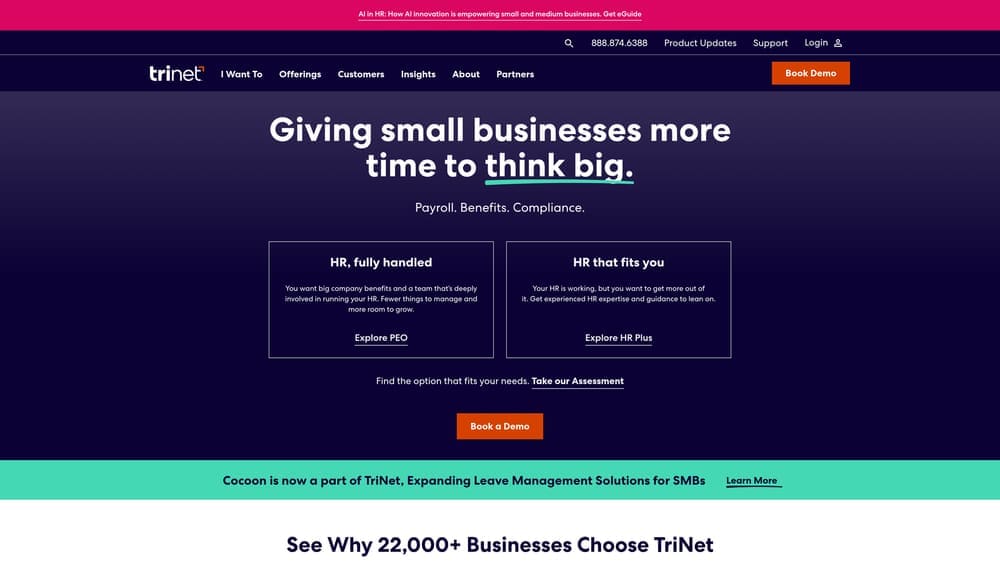
TriNet is a publicly traded PEO that differentiates itself through industry-specific service bundles, offering tailored HR, benefits, and compliance packages by vertical rather than a one-size-fits-all approach.
Where This Tool Shines
Most PEOs treat every client similarly regardless of industry. TriNet took a different approach by building vertical-specific packages for sectors like technology, financial services, professional services, and nonprofits. That matters because employment law exposure, benefits expectations, and HR priorities vary significantly by industry. A tech startup’s HR needs are genuinely different from a financial advisory firm’s.
TriNet’s benefits access is also competitive. As a large PEO, it can offer medical, dental, and vision plans from major national carriers at group rates that small businesses typically can’t access independently. For companies in competitive talent markets where benefits are a recruiting tool, that’s a real operational advantage.
Key Features
Industry-Vertical Packages: PEO service bundles tailored to specific sectors including technology, financial services, professional services, and nonprofits.
Large-Group Benefits Access: Medical, dental, and vision plans from major carriers at group purchasing rates.
Risk and Compliance Support: Regulatory guidance and employment law support with industry-specific context built in.
Cloud-Based HR Platform: Modern platform for payroll, benefits administration, and HR management accessible from any device.
Best For
Small and mid-sized businesses in industries where specialized compliance knowledge matters, particularly technology companies, financial services firms, and professional services organizations. Less ideal for businesses in industries TriNet doesn’t specifically serve.
Pricing
Custom quotes only. Pricing varies by industry, headcount, and benefits selections. TriNet does not publish rates publicly.
6. Insperity
Best for: Growing businesses that want HR consulting depth alongside standard PEO administration, not just transactional HR support.
Insperity (formerly Administaff) is a PEO that positions itself at the premium end of the market, emphasizing strategic HR consulting, performance management, and leadership development alongside the standard PEO service stack.
Where This Tool Shines
Insperity’s pitch is that HR shouldn’t just be administrative overhead — it should drive business outcomes. That philosophy shows up in their service model, which includes performance management tools, employee training programs, and leadership development resources that most PEOs don’t offer at all.
For businesses that are scaling and want their HR partner to contribute to organizational development, not just process payroll and manage benefits enrollment, Insperity’s depth is genuinely differentiated. The tradeoff is cost: Insperity is generally positioned at a premium price point, and that investment only makes sense if you’re actually going to use the consulting and development services they provide.
Key Features
Strategic HR Consulting: Advisory services that go beyond compliance and administration into workforce planning and organizational development.
Performance Management Tools: Built-in frameworks and tools for employee performance tracking, goal setting, and reviews.
Leadership Development Programs: Training and development resources for managers and executives, not just frontline employees.
Full PEO Administration: Payroll, benefits, compliance, and workers’ compensation administration as the foundation of the service.
Best For
Businesses with 5 to several hundred employees that are actively investing in culture and talent development and want an HR partner that contributes strategically. Not the right fit if you’re primarily looking for cost-efficient administrative outsourcing.
Pricing
Custom quotes only. Insperity is generally considered a premium-tier PEO, and pricing reflects that positioning. Exact rates require a direct conversation with their team.
7. Rippling PEO
Best for: Tech-forward businesses that want HR, payroll, and IT management unified in a single platform with strong automation.
Rippling PEO is the PEO offering from Rippling, a platform that distinguishes itself by combining IT device management, HR, and payroll in a single modular system — something no traditional PEO offers.
Where This Tool Shines
Rippling’s core differentiator is the unified IT plus HR architecture. When a new employee joins, Rippling can provision their laptop, set up their software accounts, run their first paycheck, and enroll them in benefits from the same platform. When someone leaves, offboarding works the same way in reverse. For businesses where IT and HR workflows are tightly connected — which is most companies with remote or hybrid teams — that integration eliminates a lot of manual coordination.
The modular approach also means you’re not forced to buy a bundled package. You can add or remove services as your needs change, which gives Rippling more flexibility than most traditional PEOs whose service structures are less adjustable mid-contract.
Key Features
Unified IT and HR Platform: IT device management, software provisioning, HR administration, and payroll in a single system — genuinely unique in the PEO market.
Automated Onboarding and Offboarding: Workflow automation that handles both HR and IT tasks simultaneously when employees join or leave.
Modular Service Structure: Add or remove services as your needs evolve without being locked into a rigid bundle.
API-First Architecture: Strong integration capabilities with third-party tools, useful for businesses with established tech stacks.
Best For
Technology companies, startups, and remote-first businesses that want tight integration between HR and IT operations. Also a strong fit for businesses that value automation and want to reduce manual administrative work across both departments.
Pricing
Custom quotes for PEO services. The base Rippling platform starts at $8 per employee per month, but PEO pricing is separate and not publicly listed. Expect to have a detailed conversation with their team to get an accurate estimate.
8. CoAdvantage PEO
Best for: Mid-market businesses with 50 to 500 employees that want a more personalized, relationship-driven PEO experience.
CoAdvantage is a mid-market PEO with strong regional presence, particularly in the Southeast and mid-Atlantic, offering dedicated account team service and flexible customization for businesses that don’t fit the large-enterprise PEO mold.
Where This Tool Shines
The large national PEOs — Paychex, ADP, TriNet — operate at scale, which has real advantages but also means your account can feel like a number in a large portfolio. CoAdvantage’s model is built around dedicated account teams that develop genuine familiarity with your business over time. For businesses where that relationship quality matters, it’s a meaningful operational difference.
Flexibility is the other notable strength. CoAdvantage allows for more customization in service structure than many larger PEOs, which is useful if you don’t need every service in a standard bundle or if your HR needs don’t fit a templated package. That flexibility can also translate into cost efficiency if you’re paying only for what you actually use.
Key Features
Dedicated Account Teams: Named account managers who develop familiarity with your business rather than rotating support contacts.
Flexible Service Customization: Ability to configure service packages based on what your business actually needs rather than accepting a fixed bundle.
Full PEO Administration: Payroll processing, benefits administration, HR support, and workers’ compensation management as core services.
Regional Expertise: Particularly strong knowledge of employment regulations and market conditions in Southeast and mid-Atlantic states.
Best For
Businesses with 50 to 500 employees, especially those located in the Southeast or mid-Atlantic, that want a mid-market PEO with genuine account relationship depth and service flexibility. Also a reasonable alternative if the large national providers feel too transactional for your preference.
Pricing
Custom quotes only. CoAdvantage does not publish pricing publicly, and rates vary based on headcount, industry, location, and services selected.
Which Provider Actually Fits Your Business
Paychex PEO (formerly Oasis) is a solid choice for businesses that want a nationally recognized provider with strong technology infrastructure, dedicated HR support, and the backing of a large payroll company. It’s particularly well-suited for businesses already using Paychex for payroll who want to deepen that relationship, and for companies where IRS-certified CPEO status matters for tax liability reasons.
That said, it’s not universally the best fit. If you’re a startup or small business that values pricing transparency, Justworks is worth a serious look. If your business is in a specific industry where vertical expertise matters, TriNet’s approach may serve you better. If you’re scaling and want HR to contribute strategically beyond administration, Insperity’s consulting depth is a real differentiator. And if you’re a tech-forward company with tight IT and HR integration needs, Rippling’s unified platform is genuinely different from anything else in this list.
The practical challenge is that most of these providers require a sales conversation before you can get a real number. That’s where independent comparison becomes valuable. Before you renew your current PEO agreement or sign with a new provider, compare your options with a clear picture of what you’re paying and what you’re getting. Most businesses overpay due to bundled fees and unclear administrative markups — and most don’t find out until the contract is already signed.
The right PEO is the one that fits your headcount, industry, budget, and service expectations. Take the time to compare before you commit.