
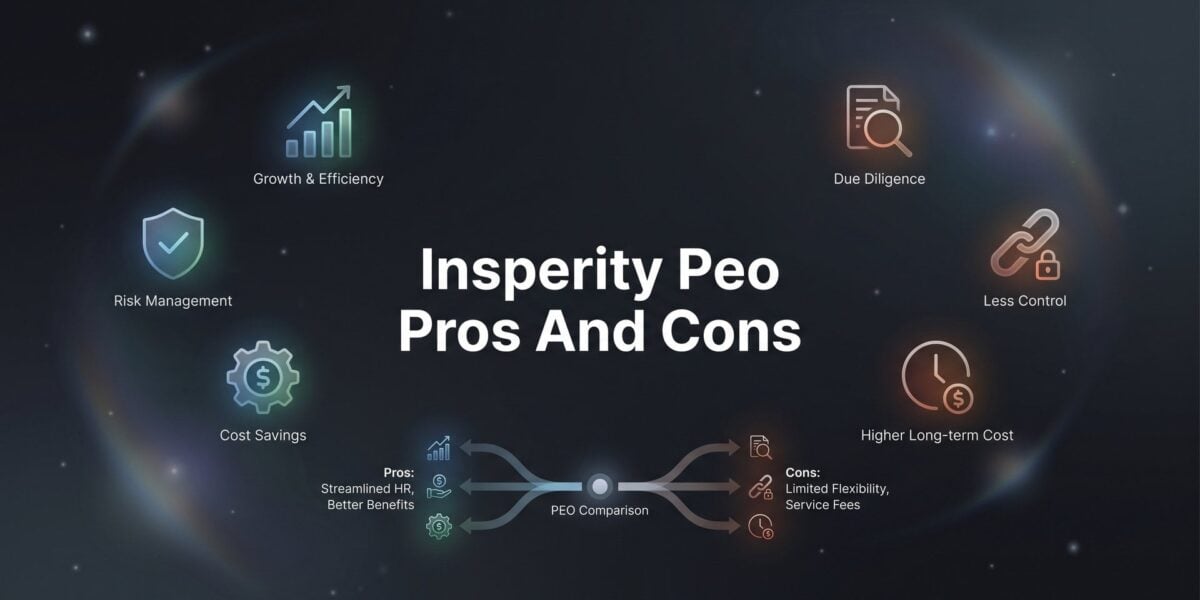
Most Insperity reviews fall into one of two camps: glowing summaries that read like vendor marketing, or frustrated complaints that don’t give you enough context to know whether the problem was Insperity or just a bad fit. Neither is particularly useful when you’re trying to decide whether to sign a multi-year PEO agreement.
This breakdown approaches Insperity differently. Instead of a general overview, it examines seven specific decision factors that actually influence whether Insperity is the right PEO for your business. Cost structure, HR support quality, benefits access, technology, company size fit, contract terms, and compliance depth. Each factor matters independently, and together they give you a real framework for evaluation.
For foundational context on how co-employment works and what PEOs typically include in their service model, our guide on what a PEO is covers the basics. This analysis is specific to Insperity’s model and is designed to help you evaluate it on its own merits, not just as a generic PEO option.
Whether you’re evaluating Insperity for the first time or approaching a renewal decision, these seven factors give you the structure to weigh what you’re actually getting against what you’re actually paying.
1. Pricing Model: What Percentage-of-Payroll Actually Costs You
The Challenge It Solves
PEO pricing is notoriously opaque, and Insperity is no exception. The core issue with a percentage-of-payroll model isn’t the rate itself — it’s what happens to your costs as your business grows. If you hire more people, give raises, or promote employees, your PEO bill goes up automatically, even if the services you’re receiving stay exactly the same.
The Strategy Explained
Insperity uses a percentage-of-payroll pricing structure, meaning your administrative fee is calculated as a percentage of your total payroll rather than a flat per-employee-per-month rate. Exact percentages are not publicly disclosed and vary by client size, industry, and negotiated terms.
The practical implication: a company with a $3M payroll pays more than a company with a $1.5M payroll for what may be an identical service package. As salaries increase across your workforce, your PEO cost increases proportionally. This creates a hidden cost trajectory that many businesses don’t fully account for when they model out multi-year PEO contracts. If you’re wondering whether the overall value justifies the expense, our analysis of whether Insperity PEO is worth it digs deeper into that question.
Flat-fee or per-employee-per-month models are more predictable because they decouple cost from compensation levels. Percentage-of-payroll models aren’t inherently worse, but they require more careful financial modeling upfront.
Implementation Steps
1. Ask Insperity for a full cost illustration using your current payroll and a projected payroll that reflects 10-20% growth over the contract term. Compare both numbers before signing.
2. Request a detailed fee breakdown that separates the administrative fee from benefits pass-through costs, workers’ compensation premiums, and any platform or technology fees. Bundled quotes make it harder to identify where costs are concentrated.
3. Model the cost against a flat-fee alternative using the same headcount and benefit selections. The gap may be larger than you expect, especially if your average salaries are above the industry median.
Pro Tips
Insperity’s pricing is negotiable, particularly for companies in the 50-150 employee range. Don’t accept the first proposal as fixed. If you’re comparing multiple providers, use competing quotes as leverage. The percentage rate itself matters less than the total cost at your actual payroll level, so always evaluate in dollar terms, not just rate terms.
2. HR Support Depth: What a Dedicated Consultant Model Actually Means
The Challenge It Solves
One of the most common frustrations with PEOs is the support experience. You call with an HR question and get routed through a call center to whoever’s available. You get a different answer each time. Nobody knows your business, your history, or your employees. For business owners who chose a PEO specifically to get HR expertise, this is a significant disappointment.
The Strategy Explained
Insperity’s model is structured differently from many competitors. They assign dedicated HR consultants to client accounts rather than routing all inquiries through a general support queue. In practice, this means your team has a named contact who’s familiar with your company’s situation, your workforce structure, and your history with the service.
This is a genuine differentiator. Many mid-sized businesses report that the quality and consistency of HR support is one of the primary reasons they stay with Insperity through renewals. The dedicated model tends to work particularly well for companies dealing with complex employee relations issues, performance management, or multi-state HR compliance questions that require institutional knowledge to navigate well. For a broader look at how this compares to standalone HR services, our piece on Insperity PEO vs HR outsourcing breaks down the key differences.
The caveat: service quality varies by consultant. Like any people-dependent service, some consultants are more responsive and knowledgeable than others. If you’re assigned a weaker contact, the model’s advantage erodes quickly.
Implementation Steps
1. During your sales process, ask specifically how HR consultants are assigned and what the average client-to-consultant ratio looks like. A consultant managing 80 accounts delivers a different experience than one managing 20.
2. Request references from clients in a similar industry and headcount range. Ask those references specifically about consultant responsiveness and depth of knowledge, not just general satisfaction.
3. Clarify escalation paths. When your dedicated consultant isn’t available or doesn’t have the answer, who handles the issue and how quickly?
Pro Tips
If you get assigned a consultant who isn’t meeting your expectations, ask to be reassigned. This is a reasonable request and most PEOs will accommodate it. Don’t let a poor consultant relationship become a reason to exit the PEO entirely before you’ve tried to resolve it internally.
3. Benefits Access: Large-Group Pooling With Some Real Trade-Offs
The Challenge It Solves
Small and mid-sized businesses typically can’t access the same health insurance plans as large corporations. The group is too small, the risk pool is too limited, and carriers price accordingly. One of the core value propositions of a PEO is that it pools all of its clients’ employees together, creating a large group that can negotiate better rates and access better plan designs.
The Strategy Explained
Insperity’s benefits program is one of its stronger selling points. As a large, publicly traded PEO, Insperity has significant purchasing leverage with major carriers. Clients often gain access to plan designs and premium structures that would be out of reach as a standalone employer, particularly for companies under 100 employees. For a deeper look at how Insperity handles the full scope of enrollment and plan management, see our overview of Insperity PEO benefits administration.
The trade-off is carrier lock-in. When you join a PEO’s benefits program, you’re enrolling in their master policy, not your own. The carriers, plan designs, and renewal terms are controlled by Insperity, not by you. If Insperity’s renewal rates increase significantly in a given year, your options are limited. You can’t simply shop the market independently without leaving the PEO relationship entirely.
This isn’t unique to Insperity — it’s a structural feature of PEO benefits programs generally. But it’s worth understanding clearly before you make a decision based heavily on benefits savings.
Implementation Steps
1. Compare Insperity’s proposed plan designs against your current coverage on a true apples-to-apples basis: deductibles, out-of-pocket maximums, network breadth, and prescription coverage. Premium savings mean less if the plan design is materially worse.
2. Ask about Insperity’s historical renewal rate trends. They may not disclose specific numbers, but you can ask references about their experience with year-over-year benefit cost changes.
3. Understand what happens to your benefits program if you exit the PEO. How much lead time do you need to establish your own group coverage? What’s the transition process for employees?
Pro Tips
If benefits cost savings are the primary driver of your PEO evaluation, make sure you’re modeling the full picture: employer premium costs, employee contributions, plan quality, and the administrative cost of managing benefits. The net savings may be smaller than the headline rate comparison suggests.
4. Technology Platform: Functional, Not Flashy
The Challenge It Solves
HR technology has moved fast over the past several years. Standalone HRIS platforms, payroll tools, and employee experience software have raised the bar significantly for what business owners and HR teams expect from a software interface. When you’re evaluating a PEO, the technology question matters more than it used to.
The Strategy Explained
Insperity offers an integrated platform called Insperity Premier that covers payroll, time and attendance, benefits administration, performance management, and HR data management. For most mid-sized businesses, it handles the core functions adequately.
Where it falls short is in the areas where modern standalone platforms have invested most heavily: user experience design, mobile functionality, self-service depth, and analytics. Teams accustomed to tools like Rippling, Gusto, or BambooHR often find Insperity’s platform feels dated by comparison. For a closer look at the mobile experience specifically, our review of the Insperity PEO mobile app covers what to expect.
The deeper issue is that when you’re in a PEO relationship, you typically can’t swap out the technology component independently. You’re using their platform. If the tech doesn’t fit your team’s workflow, your options are limited to working around it or exiting the PEO entirely.
Implementation Steps
1. Request a live demo of Insperity Premier that covers the specific workflows your HR team uses most: payroll processing, onboarding, time tracking, and reporting. Don’t evaluate based on a slide deck.
2. Have your actual HR team members participate in the demo evaluation. The people who will use the system daily are better judges of usability than the person signing the contract.
3. Ask about integration capabilities. If you use other business systems (ATS, project management, accounting), understand what native integrations exist and what requires custom API work.
Pro Tips
If technology is a top priority for your team, be honest about whether a full-service PEO is the right model at all. Some businesses are better served by a modern HRIS platform combined with a more targeted HR services arrangement. The all-in-one PEO model trades flexibility for convenience, and that trade-off is most visible in the technology layer.
5. Ideal Company Size: Why Fit Matters More Than Features
The Challenge It Solves
PEOs are not one-size-fits-all, and Insperity is no exception. The service model, pricing structure, and support infrastructure are optimized for a specific type of client. Signing with a PEO that isn’t designed for your headcount or growth stage creates friction that no amount of good service can fully offset.
The Strategy Explained
Insperity’s model tends to work best for companies in the 50 to 150 employee range. At this size, businesses are large enough to benefit from Insperity’s dedicated HR consultant model and benefits pooling, but not so large that they’ve built out internal HR infrastructure that would overlap significantly with what Insperity provides.
Below 25 employees, the cost structure often doesn’t pencil out as well. Smaller companies may find better value with lighter-touch PEOs or payroll-plus-HR-advisory models that don’t carry the same administrative overhead. If you’re running a very small team, our breakdown of Insperity PEO for 5 employees examines what micro-teams actually get and pay for.
Above 200-300 employees, many companies start to outgrow the PEO model entirely. At that scale, building an internal HR team and negotiating direct benefits contracts often becomes more cost-effective. Insperity does serve larger clients, but the value proposition shifts as internal HR capacity increases.
Implementation Steps
1. Map your current headcount and your projected headcount at 12, 24, and 36 months. Evaluate Insperity’s fit at your projected size, not just your current size.
2. Assess your existing HR infrastructure honestly. If you already have a capable HR director and established benefits broker relationships, the overlap with a full-service PEO may reduce the net value you actually receive.
3. If you’re below 25 employees or above 200, explicitly ask Insperity how their model is adapted for your size. Compare their answer against alternatives designed specifically for your headcount tier.
Pro Tips
Company size isn’t just about headcount. Industry matters too. Companies in high-risk industries (construction, manufacturing, staffing) have different workers’ compensation and compliance profiles that affect PEO cost and fit. Insperity’s model is generally stronger for professional services and white-collar industries than for high-risk classifications.
6. Contract Terms and Exit Flexibility: Read This Before You Sign
The Challenge It Solves
PEO contracts are not month-to-month arrangements. They’re typically annual agreements with specific cancellation windows, auto-renewal clauses, and termination conditions that can create real operational and financial risk if you don’t understand them before signing. This is one of the most overlooked aspects of PEO evaluation.
The Strategy Explained
Insperity’s standard agreements include auto-renewal provisions. If you don’t provide written notice of your intent not to renew within a specified window before the contract end date, the agreement automatically renews for another term. Missing that window is a common and costly mistake.
Early termination is possible but typically involves penalties or administrative fees. The specific terms vary by contract, but the general principle is that exiting a PEO mid-year creates complexity: benefits transitions, payroll system changes, tax ID reconfiguration, and potential gaps in compliance coverage. Understanding how payroll tax filing responsibility works in a co-employment arrangement helps illustrate why mid-year exits are so disruptive.
Contract terms are negotiable, particularly for larger clients or companies with competitive alternatives in hand. The standard agreement is a starting point, not a fixed document.
Implementation Steps
1. Before signing, identify the exact auto-renewal notification deadline and calendar it immediately. This date matters more than the contract end date itself.
2. Negotiate the cancellation notice window if possible. Shorter windows give you more flexibility to respond to business changes. 30-60 days is more manageable than 90-120 days.
3. Ask specifically about mid-year exit scenarios: what are the financial penalties, what happens to your benefits program, and what is the transition timeline for payroll and HR systems? Get the answers in writing, not just verbally from a sales rep.
Pro Tips
Have your attorney or a PEO advisor review the contract before signing. PEO agreements are more complex than standard vendor contracts because of the co-employment relationship, tax liability provisions, and benefits structure. The cost of an hour of legal review is negligible compared to the cost of being locked into unfavorable terms for another 12 months.
7. Compliance and Risk Management: Where Insperity Earns Its Keep
The Challenge It Solves
Employment compliance is one of the most legitimate reasons to use a PEO. Federal and state employment law is complex, changes frequently, and carries real financial penalties when mishandled. For growing businesses without dedicated HR compliance expertise, this is genuine risk exposure.
The Strategy Explained
Insperity holds IRS Certified Professional Employer Organization (CPEO) status. This designation, verifiable through the IRS CPEO registry, provides clients with specific federal tax liability protections related to employment tax obligations. In a standard PEO arrangement, the CPEO certification clarifies which party bears responsibility for federal employment taxes, which reduces ambiguity and risk for the client.
Insperity is also a member of NAPEO (National Association of Professional Employer Organizations), which maintains industry standards and best practices for PEO operations. Checking a PEO’s reputation through independent sources is always worthwhile — our look at Insperity’s BBB rating and reputation provides additional context on how the company is perceived outside of its own marketing.
On multi-state compliance, Insperity’s scale works in its favor. Managing employees across multiple states involves navigating different wage and hour laws, leave requirements, tax registrations, and workers’ compensation rules. Insperity has infrastructure for this in a way that smaller or regional PEOs often don’t.
The important limit to understand: PEO compliance support is not a complete legal shield. The co-employment relationship shares responsibility between the PEO and the client employer. Certain employment decisions, particularly those involving terminations, discrimination claims, and workplace safety, still carry liability exposure for the client. Insperity can guide and support, but it doesn’t eliminate employer-side risk entirely.
Implementation Steps
1. Verify Insperity’s CPEO status directly through the IRS CPEO registry before signing. This is a straightforward public lookup and takes five minutes.
2. Ask Insperity specifically about compliance support in the states where you have employees. If you’re in a high-complexity state like California or New York, confirm that their team has direct experience with state-specific requirements, not just general federal compliance.
3. Clarify the division of liability in writing. Understand exactly which compliance responsibilities Insperity assumes under the co-employment agreement and which remain with you as the worksite employer.
Pro Tips
If multi-state compliance is your primary driver for evaluating a PEO, it’s worth comparing Insperity against other CPEO-certified providers specifically on this dimension. CPEO status is a baseline, not a differentiator. The differentiator is the depth of state-specific expertise and the responsiveness of the compliance team when issues arise.
Putting It All Together: A Practical Decision Framework
Insperity is a well-established, IRS-certified PEO with real strengths. The dedicated HR consultant model is a genuine differentiator. The benefits access is meaningful for companies that can’t negotiate large-group rates independently. The compliance infrastructure, particularly for multi-state employers, is solid.
But it’s not the right fit for every company, and the weaknesses are real. The percentage-of-payroll pricing model can quietly inflate costs as headcount and salaries grow. The technology platform is functional but won’t impress teams accustomed to modern HRIS tools. The contract terms require careful attention before you sign, and the auto-renewal provisions have caught more than a few business owners off guard.
Use these seven factors as a structured checklist, not a scorecard. No single factor should make or break the decision. What matters is how they combine given your specific situation: your headcount, your industry, your growth trajectory, your existing HR infrastructure, and your tolerance for cost variability.
If Insperity scores well on the factors that matter most to your business, it may be the right choice. If two or three of these factors represent significant concerns, that’s a signal to look at alternatives before committing.
Before you renew your PEO agreement, compare your options. Most businesses overpay due to bundled fees and unclear administrative markups. We break down pricing, services, and contract structures so you can make a smarter decision.