
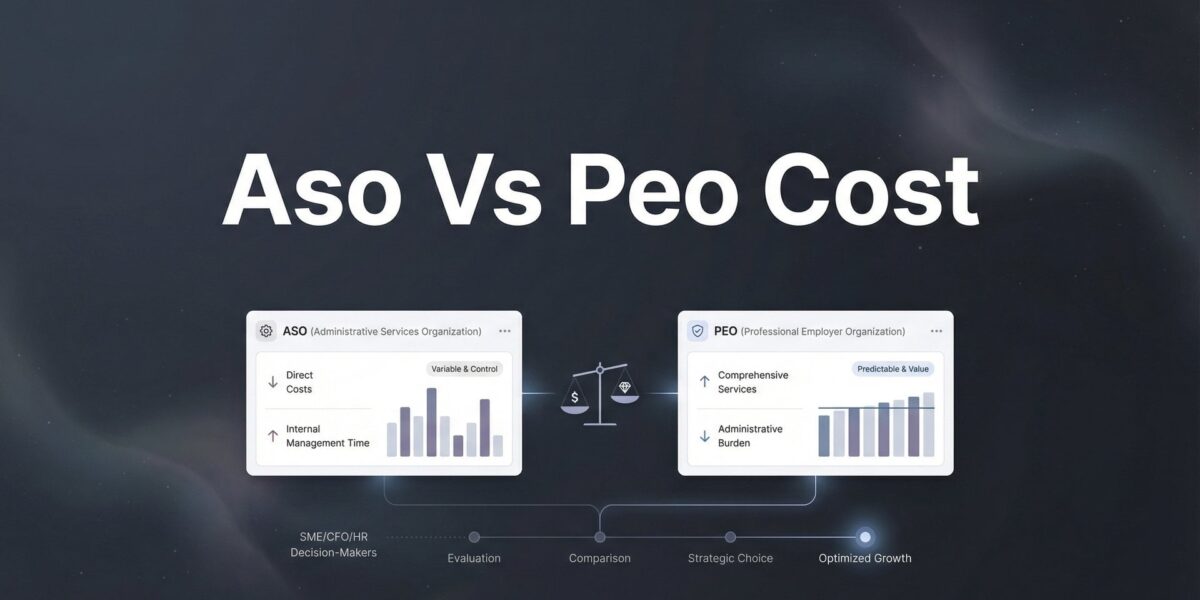
The ASO vs PEO cost question isn’t as simple as comparing two price tags. Administrative Services Organizations (ASOs) and Professional Employer Organizations (PEOs) structure their fees differently, bundle services differently, and shift risk differently—which means the “cheaper” option on paper might cost you more in practice.
This guide walks through seven strategies for evaluating the real cost differences between these models, so you can make a decision based on your actual operational needs rather than surface-level pricing.
We’re not here to tell you which is better. We’re here to help you figure out which is better for your situation.
1. Map Your Current HR Spend Before Comparing Anything
The Challenge It Solves
Most business owners jump straight into comparing ASO and PEO proposals without understanding what they’re actually spending today. You can’t evaluate whether a $450 per-employee-per-month PEO fee is reasonable if you don’t know your current cost to handle payroll, benefits administration, compliance, and HR internally.
Without a baseline, you’re guessing. And vendors know it.
The Strategy Explained
Start by documenting your complete HR cost picture. Include payroll processing fees, benefits broker commissions, workers comp premiums, unemployment insurance, compliance software subscriptions, and the internal time your team spends on HR tasks. That last piece matters more than most people realize.
If your office manager spends 15 hours a week on payroll and benefits administration, that’s 780 hours annually. At a $25 hourly cost, that’s $19,500 in opportunity cost—money you’re already spending whether you see it on an invoice or not. A thorough PEO cost benefit analysis starts with understanding these baseline numbers.
Add everything together. The total usually surprises people.
Implementation Steps
1. Pull invoices for the past 12 months covering payroll processing, benefits administration, workers comp, and any HR software or services you currently pay for.
2. Track internal time spent on HR tasks for two typical weeks, then annualize it. Include payroll processing, benefits questions, compliance updates, and new hire paperwork.
3. Calculate the fully loaded cost of that time by multiplying hours by the hourly rate of whoever handles these tasks.
4. Create a simple spreadsheet breaking costs into categories: payroll processing, benefits administration, compliance, insurance, and internal labor.
Pro Tips
Don’t forget hidden costs like the time you spend fixing payroll errors, responding to benefits questions outside business hours, or researching compliance updates. These interrupt your actual work and have real costs even if they don’t show up on invoices.
2. Understand the Fee Structure Differences
The Challenge It Solves
ASOs and PEOs price their services fundamentally differently, which makes direct comparison difficult. An ASO might quote you $85 per employee per month. A PEO might quote 4% of payroll. Which is cheaper? It depends entirely on your wage levels.
This structural difference means the “better deal” changes based on whether you employ mostly hourly workers at $15/hour or salaried professionals at $80,000 annually.
The Strategy Explained
ASOs typically charge flat fees or per-employee-per-month (PEPM) rates. You pay the same amount whether someone earns $30,000 or $130,000. PEOs usually charge a percentage of total payroll, commonly ranging from 2% to 12% depending on services, risk profile, and company size.
Run the math on your actual payroll. If you have 20 employees with an average salary of $60,000, your annual payroll is $1.2 million. A PEO charging 4% costs $48,000 annually, or $200 per employee per month. An ASO charging $95 PEPM costs $22,800 annually. Understanding this PEO cost breakdown helps you see where your money actually goes.
But if your average salary is $120,000, that same 4% PEO fee doubles to $96,000 while the ASO fee stays at $22,800.
Implementation Steps
1. Calculate your total annual payroll including salaries, hourly wages, bonuses, and commissions.
2. Convert any PEPM ASO quotes into annual totals by multiplying by 12 months and your employee count.
3. Convert percentage-based PEO quotes into dollar amounts by applying the percentage to your total annual payroll.
4. Compare the actual dollar amounts side by side, not the percentages or per-employee figures.
Pro Tips
Watch for PEO pricing that changes at different revenue or employee thresholds. Some providers quote 3% for companies under 50 employees but drop to 2.5% above that threshold. If you’re close to a tier break, factor growth into your decision.
3. Factor in Workers Comp and Benefits Costs Separately
The Challenge It Solves
Workers compensation and health insurance represent your largest HR-related expenses after payroll, but ASOs and PEOs handle them completely differently. Bundled PEO pricing often obscures whether you’re getting a good deal on insurance or subsidizing the provider’s margin.
Companies with clean safety records frequently overpay under PEO pooled arrangements. Companies with poor claims histories might save money through pooling. You can’t know which applies to you without separating these costs.
The Strategy Explained
ASOs leave you responsible for securing your own workers comp policy and health insurance. Your workers comp premium reflects your actual claims history through your experience modification rate. Your benefits costs reflect your company’s demographics and claims experience.
PEOs pool multiple client companies under master policies. Your workers comp rate reflects the pool’s combined experience, not just yours. Benefits pricing similarly reflects pooled purchasing power but also pooled risk. Many companies find that implementing a PEO safety program helps reduce their workers’ comp costs over time.
Request itemized breakdowns showing exactly what you’ll pay for workers comp and benefits under each model. Then compare those numbers against what you pay today or could negotiate independently.
Implementation Steps
1. Get your current workers comp experience mod from your insurance carrier. If it’s below 1.0, you’re likely paying less than average and pooling may cost you more.
2. Request PEO quotes that separate administrative fees from workers comp premiums and benefits costs. Don’t accept “all-in” pricing.
3. Get independent workers comp quotes from at least two carriers to establish your market rate outside a PEO arrangement.
4. Compare benefits plan designs side by side, not just premiums. A PEO plan with a $3,000 deductible isn’t comparable to your current $1,500 deductible plan even if premiums look similar.
Pro Tips
If you have a particularly low experience mod, ask PEOs whether they offer “carve-out” arrangements where you maintain your own workers comp policy while using them for other services. Some do. Most won’t advertise it.
4. Calculate the Risk Transfer Value
The Challenge It Solves
PEOs establish co-employment, meaning they become the employer of record for tax and liability purposes. This shifts certain compliance risks and liabilities away from your company. ASOs provide administrative support but leave you as the sole employer with full liability exposure.
That risk transfer has value, but quantifying it is tricky. You’re essentially buying insurance against HR compliance failures, misclassification claims, and certain employment lawsuits. The question is whether that insurance is worth the premium you’re paying.
The Strategy Explained
Under a PEO arrangement, the provider assumes responsibility for payroll tax compliance, employment tax filings, and certain regulatory reporting. They’re on the hook if something goes wrong. With an ASO, you’re still responsible even if they process the paperwork. Understanding PEO shared liability helps clarify exactly what protection you’re getting.
The value of this protection depends on your risk profile. If you operate in multiple states, manage complex wage and hour situations, or work in heavily regulated industries, compliance risk is real and costly. A single misclassification lawsuit or payroll tax penalty can exceed what you’d pay in PEO fees for years.
If you’re a simple operation in one state with straightforward W-2 employees, the risk you’re transferring is minimal and probably doesn’t justify the cost premium.
Implementation Steps
1. List your specific compliance risk factors: multi-state operations, contractor classifications, tip reporting, prevailing wage requirements, industry-specific regulations.
2. Research the average cost of compliance failures in your industry. Wage and hour settlements, misclassification penalties, and tax issues typically start at $50,000 and go up from there.
3. Estimate the probability of a compliance issue over the next three years based on your current processes and expertise.
4. Multiply potential cost by probability to get an expected value, then compare that to the cost premium you’d pay for PEO risk transfer.
Pro Tips
Don’t assume co-employment eliminates all risk. You’re still responsible for workplace safety, discrimination claims, wrongful termination, and most other employment practices. The PEO primarily protects you on payroll tax and certain compliance filing issues.
5. Evaluate What You Actually Need Bundled
The Challenge It Solves
PEOs sell full-service bundling as a benefit, but bundling only adds value if you actually need all the bundled services. You might be paying for recruitment support, performance management systems, and employee handbooks when all you really need is payroll processing and benefits administration.
ASOs let you pick services à la carte. This flexibility costs less if you only need specific support, but it also means you’re responsible for coordinating multiple vendors and ensuring nothing falls through the cracks.
The Strategy Explained
Make a realistic assessment of which HR functions you actually need help with versus which you can handle internally or don’t need at all. Most businesses need payroll processing and benefits administration. Compliance support matters if you operate in multiple jurisdictions or complex regulatory environments.
Recruitment, onboarding, performance management, employee relations, and HR technology platforms are valuable for some companies and unnecessary overhead for others. If you hire twice a year and manage a stable team, you probably don’t need recruitment support bundled into your monthly fee. You might also want to explore PEO cost vs HR software options if technology is your primary need.
ASO pricing reflects exactly what you use. PEO pricing includes everything whether you use it or not.
Implementation Steps
1. List every HR service your PEO or ASO proposals include: payroll, tax filing, benefits administration, workers comp, compliance, recruiting, onboarding, performance management, employee relations, HR technology.
2. Mark which services you currently use, which you need but don’t have, and which you don’t need at all.
3. Request ASO quotes covering only the services you actually need, and compare that cost to the full-service PEO bundle.
4. Factor in coordination costs. If you’re managing three separate vendors instead of one, that takes time and creates potential gaps.
Pro Tips
Some PEOs offer tiered service packages. If you don’t need full-service support, ask whether they have a basic tier that covers payroll, benefits, and compliance without recruitment and performance management tools. The pricing difference can be significant.
6. Model Costs at Different Employee Counts
The Challenge It Solves
The best option at 15 employees might be the worst option at 50 employees. PEO percentage-of-payroll fees scale linearly with growth. ASO per-employee fees also scale, but often with volume discounts. Your workers comp costs, benefits leverage, and internal HR capacity all change as you grow.
Choosing based solely on today’s numbers can lock you into a model you’ll outgrow within two years, forcing an expensive and disruptive switch later.
The Strategy Explained
Project your costs under each model at your current size, at 25% growth, and at 50% growth. Use realistic growth assumptions based on your actual hiring plans, not aspirational numbers.
PEO costs scale predictably with payroll. If you’re paying 4% of a $1.2 million payroll today, you’ll pay 4% of $1.8 million at 50% growth. ASO costs scale with employee count, but many providers offer volume discounts at 25, 50, or 100 employees. For specific numbers, you can reference what companies pay at different sizes, such as PEO cost for 20 employees or larger team sizes.
Also consider when you’ll need to hire internal HR help. Most companies need dedicated HR support somewhere between 30 and 75 employees depending on complexity. If you’re at 40 employees today and planning to stay there, that matters less. If you’re at 20 and growing fast, it changes the equation.
Implementation Steps
1. Create a simple model showing total costs at your current size, at 25% growth, and at 50% growth for both ASO and PEO options.
2. Ask providers about volume discounts and tier breaks. Get specific numbers for where pricing changes.
3. Factor in when you’ll need to hire internal HR. At that point, the value of outsourced services changes because you’ll have someone coordinating vendors and handling day-to-day issues.
4. Look at contract terms. If you’re locked into a three-year agreement and outgrow the model in year two, early termination fees can be substantial.
Pro Tips
Ask about pricing stability. Some PEOs adjust your percentage rate annually based on claims experience and your employee count. Others lock rates for multi-year terms. Predictability matters when you’re budgeting for growth.
7. Request Apples-to-Apples Quotes
The Challenge It Solves
Vendors quote services differently, bundle costs differently, and structure proposals differently. One PEO might include workers comp in their percentage fee. Another charges it separately. One ASO quotes payroll and benefits administration together. Another breaks them into separate line items.
Without standardized quotes, you’re comparing proposals that aren’t actually comparable. You can’t make an informed decision when every vendor structures their pricing differently.
The Strategy Explained
Create a standardized request for proposal that requires all vendors to break costs into the same categories and present them in the same format. Specify exactly what services you need quoted, what your current employee count and payroll look like, and what format you want the response in. Learning how to compare PEO contracts gives you a framework for evaluating proposals systematically.
Require separate line items for administrative fees, workers comp premiums, benefits costs, and any other charges. Don’t accept bundled “all-in” pricing that obscures where your money actually goes.
Ask for total cost of ownership over 12 months and 36 months, including all fees, insurance costs, implementation charges, and any other expenses you’ll incur.
Implementation Steps
1. Draft an RFP template that specifies your company details: employee count, total annual payroll, current benefits plans, workers comp class codes, and states where you operate.
2. List required services and ask vendors to quote them separately: payroll processing, tax filing, benefits administration, workers comp, compliance support, HR technology, and any other services you’re evaluating.
3. Request three-year total cost projections assuming 0% growth, 25% growth, and 50% growth in employee count.
4. Ask for implementation costs, contract terms, termination provisions, and any other fees not included in monthly or annual pricing.
Pro Tips
Send your standardized RFP to at least three ASO providers and three PEO providers. The pricing variation will surprise you. Also ask about service guarantees and what happens if they make errors. Who pays penalties if payroll taxes are filed late or incorrectly? Be sure to watch for hidden PEO fees that providers don’t always disclose upfront.
Moving Forward with Clarity
The ASO vs PEO cost comparison comes down to three factors: your current HR spend baseline, your risk tolerance, and whether you need full-service outsourcing or selective support.
Start by mapping what you’re actually spending today. Include internal time, not just invoices. Then evaluate fee structures against your payroll size and wage levels. A percentage-of-payroll PEO model favors companies with lower average wages. Flat-fee ASO pricing favors companies with higher average wages.
Factor in workers comp and benefits separately. Don’t let bundled pricing obscure the real numbers. If you have a clean claims history and a low experience mod, pooled PEO arrangements often cost more than maintaining your own policy. If your claims history is rough, pooling might save you money.
Consider what risk transfer is actually worth to your business. Co-employment provides real protection on payroll tax compliance and certain regulatory filings, but it doesn’t eliminate employment practices liability or workplace safety responsibility. If you operate in multiple states with complex compliance requirements, that protection has value. If you’re a simple operation in one state, it probably doesn’t justify the cost premium.
Model costs at different employee counts. The right answer at 20 employees might be the wrong answer at 50. And always request apples-to-apples quotes structured for direct comparison. Standardize your RFP so vendors can’t hide costs in bundled pricing or creative fee structures.
Before you renew your PEO agreement, compare your options. Most businesses overpay due to bundled fees and unclear administrative markups. We break down pricing, services, and contract structures so you can make a smarter decision.
The right answer isn’t the same for every business, but the right process for finding it is.