

Vensure Employer Solutions has grown fast, primarily through acquisitions. That growth strategy works well for market share, but it creates friction for existing clients. Pricing structures shift post-acquisition, service teams get reorganized, and businesses that signed on with one platform sometimes find themselves on different terms than they expected. If you’re in that position, or simply evaluating whether Vensure is still the right fit heading into a renewal, you’re in the right place.
This list covers providers that serve similar company sizes and use cases as Vensure but differ meaningfully in pricing models, service depth, and contract flexibility. Selection criteria include pricing transparency, co-employment structure, benefits access, compliance support, and scalability. If you’re new to PEOs and want foundational context before diving into alternatives, start with a broader guide to how PEOs work before comparing providers here.
Here are the top Vensure Employer Solutions alternatives worth evaluating in 2026.
1. Clicks Geek PEO
Best for: Business owners who want independent, objective PEO comparisons before committing to any provider.
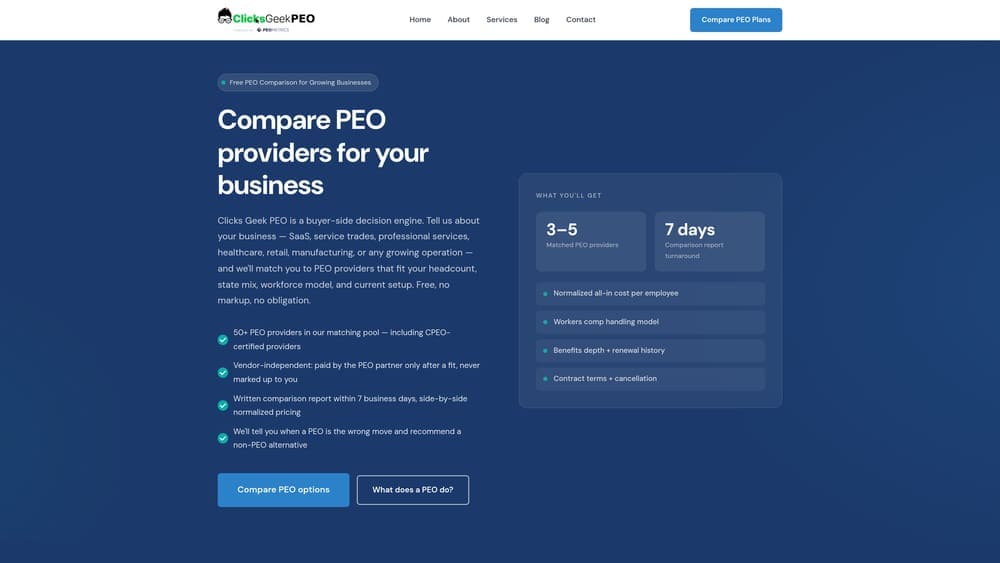
Clicks Geek PEO is an independent PEO comparison and advisory platform — not a PEO itself — built to help businesses evaluate providers side-by-side with transparent pricing breakdowns and contract analysis.
Where This Tool Shines
Most businesses shopping for a PEO are doing it without a clear benchmark. They get a quote, it sounds reasonable, and they sign. The problem is that PEO pricing is notoriously difficult to compare across providers because fee structures differ: some use percentage-of-payroll, others use per-employee-per-month, and bundled fees can obscure the real cost. Clicks Geek, in partnership with PEO Metrics, exists specifically to cut through that noise.
If you’re leaving Vensure because of pricing opacity or service inconsistency, the most practical first step isn’t picking a new provider — it’s understanding what you’re actually paying for and what alternatives look like on an apples-to-apples basis. That’s what this platform is built to do.
Key Features
Side-by-Side Provider Comparisons: Built in partnership with PEO Metrics to give businesses a structured, objective view of multiple providers at once.
Transparent Pricing Breakdowns: Cost analysis that surfaces administrative markups, bundled fees, and what you’re actually paying versus what’s quoted.
Contract Term Reviews: Helps businesses understand renewal terms, exit clauses, and what they’re agreeing to before signing.
Independent Advisory: No co-employment relationship, no provider bias — guidance that’s aligned with the business, not a commission structure.
Best For
Business owners, CFOs, or HR decision-makers who are actively evaluating a switch from Vensure or approaching a contract renewal and want objective data before committing. Particularly valuable if you’ve never done a structured PEO comparison before.
Pricing
Free comparison resources available. Advisory services are available for businesses that want more hands-on support through the evaluation process.
2. Justworks
Best for: Small businesses and startups that want predictable, published pricing with no surprises.
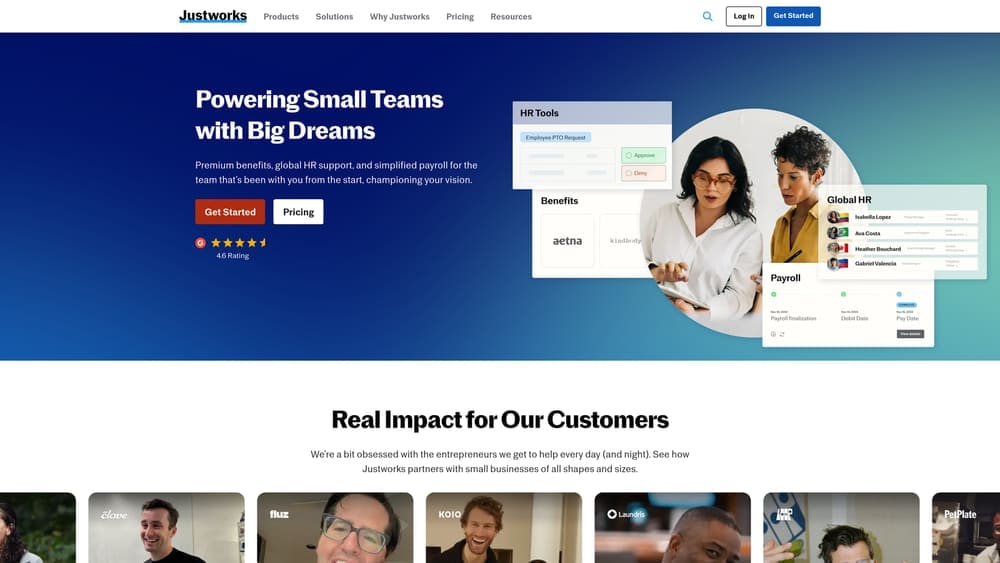
Justworks is a PEO platform built around flat, transparent per-employee pricing and a clean self-service interface designed to remove the guesswork from HR administration.
Where This Tool Shines
The biggest differentiator here is pricing transparency. Justworks publishes its rates publicly, which is genuinely rare in the PEO industry. If pricing opacity is part of why you’re leaving Vensure, Justworks is one of the most direct antidotes to that problem. You know what you’re paying before you sign anything.
The platform is also well-suited for companies that want a largely self-service experience. Onboarding is fast, the interface is clean, and the core HR functions — payroll, benefits, compliance — are tightly integrated without requiring a lot of back-and-forth with account managers.
Key Features
Published Per-Employee Pricing: Flat monthly rates listed publicly — no percentage-of-payroll model, no hidden administrative fees.
Integrated HR Suite: Payroll, benefits administration, compliance support, and HR tools in a single platform.
Large-Group Health Insurance Access: Employees at small companies get access to health plans typically reserved for larger employers.
Fast Onboarding: Minimal implementation time compared to enterprise-focused PEOs; companies can get up and running quickly.
Best For
Companies with 5 to 200 employees that prioritize pricing clarity and want a streamlined, tech-forward PEO experience. Particularly strong for startups and professional services firms that don’t need deep industry-specific customization.
Pricing
Starts at $59/employee/month for the Basic plan; $109/employee/month for the Plus plan, which includes access to benefits. Pricing is published on their website.
3. Rippling PEO
Best for: Tech-forward companies that want HR and IT infrastructure managed in a single platform.
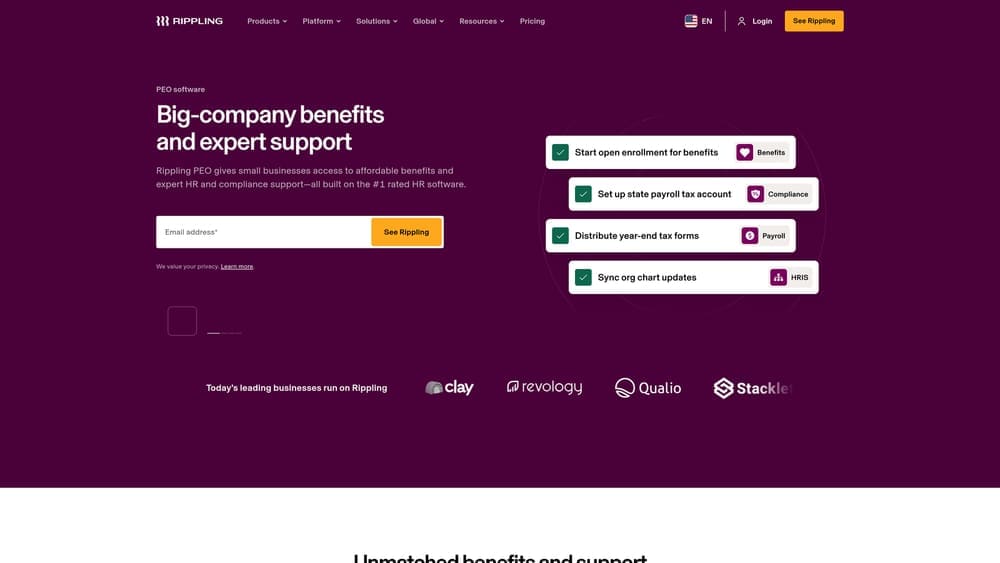
Rippling is a unified workforce platform that combines PEO co-employment with IT management, device provisioning, and app access — built for companies where HR and technology operations are closely connected.
Where This Tool Shines
Rippling isn’t just a PEO — it’s a workforce operating system. Where most PEOs stop at payroll and benefits, Rippling extends into IT: shipping laptops, provisioning software access, and automating offboarding across both HR and tech systems simultaneously. For companies managing remote or distributed teams, that integration removes a significant operational gap.
It also offers a meaningful long-term flexibility advantage: businesses can start with PEO co-employment and transition to a non-PEO model as they scale, without switching platforms. That’s a real consideration for companies that expect to grow beyond the typical PEO headcount range.
Key Features
Combined HR, IT, and Finance Platform: One system handles payroll, benefits, device management, and app provisioning without third-party integrations.
Automated Onboarding: New hire setup includes device shipping and software access provisioning, not just HR paperwork.
Custom Workflow Automation: Policy enforcement and approval workflows can be configured without engineering resources.
PEO-to-Non-PEO Transition Path: Companies can shift from co-employment to independent HR operations on the same platform as they grow.
Best For
Technology companies, software firms, and remote-first businesses where HR and IT operations overlap heavily. Also a strong fit for companies that want to start as a PEO but plan to eventually build out an internal HR function.
Pricing
Custom pricing; core platform generally starts around $35/employee/month, with PEO pricing quoted separately based on headcount and services selected.
4. TriNet
Best for: Industry-specific companies that want benefits packages and HR guidance tailored to their sector.
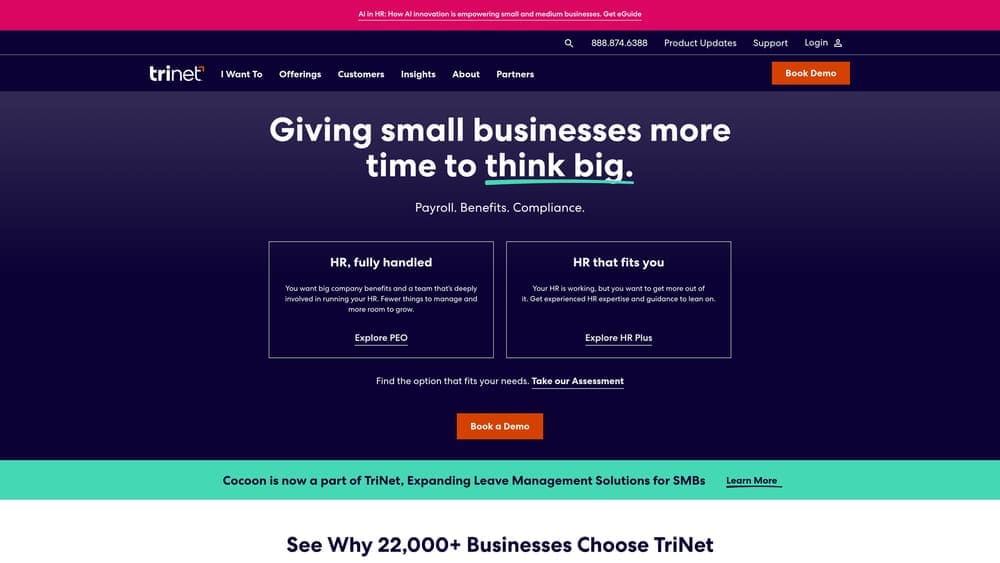
TriNet is a full-service PEO with dedicated vertical expertise across industries including technology, financial services, nonprofits, and professional services.
Where This Tool Shines
Most PEOs offer a generalist HR experience. TriNet takes a different approach by organizing its service model around industry verticals. That means the HR guidance, benefits curation, and compliance support you receive is calibrated to your specific sector rather than a one-size-fits-all framework.
For companies in regulated industries or sectors with unique benefits expectations — like tech firms competing for talent against larger employers — that vertical focus can make a meaningful difference in both the quality of benefits offered and the relevance of HR guidance.
Key Features
Industry-Vertical HR Guidance: HR business partners with experience in your specific sector, not generalist advisors rotating across accounts.
Fortune 500-Level Benefits Access: Health, dental, vision, and ancillary benefits plans that smaller companies typically can’t access independently.
Compliance Support by Vertical: Risk mitigation and regulatory guidance calibrated to industry-specific requirements.
Cloud-Based Platform with Mobile Access: Self-service tools for employees and managers accessible across devices.
Best For
Companies with 20 to 1,000 employees in defined industry verticals — particularly technology, financial services, and nonprofits — where generic HR support doesn’t address the specific talent and compliance environment.
Pricing
Custom pricing based on headcount and industry; typically structured as a percentage-of-payroll model. Requires a consultation for a formal quote.
5. ADP TotalSource
Best for: Mid-sized businesses with multi-state payroll complexity that need enterprise-grade infrastructure.
ADP TotalSource is ADP’s full-service PEO offering, combining comprehensive HR outsourcing with the multi-state payroll, tax, and compliance infrastructure that ADP’s enterprise products are known for.

Where This Tool Shines
ADP TotalSource carries real weight in multi-state payroll and tax compliance. For companies operating across several states — each with different wage laws, filing requirements, and workers’ comp regulations — having a PEO backed by ADP’s infrastructure reduces the risk of costly errors significantly. That’s not marketing language; it’s a practical advantage that comes from decades of payroll processing at scale.
The CPEO certification (IRS-certified PEO) is also worth noting. CPEO status carries specific legal protections around tax liability that non-certified PEOs don’t provide — a meaningful consideration for businesses where payroll tax risk is a concern.
Key Features
Multi-State Payroll and Tax Filing: Backed by ADP’s enterprise payroll infrastructure with deep multi-jurisdiction compliance capability.
Dedicated HR Business Partner: Named advisor providing strategic HR guidance alongside day-to-day operational support.
Workforce Analytics and Reporting: Robust data tools for tracking labor costs, turnover, and workforce trends.
CPEO Certification: IRS-certified PEO status providing additional legal protections around federal employment tax liability.
Best For
Mid-sized companies with 50 to 1,000 employees, particularly those operating across multiple states or in industries with complex payroll and compliance requirements. Strong fit for businesses that want enterprise-grade infrastructure without building an internal HR department.
Pricing
Custom pricing; generally structured as a percentage-of-payroll model for mid-sized employers. Requires a direct consultation for pricing.
6. Insperity
Best for: Businesses that want a high-touch, relationship-driven PEO experience with a named HR partner.
Insperity is a relationship-driven PEO known for dedicated HR business partners and a strong service track record across companies ranging from 5 to 5,000 employees.
Where This Tool Shines
One of the most common complaints about larger PEOs — including acquisition-heavy providers like Vensure — is the call center experience. You submit a question, get routed to a generalist who doesn’t know your account, and wait. Insperity’s model is built around the opposite: a named, dedicated HR business partner who knows your company and serves as a consistent point of contact.
That model costs more than self-service alternatives, but for companies where HR decisions carry real operational weight — hiring, terminations, benefits strategy, compliance exposure — having a knowledgeable advisor who understands your business context is genuinely valuable.
Key Features
Named HR Business Partner: Dedicated advisor assigned to your account, not a rotating call center queue.
Comprehensive Benefits Package: Health insurance, 401(k), and ancillary benefits with competitive plan options.
Performance Management Tools: Employee development, performance review frameworks, and HR strategy support beyond basic administration.
Industry Tenure: Over 35 years in the PEO space with a documented service model that has remained consistent through that period.
Best For
Companies that prioritize service quality and want an HR partner, not just a payroll processor. Particularly well-suited for businesses in growth phases where HR decisions are frequent and consequential, and for owners who don’t want to manage HR internally.
Pricing
Custom pricing; typically structured as a percentage-of-payroll. Requires a consultation for a quote. Generally positioned at a premium relative to self-service PEO alternatives.
7. Paychex PEO
Best for: Small businesses that want to start with payroll and gradually add PEO services without switching platforms.
Paychex PEO is a modular PEO solution that lets businesses begin with payroll processing and layer in co-employment services incrementally as their needs evolve.

Where This Tool Shines
Not every small business is ready to jump into full PEO co-employment from day one. Paychex is one of the few providers that lets you start smaller — with payroll or basic HR services — and scale into a full co-employment arrangement without migrating to a new system. That continuity matters more than it sounds. Platform switches are disruptive, and being able to grow within a single provider reduces that friction.
The pay-as-you-go workers’ comp option is also practically useful for businesses with variable headcount or seasonal workforce fluctuations, where lump-sum workers’ comp premiums create cash flow challenges.
Key Features
Flexible Service Tiers: Start with payroll-only and add co-employment services incrementally — no forced all-or-nothing commitment upfront.
Dedicated Payroll Specialist and HR Generalist: Named contacts for both payroll and HR support rather than a fully self-service model.
Pay-As-You-Go Workers’ Comp: Workers’ compensation administration tied to actual payroll cycles, reducing large upfront premium payments.
Scalable Platform: Grows from small business payroll to full PEO co-employment within the same ecosystem.
Best For
Small businesses with 5 to 100 employees that are either new to PEOs and want to ease in gradually, or companies with variable workforce needs that benefit from modular, flexible service structures.
Pricing
Custom pricing; payroll-only services start at a lower price point, with PEO co-employment pricing based on headcount and selected services. Requires a consultation for a full quote.
8. Amplify PEO
Best for: High-risk industries like construction, staffing, and manufacturing that need specialized workers’ comp expertise.
Amplify PEO is a specialized PEO focused on industries with elevated workers’ compensation risk, offering deep expertise in placing hard-to-insure risk classes and managing claims costs.
Where This Tool Shines
Most PEOs are built for office-based, low-risk workforces. When a construction company, staffing firm, or manufacturing operation approaches a standard PEO, they often get declined, repriced out of the market, or placed in a master policy that doesn’t actually fit their risk profile. Amplify is built specifically for those situations.
The workers’ comp expertise here isn’t a secondary feature — it’s the core value proposition. For businesses in industries where workers’ comp costs are a significant line item and where a single bad claims year can dramatically affect premiums, having a PEO with real risk management depth is a different category of value than what a generalist provider offers.
Key Features
Hard-to-Place Workers’ Comp Specialization: Access to master workers’ comp policies for risk classes that many PEOs decline or significantly reprice.
Industry-Specific Coverage: Focused on construction, staffing, manufacturing, and trades — not a generalist approach applied to high-risk industries.
Risk Management Consulting: Safety program support and risk mitigation guidance designed to reduce claims frequency and cost over time.
Claims History Consideration: Pricing and placement takes actual claims history into account rather than applying blanket rate increases.
Best For
Construction companies, staffing agencies, manufacturing operations, and trade businesses that have been declined by standard PEOs, are facing unsustainable workers’ comp premiums, or need a provider with genuine expertise in high-risk workforce management.
Pricing
Custom pricing based on risk class, headcount, and claims history. Given the specialized nature of the coverage, pricing requires direct consultation and varies significantly by industry and risk profile.
Which Vensure Alternative Is Right for Your Business
The right alternative depends entirely on what specifically isn’t working with your current arrangement. That’s worth naming clearly before you start making calls.
If pricing opacity is the issue, start with Justworks for published flat-rate pricing, or use Clicks Geek’s comparison tools to benchmark what you’re currently paying against what’s available in the market.
If your company runs on technology and your HR and IT operations are intertwined, Rippling is the most logical fit. If you’re in a regulated industry or competing hard for talent in a specific sector, TriNet’s vertical model is worth a close look.
For multi-state complexity and enterprise-grade payroll infrastructure, ADP TotalSource is the most defensible choice. If what you’re missing most is a real human advisor who knows your account, Insperity is built around exactly that. For businesses that want to grow into PEO services gradually without switching platforms, Paychex offers the most flexibility. And if you’re in construction, staffing, or manufacturing and workers’ comp is a primary pain point, Amplify PEO is in a different category from the rest of this list.
One practical note: before you commit to any new provider, make sure you understand what you’re currently paying in full — administrative fees, benefits markups, and any bundled costs that aren’t broken out clearly. Most businesses that switch PEOs are surprised by what they were actually spending once they see it itemized.
Before you renew your PEO agreement, compare your options. Most businesses overpay due to bundled fees and unclear administrative markups. We break down pricing, services, and contract structures so you can make a smarter decision before you sign anything.