
Vensure Employer Solutions has grown into one of the largest PEOs in the United States, largely through an aggressive acquisition strategy that has absorbed dozens of smaller regional providers. That kind of scale can be a genuine advantage. It can also create real service headaches, depending on which legacy platform you’re running on and how well your account has been transitioned.
If you’re evaluating Vensure for the first time, renewing an existing agreement, or considering a switch, this article is for you. We’ll break down Vensure’s actual strengths and weaknesses based on what shows up consistently in operator feedback, then walk through seven alternatives worth putting in front of a real comparison. For broader context on how PEOs work, our PEO comparison hub is a good starting point before you dig into provider specifics.
The goal here isn’t to push you toward or away from Vensure. It’s to give you enough clarity to make a decision you won’t regret twelve months into a contract.
1. Clicks Geek PEO Comparison Tool
Best for: Business owners who want objective, side-by-side PEO comparisons before signing or renewing.
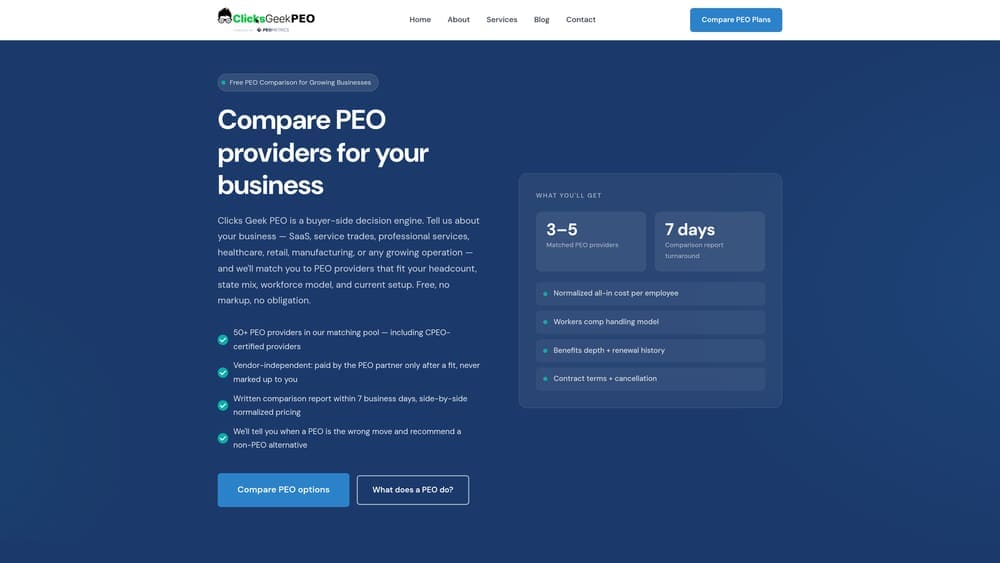
Clicks Geek PEO is an independent PEO comparison platform built to help business owners cut through provider marketing and understand what they’re actually buying.
Where This Tool Shines
Most PEO providers don’t make pricing easy to understand. Bundled fees, administrative markups, and vague contract language are common across the industry. This platform exists specifically to address that problem. It’s not a PEO itself — it doesn’t co-employ your workforce or process your payroll. What it does is help you evaluate providers side by side with transparent pricing analysis and contract term breakdowns.
The partnership with PEO Metrics adds a data layer that most independent research can’t match. If you’re comparing Vensure against three other providers and need to understand exit clauses, fee structures, or service scope differences, this is a more efficient starting point than requesting four separate proposals and trying to decode them yourself.
Key Features
Side-by-Side Provider Comparisons: Evaluate multiple PEOs against each other across service scope, pricing structure, and contract terms.
Transparent Pricing Breakdowns: Understand what you’re actually paying — including administrative markups that often go unnoticed in bundled quotes.
Contract Term and Exit Clause Analysis: Know what you’re committing to before you sign, including what it costs to leave early.
PEO Metrics Partnership: Data-driven provider evaluations backed by a dedicated PEO research organization.
No-Obligation Process: Free to use with no pressure to choose a specific provider.
Best For
Business owners evaluating PEOs for the first time, companies approaching renewal who suspect they’re overpaying, and operators who’ve had a bad PEO experience and want a more structured evaluation process before committing again. Particularly useful if you’re actively comparing Vensure against alternatives.
Pricing
Free to use. There’s no fee to run a comparison or request a provider breakdown.
2. ADP TotalSource
Best for: Mid-market companies that want enterprise-grade benefits and compliance infrastructure with a nationally recognized provider.
ADP TotalSource is ADP’s full-service PEO offering, carrying IRS-certified CPEO status and backed by one of the most established payroll and HR technology stacks in the industry.
Where This Tool Shines
ADP TotalSource’s CPEO certification matters in a practical way: it protects clients from certain federal tax liabilities under Section 3511 of the Internal Revenue Code. That’s a meaningful protection that not every PEO can offer. The benefits access is genuinely strong, with Fortune 500-level plan options that smaller companies wouldn’t qualify for independently.
Where ADP differentiates from Vensure is technology consistency. Because ADP TotalSource runs on a unified platform rather than a patchwork of acquired systems, the experience tends to be more predictable. The dedicated HR business partner model also gives mid-market clients a named contact who understands their account.
Key Features
IRS-Certified CPEO Status: Provides federal tax liability protections that standard PEOs don’t offer.
Fortune 500-Level Benefits: Access to large-group health, dental, and vision plans typically unavailable to smaller employers.
Unified Technology Platform: Consistent payroll, compliance, and HR tools without legacy system fragmentation.
Dedicated HR Business Partner: Named HR support contact assigned to your account, not a rotating call center.
Best For
Companies with 50 to several hundred employees that want a well-resourced PEO with strong technology and don’t mind paying a premium for name-brand reliability. Less ideal for very small businesses where ADP’s pricing structure may not pencil out.
Pricing
Custom-quoted. Typically priced higher than Vensure for comparable headcounts. Request an itemized proposal and compare line by line.
3. Justworks
Best for: Small businesses and remote teams that want straightforward pricing and a clean self-service platform.
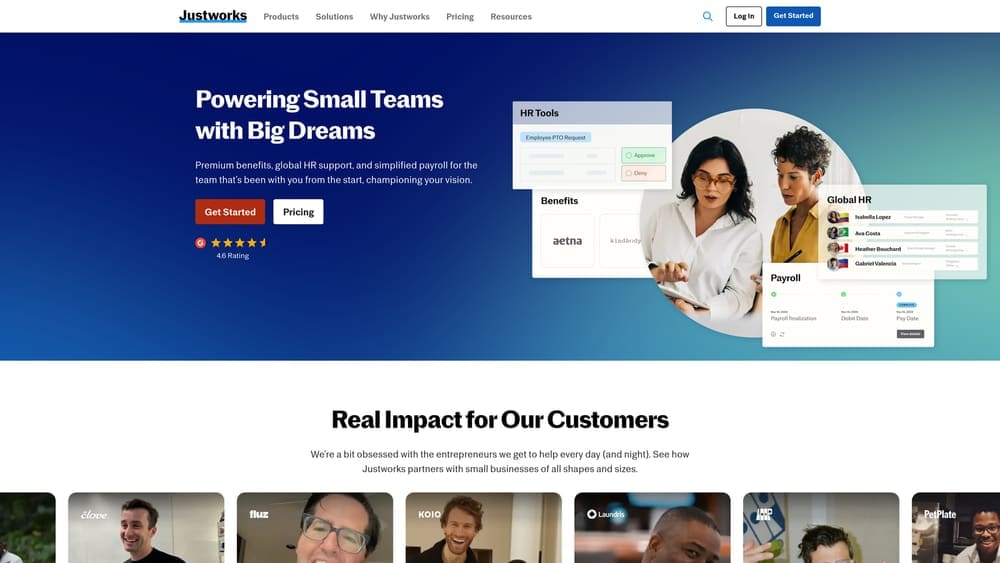
Justworks is one of the few PEOs in the market that publishes its pricing publicly, which alone makes it worth evaluating if fee transparency is a priority for you.
Where This Tool Shines
Justworks’ flat per-employee monthly pricing removes one of the most frustrating parts of PEO evaluation: trying to decode a bundled quote. What you see is what you pay, and that clarity makes it easier to model costs accurately before committing. The platform itself is also notably cleaner and more intuitive than many legacy PEO interfaces, which matters if your team is doing self-service HR tasks regularly.
For companies managing employees across multiple states, Justworks has built-in compliance tools that handle the complexity without requiring you to become an expert in every state’s employment law. This is a genuine operational advantage for distributed teams.
Key Features
Publicly Listed Flat-Rate Pricing: Per-employee monthly pricing posted on their website — no decoding required.
Modern Self-Service Platform: Clean, intuitive interface that employees actually use without training.
Multi-State Compliance Tools: Built-in support for companies with employees across multiple jurisdictions.
Strong Benefits Access for Small Teams: Competitive health and benefits options for companies that wouldn’t qualify for large-group plans independently.
Best For
Small businesses with under 100 employees, startups with remote or distributed teams, and operators who’ve been burned by opaque PEO billing and want to know exactly what they’re paying each month.
Pricing
Starts around $59 per employee per month for the Basic tier. Publicly listed on their website — one of the only PEOs where you can see pricing before a sales call.
4. Rippling PEO
Best for: Tech-forward companies that want HR and IT management in one system, or businesses that expect to outgrow PEO eventually.
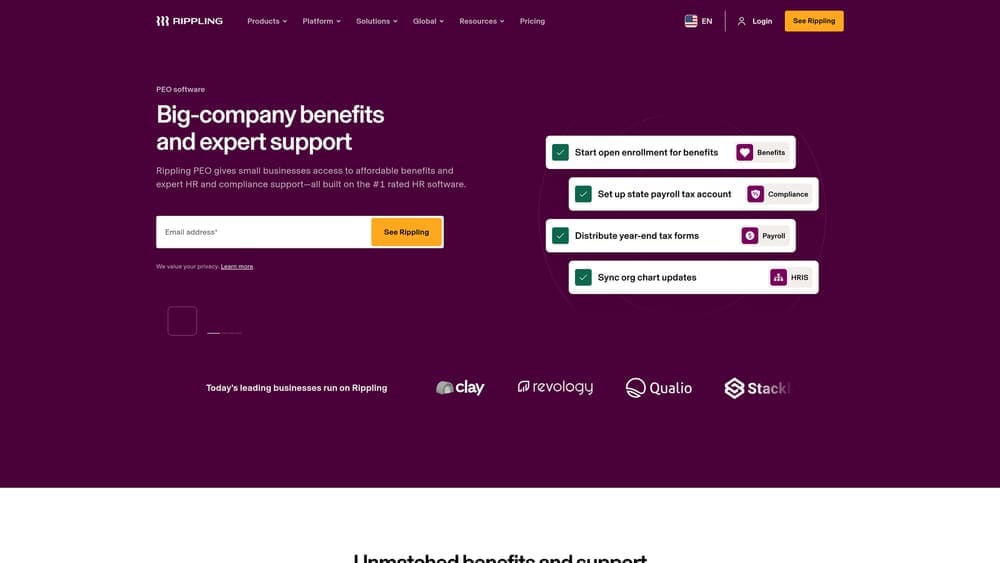
Rippling approaches workforce management differently than traditional PEOs: PEO is one module within a broader platform that also handles IT, device management, and deep third-party integrations.
Where This Tool Shines
If your business uses a lot of software tools and wants HR, payroll, and IT management in one place, Rippling’s architecture is genuinely different from anything else in this space. The ability to onboard an employee, provision their laptop, and set up their software access from a single workflow is a real operational advantage for tech companies.
The modular model also means you’re not locked into PEO forever. Companies that plan to build out their own HR infrastructure eventually can transition off the PEO layer without leaving the platform entirely — a flexibility that most traditional PEOs don’t offer.
Key Features
Modular Platform Architecture: Add or remove the PEO layer as your business needs change without switching systems entirely.
Integrated IT and Device Management: Manage hardware provisioning and software access alongside HR from one platform.
Automation and Integrations: Connects with hundreds of third-party tools, reducing manual HR administration significantly.
Transition-Friendly Design: Built for companies that may eventually move off PEO to a traditional employer model.
Best For
Tech companies, SaaS businesses, and operators who want a modern system that can scale with them — particularly those who want IT management bundled with HR rather than running separate platforms.
Pricing
Custom-quoted based on selected modules. Request a detailed breakdown of which services are bundled versus priced separately before committing.
5. Paychex PEO
Best for: Small to mid-sized businesses that want a reliable, established PEO with strong payroll infrastructure and dedicated HR support.
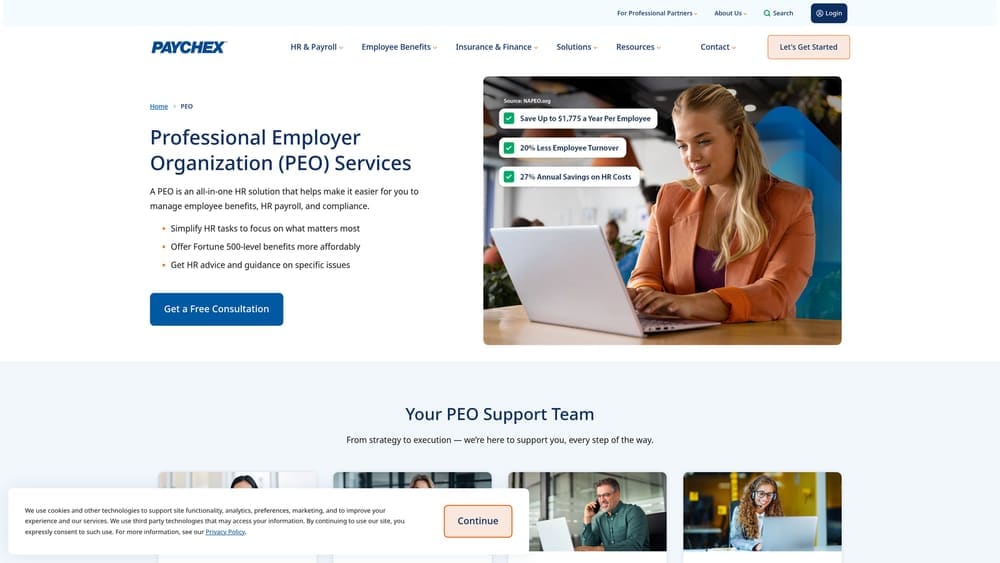
Paychex PEO carries IRS-certified CPEO status and is backed by Paychex’s decades of payroll processing experience, making it a stable, low-drama option for businesses that want solid fundamentals without the enterprise price tag.
Where This Tool Shines
Paychex PEO’s strength is consistency. The payroll processing infrastructure is mature, the tax filing track record is strong, and the dedicated HR professional model means you have a named contact rather than a generic support queue. For business owners who’ve dealt with account manager turnover at other PEOs — a complaint that surfaces frequently in Vensure reviews — Paychex’s account structure tends to offer more stability.
It’s not the flashiest platform in this comparison, but it handles the fundamentals reliably. For many small business owners, that’s exactly what they need.
Key Features
IRS-Certified CPEO: Federal tax liability protections under Section 3511, same as ADP TotalSource.
Dedicated HR Professional: A named HR contact assigned to your account for ongoing support.
Mature Payroll Infrastructure: Decades of payroll processing experience with strong tax filing accuracy.
Scalable Service Model: Works for businesses from a handful of employees up through mid-market headcounts.
Best For
Small businesses that want a dependable, established PEO without the complexity of a modular platform. Also a good fit for companies that have had negative experiences with newer or acquisition-heavy PEOs and want a more stable provider.
Pricing
Custom-quoted. Ask specifically for an itemized proposal so you can compare line items against other providers rather than evaluating bundled totals.
6. Insperity
Best for: Professional services firms and companies that want hands-on HR advisory support, not just administrative processing.
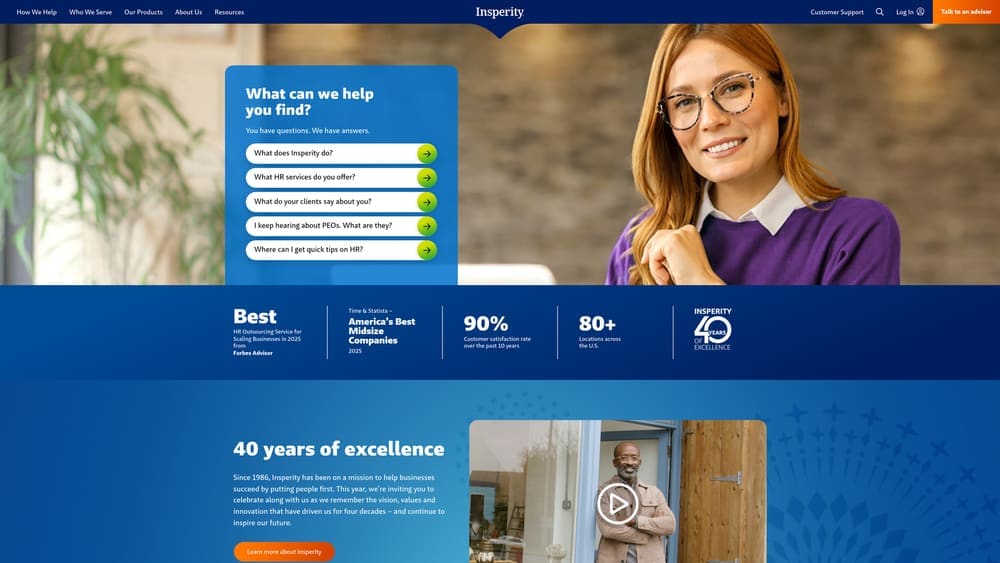
Insperity positions itself as a premium PEO, and the pricing reflects that — but so does the service model, which leans heavily on dedicated HR specialists with a strategic advisory focus rather than a transactional support model.
Where This Tool Shines
Most PEOs handle HR administration. Insperity goes further by providing HR guidance that’s more consultative in nature. If you’re dealing with performance management challenges, want help building an employee development framework, or need strategic HR input alongside the compliance basics, Insperity’s team is set up to provide that. It’s a meaningful distinction from providers that treat HR support as a call center function.
The benefits packages are also strong, with multiple plan options that give employees real choice rather than a single take-it-or-leave-it offering. For companies competing for talent in professional services, that flexibility matters.
Key Features
Strategic HR Advisory: Dedicated HR specialists focused on business outcomes, not just administrative compliance.
Performance Management Tools: Built-in frameworks for employee development and performance reviews.
Multiple Benefits Plan Options: Broader benefits selection than many PEOs offer, giving employees real choice.
Broad Headcount Range: Designed to serve companies from 5 employees up to 5,000.
Best For
Professional services firms, consulting companies, and businesses where employee retention and development are strategic priorities. Less ideal for cost-sensitive businesses where the premium pricing doesn’t align with budget constraints.
Pricing
Custom-quoted. Expect premium pricing that reflects the high-touch service model. Get a detailed proposal and evaluate whether the advisory service level justifies the cost for your specific situation.
7. TriNet
Best for: Companies in tech, life sciences, financial services, or nonprofits that want industry-specific PEO services rather than a generic bundle.
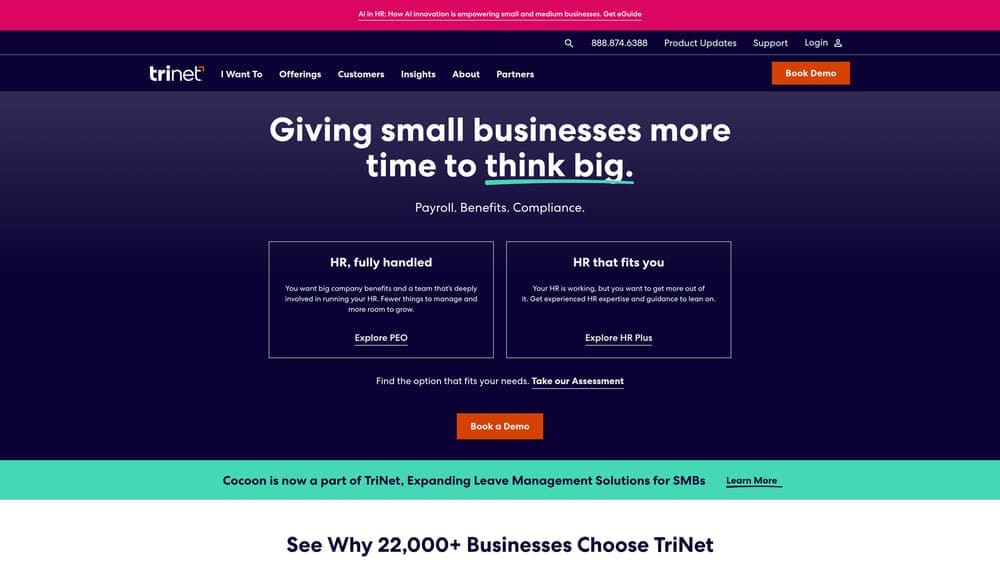
TriNet differentiates by organizing its PEO services around industry verticals, which means the compliance support, benefits packages, and HR frameworks are tailored to the specific regulatory and talent environments of your sector.
Where This Tool Shines
If you’re in a regulated industry, generic PEO compliance support often falls short. TriNet’s vertical model means the people supporting your account actually understand the specific compliance landscape you’re operating in — whether that’s HIPAA considerations for life sciences, securities regulations for financial services firms, or the grant and funding complexities that nonprofits navigate. That industry context is hard to replicate with a generalist PEO.
The cloud-based platform with mobile access is solid, and the benefits packages within each vertical tend to be competitive for attracting the kind of talent those industries need. It’s a more targeted approach than most PEOs offer.
Key Features
Industry-Vertical Service Bundles: PEO services organized around tech, life sciences, financial services, and nonprofits with sector-specific compliance support.
Competitive Vertical-Specific Benefits: Benefits packages designed to attract talent within specific industries.
Industry-Tailored Risk and Compliance: Compliance support that accounts for the specific regulatory environment of your sector.
Cloud-Based HR Platform: Accessible platform with mobile functionality for distributed teams.
Best For
Companies in regulated or talent-competitive industries where generic PEO support creates gaps. Particularly strong for tech startups, life sciences companies, and nonprofits that need compliance support specific to their operating environment.
Pricing
Custom-quoted with bundled pricing. Request an itemized breakdown to understand what’s included in the bundle versus what would cost extra for your specific headcount and industry.
Which PEO Actually Fits Your Business?
Vensure is a legitimate large-scale PEO with real capabilities. Its IRS-certified CPEO status provides meaningful federal tax protections, the workers’ comp programs are frequently cited as a genuine strength, and the geographic footprint from years of acquisitions means it can handle multi-state complexity for many businesses. Those are real advantages, not marketing language.
The honest tradeoff is this: acquisition-driven growth creates service inconsistencies that a unified, purpose-built PEO doesn’t have. Account manager turnover, technology platform fragmentation across legacy brands, and difficulty getting transparent fee breakdowns are themes that appear consistently in public operator feedback about Vensure. Whether those issues affect your specific account depends on which platform you’re on and how well your transition was managed.
The right PEO for your business depends on factors that no listicle can fully resolve: your headcount, your industry’s compliance requirements, how much you value technology experience versus raw coverage, and what you’re actually paying versus what you think you’re paying. Most businesses that switch PEOs do so because they discover they’ve been overpaying — not because the service was catastrophically bad, but because bundled fees and unclear administrative markups made it impossible to evaluate the real cost.
Before you renew your current agreement or sign with a new provider, take the time to compare your options with an independent analysis. The comparison process is free, and understanding what you’re actually buying before you commit to a multi-year contract is worth the time.
If you’re evaluating Vensure against any of the providers listed here, our comparison platform can break down pricing structures, contract terms, and service scope side by side — so you’re making a decision based on real data, not sales presentations.