
If you’re comparing Engage PEO and Alliance HR, you’re already past the point of evaluating household-name providers. Both operate in the mid-market space, serving businesses that need more than a payroll processor but don’t require enterprise-level complexity. The challenge isn’t finding information about these providers—it’s cutting through the marketing language to understand what actually differs in how they operate.
Neither provider publishes transparent pricing. Both claim strong service. Both offer benefits access and compliance support. On the surface, they look similar.
But the operational details—how they structure pricing, handle workers’ comp risk, deliver support, and enforce contract terms—create meaningful differences in cost, flexibility, and day-to-day experience. These seven factors expose where those differences actually matter for your business.
1. Geographic Coverage and State Compliance Depth
Why This Matters First
PEOs operate under state-specific licensing and compliance frameworks. A provider’s geographic footprint determines not just where they can legally serve you, but how deep their regulatory expertise runs in each state.
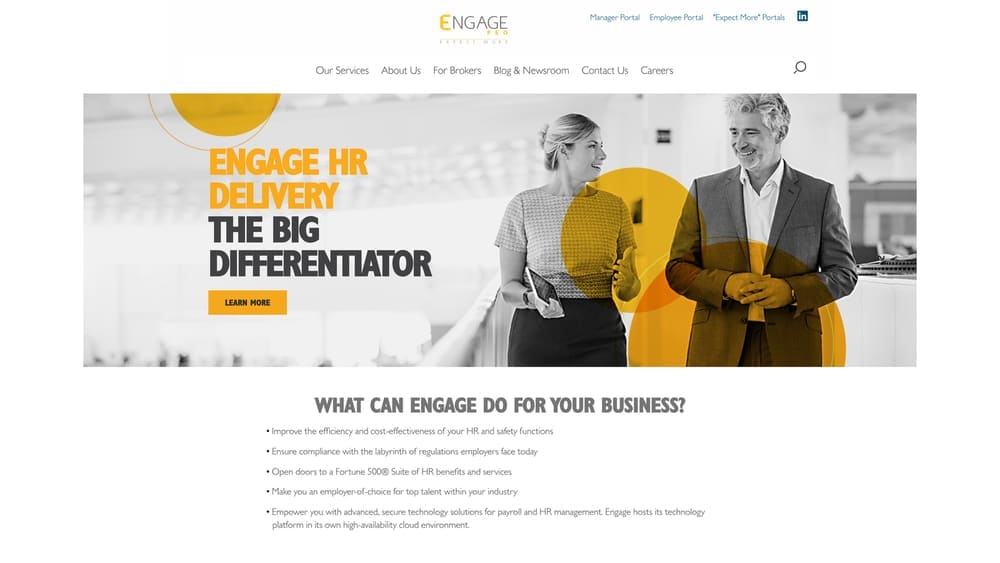
Engage PEO, headquartered in Florida, positions itself for multi-state operations. They serve clients across multiple states, which suggests infrastructure for handling varied state tax codes, workers’ comp requirements, and employment law nuances. Alliance HR operates with a more regional focus, which can mean deeper local relationships with state agencies and carriers but potentially less breadth for businesses expanding beyond their core geography. If you’re evaluating providers with broader reach, consider reviewing national PEO companies that specialize in multi-state employers.
What to Evaluate
Ask both providers: Which states do you currently serve? How many active clients do you have in each state where I operate? Who handles state-specific compliance questions—a centralized team or local specialists?
The answer matters if you’re planning expansion. A PEO that serves 15 states but only has substantial client volume in three may lack the operational depth to handle complex situations in your secondary locations.
The Regional vs Multi-State Tradeoff
Regional focus isn’t a weakness—it often means stronger carrier relationships, faster state agency responses, and staff who understand local business conditions. But it creates risk if you expand beyond that footprint. Multi-state capability provides flexibility but sometimes comes with less personalized compliance support in any single state. For businesses prioritizing local expertise, regional PEO companies may deliver better service quality.
If you operate in one or two states with no expansion plans, regional depth may outweigh broader coverage. If you’re growing into new markets, verify the provider has operational infrastructure—not just legal authorization—in those states.
2. Pricing Model Transparency and Cost Triggers
The Pricing Opacity Problem
Neither Engage PEO nor Alliance HR publishes pricing online. This is standard in the PEO industry, but it creates comparison challenges. Without transparent rate cards, you’re relying on customized quotes that may include different assumptions, bundled services, or hidden cost triggers.
Most PEOs use one of two pricing structures: per-employee-per-month (PEPM) or percentage-of-payroll. PEPM feels simpler but can include administrative fees, technology charges, and compliance add-ons. Percentage-of-payroll scales with your labor costs, which sounds fair until you realize it penalizes wage increases and creates unpredictable budgeting. Understanding the full PEO cost breakdown helps you identify what you’re actually paying for.
What Actually Drives Your Costs
Beyond the base pricing model, watch for these cost triggers: workers’ comp experience modifications that adjust quarterly, benefits participation requirements that force minimum enrollment thresholds, state unemployment tax pooling that spreads risk across the PEO’s entire client base, and administrative fees for services you assumed were included.
Request itemized quotes from both providers using identical scenarios—same headcount, same payroll, same states, same industry classification. Compare line-item costs, not just the bottom-line number. Ask explicitly: What costs can change mid-contract? What triggers adjustments? What services require additional fees? Watch out for hidden PEO fees that providers don’t disclose upfront.
The Hidden Cost of “Bundled” Services
PEOs often bundle services you may not need—HR consulting hours, compliance training modules, recruitment support—into their base pricing. If you’re paying for bundled services you won’t use, you’re subsidizing features that don’t create value for your business.
Ask both providers: Can I unbundle services? What’s the cost difference between your full-service package and a core payroll/benefits/compliance offering? If they won’t unbundle, you’re locked into their service philosophy regardless of fit.
3. Workers’ Comp Administration and Risk Pool Composition
Why Workers’ Comp Deserves Its Own Evaluation
Workers’ compensation often represents the largest variable cost in a PEO relationship. How the provider structures their master policy, manages their risk pool, and handles experience modifications directly impacts your costs—sometimes more than the base administrative fee.
When you join a PEO, you enter their workers’ comp risk pool. Your claims experience gets blended with other clients in that pool. If the pool includes high-risk industries with poor safety records, you subsidize their claims even if your business runs clean. Building a strong PEO safety program can help reduce your workers’ comp costs over time.
Questions That Expose Risk Pool Quality
Ask both providers: What industries dominate your workers’ comp risk pool? What’s your current experience modification rate? How do you handle clients with claims that spike costs? Can you show me claims frequency data for businesses similar to mine?
A provider unwilling to discuss risk pool composition is asking you to trust their underwriting without verification. That’s a red flag.
Experience Mod Handling
Your experience modification rate adjusts based on claims history. In a traditional workers’ comp policy, you control this directly. In a PEO master policy, you’re subject to the pool’s collective performance.
Some PEOs offer experience-rated programs where your individual claims history influences your costs more directly. Others pool all risk equally. If you run a low-risk operation with strong safety practices, pooled risk penalizes you. If you’re in a higher-risk industry, pooling may provide cost stability.
Understand which model each provider uses and how it affects your cost trajectory over multiple years.
4. Technology Platform Usability and Integration Capabilities
Where Technology Actually Impacts Operations
PEO technology platforms vary dramatically in usability, self-service capabilities, and integration options. A clunky platform creates administrative friction—more time spent on payroll processing, benefits enrollment, and reporting means less time running your business.
Evaluate both platforms for: employee self-service access for pay stubs, tax documents, and benefits enrollment; manager-level reporting for headcount, labor costs, and turnover metrics; integration capabilities with your existing accounting, time tracking, or HRIS systems; mobile functionality for distributed teams. Review the best PEO HR technology platforms to understand what capabilities you should expect.
The Integration Gap
Mid-market PEOs often lag in integration capabilities. If you use QuickBooks, NetSuite, or industry-specific software, verify that payroll data flows automatically. Manual data entry between systems creates error risk and administrative overhead.
Ask both providers: What integrations do you support natively? What requires custom development or third-party middleware? What’s the typical implementation timeline for integrations? Understanding PEO payroll integration requirements helps you evaluate compatibility with your existing systems.
Reporting Flexibility
Standard reports cover payroll summaries and benefits enrollment. Custom reporting—labor cost analysis by department, turnover trends by location, benefits utilization by plan tier—requires more sophisticated platforms.
Request demo access to both platforms. Run through common workflows: processing an off-cycle payroll, enrolling a new employee in benefits, generating a labor cost report by project. Evaluate whether the interface feels intuitive or requires constant support tickets.
5. Service Model Structure and Support Accessibility
Dedicated vs Shared Support Models
PEO service models fall into two categories: dedicated account management where you work with the same representative consistently, or shared support teams where you contact a general queue for assistance.
Engage PEO and Alliance HR likely use different service structures based on their scale and operational philosophy. Dedicated support costs more—providers build that into pricing—but creates continuity. Your account manager learns your business, remembers your preferences, and proactively flags issues.
Shared support teams offer faster response times during business hours but lack context. Every interaction starts from scratch. For complex situations requiring institutional knowledge, this creates frustration.
Response Time Expectations
Ask both providers: What’s your average response time for routine questions? For urgent payroll issues? For compliance questions requiring research? Do you offer after-hours support? What constitutes an “emergency” that triggers immediate response?
Verify these claims by requesting references from current clients. Ask those references: How quickly do you typically get answers? Have you experienced service degradation during busy periods? How does support quality compare to what was promised during the sales process? Learning how to choose a PEO includes evaluating service quality beyond marketing promises.
The Scalability Question
Service quality often degrades as PEOs grow. Providers that deliver excellent support at 50 clients may struggle at 500. Ask how many clients each account manager handles. Ask how the provider maintains service quality as they scale.
If a provider can’t articulate their service quality controls, assume support will decline as they grow.
6. Contract Terms and Exit Flexibility
Why Contract Terms Matter More Than Pricing
A PEO contract locks you into a service relationship that touches every aspect of employment—payroll, benefits, compliance, workers’ comp. Exit friction creates leverage imbalance. If leaving requires 90 days’ notice, data migration costs, and benefits re-enrollment, you’re trapped even if service deteriorates.
Scrutinize these contract elements: notice period for termination, auto-renewal clauses and opt-out windows, data portability requirements and costs, workers’ comp policy continuity, benefits plan transition logistics. Understanding how to compare PEO contracts helps you identify unfavorable terms before signing.
The Auto-Renewal Trap
Many PEO contracts auto-renew annually unless you provide notice within a specific window—often 60 to 90 days before renewal. Miss that window and you’re locked in for another year regardless of service quality or cost increases.
Ask both providers: What’s your auto-renewal policy? What’s the notice window? Can I negotiate annual renewal instead of auto-renewal? What happens if I miss the notice deadline?
Some providers allow negotiation on this point. Others treat it as non-negotiable. If you can’t get favorable terms, set calendar reminders well in advance of renewal deadlines.
Data Portability and Exit Costs
When you leave a PEO, you need historical payroll data, benefits enrollment records, and compliance documentation. Some providers charge for data extraction. Others limit the format or completeness of exported data. If you’re already considering exit scenarios, review our guide on how to exit your PEO for a step-by-step approach.
Ask explicitly: What data do I receive upon termination? In what format? Are there extraction fees? How long does the transition process typically take?
If a provider won’t commit to clean data portability, assume exit will be painful and expensive.
7. Benefits Access and Plan Quality
The Benefits Pooling Advantage
PEOs aggregate employees across multiple client companies to access better benefits pricing and plan options than small businesses can negotiate independently. This is often the primary value proposition for joining a PEO.
But benefits quality varies significantly between providers. Carrier networks, plan design, contribution requirements, and participation thresholds all affect whether the benefits package actually attracts and retains employees.
What to Compare
Request full plan summaries from both providers: carrier options and network coverage in your locations, plan tier options (HSA, PPO, HMO) and deductible ranges, employer contribution requirements and employee cost-sharing, dental and vision plan quality, supplemental benefits (life, disability, FSA, commuter).
Don’t accept summary marketing materials. Request actual plan documents and rate sheets. Compare deductibles, out-of-pocket maximums, and covered services line-by-line. Understanding how to manage open enrollment through your PEO helps you evaluate benefits administration quality.
Participation Requirements
Some PEOs require minimum benefits participation rates—often 70% or more of eligible employees must enroll. If your workforce skews young or part-time, meeting participation thresholds may be difficult. Ask both providers: What are your participation requirements? What happens if we fall below the threshold? Can we offer benefits to a subset of employees?
If participation requirements don’t match your workforce composition, you’ll face pressure to enroll employees who don’t want coverage or risk losing access to the benefits program entirely.
Plan Stability and Carrier Continuity
PEOs renegotiate carrier contracts periodically. Sometimes they switch carriers to control costs. When that happens, employees lose network continuity—their doctors may no longer be in-network, their prescription coverage may change, their deductible progress resets.
Ask both providers: How often do you change carriers? What’s your process for communicating plan changes? How do you handle employee disruption when carriers switch?
Frequent carrier changes create employee frustration and administrative burden. Providers with stable, long-term carrier relationships minimize this disruption.
Making the Decision
Neither Engage PEO nor Alliance HR is universally better. The right choice depends on which operational factors align with your business priorities.
If you operate across multiple states or plan geographic expansion, Engage PEO’s broader coverage may provide more flexibility. If you value regional relationships and personalized compliance support in a concentrated geography, Alliance HR’s focus may deliver better service quality.
The most reliable comparison approach: request identical quote scenarios from both providers. Same headcount, same payroll, same states, same industry classification. Compare line-item costs, contract terms, and service commitments side-by-side.
Map your specific priorities against these seven factors. If workers’ comp risk pool quality matters most, dig deep into claims data and experience mod handling. If technology integration is critical, evaluate platform capabilities thoroughly. If contract flexibility is non-negotiable, scrutinize termination terms before signing.
Before you renew your PEO agreement, compare your options. Most businesses overpay due to bundled fees and unclear administrative markups. We break down pricing, services, and contract structures so you can make a smarter decision.
The decision isn’t about choosing the “best” provider. It’s about choosing the provider whose operational model, cost structure, and service philosophy match how your business actually operates.