
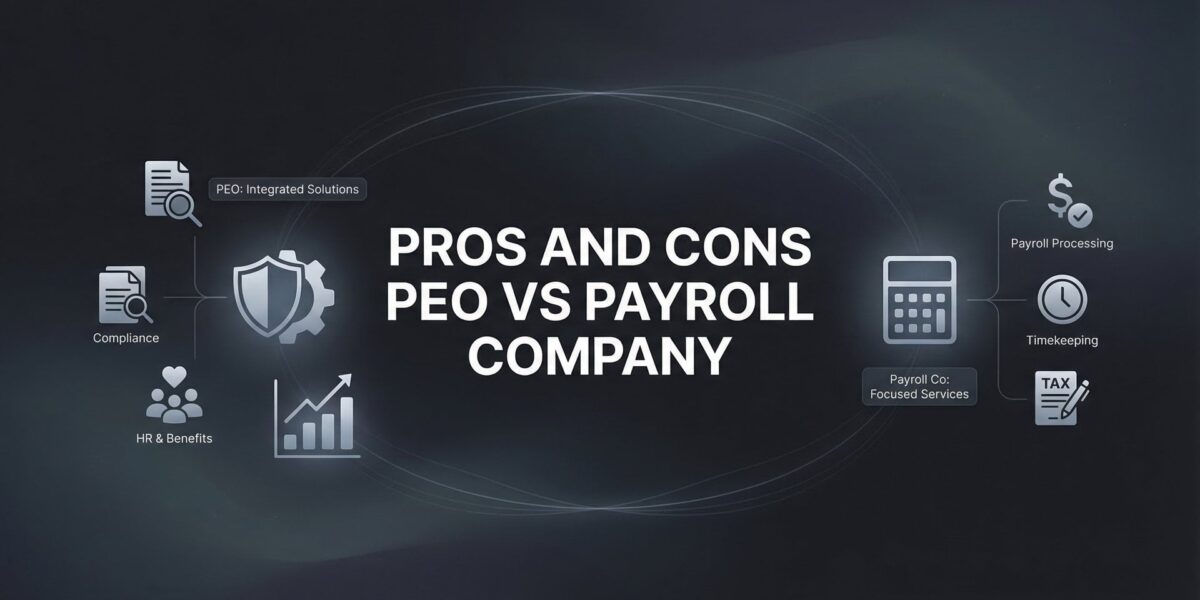
Choosing between a PEO and a standalone payroll company isn’t about which is “better” — it’s about which fits your business reality right now. A payroll company handles checks and tax filings. A PEO takes on HR, benefits, compliance, and workers’ comp through a co-employment model. The right choice depends on your headcount, growth trajectory, risk tolerance, and whether you need more than just payroll processing.
This breakdown covers the real pros and cons of each model so you can make a practical decision without the sales pitch.
1. Cost Structure Differences
Best for: Understanding total cost of ownership beyond base fees
The pricing comparison between PEOs and payroll companies looks straightforward until you account for what you’re actually getting. PEOs typically charge $150-250 per employee per month in a bundled fee. Payroll companies start at $4-12 per employee per month for basic processing.
Where This Model Shines
PEO pricing bundles payroll, HR support, benefits administration, compliance assistance, and workers’ comp into one monthly fee. You know what you’re paying upfront.
Payroll company pricing starts low but grows as you add services. Benefits administration, HR support, time tracking, and compliance tools each carry separate fees. The base price rarely reflects what you’ll actually spend.
Key Considerations
PEO Bundled Model: One predictable monthly cost covering multiple services with minimal add-on fees.
Payroll Base Costs: Low entry price that increases as you need HR tools, compliance support, or benefits administration.
Hidden Costs: Payroll companies often charge setup fees, year-end processing fees, and per-form costs that don’t appear in marketing materials.
Total Ownership Analysis: Factor in the cost of sourcing benefits independently, hiring HR help, and managing compliance when comparing models.
Best For
PEO pricing makes sense when you need multiple services and want cost predictability. Payroll-only pricing works when you have internal HR capacity and can source benefits through a broker.
The Tradeoff
You’ll pay more per month with a PEO, but you’re offloading administrative burden and gaining services you’d otherwise build internally. Payroll companies cost less upfront but require you to assemble the rest of your HR infrastructure separately.
2. Benefits Access and Buying Power
Best for: Small businesses struggling with high health insurance costs
PEOs pool employees from multiple client companies into a single large group for benefits purposes. This gives small businesses access to large-group health insurance rates typically reserved for companies with 100+ employees.
Where This Model Shines
If you’re a 15-person company trying to offer competitive health insurance, you’re likely getting quoted small-group rates that make coverage unaffordable. PEOs can reduce those costs by 20-40% through their master policy.
Payroll companies don’t provide benefits access. You’ll work with a broker to source plans independently, which means you’re stuck with whatever rates your headcount qualifies for in the small-group market.
Key Considerations
Large-Group Rate Access: PEOs leverage their total employee count across all clients to negotiate better rates with carriers.
Plan Flexibility Tradeoffs: You’ll choose from the PEO’s pre-negotiated plan options rather than building a custom benefits package.
Broker Relationship Control: With a payroll company, you maintain your broker relationship and can switch plans or carriers more easily.
Small Business Rate Impact: Companies with under 50 employees often see the most dramatic savings through PEO benefits access.
Best For
PEO benefits access matters most for growing companies that need competitive health insurance to attract talent but can’t afford small-group market rates. If you already have strong benefits through an existing broker relationship, this advantage disappears.
The Tradeoff
You’ll get better rates through a PEO, but you’re locked into their carrier relationships and plan options. If you value plan customization or have unique benefits needs, this limitation becomes frustrating.
3. Compliance and Risk Management
Best for: Multi-state employers navigating complex labor regulations
PEOs operate under a co-employment model, which means they become a shared employer of record alongside your company. This arrangement splits compliance responsibility and liability exposure.
Where This Model Shines
When you work with a PEO, they handle employment tax filings, workers’ comp administration, and compliance monitoring across multiple jurisdictions. If an audit surfaces issues, the PEO shares responsibility.
Payroll companies process your payroll and file taxes, but they’re vendors, not co-employers. You own 100% of compliance responsibility. If something goes wrong, you’re fully exposed.
Key Considerations
Co-Employment Liability Sharing: PEOs take on partial liability for employment-related compliance issues, though you’re never fully off the hook.
Compliance Support Access: Most PEOs provide compliance alerts, policy templates, and guidance on changing regulations as part of their service.
Audit Exposure Differences: With a payroll company, you’re managing audit responses and documentation requirements independently.
Penalty Risk Allocation: Compliance violations can cost $50,000 or more regardless of which model you use, but PEOs often help navigate remediation.
Best For
PEO compliance support makes the most sense for companies operating in multiple states or regulated industries where staying current on labor law changes is operationally difficult.
The Tradeoff
Co-employment creates shared liability, which can be an advantage or a complication depending on your risk tolerance. Some businesses prefer full control over compliance rather than splitting responsibility with a third party.
4. HR Support and Expertise
Best for: Companies without dedicated HR staff managing complex employee situations
PEOs typically assign a dedicated HR specialist to your account who handles employee relations issues, policy development, termination guidance, and compliance questions. You’re essentially renting fractional HR expertise.
Where This Model Shines
When you’re facing a performance issue, potential harassment claim, or termination decision, having immediate access to an HR professional who understands employment law prevents costly mistakes.
Payroll companies offer self-service HR tools and knowledge bases, but you’re not getting personalized guidance. If you need help with a specific employee situation, you’re on your own or paying for external HR consulting.
Key Considerations
Dedicated HR Specialist Access: PEO clients can typically call or email their assigned HR contact for guidance on employee issues as they arise.
Custom vs Generic Guidance: PEO HR support is tailored to your specific situation, while payroll company resources are generalized templates and articles.
Internal HR Timing: Hiring an internal HR manager costs $60,000-100,000 annually, which doesn’t make sense until you’re at 50-75 employees.
Support Availability: PEO HR specialists are available during business hours, while payroll company help desks focus on technical system issues, not HR strategy.
Best For
HR support through a PEO works best for companies in the 10-75 employee range who need professional guidance but can’t justify a full-time HR hire.
The Tradeoff
You’re getting shared HR support, not a dedicated internal resource. The PEO specialist handles multiple clients, so you’re not their only priority. Response times and availability vary.
5. Workers’ Compensation Handling
Best for: Managing cash flow and avoiding large upfront workers’ comp deposits
PEOs typically offer pay-as-you-go workers’ comp, where premiums are calculated based on actual payroll each pay period rather than estimated annual payroll upfront. This eliminates the traditional deposit requirement.
Where This Model Shines
Traditional workers’ comp policies require a 10-25% deposit upfront based on estimated annual payroll. If your estimate is wrong, you face a large year-end audit adjustment. PEOs eliminate this cash flow burden.
With a payroll company, you’re purchasing workers’ comp independently through a broker. You’ll face the standard deposit structure and annual audit process.
Key Considerations
Pay-As-You-Go Options: PEO workers’ comp premiums are deducted from each payroll, matching actual wages paid rather than estimates.
Deposit Requirements: Traditional policies tie up cash in deposits that don’t get reconciled until year-end audits.
Claims Management Control: PEOs handle claims administration, which can be helpful or frustrating depending on how involved you want to be.
Audit Exposure: Pay-as-you-go eliminates surprise audit bills because premiums are calculated on actual payroll throughout the year.
Best For
Pay-as-you-go workers’ comp through a PEO makes sense for growing companies with variable payroll or those that need to preserve working capital.
The Tradeoff
You’re giving up control over your workers’ comp carrier relationship. If you have a strong relationship with a specific carrier or broker, moving to a PEO disrupts that arrangement.
6. Control and Flexibility
Best for: Understanding operational autonomy tradeoffs in each model
Co-employment through a PEO means sharing decision-making authority on certain employment matters. The PEO becomes the employer of record for tax and benefits purposes, which creates administrative efficiency but reduces your complete autonomy.
Where This Model Shines
PEOs offload administrative tasks like benefits enrollment, compliance monitoring, and HR documentation. You’re freed up to focus on running your business rather than managing employment paperwork.
Payroll companies give you complete control over all employment decisions and vendor relationships. You maintain full autonomy over benefits, HR policies, and compliance approaches.
Key Considerations
Co-Employment Implications: The PEO appears on tax filings and benefits documentation as a joint employer, which can complicate certain business transactions.
Decision-Making Authority: You still control hiring, firing, compensation, and day-to-day management, but the PEO influences policy frameworks.
Administrative Burden: PEOs reduce your administrative workload significantly, while payroll companies require you to manage most HR functions internally.
Policy Flexibility: With a payroll company, you can change policies, vendors, or approaches whenever you want without coordinating with a co-employer.
Best For
PEOs work when you value administrative offloading over complete autonomy. Payroll companies make sense when you want full control over every aspect of your employment operations.
The Tradeoff
Offloading administration to a PEO means accepting their frameworks and processes. If you prefer building your own systems exactly how you want them, this feels restrictive.
7. Scalability and Growth Considerations
Best for: Planning infrastructure needs as your company grows
PEOs provide immediate infrastructure that scales with headcount growth. You can go from 10 employees to 75 without building internal HR systems or hiring specialized staff.
Where This Model Shines
When you’re growing quickly, a PEO handles the operational complexity that comes with adding employees across multiple states or expanding benefits offerings. The infrastructure is already built.
Payroll companies require you to build your own HR infrastructure as you grow. You’ll need to hire HR staff, source benefits, implement compliance systems, and manage multiple vendor relationships.
Key Considerations
Growth Accommodation: PEOs can typically handle rapid headcount growth without requiring you to build new internal systems.
Headcount Ceilings: Many companies transition out of PEOs at 150+ employees when building internal HR becomes more cost-effective.
Infrastructure Building: Payroll companies require you to assemble your own HR stack, which takes time but gives you exactly what you want.
Transition Triggers: Consider what headcount or complexity level would make you want to move from one model to the other.
Best For
PEOs work well for companies in rapid growth mode who need operational infrastructure without the time investment. Payroll companies suit businesses with stable headcount or those willing to build internal HR capacity.
The Tradeoff
PEOs provide immediate scalability but become less cost-effective as you grow larger. Building your own HR infrastructure takes longer but gives you more control and potentially lower long-term costs.
8. Technology and Integration
Best for: Evaluating platform consolidation versus best-of-breed flexibility
PEOs provide a single unified platform for payroll, benefits, time tracking, and HR documentation. Everything lives in one system with consistent data and reporting.
Where This Model Shines
A unified PEO platform eliminates the need to manage multiple logins, reconcile data across systems, or troubleshoot integration issues. Employee information flows automatically between payroll, benefits, and HR functions.
Payroll companies give you the flexibility to choose best-of-breed tools for each function. You can select the exact time tracking, benefits administration, and HR software you prefer, then integrate them with your payroll system.
Key Considerations
Unified Platform Benefits: Single source of truth for employee data, streamlined reporting, and fewer vendor relationships to manage.
Tech Stack Lock-In: You’re committed to the PEO’s technology platform, which may lack features you’d get from specialized tools.
Integration Flexibility: Payroll companies let you build your ideal tech stack, but you’re responsible for managing integrations and data flow.
Multiple System Management: Best-of-breed approaches require coordinating updates, managing multiple vendor relationships, and troubleshooting integration breaks.
Best For
PEO platforms work when you value simplicity and consolidation over specialized features. Payroll companies suit businesses with specific technology requirements or those who prefer assembling their own stack.
The Tradeoff
Platform consolidation through a PEO simplifies operations but limits your technology choices. Building your own stack gives you exactly what you want but requires more technical management.
9. Exit Complexity
Best for: Understanding what happens when you need to change providers
Leaving a PEO involves more complexity than switching payroll companies because of the co-employment relationship. Your EIN changes, benefits need to be transitioned, and workers’ comp policies must be restructured.
Where This Model Shines
Switching from one payroll company to another typically takes 2-4 weeks. You’re changing a vendor, not restructuring your employment arrangements. The transition is straightforward.
Exiting a PEO can take 60-90 days and requires careful planning. You’ll need to secure new benefits coverage, obtain a new EIN, transition workers’ comp policies, and migrate employee data.
Key Considerations
Benefits Continuity: Leaving a PEO mid-year can disrupt employee health insurance coverage and requires finding replacement coverage quickly.
EIN Change Implications: Your company operates under the PEO’s EIN while enrolled, so exiting means obtaining a new EIN and updating all business systems.
Transition Support: Some PEOs provide structured offboarding support, while others make the exit process difficult.
Vendor Switching Ease: Payroll company changes are simpler because you maintain your own EIN and vendor relationships throughout.
Best For
Consider exit complexity before committing to a PEO, especially if you anticipate rapid growth that might trigger a transition to internal HR within 2-3 years.
The Tradeoff
PEOs create operational efficiency while you’re using them, but exiting requires more planning and coordination than ending a standard vendor relationship.
Making the Right Choice for Your Business
The PEO versus payroll company decision comes down to what you actually need beyond processing paychecks. If you’re running lean, have simple compliance requirements, and can source benefits independently, a payroll company keeps costs low and control high.
If you’re navigating multi-state employment, need competitive benefits to attract talent, or want compliance support without hiring an HR director, a PEO delivers more value than the fee difference suggests.
Neither model is universally better. The right choice matches your current operational reality and where you’re headed in the next 2-3 years.
Consider these decision factors: Are you struggling with health insurance costs? Do you have internal HR capacity? Are you operating in multiple states? How important is complete operational control versus administrative offloading?
Your answers determine which model fits. A 15-person company with employees in three states and no HR staff will benefit from a PEO’s infrastructure. A 40-person company with an HR manager and strong broker relationships might find a payroll company more cost-effective.
Before you renew your PEO agreement, compare your options. Most businesses overpay due to bundled fees and unclear administrative markups. We break down pricing, services, and contract structures so you can make a smarter decision.
The best decision is the one based on your actual needs, not what a sales team tells you is standard for companies your size.