
You’re three weeks from benefits renewal, payroll taxes are due Friday, and someone just asked if the company handbook covers remote work policies. Meanwhile, you’re supposed to be closing a deal, managing your team, and figuring out next quarter’s hiring plan.
This is where a lot of business owners first hear about Professional Employer Organizations—usually from a broker, an accountant, or another business owner who swears it changed everything. The pitch sounds appealing: outsource the HR headaches, get better benefits, stay compliant, focus on growth.
But what does a PEO actually do day-to-day? And more importantly, is it the right move for your business?
This guide walks through the practical mechanics of how PEOs work, what they handle (and what they don’t), and when the arrangement makes sense. No hype. No generic “PEOs are amazing” talking points. Just a straight explanation of what you’re actually buying into.
The Co-Employment Relationship: How You Share Responsibilities
The term “co-employment” throws people off. It sounds like you’re giving up control of your business. You’re not.
Here’s what actually happens: when you partner with a PEO, they become the employer of record for tax and administrative purposes. Your employees get paid through the PEO’s tax identification number. Benefits run through their group plans. Workers’ comp coverage sits under their master policy.
But you still run the business.
You decide who gets hired. You manage daily work assignments. You handle performance reviews, promotions, and terminations. You set company culture, define roles, and make strategic decisions about your team.
The PEO handles the paperwork, compliance filings, and administrative infrastructure that comes with being an employer. You handle everything that makes your business actually operate.
Think of it like this: if you lease office space, the building owner handles property taxes, structural maintenance, and HVAC systems. You still control what happens inside your office—how it’s organized, who works there, what work gets done. Co-employment works similarly. The PEO manages the employer infrastructure. You manage the business operations. For a deeper dive into this arrangement, our guide on how co-employment works breaks down the legal and practical details.
The confusion usually comes from the legal structure. Because the PEO is the employer of record for tax purposes, they’re listed on W-2 forms and handle payroll tax deposits under their EIN. This doesn’t mean they control your workforce decisions. It means they’re processing the administrative side of employment while you maintain operational authority.
One common misconception: “If the PEO is the employer of record, can they fire my employees without my approval?” No. Employment decisions—hiring, firing, discipline, promotions—remain entirely with you. The PEO provides the administrative framework and guidance on compliance, but they don’t make personnel decisions for your business.
Another question that comes up: “What happens if I want to leave the PEO?” Your employees are still your employees. You can transition them back to your own payroll system or move to a different PEO. The co-employment relationship is a service arrangement, not a permanent transfer of your workforce.
The key is understanding what you’re optimizing for. If you want someone to handle payroll tax filings, benefits administration, and compliance documentation so you don’t have to build that infrastructure internally, co-employment makes sense. If you want full control over every administrative detail and prefer managing HR systems in-house, it probably doesn’t.
Core Functions: What a PEO Actually Handles
When you sign with a PEO, here’s what moves off your plate.
Payroll Processing and Tax Compliance: The PEO runs payroll under their tax ID. They calculate withholdings, process direct deposits, handle garnishments, and file federal, state, and local payroll taxes. If you operate in multiple states, they manage the different tax jurisdictions and filing requirements without you tracking each state’s deadlines and forms.
This isn’t just about cutting checks. It’s about staying compliant with tax deposit schedules, quarterly filings, year-end W-2 distribution, and responding to tax notices. Most business owners don’t realize how much administrative overhead sits behind payroll until they’ve dealt with a state tax notice or missed a filing deadline. Understanding the PEO payroll integration process helps you see exactly what gets automated.
The PEO also handles unemployment insurance claims. When a former employee files for unemployment, the PEO manages the response process, documentation, and hearings if needed. This alone saves hours of administrative time and reduces the risk of incorrect responses that increase your unemployment tax rate.
Benefits Administration: PEOs pool employees from multiple client companies into group health plans. This gives smaller businesses access to benefits packages that would be cost-prohibitive or unavailable if they tried to negotiate directly with insurers.
The PEO manages open enrollment, employee communications, plan changes, and ongoing administration. When an employee has a qualifying life event and needs to adjust coverage, the PEO handles the paperwork. When someone leaves and needs COBRA information, the PEO coordinates that process. Our walkthrough on managing open enrollment through your PEO covers what to expect during benefits season.
Beyond health insurance, many PEOs offer 401(k) plans, dental and vision coverage, life insurance, disability insurance, and sometimes supplemental benefits like FSAs or commuter programs. The administrative burden of managing these programs—enrollment forms, payroll deductions, carrier coordination, compliance reporting—moves to the PEO.
One thing to understand: you don’t get unlimited choice in benefit plan design. The PEO offers specific plans negotiated with their carrier partners. You can usually choose between a few plan options, but you’re selecting from their menu, not building a custom benefits package from scratch.
Workers’ Compensation Coverage: The PEO provides workers’ comp coverage under their master policy. Your employees are covered, claims get processed through the PEO’s system, and you’re billed as part of your overall PEO fees (usually calculated as a percentage of payroll based on your industry classification codes).
The advantage here is twofold. First, you’re not shopping for workers’ comp coverage independently, which can be difficult for small businesses in certain industries. Second, the PEO handles claims management—coordinating with injured employees, managing return-to-work processes, and dealing with insurance carriers.
The tradeoff: your workers’ comp costs are bundled into the PEO’s pricing structure. You’re not comparing standalone workers’ comp quotes. If your industry has low risk and you could get favorable rates independently, the PEO’s bundled approach might cost more. If you’re in a high-risk industry or have had claims history that makes coverage expensive, the PEO’s pooled risk model might save money.
One detail that matters: if you leave the PEO, you’ll need to secure your own workers’ comp coverage. There’s no gap in protection for active employees during the transition, but you’ll need to line up a new policy before the PEO relationship ends.
Compliance and Risk Management Support
Employment law changes constantly. Federal regulations, state-specific requirements, local ordinances—it’s a lot to track if you’re not doing it full-time.
PEOs provide ongoing compliance guidance. They help you navigate FMLA leave requests, ADA accommodation requirements, wage and hour rules, and state-specific employment regulations. When you’re not sure how to handle a situation—an employee requesting intermittent FMLA, a question about overtime exemptions, a termination that feels legally risky—you can call the PEO’s HR team for guidance.
This doesn’t mean they’re acting as your attorney. PEOs aren’t law firms. They provide general HR guidance based on employment regulations, but they’re not giving legal advice on complex disputes or litigation strategy. If you’re facing a lawsuit or a high-stakes compliance issue, you’ll still need an employment attorney. Understanding PEO shared liability helps clarify where responsibilities fall.
What they do well: helping you stay compliant with routine employment requirements. They’ll flag when you need to post updated labor law notices, remind you about required training programs, and guide you through documentation requirements for disciplinary actions or terminations.
Many PEOs also provide or help you build HR documentation—employee handbooks, job descriptions, performance review templates, termination checklists. If you don’t have formal HR policies in place, the PEO typically offers template documents you can customize for your business.
The value here depends on your current HR infrastructure. If you’re a 30-person company with no dedicated HR staff and you’ve been winging it with informal policies, the PEO’s compliance support is significant. If you already have an experienced HR manager who stays current on employment law, the PEO’s guidance becomes more of a backup resource than a primary need.
One area where PEOs add real value: multi-state compliance. If you have employees in different states, tracking each state’s paid sick leave laws, meal break requirements, final paycheck rules, and other employment regulations gets complicated fast. The PEO’s systems are built to handle this complexity automatically. Businesses expanding across state lines should review our guide on using a PEO for multi-state expansion.
A common question: “Will the PEO protect me from lawsuits?” Not exactly. They reduce risk by helping you follow proper procedures and document decisions correctly. But they don’t eliminate the possibility of employment claims. If an employee sues for wrongful termination or discrimination, you’re still the defendant. The PEO may provide guidance on how to handle the situation, but they’re not assuming legal liability for your employment decisions.
What PEOs Don’t Do (Common Misconceptions)
Let’s clear up what PEOs aren’t.
They don’t make hiring or firing decisions. If you need to terminate an underperforming employee, the PEO can guide you on documentation and process, but they’re not deciding whether that person should be let go. That’s your call. Same with hiring—the PEO doesn’t recruit, interview, or select candidates. You’re still building your team. For guidance on terminations, see our article on handling disciplinary action when you have a PEO.
They’re not a substitute for strategic HR leadership. If you need someone to develop a compensation philosophy, design a performance management system, or build a talent development program, that’s not what PEOs do. They handle transactional HR—payroll, benefits, compliance paperwork. Strategic HR requires internal expertise or a dedicated HR consultant.
They won’t solve operational problems. If your business model has fundamental issues—high turnover because of poor management, profitability problems, operational inefficiencies—a PEO won’t fix that. They make the administrative side of employment easier. They don’t fix broken business operations.
They’re also not industry-specific experts. If you’re in a highly regulated industry with specialized compliance requirements—healthcare, financial services, government contracting—the PEO’s general employment law guidance may not cover your industry’s specific regulations. You might still need specialized consultants or legal counsel for those areas.
One misconception that causes frustration: “I thought the PEO would handle all my HR problems.” What they actually handle is HR administration and compliance support. If your “HR problems” are about employee engagement, management training, or workplace culture, those require different solutions. Before committing, it’s worth understanding the potential PEO risks so you know what to watch for.
Another one: “The PEO will get me better benefits for less money.” Sometimes true, sometimes not. PEOs negotiate group rates by pooling employees across client companies, which can provide access to better plans than you’d get independently as a small business. But “better” and “cheaper” aren’t guaranteed. It depends on your current benefits situation, your industry, your workforce demographics, and the specific PEO’s carrier relationships.
When a PEO Makes Sense—And When It Doesn’t
PEOs work well for businesses in a specific situation: you have enough employees that HR administration is becoming a real time drain, but not so many that building an internal HR department makes sense.
The sweet spot is typically 5 to 150 employees. Below that, you might not have enough administrative burden to justify the cost. Above that, you might be better off hiring dedicated HR staff and managing systems in-house. If you’re on the smaller end, our analysis of PEO strategies for 5 employees covers how to make it work without overpaying.
Good fit indicators: You’re spending significant time on payroll, benefits administration, and compliance questions. You operate in multiple states and tracking different employment regulations is getting complicated. You want to offer competitive benefits but can’t access good group rates independently. You don’t have dedicated HR expertise on staff and need ongoing compliance guidance.
Poor fit scenarios: You’re a very small team (under 5 employees) and the administrative burden is minimal. You’re in an industry with highly specialized compliance needs that require expert-level knowledge beyond general employment law. You want complete control over every HR process and prefer building internal systems. You already have strong HR leadership and infrastructure in place.
Cost is a real consideration. PEOs typically charge 2% to 12% of total payroll, depending on the services included, your industry, headcount, and the specific provider. For a company with $1 million in annual payroll, that’s $20,000 to $120,000 per year. Our breakdown of average PEO cost for 10 employees gives you concrete numbers to work with.
Is it worth it? Depends on what you’d spend otherwise. If you’d need to hire an HR manager ($60,000–$80,000 salary plus benefits), buy standalone benefits and workers’ comp coverage, and pay for payroll software and compliance tools, the PEO might cost less while providing more comprehensive support. If you’re already managing everything efficiently in-house or your administrative burden is minimal, the PEO’s fees may not make sense. Our comparison of PEO cost vs hiring an HR manager walks through the math.
One factor that tips the decision: benefits access. If you’re struggling to offer competitive health insurance because small group rates are expensive or carriers won’t quote your industry, the PEO’s group purchasing power can be significant. For some businesses, benefits access alone justifies the cost.
Another factor: risk management. If you’ve had workers’ comp claims, unemployment disputes, or compliance issues that cost time and money, the PEO’s infrastructure can reduce those risks. Not eliminate them—but reduce the likelihood of costly mistakes.
Making the Decision That Fits Your Business
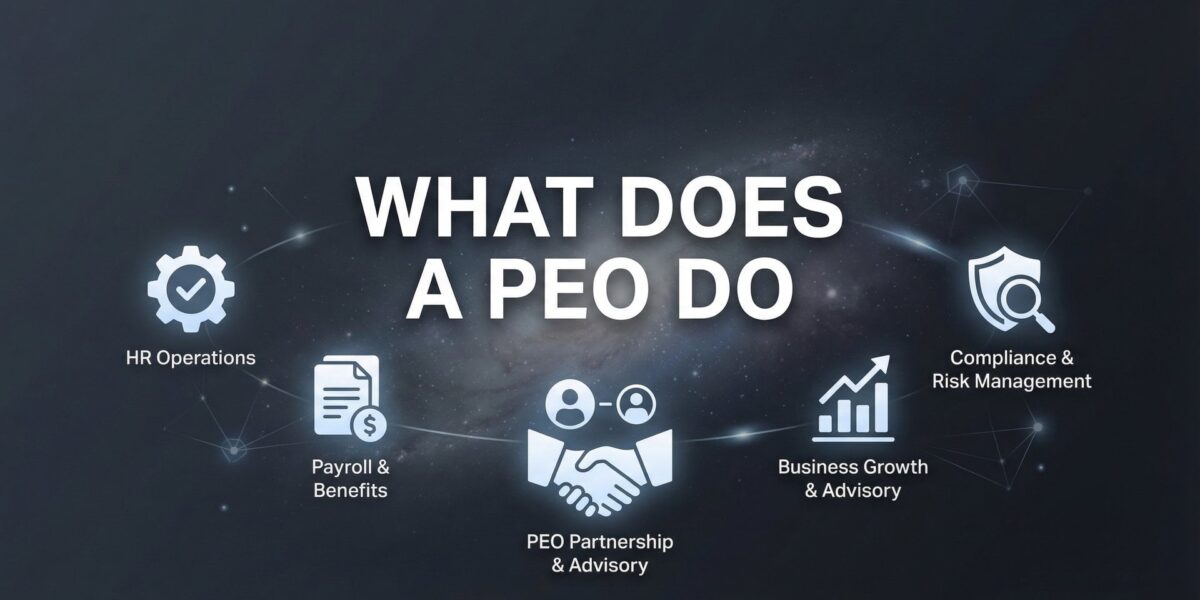
A PEO handles the administrative machinery of employment—payroll taxes, benefits enrollment, compliance documentation, workers’ comp claims—so you’re not building and managing that infrastructure yourself. It’s a partnership where they provide the employer systems and you focus on running the business.
Whether that trade-off makes sense depends on your specific situation. If compliance complexity, benefits access, or administrative burden are draining time you’d rather spend on operations, a PEO comparison is worth exploring. If you prefer maintaining direct control over HR systems or already have strong internal infrastructure, it might not be the right fit.
The co-employment relationship works when both sides understand what they’re responsible for. You’re not outsourcing business decisions. You’re outsourcing the administrative backend that supports employment.
Before you renew your PEO agreement, compare your options. Most businesses overpay due to bundled fees and unclear administrative markups. We break down pricing, services, and contract structures so you can make a smarter decision.