
If you’ve been comparing Alcott HR against a standard payroll company, you’re asking the right question — but it’s also one that trips up a lot of business owners. Both options handle payroll and deal with taxes, so the surface-level similarities are real. The difference is in the model underneath: co-employment versus software, shared liability versus full employer responsibility, pooled benefits versus whatever you can negotiate on your own.
This article breaks down Alcott HR’s PEO model against payroll-only alternatives, flags a few national PEOs worth comparing, and helps you figure out which structure actually fits your situation. If you’re still getting your bearings on how PEOs work at a fundamental level, our guide on what a PEO is covers the foundational model before you go further here.
Here are the top tools and providers to evaluate when making this decision.
1. Clicks Geek PEO Comparison Tool
Best for: Business owners who want an independent, side-by-side view of PEO providers before committing.
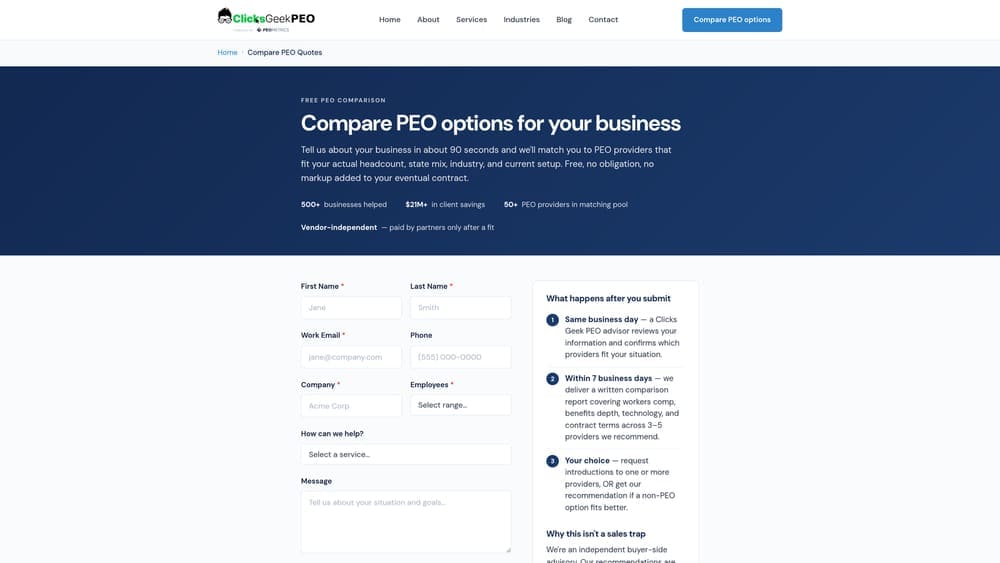
Clicks Geek PEO is an independent comparison and advisory platform built specifically for business owners evaluating PEO providers — including Alcott HR — without going through a broker or sitting through a sales pitch.
Where This Tool Shines
Most business owners evaluating Alcott HR have only heard about them through a referral or a single quote. The problem with that path is you have no frame of reference. Without a side-by-side comparison, you can’t tell if the pricing is competitive, if the contract terms are standard, or if another provider would serve your workforce better.
Clicks Geek PEO fills that gap. It’s not a PEO and it’s not a broker, which means there’s no commission incentive pushing you toward any specific provider. The focus is on giving you the information you need to make a clear-headed decision — pricing structure, service depth, contract terms, and how providers stack up against each other.
Key Features
Side-by-Side Provider Comparisons: Evaluate Alcott HR alongside national and regional PEOs in a structured format.
Transparent Pricing Analysis: Breaks down administrative fees, PEPM structures, and percentage-of-payroll models so you can see what you’re actually paying for.
Independent Advisory Approach: Not affiliated with any PEO provider, which means the analysis isn’t shaped by referral relationships.
Contract and Service Depth Review: Covers what’s included, what’s not, and where hidden fees tend to appear.
Designed for Renewal Evaluations: Particularly useful if you’re already with a PEO and want to know if you’re overpaying or under-served before renewing.
Best For
Business owners in the evaluation or renewal stage who want objective information before signing or re-signing a PEO contract. Especially useful for Northeast-based businesses comparing Alcott HR against national alternatives without the noise of a broker relationship.
Pricing
Free to use. No subscription, no broker fee, no obligation.
2. Alcott HR
Best for: Small to mid-sized businesses in the New York metro area or Northeast seeking a regional PEO with local compliance knowledge.
Alcott HR is a regional PEO headquartered in Melville, New York, operating under a co-employment model and primarily serving businesses in the Northeast.
Where This Tool Shines
The core advantage of a regional PEO like Alcott HR is proximity and local expertise. New York employment law is genuinely complex — paid family leave requirements, city-specific wage rules, workers’ comp nuances — and a provider that operates primarily in that environment tends to have sharper compliance knowledge than a national platform trying to cover all 50 states at once.
Co-employment also means Alcott HR shares employer liability with you, which changes your risk exposure in meaningful ways. You’re not just outsourcing payroll processing; you’re sharing the employer-of-record relationship, which affects workers’ comp rates, benefits access, and HR compliance responsibility.
Key Features
Co-Employment Model: Shared employer liability with Alcott HR, not just payroll processing on your behalf.
Pooled Employee Benefits: Access to group health insurance and other benefits through Alcott HR’s employee pool — often more competitive than what a small employer can negotiate independently.
Payroll and Tax Administration: Full payroll processing, tax withholding, and filing handled under the co-employment structure.
Workers’ Compensation Coverage: Included within the PEO relationship, which can reduce costs compared to a standalone policy for small employers.
Local HR Compliance Support: Specific familiarity with New York and Northeast regulatory requirements.
Best For
Small businesses in the New York metro area or broader Northeast that want a regional PEO relationship with local compliance depth. Less suited for businesses operating across multiple states or those that need a tech-forward platform with extensive integrations.
Pricing
Custom quote required. Pricing is not publicly listed. Expect either a per-employee-per-month or percentage-of-payroll structure, which is standard for regional PEOs.
3. Gusto
Best for: Small businesses that want clean payroll processing and basic HR tools without entering a co-employment relationship.
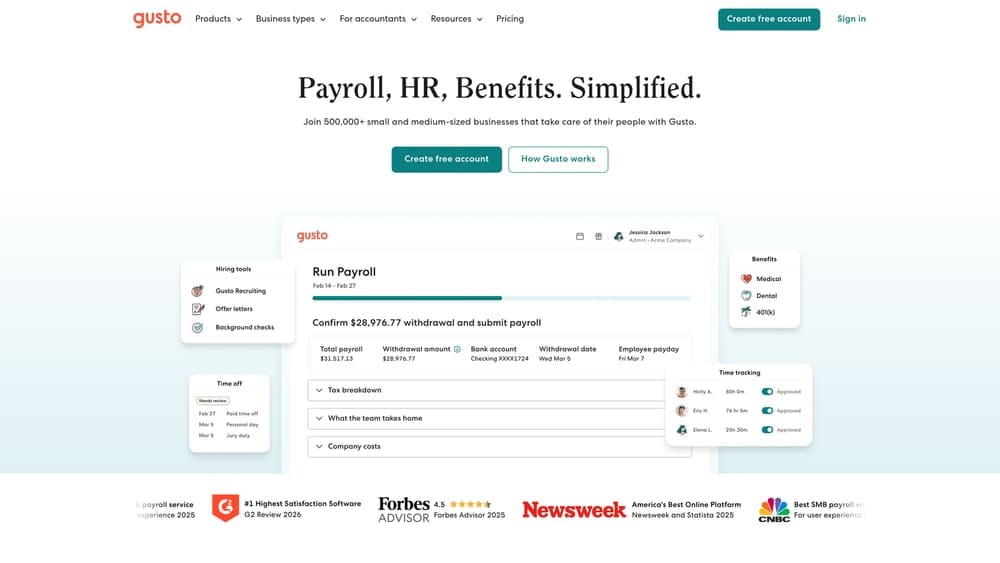
Gusto is a cloud-based payroll and HR software platform — not a PEO — widely used by small businesses that want payroll handled well without the complexity of co-employment.
Where This Tool Shines
Gusto is the cleaner, simpler option if your actual need is payroll automation and you’re not looking for shared liability or large-group benefits access. It’s well-designed, relatively affordable, and handles the core payroll and tax filing tasks without requiring you to restructure your employment relationship.
The tradeoff is that you remain the employer of record entirely. No shared workers’ comp, no pooled benefits, no HR compliance partner. If you’re a small team in a low-risk industry with straightforward HR needs, that’s a reasonable tradeoff. If you’re in New York with a growing headcount and real compliance exposure, it’s a different calculation.
Key Features
Automated Payroll and Tax Filings: Handles payroll runs, federal and state tax filings, and year-end forms.
Basic HR and Onboarding Tools: Offer letter templates, onboarding checklists, and document management.
Benefits Administration: Can administer health benefits, but without the pooled buying power of a PEO.
Time Tracking and Compliance Alerts: Built-in tools for tracking hours and flagging compliance issues.
Accounting Integrations: Connects natively with QuickBooks, Xero, and other common platforms.
Best For
Micro-businesses and small teams that need reliable payroll software without co-employment complexity. Works well for businesses under 20 employees in lower-risk industries where HR liability isn’t a primary concern.
Pricing
Starts at approximately $46/month base plus a per-employee fee. Verify current rates on Gusto’s website, as pricing tiers change periodically.
4. ADP TotalSource
Best for: Growing businesses that want a full co-employment PEO with national reach and institutional HR infrastructure.
ADP TotalSource is the full-service PEO arm of ADP, one of the largest HR and payroll companies in the country, offering co-employment services nationally.
Where This Tool Shines
ADP TotalSource makes sense when you need the depth and scale of a national PEO with a recognizable infrastructure behind it. The benefits pooling is substantial, the compliance resources are broad, and having a dedicated HR business partner gives you someone to call when employment issues come up — not just a ticketing system.
Compared to Alcott HR, TotalSource is better suited for businesses that operate across multiple states or are scaling beyond the Northeast. The tradeoff is that larger platforms can feel less personal than a regional provider, and the pricing tends to reflect the breadth of service.
Key Features
Full Co-Employment Model: Shared employer liability with national service coverage across all states.
Large-Group Benefits Access: Pooled buying power for health insurance and other employee benefits.
Dedicated HR Business Partner: Named HR support assigned to your account.
Workers’ Comp and Risk Management: Integrated coverage and risk support within the PEO relationship.
Integrated Payroll and Compliance Platform: ADP’s payroll infrastructure with PEO-layer compliance support.
Best For
Mid-sized businesses or fast-growing companies that need a national PEO with deep HR infrastructure and multi-state capability. Also a reasonable option for businesses that already use ADP payroll and want to step up to co-employment.
Pricing
Custom quote required. Not publicly listed. Expect pricing to reflect the scale and service depth of a national provider.
5. Paychex PEO
Best for: Businesses already using Paychex payroll that want to add co-employment services without switching platforms.
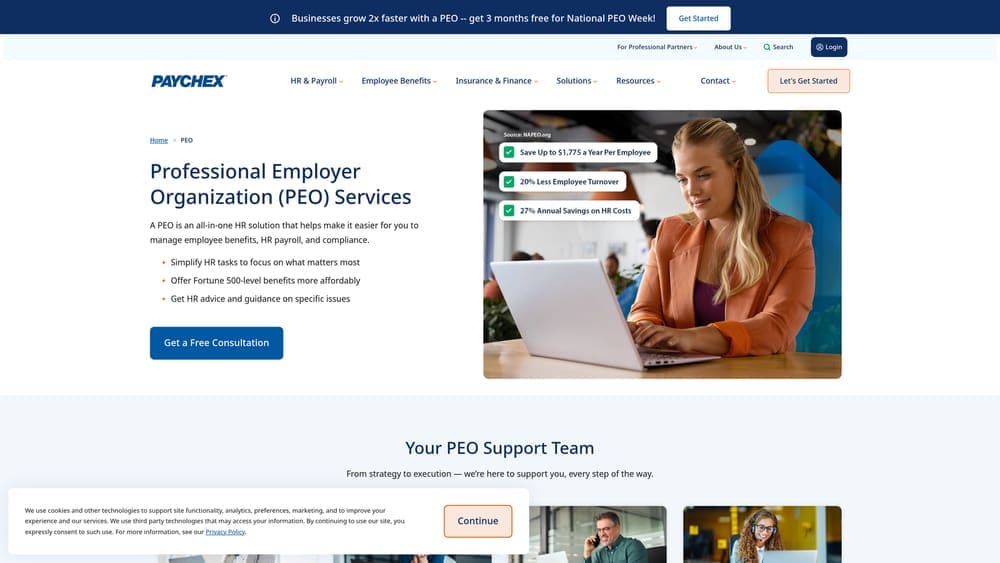
Paychex PEO offers co-employment services built on top of Paychex’s established payroll infrastructure, with national service coverage and a familiar HR framework.
Where This Tool Shines
Paychex occupies an interesting middle ground. It’s not a startup platform and it’s not a niche regional provider. It’s a well-established payroll company that has built a PEO layer on top of its existing infrastructure, which means the payroll side is solid and the transition path is smoother if you’re already a Paychex customer.
For businesses that have been using Paychex for payroll and are now considering a PEO upgrade, this is often the path of least resistance. The dedicated HR generalist support is a genuine value-add compared to payroll-only service.
Key Features
Co-Employment with National Coverage: Operates across all states under a standard co-employment structure.
Payroll Integrated with PEO Services: Payroll processing and PEO compliance handled in one system.
HR Compliance and Risk Management: Support for employment law compliance and HR risk issues.
Employee Benefits Access: Group benefits through the PEO relationship.
Dedicated HR Generalist: Named HR support for day-to-day questions and escalations.
Best For
Businesses with 10 to 150 employees that want a PEO with a familiar payroll backbone. Particularly logical for existing Paychex customers evaluating a move to co-employment.
Pricing
Custom quote required. Pricing not publicly listed.
6. Justworks
Best for: Small businesses that want PEO services with transparent, publicly listed pricing — no quote required to understand costs.
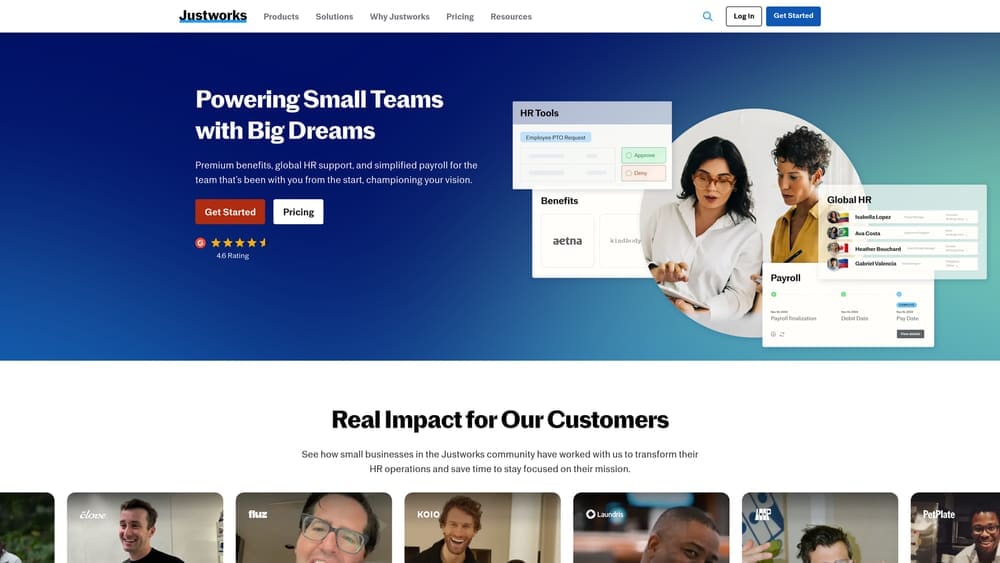
Justworks is a PEO that stands out primarily for publishing its pricing tiers openly, which is genuinely unusual in an industry where almost every competitor requires a sales call before you see a number.
Where This Tool Shines
Pricing transparency is Justworks’ clearest differentiator. If you’re comparing Alcott HR and can’t get a straight answer on what you’ll actually pay per employee, Justworks gives you a real number to work with. That alone makes it a useful benchmark when evaluating any other PEO.
Beyond pricing clarity, Justworks delivers solid co-employment fundamentals: shared liability, large-group benefits access, payroll, and compliance support. It’s built for smaller teams, so the service model is relatively streamlined compared to enterprise-focused platforms.
Key Features
Publicly Listed Pricing: Tiered per-employee-per-month rates available on their website without a sales call.
Co-Employment Model: Full shared employer liability structure.
Large-Group Health Insurance Access: Benefits pooling through the PEO relationship.
Payroll, Compliance, and HR Support: Core PEO services bundled into each tier.
Strong Fit for Small Teams: Designed with businesses under 50 employees in mind.
Best For
Small businesses that want PEO benefits without opaque pricing. Particularly useful for founders and operators who want to evaluate costs independently before talking to a sales team.
Pricing
Publicly listed tiered pricing. Check Justworks.com directly for current rates, as tiers and fees are updated periodically.
7. Rippling
Best for: Tech-forward teams that want PEO services integrated with HRIS, IT management, and deep workflow automation.
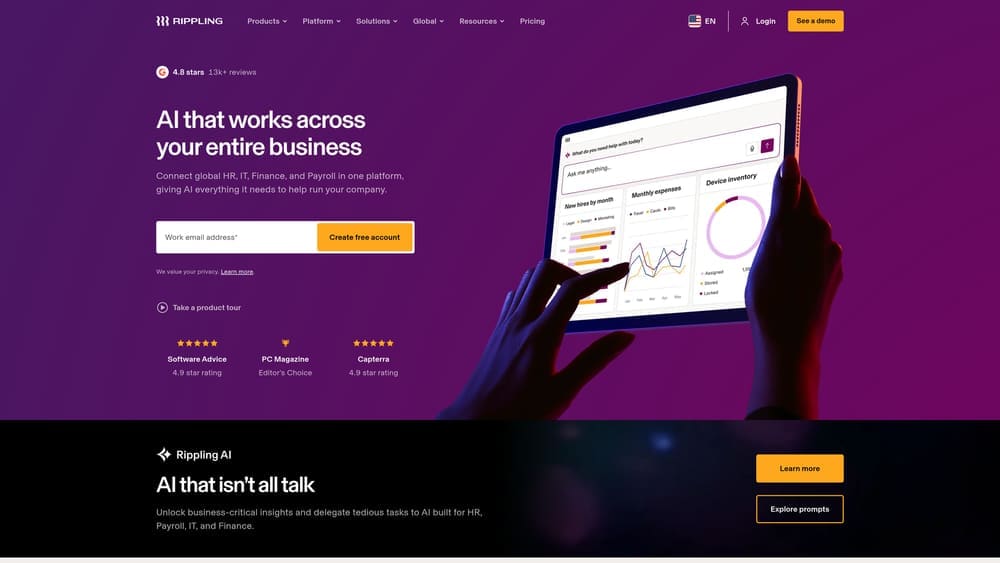
Rippling is a modular workforce management platform that offers PEO services alongside payroll, HRIS, and IT device management — built for teams that want everything connected in one system.
Where This Tool Shines
Rippling is a different category of tool than a traditional PEO like Alcott HR. The platform is built around automation and integration — onboarding a new employee can trigger payroll setup, benefits enrollment, software provisioning, and device shipping simultaneously. That’s a level of operational efficiency that regional PEOs don’t offer.
The PEO component is real and functional, but it’s one module within a larger platform. If your priority is compliance support and personalized HR guidance, a traditional PEO may serve you better. If your priority is operational efficiency and tech integration, Rippling is hard to match.
Key Features
PEO Plus HRIS and IT Management: Co-employment services alongside device management and software provisioning in one platform.
Highly Automated Onboarding and Offboarding: Multi-system workflows triggered by a single action.
Extensive Third-Party Integrations: Connects with hundreds of apps across HR, finance, and operations.
Global Workforce Capabilities: Supports international payroll and compliance for teams with global employees.
Modular Structure: Can use payroll-only or full PEO depending on what your business needs.
Best For
Tech companies, remote-first teams, and businesses with complex software stacks that want workforce management and PEO services in a single integrated platform. Less suited for businesses that prioritize hands-on HR support over automation.
Pricing
Custom quote required. Modular pricing depends on which features you select. Contact Rippling directly for a breakdown.
8. QuickBooks Payroll
Best for: Micro-businesses that need affordable, straightforward payroll processing with no HR complexity.
QuickBooks Payroll is payroll processing software from Intuit — simple, widely used, and built for small businesses that primarily need payroll handled without any co-employment or HR advisory layer.
Where This Tool Shines
If you’re a small operation — a few employees, low HR complexity, and no interest in co-employment — QuickBooks Payroll does the core job well. It runs payroll, files taxes, handles direct deposit, and integrates natively with QuickBooks accounting. That native integration is a genuine convenience if you’re already running your books in QuickBooks.
What it doesn’t do is anything a PEO does. You remain the employer of record entirely. There’s no shared liability, no benefits pooling, no HR compliance partner. That’s fine for a five-person business with simple needs. It becomes a real gap as your headcount grows and your compliance exposure increases.
Key Features
Automated Payroll and Tax Filings: Runs payroll and handles federal and state tax submissions automatically.
Direct Deposit and Contractor Payments: Supports both W-2 employees and 1099 contractors.
Basic Benefits Add-Ons: Some benefits administration available, but without pooled buying power.
Native QuickBooks Integration: Payroll data syncs directly into your accounting software.
No Co-Employment: Employer retains full liability — no shared employer-of-record relationship.
Best For
Businesses with under 10 employees that are already in the QuickBooks ecosystem and need payroll handled cleanly without any additional HR infrastructure.
Pricing
Starts at approximately $45/month base plus a per-employee fee. Check Intuit’s website for current pricing, as plans and rates are updated regularly.
9. TriNet
Best for: Businesses in professional services, technology, or life sciences that want a PEO with industry-specific compliance and benefits expertise.
TriNet is an industry-vertical PEO that organizes its services around specific sectors rather than offering a one-size-fits-all generalist model.
Where This Tool Shines
The vertical-specific approach is TriNet’s real differentiator. If you run a technology company or a professional services firm, the compliance considerations, benefits benchmarks, and HR risk profile look very different from a retail business or a construction company. TriNet’s service tracks are built around those distinctions, which means the HR support you get is calibrated to your industry rather than generic.
Compared to Alcott HR, TriNet is better suited for businesses where industry-specific compliance depth matters more than geographic proximity. If you’re a tech startup in New York that cares more about equity compensation guidance and tech-sector benefits benchmarks than NY-specific labor law nuance, TriNet may be the stronger fit.
Key Features
Industry-Specific PEO Tracks: Service models tailored to professional services, technology, life sciences, and other sectors.
Large-Group Benefits Access: Pooled benefits with competitive rates for small and mid-sized employers.
Industry-Aligned HR Support: HR guidance calibrated to sector-specific norms and risks.
Sector-Specific Compliance Support: Compliance resources that reflect the regulatory environment of your industry.
Best For
Small to mid-sized businesses in professional services, technology, or life sciences that want a PEO with genuine industry depth rather than a generalist regional provider.
Pricing
Custom quote required. Pricing not publicly listed. Expect pricing to vary based on industry track, headcount, and benefits selections.
Which Option Actually Fits Your Business?
Here’s a practical way to think through the decision based on your situation.
If you just need payroll handled cleanly and you have a small team with minimal HR complexity, Gusto or QuickBooks Payroll covers the basics without co-employment overhead. You stay the employer of record, costs are predictable, and the setup is straightforward.
If you want a PEO and you’re based in the New York metro area or Northeast, Alcott HR is worth evaluating seriously. The local compliance knowledge is real, and a regional provider often delivers more attentive service than a national platform. The gap is that you have no pricing benchmark without a comparison.
If you want a PEO with national reach, ADP TotalSource and Paychex PEO are the institutional options. TriNet is the right call if your business operates in a sector where industry-specific HR depth matters. Justworks is worth a look if pricing transparency is a priority and your team is under 50 people. Rippling makes sense if you’re running a tech-forward team that wants automation and integrations alongside co-employment.
Before you renew your PEO agreement or sign a new one, compare your options. Most businesses overpay due to bundled fees and unclear administrative markups. We break down pricing, services, and contract structures so you can make a smarter decision — whether that’s Alcott HR, a national PEO, or a payroll-only platform that fits your actual needs.