
You’ve probably landed here because someone pitched you on CoAdvantage, you found them while researching PEO options, or you’re already a client wondering whether to renew when your agreement comes up. Any of those scenarios is a reasonable reason to want a straight answer.
CoAdvantage occupies an interesting middle ground in the PEO market. They’re not a household name like ADP TotalSource or Paychex PEO, but they’re not a scrappy regional outfit either. They’re a legitimate mid-market player with a real track record, IRS certification, and a service model that genuinely works well for certain types of businesses.
The problem is that “works well for certain businesses” isn’t the same as “worth it for your business.” And that distinction is what most PEO marketing materials conveniently skip over. This article is an independent breakdown of what CoAdvantage actually delivers, where they earn their fees, where they fall short, and how to decide whether they belong in your operations or not. We don’t sell CoAdvantage services. We have no stake in which direction you go. The goal here is clarity.
Who CoAdvantage Actually Serves
CoAdvantage’s roots matter here. The company has a background in staffing-adjacent HR services, and that history shapes what they’re genuinely good at. Their core client base tends to be small-to-mid-sized businesses, typically in the 10 to 150 employee range, though they technically serve companies up to 500 employees and beyond.
One credential worth understanding upfront: CoAdvantage holds CPEO status, meaning they’re a Certified Professional Employer Organization as recognized by the IRS. This isn’t just a marketing badge. CPEO certification means the PEO takes on certain federal employment tax liabilities that would otherwise sit with you as the employer. It also comes with financial assurance requirements that provide clients a layer of protection. Not every PEO carries this certification, so it’s a legitimate differentiator worth noting.
Industries where CoAdvantage tends to perform well include light industrial operations, staffing-adjacent businesses, professional services firms, and general small business environments where the priority is solid payroll execution, benefits access, and workers’ comp management. Their staffing background gives them particular depth in workforce management and risk classification, which matters a lot if your business has variable headcount or employees working in environments with elevated injury risk.
Where they’re less competitive is worth being honest about too. Businesses with complex technology requirements, fast-growing teams that need sophisticated HR tooling, or organizations with highly customized benefits strategies may find CoAdvantage’s model a bit rigid. Companies in highly regulated industries that need deep compliance specialization may also find that other providers offer more tailored support.
The client profile that tends to get the most value from CoAdvantage is a business owner who wants a reliable, full-service PEO relationship without needing a cutting-edge platform. If your priority is getting payroll done accurately, accessing health benefits your company couldn’t negotiate alone, and having someone handle workers’ comp administration, CoAdvantage can check those boxes. If you want a slick mobile app, real-time analytics dashboards, or seamless integrations with your existing HR tech stack, you may find yourself frustrated.
This isn’t a knock on CoAdvantage specifically. It’s just an honest read on where their model fits and where it doesn’t. The companies that get burned by any PEO are usually the ones who chose based on price alone without honestly evaluating whether a PEO is financially worth it for their situation.
Services and Pricing: What You’re Actually Paying For
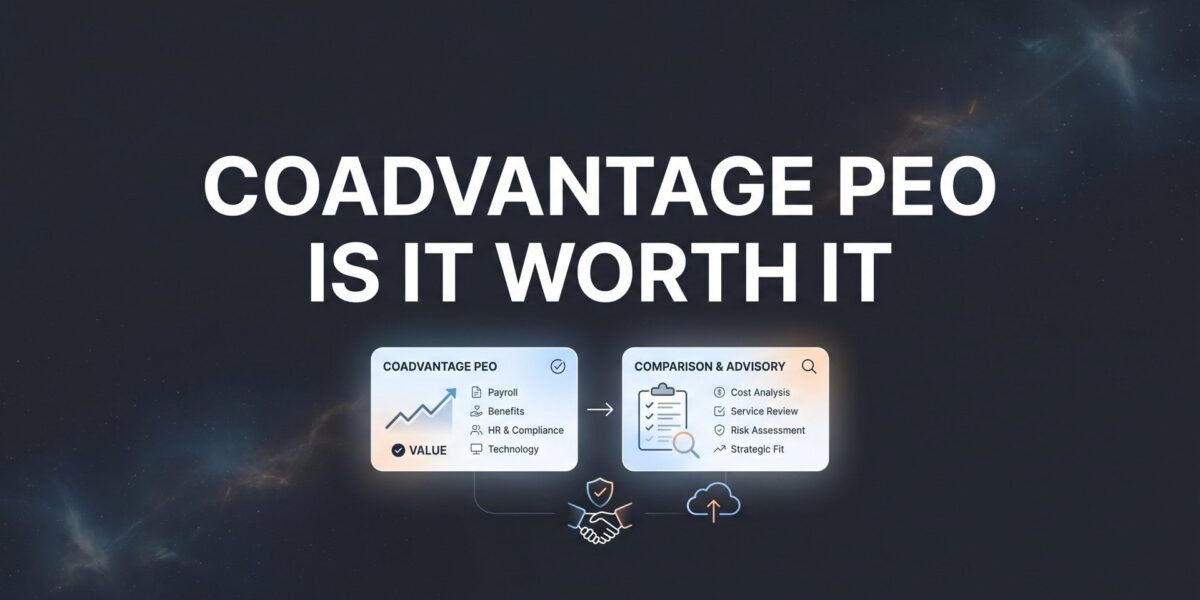
CoAdvantage’s core service bundle covers the fundamentals: payroll processing and tax administration, benefits administration, workers’ compensation, HR support, and compliance assistance. For most small businesses, that’s the full stack they need. The question is what’s genuinely included versus what gets added to your invoice as an extra line item.
Payroll and tax administration are core to the model. CoAdvantage handles payroll processing, tax withholding, filings, and year-end W-2 distribution. These are table stakes for any PEO, but execution quality matters, and CoAdvantage generally delivers reliable payroll processing. Benefits administration includes access to their pooled health insurance, dental, vision, and retirement plan offerings. Workers’ comp is bundled into the relationship, typically on a pay-as-you-go basis. HR support includes access to HR advisors for compliance questions, handbook development, and general employment guidance.
Now for the pricing conversation, which is where things get real.
CoAdvantage typically prices on a percentage-of-payroll model. This means their fee is calculated as a percentage of your total gross payroll. If your wages go up, your PEO costs go up proportionally. Compare this to per-employee-per-month (PEPM) pricing used by some competitors, where your fee is a flat amount per employee regardless of what those employees earn.
The percentage model can work in your favor if you have a lower-wage workforce. It can work against you if your employees are well-compensated. A software company paying engineers strong salaries will pay significantly more under a percentage model than a comparable headcount of hourly warehouse workers. This math is worth running before you sign anything, especially when you consider how Paychex PEO structures its pricing by comparison.
Administrative fees: Watch for separate administrative fees on top of the base percentage. These aren’t always prominently disclosed, and they can add meaningful cost to what looked like a clean rate.
Benefits markup: PEOs often add a margin to the health insurance premiums they pass through to clients. Ask CoAdvantage directly whether their quoted benefits rates include any markup, and get that answer in writing. Some PEOs are transparent about this; others bury it.
Workers’ comp rate transparency: CoAdvantage’s workers’ comp is typically pay-as-you-go, which is genuinely good for cash flow. But ask about their rate structure, how claims history affects your rates, and whether you’ll see a detailed breakdown of how your workers’ comp costs are calculated.
Contract terms and renewal pricing: Understand what happens at renewal. Some PEO agreements include rate escalation clauses or changes to benefits structures at renewal that clients don’t see coming. Read the service agreement carefully before signing, and get clarity on what notice period is required if you want to exit.
None of this is unique to CoAdvantage. These are common PEO pricing considerations. But they’re worth scrutinizing specifically in your CoAdvantage quote before you commit.
Where CoAdvantage Earns Its Fees
Let’s give credit where it’s due. There are areas where CoAdvantage delivers genuine value, and for the right business, that value can clearly justify the cost.
Benefits access: This is often the most tangible ROI for small businesses using any PEO. CoAdvantage pools its client base to negotiate group health insurance rates that individual small businesses simply can’t access on their own. If you have 20 employees and you’re currently piecing together a health plan on the open market, the benefits access alone can be a meaningful cost and quality improvement. The quality of CoAdvantage’s benefit offerings is generally competitive, though the specific carriers and plan options will vary based on your location and workforce profile. Ask for a detailed benefits comparison against what you’re currently paying before assuming the savings are significant.
Workers’ comp and risk management: This is where CoAdvantage’s staffing background shows up as a real advantage. Their pay-as-you-go workers’ comp model means you’re not writing a large upfront deposit check at the start of the year. Instead, workers’ comp premiums are calculated and collected with each payroll run. For businesses in construction, light manufacturing, or other higher-risk industries, this cash flow difference is meaningful. Beyond the payment structure, CoAdvantage’s claims management support can reduce the administrative burden when incidents occur and help manage the long-term cost impact of claims.
Dedicated HR support: CoAdvantage’s model typically includes assigned HR contacts rather than routing every question through a generic call center. For business owners dealing with a termination, a leave of absence situation, or a multi-state employment question, having a person who knows your account is worth more than it sounds. The call-center model used by some larger PEOs can be genuinely frustrating when you’re dealing with a time-sensitive HR issue. This is one area where CoAdvantage’s mid-market positioning can actually be an advantage over larger providers.
Compliance support: Employment law changes constantly. Minimum wage updates, leave law expansions, ACA reporting requirements, EEO filings. CoAdvantage handles a meaningful portion of this compliance burden, which has real value for a business owner who doesn’t have a dedicated HR team. Businesses operating across state lines face even more complexity, as multi-state payroll requirements can quickly overwhelm internal resources.
These aren’t small things. For a 30-person business without an HR department, this bundle of services represents real operational support. The question is whether the cost of that support is priced fairly relative to what you’re actually receiving.
Honest Gaps Worth Knowing Before You Commit
CoAdvantage isn’t the right fit for every business, and it’s worth being direct about where their model shows its limitations.
Technology and platform experience: CoAdvantage offers an online platform for payroll and HR administration. It works. But if you’ve used modern HR platforms from providers who have invested heavily in UX, mobile functionality, and integrations, CoAdvantage’s tech may feel dated. Employee self-service, manager dashboards, and integration with tools like your accounting software or ATS are areas where more tech-forward PEOs have a clear edge. If your employees and managers expect a polished digital experience, evaluate the platform directly before committing. Ask for a demo and have your actual users interact with it, not just the decision-makers.
Scalability beyond mid-market: CoAdvantage’s sweet spot is roughly 10 to 150 employees. Businesses growing past 150 to 200 employees often find that their needs evolve in ways that mid-market PEOs struggle to accommodate. More complex organizational structures, multi-state compliance at scale, sophisticated HRIS requirements, and benefits customization needs can push you toward enterprise-tier providers. Understanding how providers like Insperity handle the 150-employee mark can help you plan for that transition.
Contract and exit terms: This applies to PEO agreements generally, but it’s worth flagging specifically here. Understand the notice period required to exit. Understand what happens to your benefits continuity if you leave mid-plan year. Understand data portability — can you export your employee records cleanly, and in what format? If you’re already a CoAdvantage client considering a change, reviewing the CoAdvantage cancellation process in detail is a smart first step.
Benefits flexibility: CoAdvantage’s benefits model is built around their pooled offerings. If you want highly customized benefits packages, unusual plan structures, or specific carriers that aren’t in their portfolio, you may find the model limiting. This is a trade-off inherent to the PEO structure, but it’s worth knowing going in.
None of these gaps are dealbreakers on their own. They’re considerations that should inform whether CoAdvantage is the right fit for where your business is now and where it’s headed.
How to Frame Your Decision Against the Alternatives
Rather than a feature comparison chart, a more useful exercise is running CoAdvantage through a decision filter based on what you actually value.
If your priority is reliable payroll execution, benefits access for a smaller workforce, and workers’ comp bundling without heavy technology requirements, CoAdvantage is a reasonable fit. If you prioritize a modern platform experience, deep HR analytics, or rapid scalability, other providers have invested more heavily in those areas and may serve you better.
If compliance support and dedicated HR contacts matter more than self-service technology, CoAdvantage’s model aligns well. If your team expects to manage most HR tasks independently through a polished app, the gap between expectation and reality could create friction. Exploring how Paychex PEO compares to CoAdvantage directly can help clarify where each provider has an edge.
It’s also worth asking whether a PEO is the right structure for your business at all. An Administrative Services Organization (ASO) provides HR administration and compliance support without the co-employment relationship. If you’re primarily looking for payroll and compliance help but want to retain full employer status and more flexibility over benefits, an ASO might be a better fit at a lower cost. For very small businesses, a quality payroll provider plus an HR consultant on retainer can sometimes deliver more value than a full PEO engagement. Understanding the differences between a PEO and a payroll company is essential before making that call.
If you’re already with CoAdvantage and evaluating renewal, the most important question to ask is whether you’re staying because it’s genuinely the best option or because switching feels like too much work. Inertia is expensive in PEO relationships. Benefits markup, administrative fees, and pricing that made sense two years ago may not reflect the market today. Benchmarking your current CoAdvantage costs against at least two other providers before renewing is a reasonable standard. If CoAdvantage comes out competitive in that comparison, renew with confidence. If the gap is significant, you have a real decision to make.
The renewal trap is real. Most business owners who overpay for PEO services aren’t doing so because they made a bad initial decision. They’re doing so because they stopped evaluating and started assuming.
The Bottom Line on CoAdvantage
Is CoAdvantage worth it? For the right business, yes. For the wrong business, you’ll pay for services that don’t fit and a platform that frustrates you.
The businesses that tend to get genuine value from CoAdvantage are those in the 15 to 100 employee range, operating in industries where workers’ comp management matters, without heavy technology expectations, and with a need for benefits access they couldn’t negotiate independently. That’s a real segment of the market, and CoAdvantage serves it reasonably well.
The businesses that tend to be disappointed are those who prioritized price without evaluating platform quality, who signed without reading the contract terms carefully, or who are growing fast enough that they’ll need to switch providers within a year or two anyway.
The key decision factors come down to your size, your industry, your growth trajectory, and what you actually need from a PEO relationship. CoAdvantage’s CPEO status, workers’ comp model, and dedicated HR support are real strengths. Their technology and scalability limits are real constraints. Both things are true at the same time.
Before you renew your PEO agreement or sign a new one, the smartest move is to get multiple quotes and compare pricing structures side by side. Most businesses overpay due to bundled fees and unclear administrative markups that only become visible when you have something to compare them against. Compare your options to see how CoAdvantage stacks up against other providers for your specific headcount, industry, and service needs. That comparison costs you nothing and gives you the information you need to make a decision you can actually defend.